Showing posts with label woodpecker. Show all posts

Sunday, March 2, 2014

Weldon Spring MO Christmas Bird Count 2014

Eastern Phoebe, photo by John Benson, from Wikipedia

Thanks to all who helped with the Weldon Spring Christmas Bird Count, Jan. 4, 2014! We had 18 participants, 63 species, 8774 birds, and some really decent weather for the season. The Weldon Spring Count (also known as the "Busch count," officially labeled by National Audubon Society as "MOWS") has been held every year since 1952, sponsored by Webster Groves Nature Study Society. The count, like all Christmas Counts, is held between Dec. 14, 2013, and Jan. 4, 2014, and covers a 15-mile-diameter circle. In our case, the circle is centered on the town of Weldon Spring in St. Charles County, Missouri. It includes some of the best land-birding in the greater St. Louis area: Busch Memorial Conservation Area and, bordering the Missouri River,  Weldon Spring Conservation Area.

Only one species had an unusually high count this year: Red-shouldered Hawks totaled 22, topping the previous high of 18 in 2008. Out of 62 counts, Red-shouldered Hawk has occurred only 28 times.

Several species were unusually low. Only 2 Red-headed Woodpeckers were reported. The previous low was 1 in 1964, occurring 51 out of the 62 counts. Red-headed Woodpecker is a "species of concern;" one of 117 species on the "yellow list" in the 2007 WatchList. Only 1 Ruby-crown Kinglet was reported—previous low of 1 in 2012. Only 2 Cedar Waxwings and 2 Purple Finches were seen. The low for Purple Finch was a single bird in 2012. The House Sparrow count was also low—only 6. (Most of us feel that’s a good thing.) The all-time low for House Sparrow on our count was 5 in 2007.

A highlights for me were Hermit Thrush and Fox Sparrow, found along a seldom-used road in the north-east section of Busch. Another Hermit Thrush was found in Babler State Park. Hermit Thrushes are listed as "rare" in winter, and although the Fox Sparrow is considered "uncommon," but not rare, I've missed it a number of times on the count.

Our rock star was an Eastern Phoebe, found independently in the Weldon Spring area by two different groups. This is only the third occurrence out of 62 counts—one in 1986, one in 2005. Birds of the St. Louis Area: Where and When to Find Them describes the Eastern Phoebe as "hardiest of the flycatchers" on our area. The complete report is available to download at the bottom of the Birding page of the Webster Groves Nature Study Society's website. Happy birding in 2014!

Thursday, June 23, 2011

Pa-RUM-pa-pum-pum

Through May and early June I occasionally heard a rapid, metallic drumming—almost a trill. "I'll bet a woodpecker is drumming on someone's aluminum siding," I thought, but I could never find the bird. On Memorial Day weekend however, I heard the sound again—very close, but where?
  
Caught in the act! See the little drummer bird, just beneath the metal cap on my chimney? It is believed that woodpeckers use drumming as a substitute for song. Woodpeckers don't have a song for claiming territory or attracting a mate like a robin or cardinal would employ. They don't need one. All a woodpecker has to do if find some resonant material—a hollow snag, or your aluminum gutter—and drill, baby, drill! David Sibley's website has a great article about drumming, complete with sonagrams and recordings of Downy and the similar-looking and similar-sounding Hairy Woodpecker.

Sibley notes some intriguing findings in the research: both male and female Downy Woodpeckers drum and at all times a year. We assume the male is trying to attract a mate with his drumming/song. Is the female doing the same? And if we hear drumming in January, is that drummer defending a territory even though it's not nesting season? My grainy photo doesn't show the red nape patch, but this was a male playing his drum for me, and the neighborhood. What is he trying to say with his 15 beats per second?

When I visited southeastern Arizona in the summer of 2000, I fascinated to see that birders decorated their yards with dried agave stalks. The stalks seemed to advertise to hummingbirds that dinner time had arrived. Fiesty little Rufous and Black-chinned hummers would perch on the stalk, survey the feeders, and dive in. I was dying to carry off one of these stalks for my own yard, but alas, it would not fit into my baggage. I cast around for a substitute, and saw the potential in a year-old Compass Plant stalk.

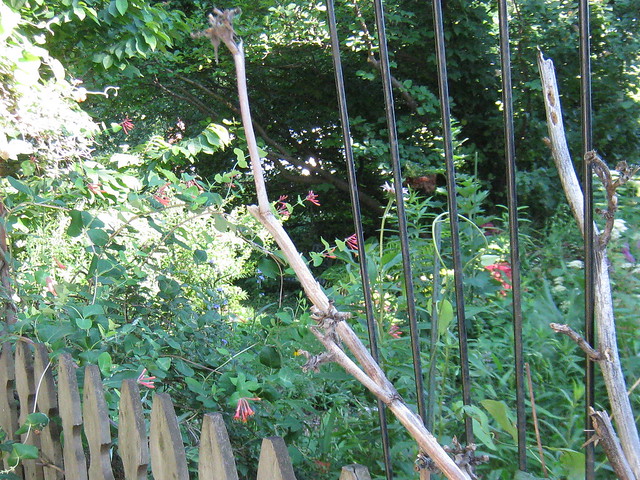
I wrote about Compass Plant (Silphium laciniatum) last August. It's one of my favorites. This spring I tied several Compass Plant stalks to my fence. Investigating the stalk this morning, I saw not a hummingbird, but a young female Downy Woodpecker. 

She drilled into the stems and pulled out something that was black. You can see tiny drill holes near the top of the right stalk. Even tinier ones are barely visible in the left stalk, just below the center of the photos. According to John Hilty's website, Illinois Wildflowers, inside the dried stem could have been the larva of the Tumbling Flower Beetle. What a great name! Check out MOBugs' post on this insect, with great photos.

Saturday, January 8, 2011

Bird Encounters of the Christmas Count Kind


Huge ice crystals mark the sand in Dardenne Creek AMcC
We began our Christmas Bird Count by looking for the Red-headed Woodpecker, near what’s labeled as “Shorebird Area.” This low spot below the dam for Busch Conservation Area’s largest lake, Lake 33, is reliable for Red-headeds, a species that has declined 4.6% per year since 1980, according to National Audubon Society. They gave us quite a show, sparring with Blue Jays, and chattering to each other on a snag that looked like Swiss cheese.
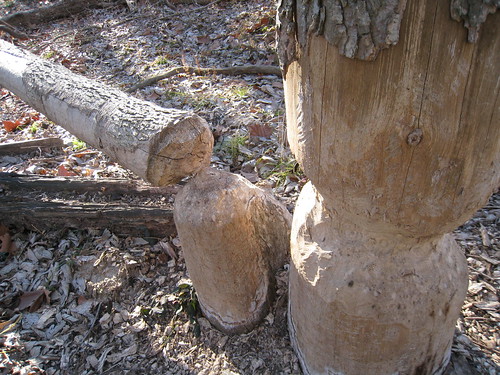
beaver cuts along Dardenne Creek AMcC
There was no open water at “Shorebird,” so after a lap around fields that sparkled with frost, we headed down to Dardenne Creek. The sand bars were puddled with white ice, the kind that we liked to smash when we were kids. Ripples and huge crystals of ice marked the sand. A small flock of Swamp Sparrows and White-throats hopped away.
On the high bank of Dardenne we saw the work of an ambitious beaver. The beaver cuts looked old, but it’s interesting that Red-headed Woodpeckers are associated with beaver. The woodpeckers claim the trees killed when flooded by beaver ponds, and exploit the edge habitat created as beavers fell trees.
After lunch, we headed down a disused service road, toward a corner of large white pines. White pine is not native to our area; possibly this stand was planted for lumber. My friend Connie was determined we’d find a Red-breasted Nuthatch in the pines. White-breasted Nuthatches are expectable year-round residents at Busch, but Birds of the St. Louis Area: Where and When to Find Them lists Red-breasted as uncommon to casual (that is, beyond rare) in January. In the pine grove, she produced her iPhone, with not one, but three different apps for bird songs, and played a recording of the Red-breasted Nuthatch. Then we paused—silence. At least 30 seconds ticked by, then, an answer! There must have been some pretty bad grammar in that recording, because this Red-breasted Nuthatch was outraged! He scolded us till we fled, not wanting to stress the little guy beyond endurance.
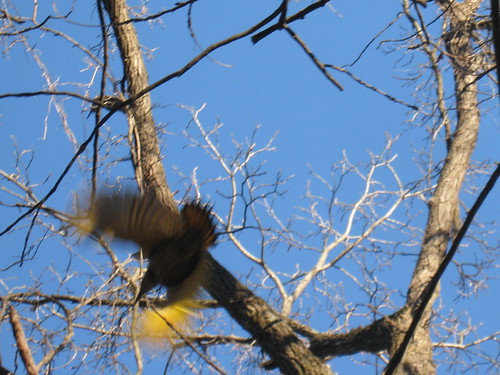
Northern Flicker in the mixed species flock AMcC
We crossed the road and entered the trailless area that will now be known as “The Enchanted Forest. Within a few minutes, we found ourselves surrounded by birds: three calling Yellow-rumped (Myrtle) Warblers, a Northern Flicker, and another Red-breasted Nuthatch—all in the same tree! Now a Brown Creeper joined the group, tugging itself up a tree trunk, where Blue Jays screeched. Not far beyond, a Pileated Woodpecker answered the jays. In the same tree, a Hairy Woodpecker minded his own business. The sun peeked briefly from behind the clouds, and a male Golden-crowned Kinglet snatched those rays to light his golden-orange crest. Chickadees and a dozen American Robins called all around us. As we moved through the flock, stumbling over an old wire fence as we looked skyward, they vanished. Not even a White-throat chirped as we walked back to the car.