Showing posts with label invasive species. Show all posts

Sunday, July 3, 2011

Bringing Conservation Home


It started with a great idea and a colossal winter creeper vine (Euonymus fortunei).

Some time in the late 80s I started growing antique roses. Well, I saw this fabulous photo of a climbing rose called 'Seagull' romping through the tree tops in an English garden. I ordered it from specialty nursery in California. I planted it on the downhill (eastern) side of my huge silver maple in the front yard. Shortly afterwards, I received a note from the nursery saying that they did not send me 'Seagull,' but 'Rambling Rector.' This isn't too unusual with antique rose varieties. I don't know even today what difference there is between the two. Both have thousands upon thousands of small, white, fragrant, semi-double blooms that appear once a year, from mid-May to early June. True to its rambling nature, 'Rambling Rector' threw its long canes around the maple's trunk climbing ever higher. There were setbacks of frost or falling maple limbs but the plant always recovered, leaping into my neighbors sweet gums, and heading towards my front door.

You're supposed to prune ramblers by removing the oldest canes after the bloom. Let's just say that whoever came up with the idea of putting yard waste into paper bags never pruned a climbing rose. The canes are often 10 feet long—up to 20—and then there are those bloodthirsty thorns! The plant of course uses thorns to latch onto limbs and climb. They probably discourage cows and woolly mammoths too.

A victim of my own gardening success, I've worn out the pruners, jeans, gloves, and lacerated my scalp trying to control this plant. Most years, my enthusiasm for the charming blossoms
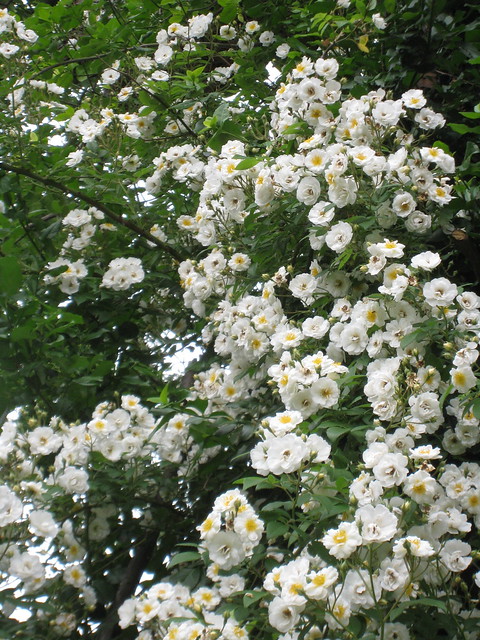

was overwhelmed by cowardice, and the plant went unpruned.
Enter, St. Louis Audubon.  SLAS is piloting a program called "Bringing Conservation Home" to encourage homeowners to include in their landscape plants that are native to the area, and help sustain native wildlife and I was lucky to be invited to be a part of it. Dave Tylka, author of  Native Landscaping for Wildlife and People, and Mitch Leachman, Executive Director of St. Louis Audubon Society  head up the team, but like me, most of us are interested amateurs. We visit the homes of gardeners who invite us, provide an inventory of plants in the landscape, and offer suggestions for landscaping that will improve their habitat.

I already have a good portion of my yard devoted to native plants, but there's more to it than that; namely, fighting those invasive, exotic plants. I hacked and sprayed my bush honeysuckle some time ago, but there's another villain in the picture: winter creeper (Euonymus fortunei). I knew winter creeper was non-native, but I didn't realize the harm it can do as it smothers the landscape. All the qualities that make it a useful ground cover also make it destructive to the environment: vigor, tolerance of a wide variety of  conditions, and the ability to form an evergreen mat of foliage to shade out competitors.

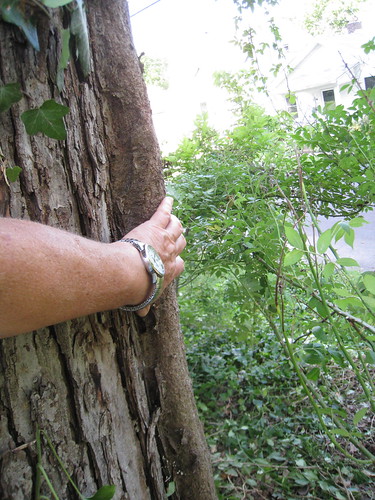
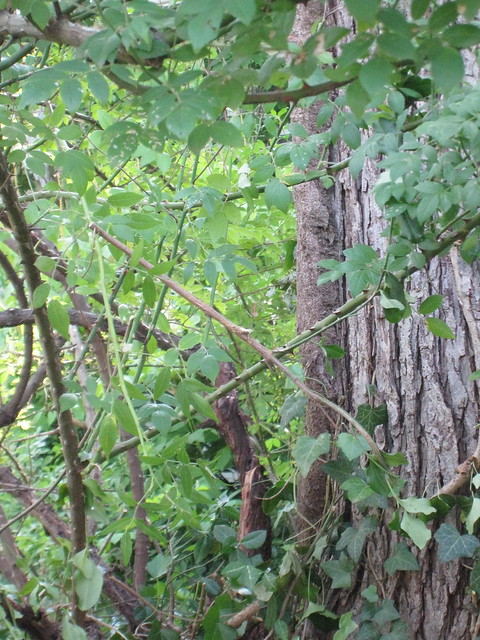
I also wasn't aware that, like English ivy (Hedera helix), winter creeper matures, blooms, and forms seeds only when it able to climb high enough to reach good light. Take a second look at my first photo. See the green vine? And the sneaky bush honeysuckle at lower center, buried within the monster rose?

So I got motivated. I tried just removing the winter creeper.
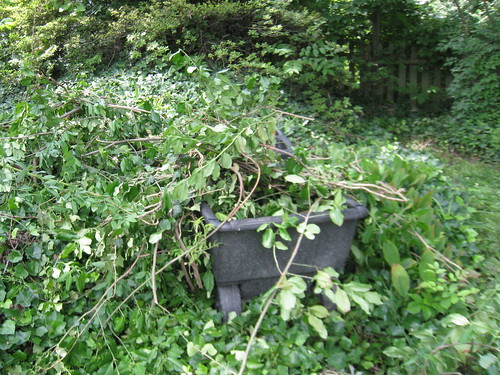
Pole pruner, loppers, leather gloves are all worse for the wear. I almost lost my shorts to the thorns, and in the front yard, that's a problem. I looked like I'd just boxed six rounds with a buzz saw and lost.
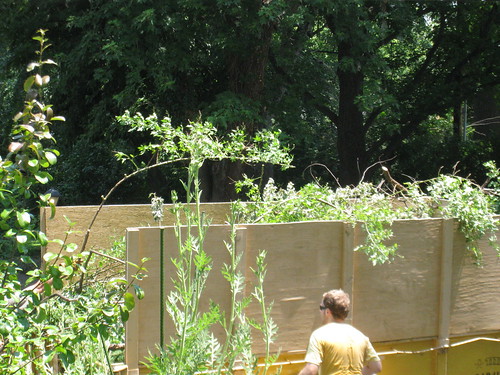
At last, I threw in the towel. I hired someone to remove the vines, rose and all. Now I've got a huge new space to fill with native plants that hopefully will be attractive all year long.


Saturday, June 18, 2011

Tick Protected and Trendy

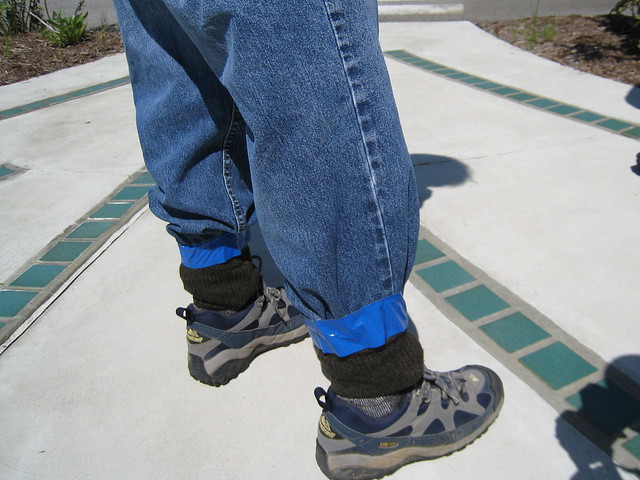
Modeling the latest in tick protection. Stylin', ain't I?
In June, 2008, my furry friend, Rosie, and I set out to do our breeding bird survey at Busch Memorial Conservation Area. It's the same territory I still visit and wrote about in my 2 most recent posts. Lake 22 always delivers. That day, an adult and juvenile Orchard Oriole showed off near their nest. I spotted a Hairy Woodpecker and no less than 4 Pileated Woodpeckers! We had some tough going as we headed east from the small lake toward the creek. The gullies had washed even deeper than the year before and the grass was already above my shoulders. Suddenly Rosie started fighting me for the leash. Usually she was more than eager to head down a trail, but perhaps this terrain was too for a 14-year-old Cairn terrier, so I picked her up. I carried her for a short distance, but the trail was getting deeper and more slippery, so we headed back to the car and on to the next lake.

Once we were in the car I noticed that she had several tick on her head and neck, some already attached. I knew we'd have a long session brushing, combing, and tweezing ticks from her thick fur when I got home. I had always been a bit casual about ticks. I was annoyed and disgusted with the itchy red welts left after a bite, but I never freaked out or stayed home to avoid them. Other birders wore long pants, but in the heat, the comfort of shorts was worth the risk of a bite. Sometimes I'd use bug spray.

I headed for the shower when I got home, which is when I discovered that we had gone through a huge swarm of ticks. There were dozens on me! Rosie must have had a hundred. I don't know how long I spent removing them from her, and in spite of being rewarded with treats for tolerating the process, she was not happy. I checked her again the next day and found more. Was this what she was trying to tell me back at Lake 22?

About week later I spiked a fever and called the doctor's office. The first thing they asked was, "Have you been exposed to ticks recently?" That gave me a pretty bad feeling. The doc gave me a prescription for an antibiotic and the fever soon disappeared. Unfortunately, the fever was only a small part of the illness. I was extremely tired. Each morning I'd get up after sleeping 11 hours or so, I'd drink a whole pot of coffee, and then I'd need to lie down to rest. I was taking 2 graduate credit classes at the time, so I'd drag myself over to the desk to work. By 5 PM, I'd be through for the day.

All my tests came back negative for 3 tick-borne diseases in my area of the Midwest: Rocky Mountain Spotted Tick Fever, Lyme disesase, and Ehrlichiosis. At the time, my doctor said that the tests were not too reliable, and he believed that I had one—or more! In spite of treatment, my extreme fatigue continued throughout the summer. The garden was overrun with weeds.

In September, 3 months after the tick bite, I was determined to go to my camp reunion. I told my friends that I had to be back about no later than 9 PM. I had a great time of course, and got home at 9:30 PM. Normally the last thing I do before bed is check that the doors are locked.

When I awoke the next morning, I found that not only had I not locked the door, I didn't even shut it. It was another 3 months before my sleep pattern returned to normal.

Later in 2009, Rosie's blood work showed that she had contracted Ehrlichiosis at some point. It was just 2 weeks ago though that I had some tests, and when my new doctor called with the results, she asked, "When did you have Ehrlichiosis?"

My bout with the disease was debilitating and not at all good for my garden, but I was lucky. Tragically, this week a healthy, middle-aged local woman died from a tick-borne illness. Another St. Louisan died in from Ehrlichiosis in June, 2009.

Tick-borne illnesses are scary, but I'm not going to quit enjoying the outdoors. Here are some tips for protecting yourself from tick exposure:

  • Pull your socks up onto the outside of your pant legs and wrap with duct tape. Ya gotta admit—it's a look!
  • Use bug spray with DEET on clothing and exposed skin. Don't forget to spray the dog!
  • Spray with permethrin on clothing. I spray permethrin on my jeans the night before a birding trip.
  • As soon as you return home from the woods and fields, put all clothing in the washer and dryer, check for ticks, and shower. Fortunately, it takes about 24 hours before an attached tick can transmit any pathogens.
  • Get rid of that invasive bush honeysuckle! Scientists from Washington University in St. Louis did experiments at the very same Busch Conservation Area, and found a connection between the abundance of bush honeysuckle, concentrated deer populations, and high density of disease-carrying ticks. Just another reason we should care about the environment!


Sunday, December 19, 2010

Critical Mass of Starlings


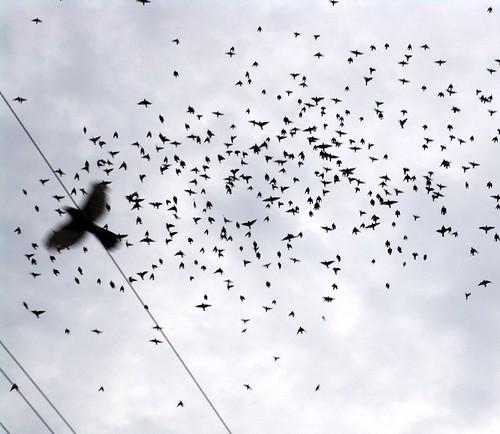
Birding while driving is never a good idea, but while flocks of starlings wheel and twist over the highway, I give them a quick glance. When the flock is behaving this way, I suspect there’s a hawk nearby. Here it is, a red-tail, high and outside. As I leave the highway, I see another flock gathering, preparing to roost in the neighborhood. Blocks away, I arrive at my destination, still hearing the cacophony of chatters and whistles.
At one point, some called European Starlings the most abundant bird in North America. It wasn’t always so. The Acclimatization Society of New York, NY, is responsible for turning them loose on this continent in 1890. Their stated goal was to introduce to North America all the birds mentioned by Shakespeare. Henry IV, Part I is play responsible. The character Hotspur, furious at the King over his refusal to ransom Hotspur’s brother-in-law Mortimer, raves that he’ll train a starling to say “Mortimer” and give it to the King as a gift. It’s a good idea. Starlings are great mimics, as befits a member of the myna family, as this video shows.
Cooper's Hawk with flock of European Starlings
photo by zen Sutherland
European Starlings are aggressive, noisy cavity nesters. In winter, they like to roost with about 999 of their closest pals. This has not endeared them to human communities. If you have to endure these gatherings, Cornell has some advice for you, and best of luck.
In 1960, Eastern Airlines flight 375 took off from Boston and struck a flock of starlings. The crash killed 62 people, the worst accident caused by bird strike on an aircraft. We blamed them too for the decline of bluebirds. Starlings have become of the most despised of all winged creatures—right up there with mosquitoes. Recent studies, however, have failed to turn up evidence that starlings have had any negative effect on any North American species, except the sapsucker.
Our relationship with the starling may be an uneasy one, but that doesn’t diminish our fascination with those amazing flocks. An article in Wired Science, June 2010 explains their behavior as “synchronized orientation…in a critical system,” meaning that members of the flock can communicate so well that if a single bird turns, the flock of thousands can follow. The behavior dazzles humans, as well as avian predators.

Wednesday, November 24, 2010

Bittersweet


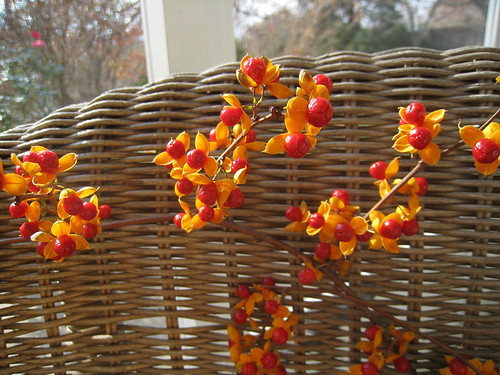
American Bittersweet AMcC
Spring is a time of easy metaphors for renewal, hope, life. Autumn, well, not so much. Lovely fall colors are cheery, but brief. Just as Goldengrove is unleaving, a magnificent vine is revealed, covered with clusters of small, shiny red fruits, surrounded by open capsules of orange. We call it American Bittersweet, Celastrus scandens. Kurz notes in Shrubs and Woody Vines of Missouri that Celastrus is a Greek name for a tree and scandens means climbing. But how did it get its melancholy English name? Perhaps its autumnal display associates it with the demise of summer, the season of loss.

We humans like to ascribe meaning to natural phenomena. The albatross symbolizes guilt; the raven, death; the lark, “blithe spirit;” bittersweet, remembrance.

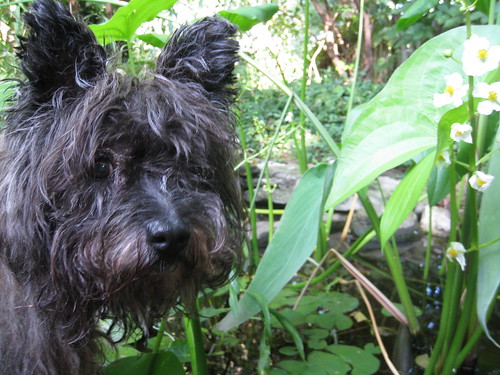
The contradictory name has been on my mind, since the furry friend you see in my profile picture died this week. For those who have experienced the death of a dear pet, I don’t need to explain my feelings. For those who have not, I don’t think I can adequately describe it. Instead, I’ll focus on the sweet memories.

Rosie and I went everywhere together for more than 16 years. She accompanied me on many birding trips, though she really preferred chipmunks, moles, and other mammals. She camped with us in the Rocky Mountains one June, and I was surprised to see her barking at two Gray Jays. She didn’t usually pay attention to birds. Then I saw one dart in and snatch a bit of her fur while the other stole a kibble from her bowl.

Rosie the Fishin' Dog AMcC
My brother-in-law called her “the fishin’ dog.” Her favorite spot was the tiny pond in my back yard. I keep a few goldfish there to eat mosquito larvae, and once she spotted them, she wanted them. She tried to catch a fish every day of her life and never succeeded. Far from being discouraged, she came back to the job fresh every time. She spent so much time in the water that one summer I had to take her to the vet for swimmer’s ear.

Like a true a terrier, she was independent. She seldom asked to sit in my lap as I watched TV, but she did like a good nature show now and then, especially if there were bears to bark at. When she was a puppy, she sat up on the bed while I watched Turner and Hooch; starring the tidy detective Tom Hanks and the untidy Dogue de Bordeaux named Hooch. She barked and jumped and generally went nuts every time Hooch came on the screen. That video was like a Jane Fonda exercise tape for Rosie.

If you grow bittersweet in your woodlot or on an arbor, be sure you get the native variety, not Celastrus orbiculatus, Round-leaved or Asiatic bittersweet. The fruits of Round-leaved bittersweet are less showy, and the plant is aggressive. As the name suggests, the easiest way to determine if the vine is native to the US or an invasive invader is the shape of the leaves. American bittersweet’s leaf is not round, but an elongated oval with a pointed tip. Sweet as they are to look at, the fruits are poisonous.