Showing posts with label dogs. Show all posts

Sunday, August 28, 2011

High Praise from a Prairie Vole


When Chunk and I take our walk through the neighborhoods and down to the park, I sometimes keep count of the number of species we see: 12-22 birds (depending on how long the walk; highest number in spring), and usually only 2 mammals— Eastern Gray Squirrel (always), and either Eastern Cottontail or Eastern Chipmunk. Chunk is more of a mammal-watcher than a bird-watcher and recently he's been pushing the mammal species total upward.

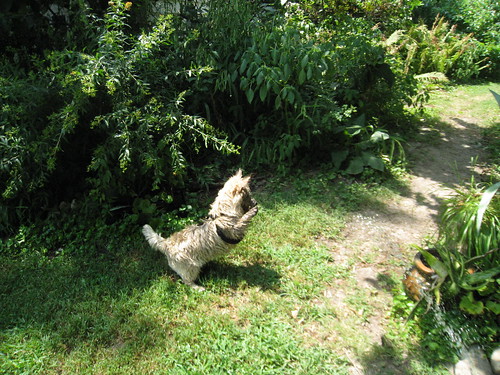
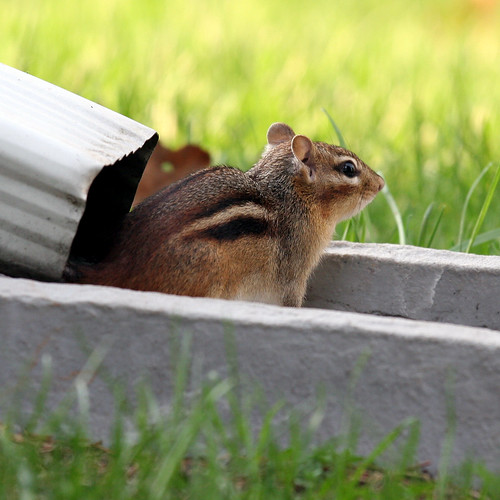
At first, I assumed these holes were the entrances to chipmunk tunnels, but they were too small: only 1 1/4 to 1 3/4 inches (3.17-4.45 cm) in width. There were many on them too on the gentle slope by the cemetery fence; I knew there couldn't be that many chipmunks in the small area. Then I spotted one. It looked like a small, grey mouse, with a rounded head. As you can see from my one-handed snapshot above, Chunk didn't wait to see it—he dove right in! Never fear, my fellow critter-lovers, I didn't let him catch one.

I suspected voles, so first I checked Mark Elbroch's Mammal Tracks & Sign; A Guide to North American Species, 2003. This is really a fascinating book, filled with photos, though some of the mammal signs are, well, unattractive. Elbroch confirmed that the holes were within the range of voles.
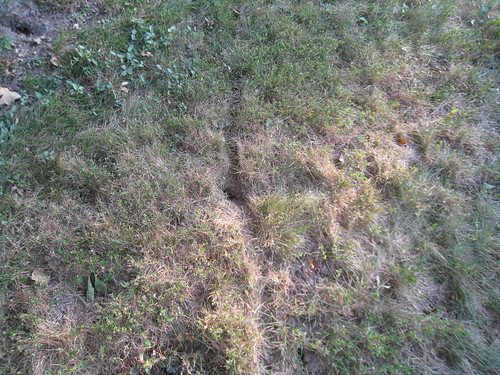
The pathways through the dry grass and winter creeper seemed significant signs too.
Prairie Vole, photo from Wikimedia Commons, by US National Park Service
Next I checked Mammals of North America, by Bowers, Bowers, and Kaufman. Judging by the range maps and the dry habitat, these are most likely Prairie Voles (Microtus ochrogaster). Both sources mention the runways between tunnel entrances. I realize now that these little guys are to blame for the disruptions in my front garden of glade and prairie wildflowers and grasses. Since they are a prairie species, I'll take their presence as a compliment.

Mammal watchers might also enjoy:
Mountain Lion, St. Louis
What are ya usin' for bait?
Charismatic Megafauna
Walk on the Wild Side 

Sunday, July 24, 2011

New Helper in the Garden; A Guest Post by Chunk


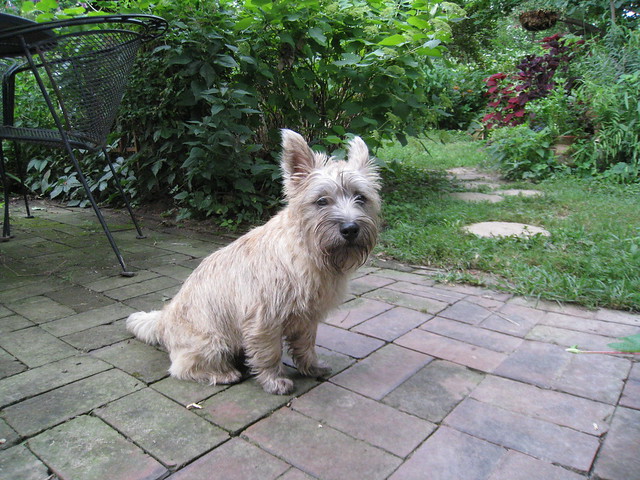
It's a good thing I came along, because Anne really needs help in this garden. Case in point…


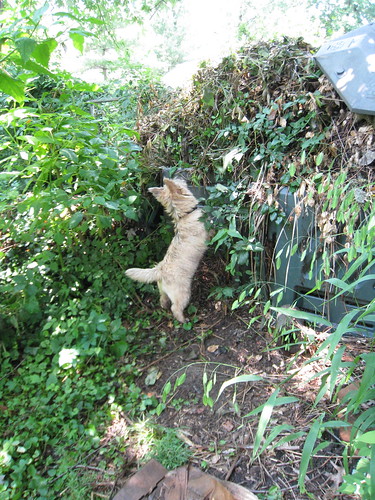
She put some wonderful, smelly fruit in the compost pile. I had to get it out. Then I ate it.


Ahh! It's nice to cool down after working in the sun.


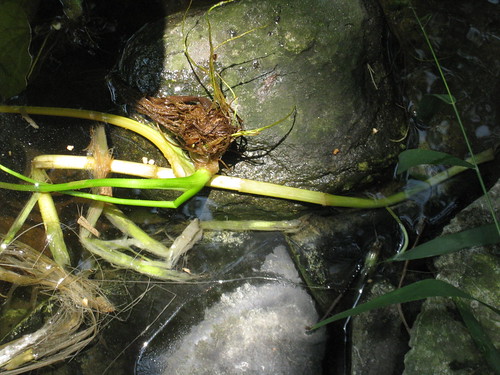
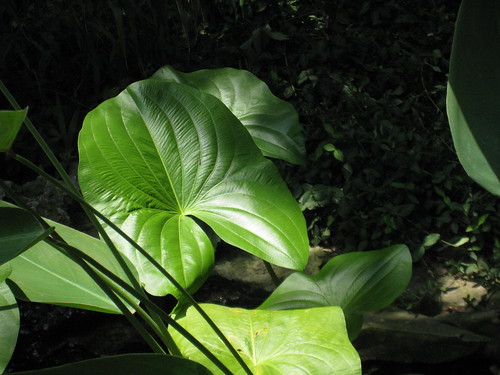
She doesn't know much about her pond. These things are delicious!


So are the stems. But my BFF Lily and I ate most of them.


They say muskrats like them too. I'd really like to meet a muskrat.


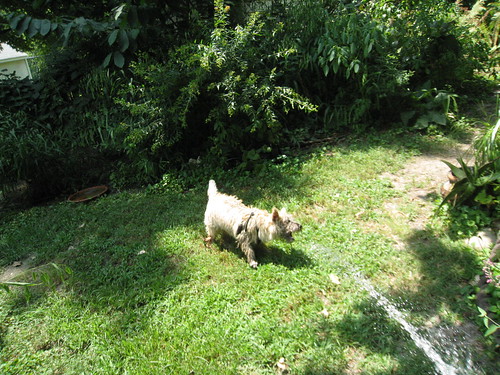
She lets that water spray everywhere!


Luckily, I'm here to attack it.


I know there's a rodent in this yard somewhere. (Thanks, Dawn Huczek, for your great photo!)


Why don't you let me handle the little critter that my way, hmmm?

  
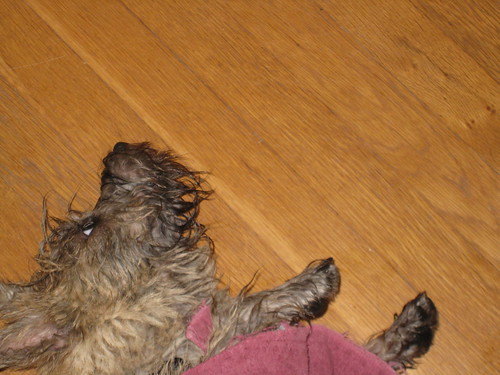
She does appreciate me though. After a hard day on the beach, she helps me dry off.


But I can do that myself too.
Now for a well-deserved rest…

Thursday, June 2, 2011

Strong Bonds

I've lived with a dog or cat or both almost every minute of my life. Certainly our ancestors of every culture lived with animals. Some considered them gods. Many cultures saw animals as sentient beings with their own languages and customs. In the photo above, doesn't Josey look as if she's about to make a clever remark?

Archeologists have found evidence that dogs were kept as pets in a 14,000-year-old grave in Germany. Evidence that dogs lived with humans has been found in a cave in  11,000-year-old site in Utah. A Wikipedia article dates the domestication of the dog to  15,000 years ago in east Asia and Africa. In a dig in Jordan, anthropologists found the oldest evidence remains of a what may have been a pet fox buried with human remains 16,500 years ago. Pet lovers, we have tradition solidly on our side.

Dogs, cats, and even foxes lived with people in ancient times because they were useful. They hunted rodents that could destroy food stores, gave early warning of danger, aided hunters. People were useful to dogs and cats too, but the connection between the species must at times have been more than simple exchange of benefits. People and pets can share a very strong bond, whether in the Stone Age or the Digital Age.

My vet once described me as the woman who runs a home for geriatric dogs, and that sums it up nicely. A year ago I had three dogs. Last fall, I wrote a post about Rosie, my companion for 16 years. This past week, Josey, oldest and last of the three, died. Caring for Josey, along with other obligations in spring, is partly responsible for my infrequent blogs posts this month.

Josey was a long-haired dachshund and a sweetheart! I inherited her and Ginny, a Shih Tzu, when my friend and neighbor, Georgia, died a year and a half ago. With a yard to investigate, treats in the evening, and an occasional piece of chicken in the food bowl, the dogs adapted to the change and life was good.

My friend Dodie says that dogs make us more human. I have no doubt that she's right.

Wednesday, November 24, 2010

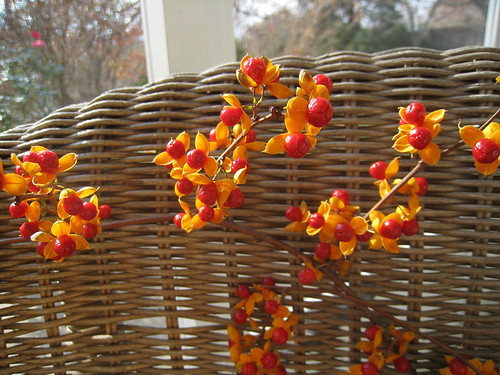
Bittersweet


American Bittersweet AMcC
Spring is a time of easy metaphors for renewal, hope, life. Autumn, well, not so much. Lovely fall colors are cheery, but brief. Just as Goldengrove is unleaving, a magnificent vine is revealed, covered with clusters of small, shiny red fruits, surrounded by open capsules of orange. We call it American Bittersweet, Celastrus scandens. Kurz notes in Shrubs and Woody Vines of Missouri that Celastrus is a Greek name for a tree and scandens means climbing. But how did it get its melancholy English name? Perhaps its autumnal display associates it with the demise of summer, the season of loss.

We humans like to ascribe meaning to natural phenomena. The albatross symbolizes guilt; the raven, death; the lark, “blithe spirit;” bittersweet, remembrance.

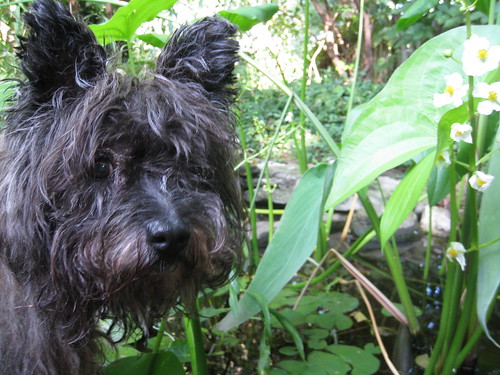
The contradictory name has been on my mind, since the furry friend you see in my profile picture died this week. For those who have experienced the death of a dear pet, I don’t need to explain my feelings. For those who have not, I don’t think I can adequately describe it. Instead, I’ll focus on the sweet memories.

Rosie and I went everywhere together for more than 16 years. She accompanied me on many birding trips, though she really preferred chipmunks, moles, and other mammals. She camped with us in the Rocky Mountains one June, and I was surprised to see her barking at two Gray Jays. She didn’t usually pay attention to birds. Then I saw one dart in and snatch a bit of her fur while the other stole a kibble from her bowl.

Rosie the Fishin' Dog AMcC
My brother-in-law called her “the fishin’ dog.” Her favorite spot was the tiny pond in my back yard. I keep a few goldfish there to eat mosquito larvae, and once she spotted them, she wanted them. She tried to catch a fish every day of her life and never succeeded. Far from being discouraged, she came back to the job fresh every time. She spent so much time in the water that one summer I had to take her to the vet for swimmer’s ear.

Like a true a terrier, she was independent. She seldom asked to sit in my lap as I watched TV, but she did like a good nature show now and then, especially if there were bears to bark at. When she was a puppy, she sat up on the bed while I watched Turner and Hooch; starring the tidy detective Tom Hanks and the untidy Dogue de Bordeaux named Hooch. She barked and jumped and generally went nuts every time Hooch came on the screen. That video was like a Jane Fonda exercise tape for Rosie.

If you grow bittersweet in your woodlot or on an arbor, be sure you get the native variety, not Celastrus orbiculatus, Round-leaved or Asiatic bittersweet. The fruits of Round-leaved bittersweet are less showy, and the plant is aggressive. As the name suggests, the easiest way to determine if the vine is native to the US or an invasive invader is the shape of the leaves. American bittersweet’s leaf is not round, but an elongated oval with a pointed tip. Sweet as they are to look at, the fruits are poisonous.