 |
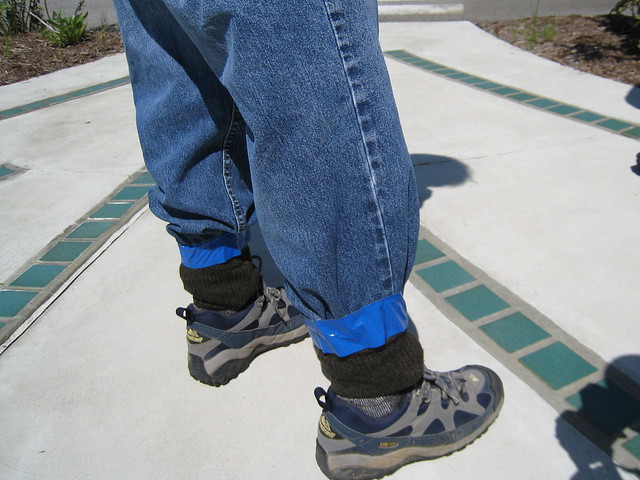
| Modeling the latest in tick protection. Stylin', ain't I? |
Once we were in the car I noticed that she had several tick on her head and neck, some already attached. I knew we'd have a long session brushing, combing, and tweezing ticks from her thick fur when I got home. I had always been a bit casual about ticks. I was annoyed and disgusted with the itchy red welts left after a bite, but I never freaked out or stayed home to avoid them. Other birders wore long pants, but in the heat, the comfort of shorts was worth the risk of a bite. Sometimes I'd use bug spray.
I headed for the shower when I got home, which is when I discovered that we had gone through a huge swarm of ticks. There were dozens on me! Rosie must have had a hundred. I don't know how long I spent removing them from her, and in spite of being rewarded with treats for tolerating the process, she was not happy. I checked her again the next day and found more. Was this what she was trying to tell me back at Lake 22?
About week later I spiked a fever and called the doctor's office. The first thing they asked was, "Have you been exposed to ticks recently?" That gave me a pretty bad feeling. The doc gave me a prescription for an antibiotic and the fever soon disappeared. Unfortunately, the fever was only a small part of the illness. I was extremely tired. Each morning I'd get up after sleeping 11 hours or so, I'd drink a whole pot of coffee, and then I'd need to lie down to rest. I was taking 2 graduate credit classes at the time, so I'd drag myself over to the desk to work. By 5 PM, I'd be through for the day.
All my tests came back negative for 3 tick-borne diseases in my area of the Midwest: Rocky Mountain Spotted Tick Fever, Lyme disesase, and Ehrlichiosis. At the time, my doctor said that the tests were not too reliable, and he believed that I had one—or more! In spite of treatment, my extreme fatigue continued throughout the summer. The garden was overrun with weeds.
In September, 3 months after the tick bite, I was determined to go to my camp reunion. I told my friends that I had to be back about no later than 9 PM. I had a great time of course, and got home at 9:30 PM. Normally the last thing I do before bed is check that the doors are locked.
When I awoke the next morning, I found that not only had I not locked the door, I didn't even shut it. It was another 3 months before my sleep pattern returned to normal.
Later in 2009, Rosie's blood work showed that she had contracted Ehrlichiosis at some point. It was just 2 weeks ago though that I had some tests, and when my new doctor called with the results, she asked, "When did you have Ehrlichiosis?"
My bout with the disease was debilitating and not at all good for my garden, but I was lucky. Tragically, this week a healthy, middle-aged local woman died from a tick-borne illness. Another St. Louisan died in from Ehrlichiosis in June, 2009.
Tick-borne illnesses are scary, but I'm not going to quit enjoying the outdoors. Here are some tips for protecting yourself from tick exposure:
- Pull your socks up onto the outside of your pant legs and wrap with duct tape. Ya gotta admit—it's a look!
- Use bug spray with DEET on clothing and exposed skin. Don't forget to spray the dog!
- Spray with permethrin on clothing. I spray permethrin on my jeans the night before a birding trip.
- As soon as you return home from the woods and fields, put all clothing in the washer and dryer, check for ticks, and shower. Fortunately, it takes about 24 hours before an attached tick can transmit any pathogens.
- Get rid of that invasive bush honeysuckle! Scientists from Washington University in St. Louis did experiments at the very same Busch Conservation Area, and found a connection between the abundance of bush honeysuckle, concentrated deer populations, and high density of disease-carrying ticks. Just another reason we should care about the environment!