Sunday, September 26, 2010

They'd Rather Fight than Switch!

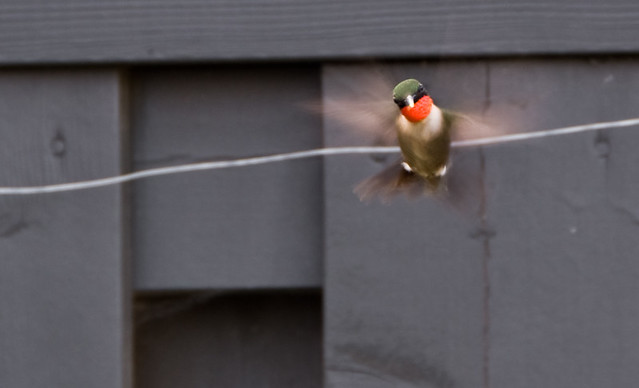
Hummingbird throwdown! Photo by Amyn Kassam

Here’s what we love about hummingbirds: They have that vertical posture, they make eye contact, they love sweets, and of course, they fight. They’re so human!


Watching hummingbirds is not like watching other wildlife. Hummers get up close and personal. Laura Erickson, in her 2006 book, 101 Ways to Help Birds, tells us about hummers that tap on her window when they want her attention. I watched a hummingbird pirouette around a friend wearing a coral-colored shirt, even though he was surrounded by a crowd partying on a small deck.  Hummers have come within inches of my face to catch the spray as I water my plants.


My neighbor recently told me about two hummers that clashed and then crashed, knocking each other to the ground right in front of his basset hound. Both recovered and flew off before the dog could get over her surprise and devour them. Last summer, a skirmishing hummer clobbered my brother-in-law in the head!


The level of aggression in hummingbirds is a mystery to me. Isn’t fighting over resources a waste of valuable foraging and feeding time? In her 2000 book, Attracting and Feeding Hummingbirds, Sheri Williamson points out that plants must be frugal with the nectar they produce. Nectar is of no use to the plant directly. It’s sole purpose is to pull in pollinators, so once a blossom has been pollinated, it ceases to produce nectar. Since plants are so stingy, hummers adopt a strategy of claiming a  territory and protecting their resource ferociously. According to Williamson, “Territories are smaller where flowers are abundant, larger where they are scarce (14).” I can see the evolutionary advantage of resource guarding, but I’m not sure why it seems so much stronger in hummers than—say—woodpeckers.


Like grizzly bears and bull elephants, hummingbirds use “mock charges” to panic their rival into flight, while minimizing the risk of injury to themselves. Adult males can flash their color throat feathers (the gorget) to intimidate from a distance. Females and juvenile bird display the white tips of the outer tail feathers for the same purpose, as you see in the photo above by my Flickr friend, Amyn Kassam. Hummingbirds can scold predators and interlopers with chirping sounds, and some can startle  with buzzing sounds produced by tail or wing feathers. There are times however when, like Taryton smokers, hummingbirds would rather fight than switch.


Some of my readers know that I worked at a youth camp in the Ozarks for many summers. Trumpet creepers (Campsis radicans) brought in birds by the dozen. Like Snoopy and the Red Baron, hummers battled around the camp office from sun up till sundown. Once, a staff member was actually injured in a hummingbird fight. As she crossed the parking lot, two hummers collided in front of her and a dislodged feather hit her in the eye!
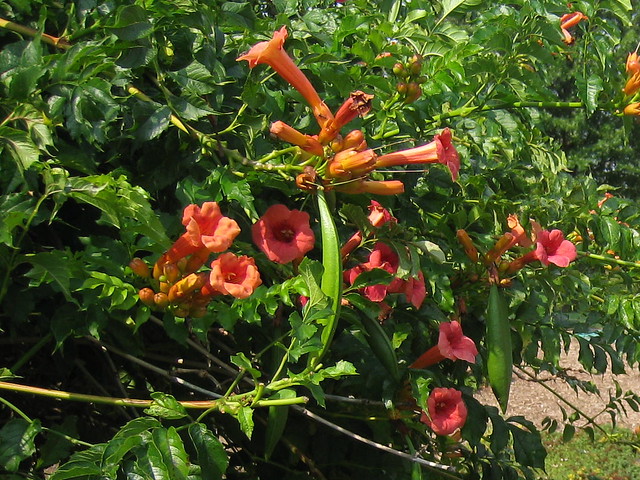
Trumpet Creeper is a hummingbird magnet! Photo by AMcCormack

Trumpet creeper is a hummingbird magnet for a reason. In a 2003 article in LOS News, the newsletter of the Louisiana Ornithological Society, Dennis Demcheck wrote about the “Sugar Content of Hummingbird Plants in Louisiana Gardens.” Demcheck used a refractometer to measure the concentration of sugar in the nectar of blossoms in his garden—the same equipment used by wine makers. He found that, among wild/native plants, the trumpet creeper had the highest concentration of sugar at 34.3%, with each bloom producing a large volume of nectar. To reach that nectar, the bird must actually climb inside the 3-inch long bloom. It’s quite a risk for a bird to limit its vision like that, but obviously worth it.

If you’re thinking about adding trumpet creeper to your home garden, linger on this blog a little longer. Trumpet creeper is a big plant; every bit as aggressive as the hummers that love it. The main stem can be wider than your hand and all those branches in summer are heavy as they lie on the roof of your garage or branches of your prized specimen tree. Maybe you can persuade your neighbor to grow it.

Monday, September 20, 2010

Forgotten Pollinators

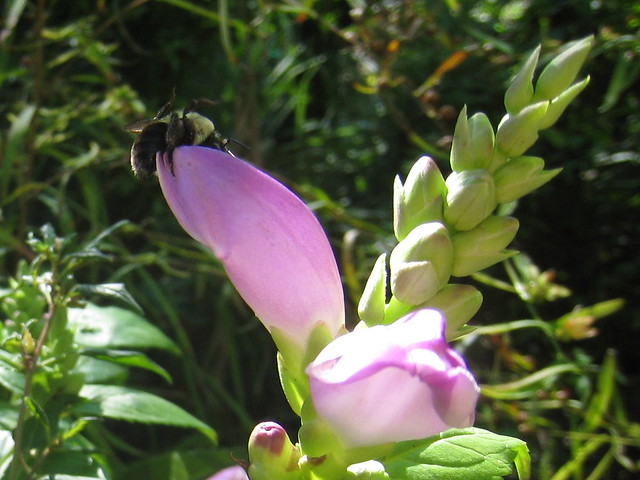
Bumblebee inside translucent blossom of Rose Turtlehead AMcCormack
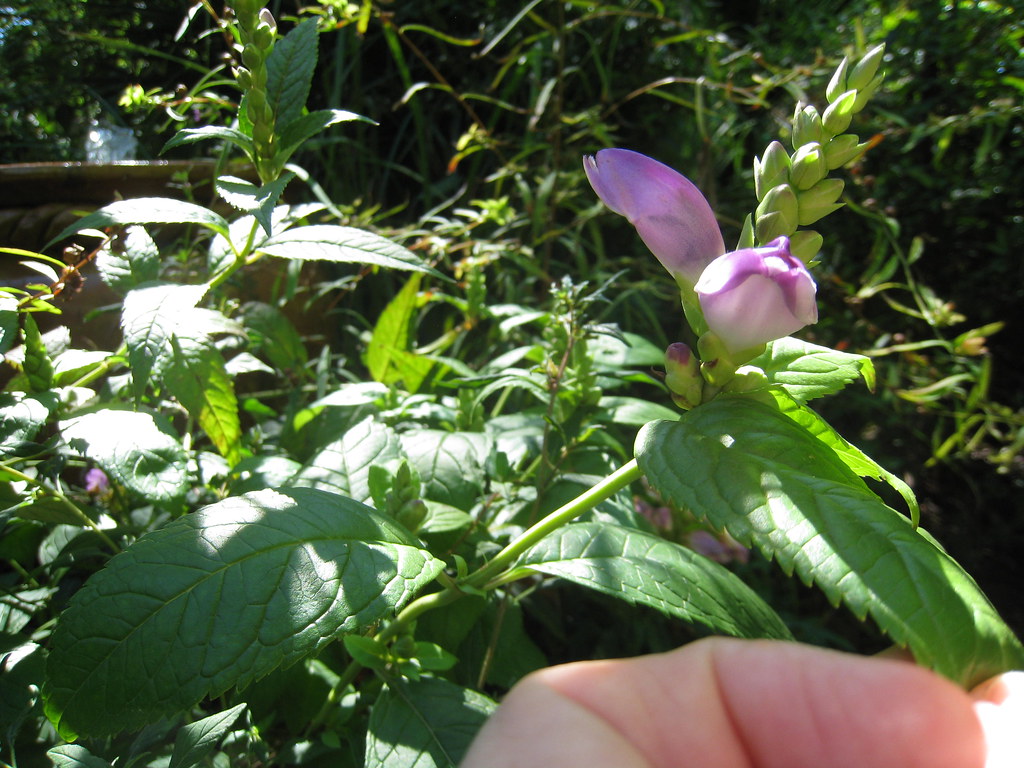
Take a lovely wildflower like Rose Turtlehead (Chelone obliqua). If it is going to bear seeds, the plant needs to have its pollen grains transferred to the stigma of another, unrelated Rose Turtlehead. With its genetic survival at stake, you would think that the species would make things inviting and easy for passing pollinators. Inviting, it is. The blossom contains nectar; nectar produced by the plant for the sole purpose of attracting a pollinator. Easy, it is not. Like Adam and Eve, bumblebees must earn their living by the sweat of their brows--except they don't have brows.

First, the Turtlehead forces the bee to struggle through a tight, tubular opening. Then, the plant positions its nectar reward far at the back of its one-and-a-half-inch blossom. Once the bee reaches the nectar, she finds that the pollen she was counting on to feed the kids is stuck on the anthers. Determined, she vibrates her body violently to shake the pollen from the anthers. Now she must somehow work her way out of the bloom, and fly off with her load to another delectable Rose Turtlehead. The process is called buzz pollination, and it's not just Turtleheads that require it of their pollinators. Tomatoes, blueberries, and many wildflowers such as wild indigo (Basptisia australis) produce more and larger fruits if they are successfully buzz pollinated.

Bumblebee struggles to break free of the blossom AMcC

Not every pollinator is up to the task. Honeybees and smaller native bees are too tiny. Only the Sumo wrestlers of the bee world, the bumblebees, can really deliver that buzz. What is the evolutionary brass ring that Turtlehead is reaching for? By withholding its reward from pollinators other than it's favored one, the plant encourages that selected pollen-carrier to visit another bloom of the same species--"pollinator constancy." Evidently, once the bumblebee finds something she likes, she sticks with it.


I had really hoped that my photos would help me identify the species of bumblebee, but I just didn't get enough of the insect in the frame. I'll keep trying though. There are several web pages that help with bee identification. My favorite is the identification key to bumblebees from Discover Life. The Xerces Society has a page devoted to the topography of the bumblebee. Bumblebee.org has a great color chart for identifying bumblebees as well as information about their life cycle and how to attract them.

The media has given quite a bit of attention to colony collapse disorder, which has caused the European honeybee to vanish from many places where it was once abundant. We can't afford to lose our native bees as well. The Xerces Society provides information about bumblebee conservation, as well as information about my region, Missouri.
Aerodynamically, the bumblebee shouldn't be able to fly, but the bumblebee doesn't know it, so it goes on flying anyway. 
Mary Kay Ash
Not really true, aerodynamically, but isn't it a great quotation?


Tuesday, September 14, 2010

Baby Hummingbirds


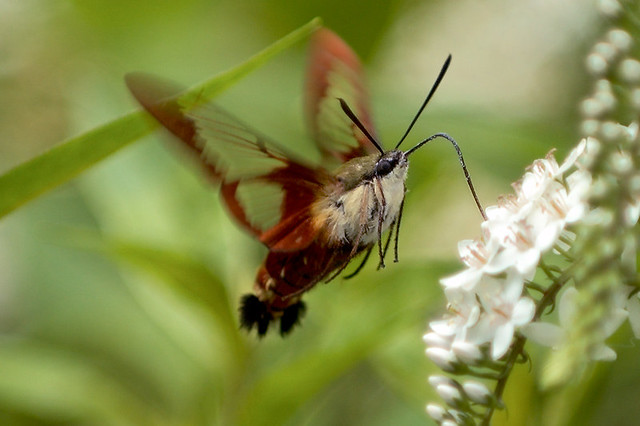
Hummingbird Clearwing moth Photo by Joe Holmes

Being a birder, I usually remember vividly where I was when a see a new bird for the first time, but seeing a new insect doesn’t usually stand out as well for me. Not so the hummingbird moth! I remember bright sunshine as I climbed up a small rise to a gravel road. There in the roadside wildflowers was the most bizarre sight. It behaved like be a hummingbird, but it was too small. It didn’t have the right attitude either. Hummingbirds often stand up vertically as they zip in and out of flowers. This creature was definitely visiting flowers, but it didn’t hold itself vertically. The wings weren’t right either. They were almost visible; hummingbird wings seem to disappear at times as they zoom past. Then the little creature disappeared.

It took some time to discover that my little mystery critter was a sphinx moth. Day-flying moths, the sphinx family feed on flower nectar. Some, like the Hummingbird Clearwing Moth, mimic the markings of bumblebees to discourage predators. They may look like bumblebees, but they behave like hummingbirds, using a proboscis instead of a long tongue to lap up the nectar of blossoms.

Their flight is faster and more direct than most moths—like a hummingbird, but not as fast by my reckoning. Like hummingbirds and bees, they are pollinators. According to David Wagner (Caterpillars of Eastern North America) the female Hummingbird Clearwing moth lays eggs on viburnum or honeysuckle and the bright green caterpillars thrive, growing to 2 inches. I haven’t found the caterpillars in my yard, though I grow both of these. I see the adults sometimes, so I’ll be on the lookout.

The Hummingbird Clearwing’s scientific name is Hemaris thysbe. According to the Bug Guide, the specific name of Thysbe was chosen because of the blood red color of the wing edges and tail of the moth. You would probably have to have a played a part in Shakespeare’s Midsummer Night’s Dream to remember that Thysbe’s veil was found by her lover Pyramus, blood-stained after a lion mouthed it. Poor Pyramus jumps to the conclusion that his darling is deceased and kills himself. I know it doesn’t sound funny, but it’s hysterical in the play. I prefer to believe that this moth was named for the comic reaction it provokes, rather than it’s rusty color.

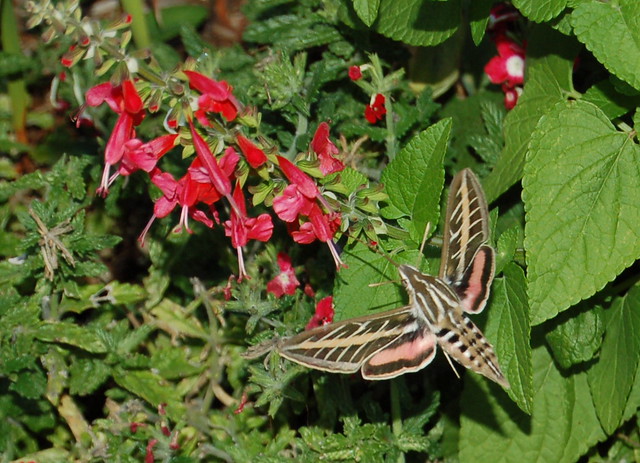
White-lined Sphinx moth Photo by Katrina Wiese
When people find that I’m interested in hummingbirds, they sometimes say, “Oh, yes, we had baby hummingbirds in our garden this summer.” However, my friend Lanny Chambers, a hummingbird bander, tells me that except for very minor differences, juvenile hummers are the same size as adults. A very small “hummingbird” is most likely a moth. Check out this fun website dedicated to hummingbird moths.

Hummingbirds are notoriously territorial. It seems they would rather fight with other hummers than eat. Hummers will chase away other birds, even those many times their size. I once watched a Rufous Hummingbird chase a Blue Jay down the block! Yet this same bird tolerated a Hummingbird Clearwing moth that was nectaring alongside it. Apparently it did not recognize the moth as a competitor.

Sunday, August 29, 2010

Attracting Hummers

Adult male Ruby-throated hummer flashes his gorget at the camera. Photo by kmaraj


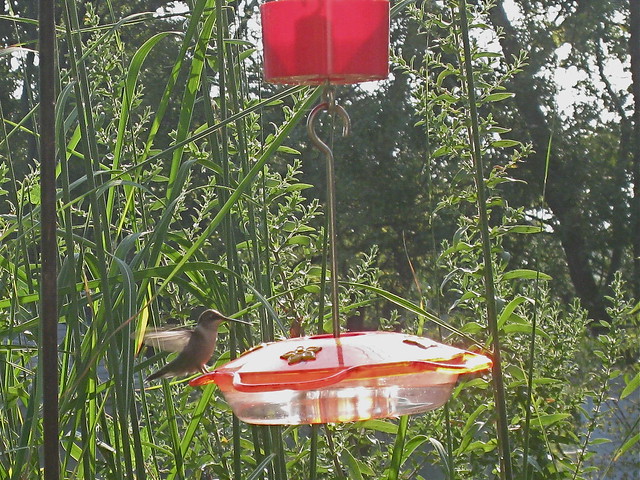
Everyone has a hummingbird story—everyone who’s ever seen one that is. I took it for granted that everyone had seen a hummingbird, but a few years ago, I dragged a neighbor over to my yard to look at an unusual hummer. She was an older person who had grown up in the Ozarks, yet this was the first hummer she’d ever seen. The only reason she saw this bird was because of the feeder. The feeder is a place to look—a predictable spot for the hummer’s brief visit. This is why I prefer feeders that attach to a window. I know many people who have glimpsed a hummer, but weren’t sure it was actually even a bird. When a bird flies right up to the glass and for a pause that refreshes, you can really see it—ruby-colored gorget and all. (“Gorget” is a term that describes the iridescent feathers of the throat of the adult male.)

I visited Big Bend National Park one summer. A bit like visiting Hades, but wow—the hummers! There were Black-chins with purple throats, Broad-tails with wings that make a ringing sound, and the largest US hummer, the Blue-throated. Most exciting of all was the Lucifer Hummingbird male with his brilliant hot pink gorget. Most visitors to the park never saw any of these however, since most don’t know hummers are abundant there, don’t have binoculars, and don’t know where to look. The park, you see, does not allow feeders. I understand why people shouldn’t feed wildlife in a national park, but applied to hummingbird feeders, it’s a rule that diminishes the experience of some visitors to Big Bend.

I’ve talked to numbers of people who live in good areas for hummers, put out feeders and plant hummingbird-attracting flowers, but have no birds. I suspect they do, but of that feeder and red salvias are any distance from the house, it’s easy to miss a 3.2-inch green-backed bird. The moral of the story: get a feeder and put it where you’ll see it!

Young male Ruby-throat. Above the feeder, an “ant moat” keeps ants at bay. AMcC
The formula: Keep a jar that has cup measurements on the side. I fill it with 2 cups of warm water, then add 1/2 cup of sugar. I put the lid on and shake. I keep one or two in the fridge so I’m always ready to refill or replace nectar. I know a lot of articles recommend boiling the water, but the only reason for that is to reduce the bacteria load. I save a step by using tap water, which presumably has little bacteria. I replace the solution often—at least every 3 days. If the temperature climbs near 100°, I replace it daily. That’s a lot of work if you have several feeders, so save steps where you can.

There is some evidence to suggest that cane sugar is better than beet sugar. If the package is just labeled “Sugar,” it’s probably beet sugar. Only sugar from sugar cane can be labeled “Cane Sugar.” There’s tons of evidence that shows that honey is very bad for hummingbirds. The feeder is supposed to replicate the nectar produced by flowers that attract hummingbirds as pollinators. Nectar produced by flowers is sucrose, a disaccharide, whereas honey is monosaccharide fructose. In the wild, hummingbirds feed on flowers; they don’t raid beehives.

What about the red food color? I know commercial hummingbird nectar is dyed red, but dye is not recommended. It’s true that hummers are attracted by the color red, but that’s why hummingbird feeder should be red at the business end. The feeder port is analogous to a red blossom, but the nectar inside a flower is colorless. For more about feeders, check Lanny Chambers excellent website.

It’s important to keep any bird feeder clean, but doubly important for hummingbird feeders. It doesn’t take long for colonies of bacteria to foul the mixture and this can do real harm to the bird. If you don’t have the time to maintain clean feeders, consider feeding only during times of greatest abundance. Here in Missouri, that’s spring migration—April and May, and especially August through late September. I actually keep my feeders up till Christmas—but that’s another post.

Sunday, August 22, 2010

When Butterflies Attack!!!

Monarch butterflies fighting AMcC

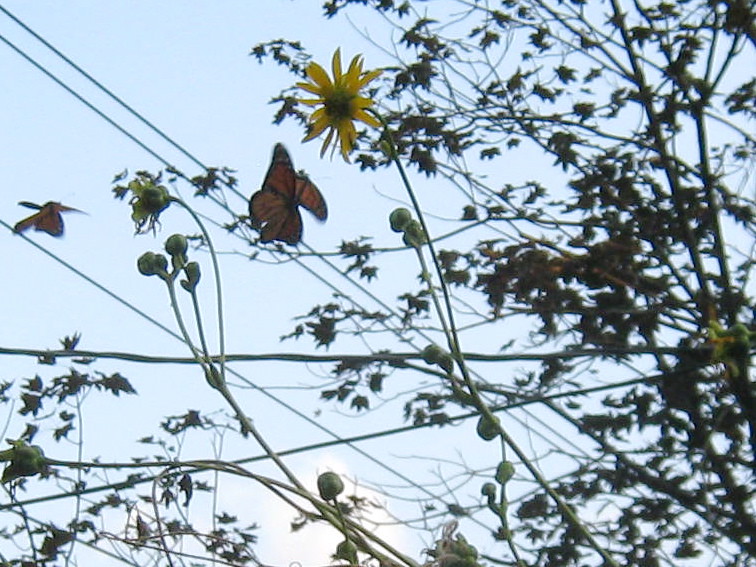
Seen through the rose-colored binoculars of the romantic nature-lover, butterflies are the very embodiment of harmony, as they flutter from one fragrant blossom to another. So how come I came home from work last week to find a brawl in my front yard? Three Monarch butterflies were duking it out, paying little attention to cars or photographers. These butterflies were not just circling each other in a “duel,” they were actually making contact!

Of course, butterflies have to struggle to survive and pass on their genes, the same as other wild creatures. Male Monarchs use a strategy for finding mates called “patrolling.” The male patrols an area, perhaps the top of a small hill were views are unobstructed, looking for females. I use the word look, because although moths are known to find mates through scent, butterflies rely primarily on sight (Boggs, Watt, Ehrlich, Butterflies: Ecology and Evolution Taking Flight, 75). Once the male detects a female, he gives pursuit and tries to mate. If however he encounters another male, he may attempt to drive off the interloper.

I remember spotting a male Monarch in my mom’s garden. When I pointed it out to her, she looked at me suspiciously. “How can you tell?” she asked.

“Well,” I said, still watching the butterfly in my binoculars, “you have to have a pretty good look.” (Bah-dum-bum.) She laughed hysterically. She didn’t even hear me explain that males have a small black scent patch on the hind wing, close to the rear of the abdomen.

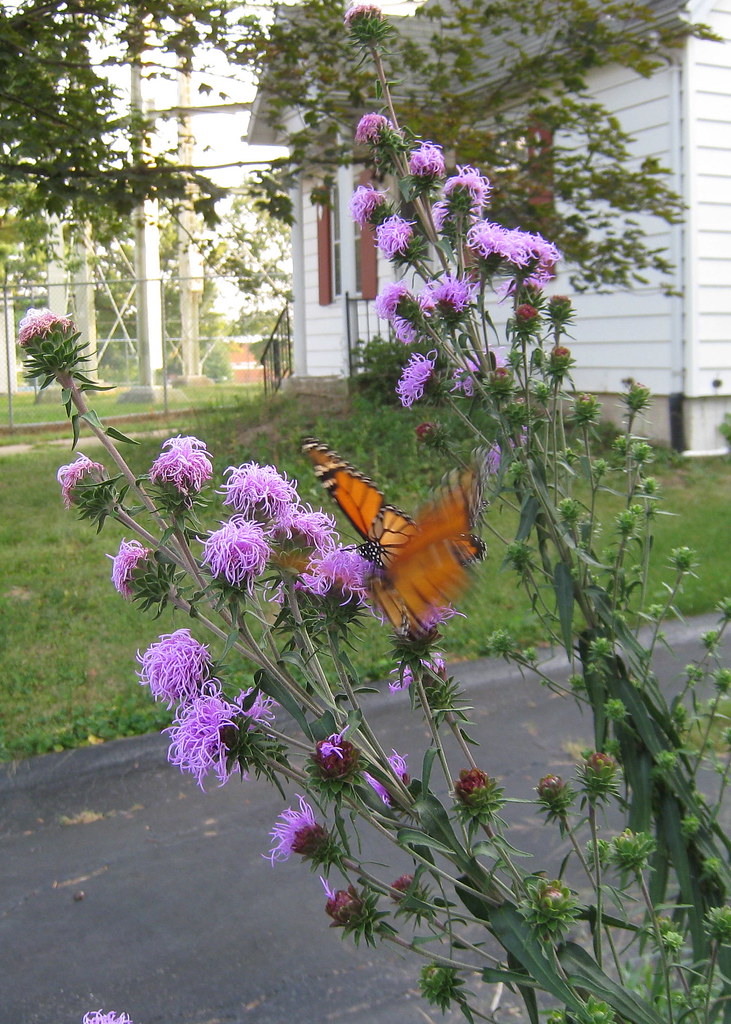
I doubted whether I could get a photo of rock-’em-sock-’em Monarchs, but I headed out with my point-and-shoot camera anyway. I snapped off about 20 worthless shots of orange blurs above purple and yellow blurs. Finally, as I stepped up to a cooperative Monarch on my Rough Blazing star, another one dropped vertically into the frame, landing directly on to the first. I actually heard the collision! The first Monarch was definitely a male, but I can’t be positive about the attacker. However, of the three Monarchs I observed over the course of 2 hours, all the ones I saw well were male.

Monarch mayhem AMcC
I shared my photos with the Flickr group, “When Animals Attack!” Mine are the only butterfly photos in the pool.
3 Monarchs in a dogfight over Kirkwood AMcC