Friday, July 30, 2010

The Real Rock Pigeons

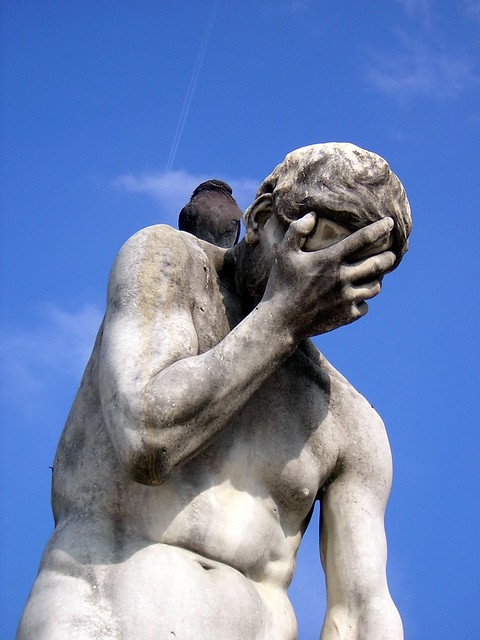
Paris and Pigeon, photo by Fabio Venni

Much has been made of the critical remarks by pigeons, dropped on the band Kings of Leon during their recent concert in St. Louis. Sharon Stiteler, The Birdchick™ speculated that the birds disapproved of the lyrics of the Kings’ hits, “Sex on Fire” and “Use Somebody.” Well, I could see it if this were a Tom Lehrer concert. After all, one of his hits was “Poisoning Pigeons in the Park.” But why would these birds hate on Kings of Leon?

Rock Pigeons, as they’re officially called, are capable of spreading disease to humans. Bob Dylan had to cancel a European tour in 1997 when he contracted histoplasmosis, probably from pigeons. They can carry other nasty diseases too, but for the most part, people with healthy immune systems have little to fear from pigeon-borne diseases. That being said, I helped some friends repair a porch where neighborhood pigeons had roosted for years, and it was pretty unpleasant.

Pigeons are not native the western hemisphere and are pretty much the Rodney Dangerfield of birds. They gather in big, messy flocks, they don’t have a beautiful song—to human ears. In fact it’s hard to believe that European settlers brought them here in the 1600s. Perhaps they were homesick for the whitewashed buildings of home. More likely they raised them for food. 

photo by Scott Beale/Laughing Squid
laughingsquid.com.
The US Army Signal Corps used pigeons to deliver messages during World War I. The most famous of these, Cher Ami, carried a message through heavy fire, saving 194 American lives. Cher Ami was awarded a silver medal from the US and the Croix de Guerre by the French. Poor Cher Ami died of wounds he received on his last mission. He is now a mounted display at the Smithsonian. During peace times, carrier pigeons have been trained to carry medications. And lest you think that carrier pigeons are so 5-minutes-ago, note that the carrier pigeon is Twitter’s mascot.

If you give pigeons a chance, they do have some good qualities. I remember a friend telling me, “I saw the most beautiful birds flying around the hospital.” When I informed her that they were pigeons, she insisted, “Oh no, they weren’t pigeons. These birds were beautiful!” And they are. 

Photo by Tony Roberts/Pickersgill Reef

Where would I be without my Flickr friends? Thanks Fabio Venni, Scott Beale, and Tony Roberts for licensing your photos through Creative Commons!

PS: I spoke with a young friend who works at the outdoor theatre where Kings of Leon cringed. She told me that the consensus among employees is that there were 3 pigeons or less above the stage. Does it seem likely that large numbers of birds would choose a well-lit, noisy stage as a roost for the night? It may be that our feathered friends are not to blame after all.

Tuesday, July 27, 2010

Way down yonder in the Pawpaw patch

Zebra Swallowtail nectars on Dogbane, photo by Joby Joseph

The only place I seen Zebra Swallowtails in numbers is at Shaw Nature Reserve in Gray Summit, Missouri, where they were doing exactly what Glassberg describes in Butterflies through Binoculars. The group flew close to the ground, and they made quite an impression with better than 3-inch wingspan and “tails” up to an inch long. In my own yard however, I usually see a single Zebra flying near the top of my pawpaw tree.

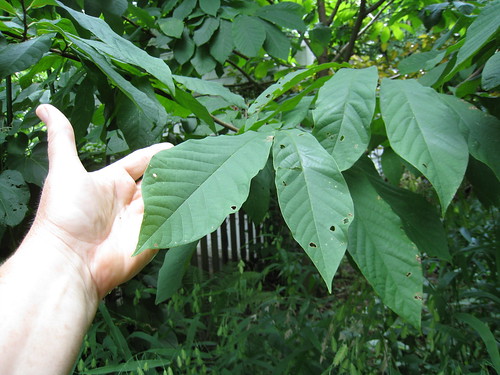
Pawpaw leaves are large and tropical looking AMcC
I got my pawpaw at the spring native plant at Shaw Nature Reserve. It took some teamwork to get it in the car. My friend Pat and her sister helped pack the tree, all the trays of plants, and me into the back seat. We rode back home with the tip of the tree peeking out the window of the car. My motivation for planting it a shady corner of the yard was Native Landscaping for Wildlife and People. Author Dave Tylka writes that pawpaw is the “only Midwest larval food for zebra swallowtail.” Like Pipevine Swallowtail and Monarch caterpillars, Zebra Swallowtail larvae chow down on a plant that other plant predators can’t abide. In an article on Beetles in the Bush, Ted MacRae mentions the alkaloids that protect the plant’s bark and seed from insects.

Besides Zebra Swallowtail caterpillars, I would dearly love to see some fruit on the tree. At the camp where I worked many summers, a grove of pawpaws grew at the base of the hill we called Sunnytop. Remembering the song—“pickin’ up pawpaws, put ’em in your pocket”—I looked for the fruit every summer. No luck. Knowing that he had grown up in rural Jefferson/Ste. Genevieve Counties near camp, I asked the property manager, Jim LaPlant, about the fruit. Jim laughed and told me that as a boy, others had called him “a Pawpaw-eatin’ Frenchman.” Exactly what that meant I don’t know. Reportedly pawpaws are messy to eat. Is that what these mean kids were talking about? Or was it because supposedly only unpopular people would eat them? Or was it just another in the long and regrettable tradition of insulting a person by referring to his ethnic food? Well, lots of folks do like pawpaws. By golly, Pawpaws have their own Flickr group. What’s more, on September 17-19 this year, Lake Snowden, Ohio, holds its 12th Annual Pawpaw Festival. They have an atalatal-throwing contest there too and you just don’t see that every day!

Photo by Beautiful Rust

To grow fruit, a tree needs a pollinator. In the case of the pawpaw, it’s not butterflies, though it is a type of fly. Being an understory tree, pawpaw blooms early, before the canopy of trees block most of the light. It’s strange maroon/brown blossoms hang off the bare limbs. The scent has been described a rotting meat or, as Don Kurz describes it in Trees of Missouri, like fermenting grapes. I’ve never noticed any scent myself, but if I did, I don’t think I’d be confused between rotting meat and rotting fruit.

Kurz also explains a bit about the scientific name, Asimina triloba. “Triloba” refers to the 3-lobed shape of the flower. “Asimina” is a Latinized version of the French rendition of an American Indian name for the tree. I didn’t find any explanation of what that American Indian word was or what it mean. I didn’t find any satisfactory explanation of the word “pawpaw” either, except that it is  also applied to papaya, a unrelated fruit tree.

Pawpaw Sphinx moth,
photo by Seabrooke Leckle

Whether or not my tree ever bears fruit, it will one day host larvae of either the Zebra Swallowtail or the Pawpaw sphinx moth, Dolba hyloeous. Seabrooke Leckle writes about this gorgeous moth and other large moths in a 2009 post in her blog, the Marvelous in Nature.

The scent is not the only confusion. California Rare Fruit Growers state that it is pollinated by  “unenthusiastic” flies & carrion beetles. James Trager mentions that the flowers a probably pollinated by fungus gnats, a type of fly that feeds on decaying plant material. Either way, the flowers are self-incompatible—that is, they need to be pollinated from an unrelated tree if the fruit is to form. I actually found an “unrelated” pawpaw about a thousand feet from my tree. I wonder how far a 1/8th of an inch-long fungus gnat can fly?


Special thanks to my Flickr friends (credited in the caption under the photos) who were kind enough to license their photos through Creative Commons.

Monday, July 26, 2010

Missing Moon Rocks

Harrison Schmitt, geologist & astronaut, on Apollo 17
On July 10, the St. Louis Post Dispatch ran a story about Missouri’s missing moon rock. In 1972, Richard Nixon gave each state and many countries a “Goodwill Moon Rock.” The gifts were handled very casually to say the least. Someone absconded with Honduras’ rock and tried to sell it to an undercover agent. He is the one that got caught. At least one of the moon rocks wound up in a former governor’s garage. Of 270 “lunar samples, ” gifted to US states and foreign governments, more than 100 are unaccounted for. For a thorough discussion of the missing moon rocks, check collectSpace. Missouri’s governor at the time of the gift was Kit Bond. Missouri is among 15 states that cannot account for the rocks. Bond says he doesn’t remember receiving the Apollo 17 rock. We Missourians have no doubt that he’s being truthful when he says he doesn’t remember it.

At the time, no one seemed to understand the value of a chunk of the moon. Most people expected that the Apollo missions would continue, and Mars would be next. There would be plenty of rocks to come. Other issues occupied the front page in the 70s, like Watergate, Star Wars, the death of Elvis, the end of Gunsmoke, and the beginning of The Love Boat. Like the space race itself, souvenirs of a trip to the moon dropped off the public’s radar.

No one cared, that is, till a Professor Gutheinz at the University of Phoenix decided to give his students a bit of investigation practice. He assigned “The Moon Rock Project,” whose purpose it is to track down all of the goodwill moon rocks. Thirty-eight years after the last eagle landed on the moon, it turns out these lunar knick-knacks are worth 5 million. Dollars! I mentioned the story to my mom, who casually replied, “Oh, your dad had a moon rock.”

Stunned silence. “Oh, yeah, Herb gave him one.” If anybody in St. Louis could get his hands on a moon rock, it would have been Herb (not his real name). “He got it from someone at McDonald’s.” That would be McDonnell-Douglas, now Boeing. “It was just pebbles. Your dad put the pebbles in an envelope and wrote something on it.”

We searched every closet and old dresser drawer we could find, but like Missouri’s goodwill tchotchke, it had vanished. I wondered what my friend Randy Korotev thought about the story. Randy is on the research faculty at Washington University and studies moon rocks for a living. He also writes the top-ranked website on lunar meteorites—meaning the moon rocks that came to earth without the help of Buzz Aldrin or Tom Hanks.

Anne: Hey Randy! Thanks for spending some time with us at GwB! Did you know anything about the “Goodwill” rocks, covered in Lucite and mounted on a plaque, before this story hit the news?

Randy: I knew that many heads of state had received them, but I didn’t know that US state governors had received them until a student involved in this project e-mailed me a year ago to ask if I knew where the one that had been given to the Missouri governor was.

Anne: Were any of the rocks you studied from museums, or did they all come directly from NASA?

Randy: I get all my samples directly from NASA’s astromaterials curation office at the Johnson Space Center. That’s the only place that one can legally acquire an Apollo sample for study.


There are lots of Apollo rocks on public display. If NASA approves the request, the curation office turns samples over to the public affairs office and those samples become unavailable for scientific study. Nearly all of the samples on display in museums and all of the give-away samples were basalts (solidified lava). Some of these samples weigh several kilograms. All of the science you need to get from a basalt you can get from 10-20 grams. So, small pieces of these samples are the ones that are used for displays and politicians. I expect all the governors received a little sample of one rock.

Anne: Does it seem likely to you that moon pebbles are languishing in forgotten desk drawers around town?

Randy: If 50 governors got samples, then yes. But, not among the scientists. Every two years I have to do a complete inventory of the samples I have. So, if you have Apollo samples, you’re reminded at least every two years.

Anne: If I were to find an envelope of “moon pebbles,” would it be possible to look at them and determine if they were from the lunar surface or a parking lot surface? Or would it take extensive testing?

Randy: The short answer is that it would take a moderately expensive test to prove it one way or the other. (I’d do it for you for $200.)


The story you tell is familiar to me. I’ve been sent samples by people who have stories like, “My late father was given this moon rock by an Air Force general in 1972,” or, “My uncle was given these sample by a NASA security guard who knew Buzz Aldrin.” The kids of the late elders now want to know if the family legend is true. I’ve been contacted 10-12 times, and the lunar sample curator says that they get calls like that all the time. 


Sometimes I can take one look and say, “This isn’t a Moon sample.” I can’t say that a rock is from the Moon rock “just by looking.” None of the ones I’ve analyzed, however, has been from the Moon. I can tell that with 100% confidence on the basis of our analytical results (chemical composition). If you gave me a real Apollo sample, I could tell you which of the 6 landing sites it came from better than 9 out of 10 times. By the way, if it was my opinion that it really was an Apollo sample, I’d inform the NASA lunar sample curator. Then, you’d probably get a visit by guys who don’t smile and wear suits with white shirts.

Anne: Missouri’s missing rock is from Apollo 17. What their anything unique about Apollo 17?

Randy: It was the last mission and the variety of rock types was probably greatest. The basalts are distinct from those of the other sites. Some of the non-basalts are unique. Those samples aren’t given away.

Anne: The American public lost interest in manned space missions. We certainly undervalued the moon rocks and space exploration in general. Do you think that the public has ever appreciated the full importance of space travel?

Randy: Some people have. Some people think it never happened. I know a lot of students who are fascinated by the recent missions to Mars and asteroids. I’ve seen an upturn in interest in students in the past ten years. The Chinese, Japanese, and Indians are taking space exploration very seriously. 
Looking for moon rocks.
Anne: If you think you've found a moon rock, lunar sample, or meteorite, Randy says read this and this. Thanks Randy!

Sunday, July 25, 2010

Pipe Dream

Pipe vine casts deep shade. AMcC


I first read about pipevines—the plants—and its relationship to Pipevines—the butterflies—from an article in American Butterflies, Summer 2001, written by Jeffrey Glassberg. American Butterflies is the quarterly journal of the North American Butterfly Association (NABA). NABA launched its “Pipe-dream Project” that year. The North American Bluebird Society (NABS) promotes nestboxes and habitat suited to bluebirds, and along with other organizations, has successfully expanded the range, increased populations and public awareness of Eastern, Western, and Mountain Bluebirds. NABA hoped to do the same for the Pipevine Swallowtail and its southern cousin, the Polydamas Swallowtail. Glassberg recommended growing the host plant, pipevine, either Dutchman’s Pipe, Aristolochia macrophylla, or a pipevine species native to your area. I had never had a Pipevine Swallowtail in my yard so I couldn’t wait to try it. Dutchman’s Pipe is native to the Eastern US, and I would have preferred to plant Missouri’s species, Wooly Dutchman’s Pipe, A. tomentosa, but I was unable to find a source at the time. I planted two Dutchman’s pipe vines on a metal arch, set in concrete. I had intended that arch for climbing roses, but that another story.

The species name, macrophylla, means “large leaf.” Many of the leaves are 6 inches wide and more than 7 inches long. They arrange themselves like shingles on a roof, casting a deep shade. When people sat outdoors to cool off in summer, folks planted it to cover the porch. Now that most of us enjoy air-conditioning in the heat, the plant is rare in suburbs and towns.

The first season the vines looked acceptable, but weak. By late summer, I had seen a few Pipevine Swallowtail adults, but no eggs or caterpillars. The next summer, I had more adults, but still no “cats.” Just before the plants’ third season, I met a woman who had grown the plant for years. She advised me to prune it to around one or two feet in the spring. I was horrified. Perhaps you’ve heard the old garden wisdom about vines, “First they sleep, then they creep, then they leap!” That summer, mine leapt. The vine covered the arch, headed down the fence, and made a grab for the gutters. I do prune my pipe vines in late winter now, and trim during the growing season if they misbehave. The plant laughs at pruners, and the butterflies seem to prefer to lay their eggs on the fresh growth.

Dutchman's Pipe bloom. Photo by Margy Terpstra ©

My plants bloom well in spring, though the flowers are small. They’re not showy, but their strange shape (like a meerschaum pipe) has an even more bizarre function. According to the Plant Diversity Website, the flower is perfumed like road kill. Fear not, gentle gardener! I have never detected this odor. A hungry fly enters the bloom and finds itself trapped in the convoluted shape. There the fly stays till it is covered with pollen and the flower matures, releasing it to play London Bridge once more.

This summer, Pipevines been particularly abundant. I can see them all day long. It took a long time for me to find the cats. Last summer I had several “hatch outs” and I learned what to look for. If you see a leaf with damage, try looking underneath it. Sometimes a dark shadow turns out to be a group of larva. For more about the caterpillars, see “Botanical Arsenic and Old Lace.” For more about the adult, see “Leaping Lepidopterists, Batman!” 
Dutchman's pipe grows on an arch. AMcC

Friday, July 23, 2010

Botanical Arsenic and Old Lace


Take a few minutes to watch this amazing time-lapse video by JCMegabyte. It covers the entire life cycle of the Pipevine Swallowtail butterfly. Video footage is courtesy of JCM Digital Imaging.

Plants have a fascinating variety of strategies to defend themselves against herbivores, including ourselves. If a species is to survive in the wild it needs thorns or spines, or armor, such as thick bark or nutshells. One of the most intriguing is the use are the poisons plants manufacture and concentrate in their leaves or seeds. Sort of like a botanical Arsenic and Old Lace

Of course, Aunts Martha and Abby used elderberry wine with cyanide, while Pipevine (Aristolochia macrophylla) leaves contain a toxin called aristolochic acid. If you were to eat enough of it, it could be fatal. This is the plant that Pipevine Swallowtails require in their larval stage. How can a small caterpillar thrive on a plant that could kill great big humans? Co-evolution my friends—eons of it. The caterpillars are able ingest the toxin without any ill effects, making both the larva and adult taste terrible. Birds and other predators learn to avoid them.
Aunt Martha: One of our gentlemen found time to say, How delicious!”


The larvae are black, with hornlike protuberances of orange or red. They also like to hang out in gangs, which is actually pretty intimidating to see if you don’t know what they are. The bright orange spots set off by blue on the adult are warning colors too. Kenn Kaufman and Jim Brocks book, Butterflies of North America, lists 6 other black butterflies of the Midwest that gain protection by mimicking the Pipevine Swallowtails coloration. The colors are effective for me too. I’ve never been tempted to eat a Pipevine Swallowtail.
Late instar of Pipevine Swallowtail caterpillar, on pipevine of course!