On June 11 and 12 I did more breeding bird surveys at Busch Memorial Conservation Area in St. Charles Co., Missouri, with my friend Kevin Renick. We didn't see the numbers of butterflies I mentioned in my previous post, but we saw and heard some great birds, including two not commonly seen: a Blue Grosbeak along the dam at Lake 37, and a brief view of a Blue-winged Warbler at the same spot.
Kevin is a singer-songwriter as well as a whiz at birding; his musical abilities extend into his nature hobby. What impressed me most this weekend was Kevin's ability to consistently tell the difference between the songs of the Scarlet Tanager and the Summer Tanager. Both birds nest here in oak-hickory forests of Missouri, and although their calls are very different, their songs are very much alike. I asked him to summarize the differences between the two songs. I'm accompanying Kevin's summary with video from the incomparable recordist of nature sounds, Lang Elliot.
Kevin's hints: "The Scarlet Tanager's song has sometimes been described as being like a 'robin with a sore throat.' It's a melodic warble, but it has a prominent screechy or raspy sound on one or two notes of its phrasing. The Summer Tanager on the other hand, is not raspy at all. It's a clear, sweet warble, a bit gentler than the Scarlet."
If you hear the bird's call—as opposed to its song—you've got it made. The Summer's call begins this video: "Picky-tucky-tuck." The Scarlet Tanager call, heard in the middle of his video, is "Chick-burrr. Chick-burrrr." David Sibley, author of The Sibley Guide to Birds, says that the Summer's song includes, "brief but distinct pauses between phrases." The Scarlet's by contrast is made up of a "fairly rapid, continuous series."
Thanks to Kevin Renick for his song analysis and to Lang Elliot for making his videos available.
Showing posts with label finch. Show all posts
Showing posts with label finch. Show all posts
Wednesday, June 15, 2011


Thursday, March 24, 2011
For a Few Bags of Gumballs
 |
| Into each life, some Sweet Gum balls must fall. AMcC |
That's too bad because Sweet Gum, Liquidamber styraciflua, is really the archetype of trees. It's a big, healthy tree, and if utility company tree-trimmers don't come after it, the Sweet Gum will grow into a perfect pyramid. It doesn't have disease problems like crabapples. It won't split up in a storm, like Bradford pears. It doesn't stain your car, sidewalk, and white siding like mulberry; doesn't stink to high heaven like a Gingko. It's not invasive; in fact, it's native to Missouri and the East all the way south to Central America. What's more, according to USDA Forest Service, it won't produce the dreaded "cukoo bir" till it's 20 years old. So, if you're planning on moving within 19 years, go ahead and plant one! If not, be advised that Trees of Missouri, by Settergren and McDermott, records a tree in Tywappity Bottom (now Scott County in southeast Missouri) that was 140 feet tall and 5 feet wide at the trunk.
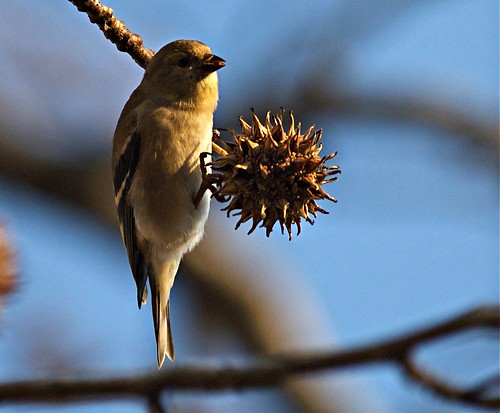 |
| Tom Davis managed to capture an image of a winter-plumaged Am. Goldfinch with a Sweet Gum seed in its beak! |
Saint James is the Sweet Gum Capital of Missouri, although even in that fair city, there seems to be some controversy about the "conkleberry."
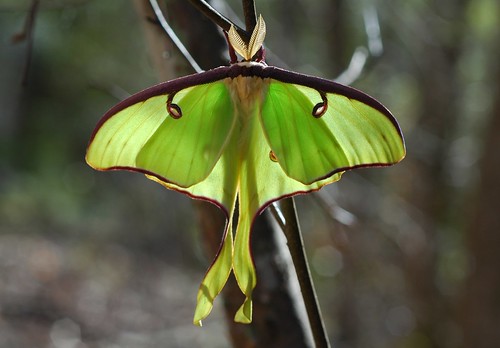 |
| Freshly emerged Luna Moth, photo by Sophro |
Sunday, February 20, 2011
The Crossley ID Guide
 |
| Cape May Warbler in The Crossley ID Guide, p. 411 alongside Birds of America, plate 95 |
You're not gonna get this book into the pocket of your birding vest—it's bigger than The Joy of Cooking. I own only one bird book that larger and heavier than The Crossley ID Guide: the reprint of the 1917 Birds of America I got for Christmas in 1965. Edited by T. Gilbert Pearson, with color plates by Louis Agassiz Fuertes, its dust jacket proclaims in all caps, "This is the perfect, permanent bird book for all ages." Did the publisher mean it was perfect for a 14-year old as well as a 41-year old? Stone Age as well as Bronze Age? Industrial as well as Digital?
Like Fuertes' published paintings in Birds of America, Richard Crossley's plates are large, showing the species shown in its typical habitat. Crossley is not a painter however, his color plates are composite photos. Numerous photos of the bird are set against a background of the typical habitat. In the foreground of the of the composition appear a few close-up photos of the bird, each in a different plumage. In many plates, the middle ground displays several images of the bird in flight. In the distance are proportionally small images of the same species. Crossely's purpose is to pack as much identification information about the species into one scene as he can; how it may appear in flight, at rest from the side, viewed from the front when feeding, in the distance where streaks seem to blend into a wash of color.
At first I found these scenes a bit like a backlot studio shot in an old movie—I was distracted by the background. The more I looked at the page however, the more the images appeared 3-dimensional. Crossley is not trying to depict field marks. He asks the reader to look over the complete image, focusing first on this bird, then that, putting those photos of variable plumages and postures into context. In Japanese films, the director often gives the audience a wider shot than we're used to with Hollywood movies; the viewer, not the director, decides what to look at within the frame. Crossley's approach is more Kurosawa than Corman.
It will take me a long time to go through this book, but I'll use one plate as an example of the role this book can play in your birding toolbox. When I first moved to Kirkwood in the 80s, I occasionally saw what I called "the mystery bird." Its wings were swept back like a gull, but the tail wasn't the right shape for a gull. Sometimes I'd see a distant bird with a leading edge so straight that it appeared to be headless. It's flight was so effortless and acrobatic, I thought it might be a falcon. All of these are shown in the tiny distance shots on page 239.
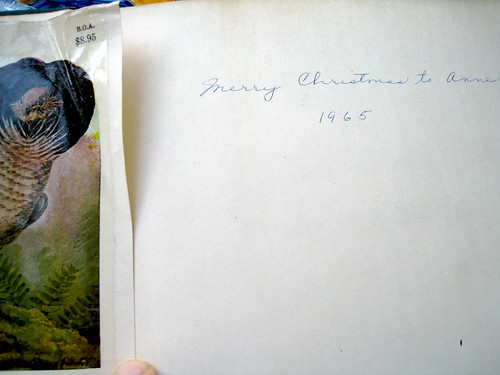 |
| Ruffed Grouse peers in from the dust jacket to read the 1965 version of an interactive comment. |
The fact that I can point you toward that page whether you own the book or not is another feature of this birding guide that Peterson and Pearson never dreamed of; it's interactive! I can try to soak it all the images on the printed page, but if I need more information, I can find it with a click on the website. The web version has labels, comments, and questions not included in the book. Of course, you can "like" it, make comments, or leave questions for the author on Facebook too. Adjusted for inflation, at $8.95, Birds of America was roughly 3 times the Amazon price of The Crossley ID Guide!
If you wrote about this book on the web and I haven't listed you below, I'd love it if you'd comment and give us the link!
10,000 Birds
The Bird Chaser and second post
Audubon Magazine
Birdzilla.com
Monarch's Nature Blog
The Bird Booker Report
Sapsucker Woods (gift shop of Cornell U)
What Bird Forum
Sunday, December 12, 2010
Pokey Hat
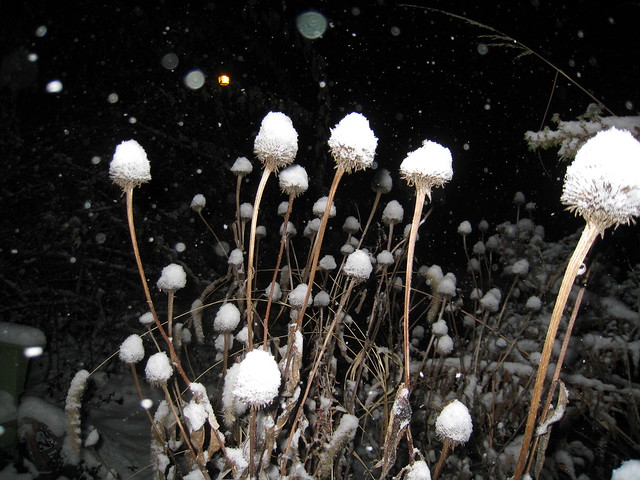 |
| Pokey hats, early on a snowy Sunday. AMcC |
Some years ago I had the opportunity to visit a state park with a friend from Scotland. Montauk State Park is a beautiful spot on the banks of the upper Current River. After a long day of watching people fish for trout, we visited the lodge. My friend stepped up to the snack bar and in a heavy Glaswegian accent ordered a “pokey hat.” It took some effort to discover that she meant an ice cream cone. Hilarious!
 |
| Cup Plant hangs on to the snow too, almost as well as it does rain water. AMcC |
I saw a pokey hat in my front yard early this morning. The prickly seedhead of Purple coneflower (Echinacea purpurea) is especially good at showing off the beautiful snow. It’s afternoon now and gusts of 40 mile-per-hour winds haven’t yet knocked the hat off.
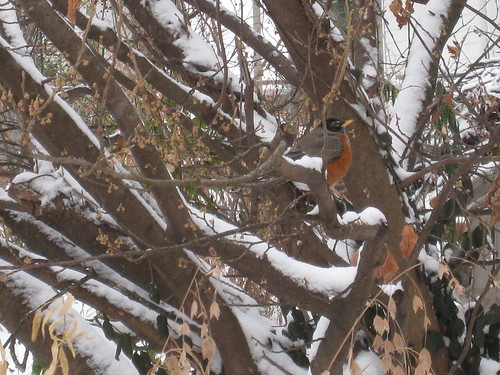 |
| Male American Robin rides the storm out in the witch hazel tree. AMcC |
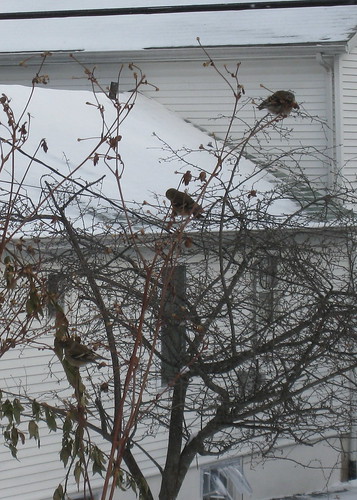 |
| Am. Goldfinches hard at work on the seeds of Prairie Dock. AMcC |
In spite of a temperature of 19° F (wind chill of 2°), Slate-colored Junco, Carolina Chickadee, Downy Woodpecker, and White-throated Sparrow are busy in the back yard. In the front, American Goldfinches tease the last seeds out of Prairie Dock seedheads (Silphium terebinthinaceum).
All this activity is missing from gardens where the owner tidies up in fall. That’s one less chore for those who garden with binoculars.
Tuesday, July 13, 2010
Are they edible?

Those pesky stinkhorns sure are conversation-starters! I’ve had several people ask if they are edible, and the answer seems to be “Yes,” and “No.” Tom Volk’s “Fungus of the Month” article says that they are, with certain cooking techniques. Another source, “Wildman” Steve Brill found them to be revolting, even when cooked in broth. The totally amazing 2006 BBC series Planet Earth had a time lapse video of a Netted Stinkhorn’s growth. I’d love to embed the video, but the embedding is disabled. Click this link, or better yet, watch Planet Earth. I came across a discussion on this topic at GardenWeb. I was glad to see at least one gardener recognized that they are harmless, interesting mushrooms. Just think of them as “fun-guy!” Thanks for all the comments and photos!
Thursday, July 8, 2010
Reincarnated Cowboys
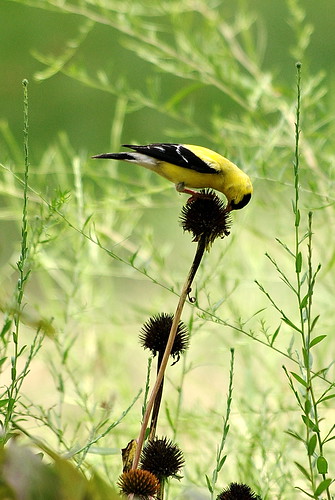 |
| Photo by Richard Skoonberg |
Hybridized garden varieties are shorter than the species—that is, less than 4 feet tall. Nurseries have developed purple coneflowers that are orange, red, or deep purple. If you like to play with scale, try ‘Little Annie,’ a new variety. It’s miniaturized—less than 10 inches, with many small flowers. I have one in a container one the front porch. Modern garden varieties hold their petals closer to horizontal, but I prefer the charming droop of the unimproved native plant.
Of course the main reason to have loads of purple coneflowers is goldfinches. Cornell doesn’t mention it in their fantastic bird website, but rodeo-riders—and perhaps the clowns too—are reincarnated as goldfinches. When the blooms are finished and most gardeners would get out the shears, that’s the time little yellow birds hop onto that bloomed-out conehead and ride, Sally, ride! My Flickr friend Richard Skoonberg captured this photo as a male goldfinch tweezes the seeds out, then flies off to feed his nestlings. American Goldfinches are one of the few species of birds that feed seeds to their young, not insects. In the process, they drop a few seeds in new areas, allowing the plant to spread. Purple coneflowers are indispensable in a wildlife garden!
Subscribe to:
Posts (Atom)