Showing posts with label compass plant. Show all posts

Thursday, June 23, 2011

Pa-RUM-pa-pum-pum

Through May and early June I occasionally heard a rapid, metallic drumming—almost a trill. "I'll bet a woodpecker is drumming on someone's aluminum siding," I thought, but I could never find the bird. On Memorial Day weekend however, I heard the sound again—very close, but where?
  
Caught in the act! See the little drummer bird, just beneath the metal cap on my chimney? It is believed that woodpeckers use drumming as a substitute for song. Woodpeckers don't have a song for claiming territory or attracting a mate like a robin or cardinal would employ. They don't need one. All a woodpecker has to do if find some resonant material—a hollow snag, or your aluminum gutter—and drill, baby, drill! David Sibley's website has a great article about drumming, complete with sonagrams and recordings of Downy and the similar-looking and similar-sounding Hairy Woodpecker.

Sibley notes some intriguing findings in the research: both male and female Downy Woodpeckers drum and at all times a year. We assume the male is trying to attract a mate with his drumming/song. Is the female doing the same? And if we hear drumming in January, is that drummer defending a territory even though it's not nesting season? My grainy photo doesn't show the red nape patch, but this was a male playing his drum for me, and the neighborhood. What is he trying to say with his 15 beats per second?

When I visited southeastern Arizona in the summer of 2000, I fascinated to see that birders decorated their yards with dried agave stalks. The stalks seemed to advertise to hummingbirds that dinner time had arrived. Fiesty little Rufous and Black-chinned hummers would perch on the stalk, survey the feeders, and dive in. I was dying to carry off one of these stalks for my own yard, but alas, it would not fit into my baggage. I cast around for a substitute, and saw the potential in a year-old Compass Plant stalk.

I wrote about Compass Plant (Silphium laciniatum) last August. It's one of my favorites. This spring I tied several Compass Plant stalks to my fence. Investigating the stalk this morning, I saw not a hummingbird, but a young female Downy Woodpecker. 
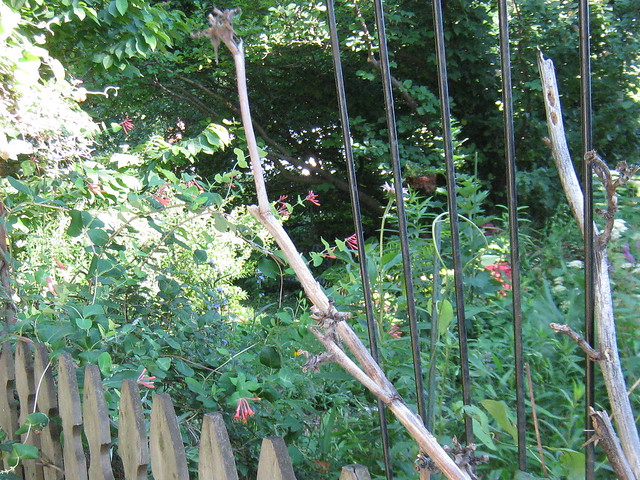
She drilled into the stems and pulled out something that was black. You can see tiny drill holes near the top of the right stalk. Even tinier ones are barely visible in the left stalk, just below the center of the photos. According to John Hilty's website, Illinois Wildflowers, inside the dried stem could have been the larva of the Tumbling Flower Beetle. What a great name! Check out MOBugs' post on this insect, with great photos.

Wednesday, August 11, 2010

A Compass on the Lone Prairie

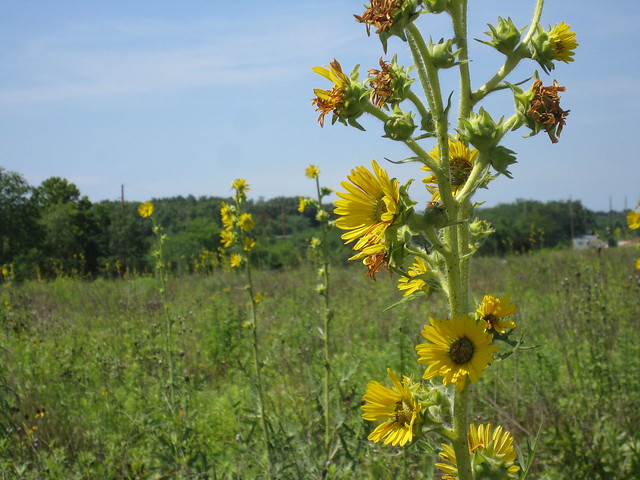
Compass Plant blooms at Howell Prairie, St. Charles Co., MO AMcC

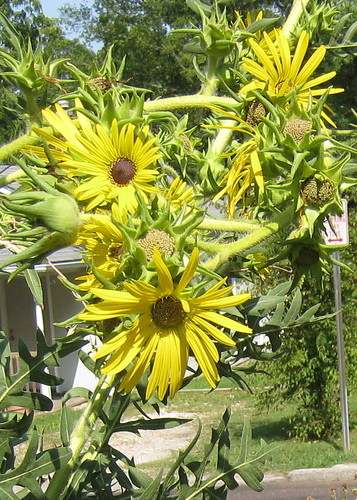
My first reason for wanting to find Compass plant for my yard is the tale that it can be used as a compass. Now that my plants are large, I can say that the tale is true—mostly. Compass plant (Silphium laciniatum) is a plant of tall grass prairies and glades and everything about it shows is adaptated to dry conditions with blazing sun. Leaves and stem are hispid, as the botanists say; or covered with “little tiny hairs,” as Jonathan Winters would say. The stiff white hairs reflect light, effectively protecting the plant’s tissues against the sun.

Presumably, they also discourage deer and antelope from snacking on it as they play on the range. Instead of large, light-gathering leaves on a tropical philodendron, Compass plant’s leaves are large but deeply cut, reducing the surface area. Merv Wallace at Missouri Wildflowers Nursery says they look like “green flames.” The plant’s best trick is to move those leaves around during the day so that they face east and west, presenting only a narrow edge to the scorching south. Now the leaf points north, hence, the name. Of course, if the plant is shaded by something, the leaves may face any direction, so navigators beware!

Leaves point north AMcC
I wonder what the first Europeans thought of Compass plant when they first explored the tall grass prairies of the Midwest. It towers up to 8 feet, with a tough, thick stem, topped with 2 to 3 inch sunny flowers. Many sources mention that the Indians used the resin in the top part of the stem for chewing gum. The Pawnee used the dried root as a medicine, given in tea. I don’t envy the job the Pawnee women had, trying to dig the huge taproot in dry soil, using only a sharpened stick.

In Ozark Wildflowers, Kurz tells us that the Omaha and Ponca believed the plant attracted lightning and would not camp near it. It makes sense if you image mile after mile of treeless, tall grass prairie. Compass plant could very well be the tallest structure out there. Tall things can be at a premium for birds on the prairie. Meadowlarks and sparrows need to make their presence known so they can defend territory and find a mate, and Compass plant stalks are just the ticket. On a birding trip to southeast Arizona, I noticed that some of the Arizona birders tied Agave stalks to their fences, providing an attractive perch for hummers. I couldn’t get an Agave stalk into my carry-on, so I use last season’s Compass plant stalk for my hummers.

If you grow Compass plant, remember that it takes a few years for it to bloom, growing from seed. Once your plant sends up its tall stalk from the leaves at the base, stake it at least by June, with a heavy stake, driven in deeply. Out on the prairie it wouldn’t matter if a few stalks fell over in a storm, there would still be many of them blooming. But we gardeners don’t have that kind of space. Horizontal blooms don’t really impress in the garden.

Compass Plant blooming in August AMcC
Several insects depend soley or partly on Compass plant: the Silphium beetle, Rynchites sp. and the prairie cicada, Okanagana balli, which the Illinois Dept of Natural Resources calls, “the rarest large insect in Illinois.” Studies on this insect in Kansas found that although it occurs on remnant native prairies, it has never been found on a restored prairie. I was unable to find out if the prairie cicada occurs in my home state, Missouri.

Cattle and horses do eat Compass plant, according to the USDA Natural Resources Conservation Service. I like to look out at my plants and imagine buffalo grazing on Compass plant. The buffalo wouldn’t stay long in my yard—I only have two plants. I bet the plants would grow back though. Dr. John Hilty’s website says that Compass plant can live for 100 years!