Showing posts with label hummingbird. Show all posts

Sunday, November 20, 2011

The Very Very Late Ruby-throat

I
I strolled around the turrets of Hogwarts Castle, enjoying the sweeping views of tropical foliage. From the ravine below, a hummingbird came into view. It was large--something along the lines of a Violet Sabrewing. I reached out and held the bird. It seemed to be in some kind of transitional plumage: purple, mixed with buff and green. Then I was startled by sounds of an uproar coming from Hogwarts. A group of boys rode some kind of magical escalator, screaming with laughter. The bird vanished. Beautiful singing of pygmies (or Solomon Islanders) woke me. That's because my alarm plays CDs; this morning, it's Deep Forest's controversial 1993 album, Deep Forest.


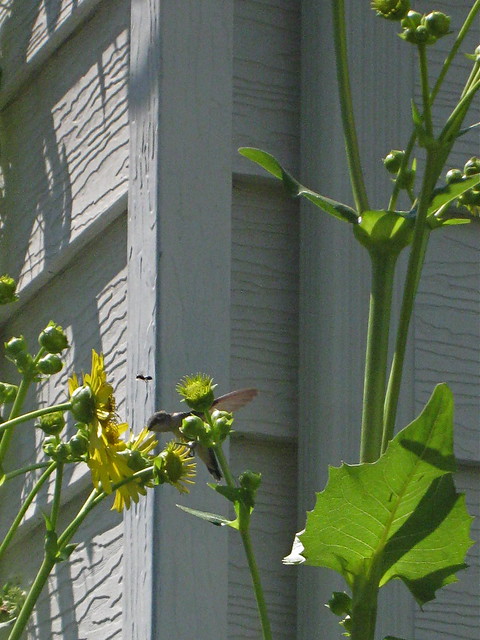
Wondering what I had eaten the night before to produce such a vivid dream, I finished up my morning chores and headed to work without a moment to spare. As I headed for the gate Tuesday, Nov.15, an unmistakable silhouette  popped up into the sweet gum tree--a hummingbird! I ran back to the house for my binoculars. Like my dream bird, the hummer had vanished and I headed for work.


I posted my report of the hummingbird on MObirds, the listserve of the Audubon Society of Missouri. I also contacted my friends Lanny Chambers and Margy Terpstra. Margy lives nearby. She and her husband are wild bird photographers. They have a wealth of subjects in their beautiful, wildlife-friendly yard. Lanny is a hummingbird bander who has visited my yard many times chasing fall hummers. He also holds the record for the only Allen's Hummingbird in the state--banded in his own yard!

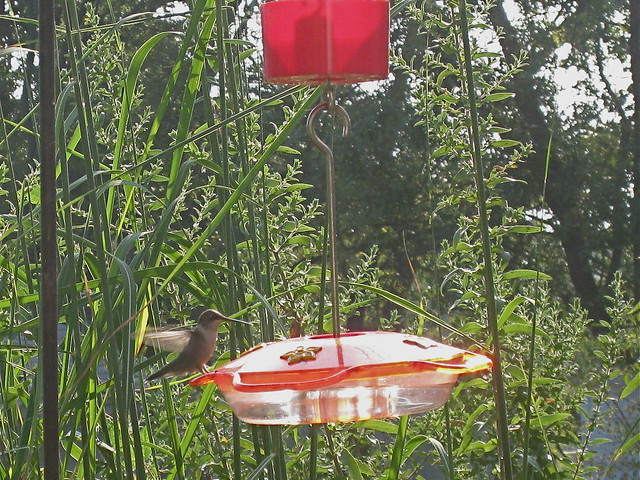
I didn't return up till after dark on Tuesday. Wednesday morning the temperature on my back porch was 33 ° F. The bird bath had a skin of ice, but I caught a brief view of a dark bird at the nectar feeder. Surely this is some rare stray! Wed. evening that I saw the bird again, and was shocked to see that it looked exactly like a male Ruby-throated Hummingbird! Ruby-throats are the only hummer normally present in our area, but they should be gone by October 10 or so. Males migrate earlier than females and juveniles. I don't remember ever seeing one after mid-September.

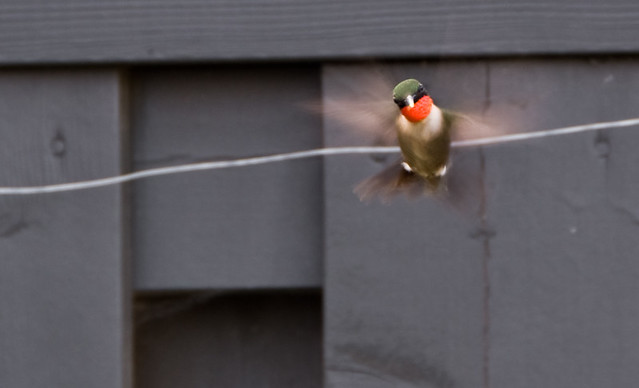
I didn't get to study the bird long before the light was gone. That's when I checked my email to find Margy's wonderful photos of Lanny examining the bird in hand. It was indeed a male Ruby-throat. It may not be the latest Ruby-throat ever, but it's likely to be the latest confirmed record. As you can see in the photos, he is a worn individual. His weight was good however, and Lanny saw no reason that the bird would have trouble migrating to his winter home in southern Mexico or even Panama.


I spotted the bird again Thursday and Friday mornings and evenings, still visiting the last of my Big blue sage (Salvia guaranitica) and Mexican bush sage (S. leucantha). The sages and the bird had weathered near-freezing temperatures for 3 nights. Saturday we warmed up to 60°, but I didn't see the bird. Let's hope that soon he'll be rubbing shoulders with Violet Sabrewings. Thanks to Margy Terpstra for the use of her photos and to Lanny Chambers for enabling us to play a role in the study of hummingbird migration.

You might also like these posts:

Mexican Sage is a Hummer Magnet
 
Hole in One!
Rootin' Tootin' Rufous

Sunday, August 21, 2011

A Bird Bath for Hummingbirds

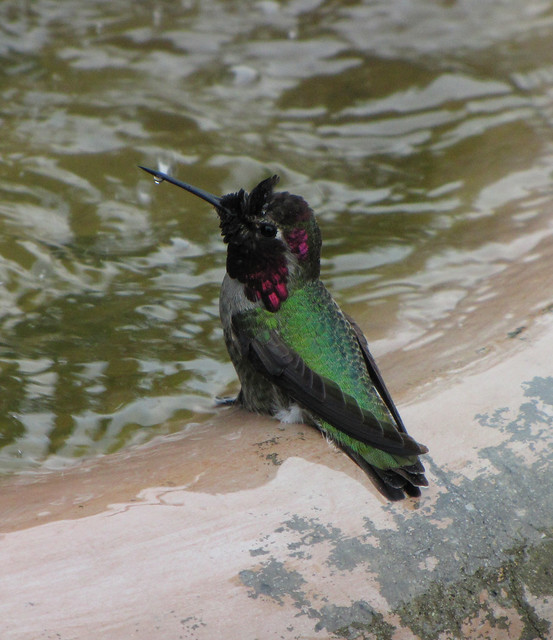
Anna's Hummingbird photo by randomtruth
On a particularly anxious day some years ago, I glanced out the kitchen window, looking at the viburnum leaves, covered with with rain drops. Movement caught my eye—a hummingbird, diving chest first into the droplets, flailing her wings and splashing around in the microliters of water on the leaf. Because I'm a human and humans always look for meaning—especially when they're really stressed—I read a message in this brief, extraordinary scene: "Things will work out fine." And they did.

Hummers get plenty of liquid as they lap up nectar from a trumpet creeper bloom or from your feeder, so they don't need to drink from a bird bath as a Mourning Dove or Cedar Waxwing might. However hummingbird banders tell me that the feathers are often sticky with nectar, both natural and artificial, so they do need to bathe to keep their feathers in top condition. Hummers can bathe in a rain shower, or you can try to attract them with water by…
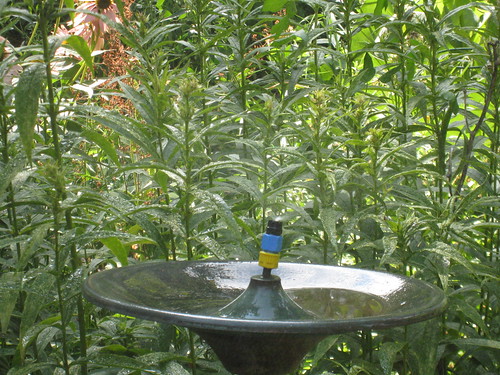
Providing a mist fountain. I use a connector with shut-off valves so I can have two hose lines. 
After I finish watering the container plants, I completely shut off the water. Then I open the valve on the line that leads to the mister. 
This little device will run a long time on the residual water pressure within the hose. 

An easier method is to hose down some large leaves. 

I hope you have a chance to see a hummer take a "leaf bath." If you do, and I'd love to see your photo!

For those of you keeping track, here in the Midwest, Anna's Hummingbird, seen in the photo above, is not one of our normal birds. In fact, there are only 5 records for the state of Missouri, most recently in 1997—the only record in my area. Thanks, Josh Uffman, for compiling, organizing, and sharing the state records. 

The charming photo of an adult male Anna's is by randomtruth, and I'd like to thank him for sharing his photo with a Creative Commons license. Be sure to check out his blog, The Nature of a Man. He wrote a terrific post about Anna's Hummingbird: California Christmas Ornaments.

Saturday, August 13, 2011

Juice from a Thousand Flowers

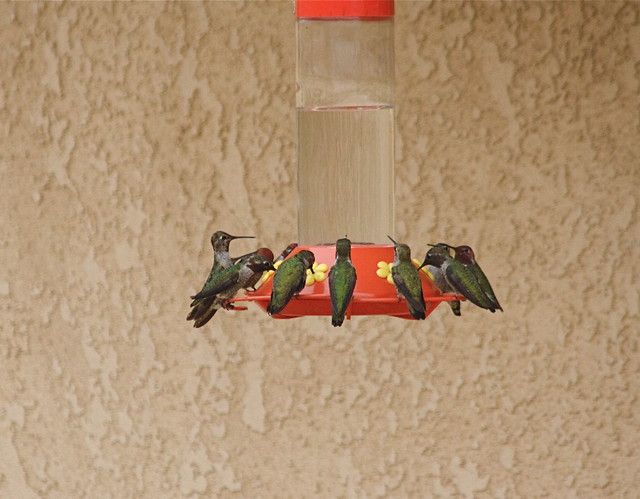
So many hummers! This is my goal! Thanks to Teddy Llovet for the photo.
If you want to attract hummingbirds to your yard, keep in mind that hummers may need up to 1,000 blooms a day. As I mentioned in my previous post, those of use who live in the city or suburbs are going to need nectar feeders! How do I go about filling my hummingbird feeders? Well, I'm glad you asked:
2 cups hot tap water
1/2 cup sugar
That's really all there is to it, but I do have some refinements.

Now that I'm filling so many feeders, I mix up 6 cups at a time and store it in a juice pitcher in the fridge. I've read that it may be better for the birds to use sugar made from cane, not sugar made from beets, so I look for "cane sugar" on the package. Other than that, I buy what's on sale.


I use a jar funnel on the pitcher when I throw in the sugar. It reduces the mess a bit. Look for this type of funnel with the canning supplies in summer and fall. I put the lid on the pitcher and shake.
Some feeders have a built-in "ant moat." Not this one.
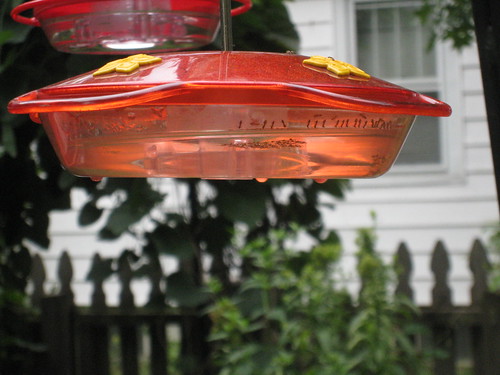
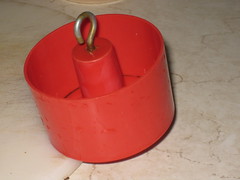
Do you find rafts of ants floating in your nectar feeder? You need an "ant moat." Ants follow a path down the wire/hook/hanger into the nectar, but they can't swim across a water barrier. Look for a feeder that has a "built-in ant moat" that you fill with plain water, or buy a separate moat.
Stand-alone "ant moat." Just fill with water.
Another cool thing about an ant moat with water is that it serves as a bird bath for small birds. I advise against using something called an "ant barrier." Usually it contains chemicals to deter the ants.

Some fallacies about hummingbird nectar:
Not true: You have to boil the water.
If your tap water is safe for you to drink, it will be safe enough for the birds.

Not true: Use commercial nectar, which is red.
Natural nectar is never red, although the flower may be. Don't add artificial dyes to a hummingbird's diet needlessly. Just get a red feeder.

Not true: Honey is more natural than sugar.
Hummingbirds do not raid bee hives. They drink the nectar produced directly by plants. That nectar is sucrose, as is table sugar. Honey is a different type of sugar; mostly glucose and fructose. Even worse, honey can cause harm to the birds as it ferments.

Not true: You should train your hummers to use a more dilute solution by gradually decrease the amount of sugar.
First of all, you can't train "your hummers." Hummingbird banders tell me that most birds stay only a few days in an area before moving on.
This fallacy is based on the assumption that more sugar is bad for the bird. But most hummingbird-pollinated flowers have a 20% solution in their nectar, though some, like trumpet creeper (Campsis radicans) have up to 34%! See the Louisiana Ornithological Society's Newsletter, March 2003, "Sugar Content of Hummingbird Plants in Louisiana Gardens," by Dennis Demcheck here.
For a more thorough discussion of the proper concentration of sugar in a nectar feeder, check this discussion from the HumNet listserve.
  
PS: I received a comment through Facebook from Sheri Williamson, co-director and founder of Southeastern Arizona Bird Observatory. She suggested using cold tap water, since hot water may contain lead. The only reason I used hot water was to speed up the mixing of the sugar solution, so I can easily switch to cold water. 

You might also enjoy:
               
They'd Rather Fight Than Switch

Mexican Sage is a Hummer Magnet

Tuesday, August 9, 2011

A Rabble of Ruby-throats?


I love my hummingbird plants, but when I read that hummers may need up to 1,000 blooms a day, I knew I was going to need feeders! A little more investigation into hummingbird calorie requirements at Hummingbirds.net is really instructive—and a bit overwhelming for a gardener.

I recently came across the blog of Susan and Richard Day, Daybreak Blog. Susan is one of the authors of a favorite book, The Wildlife Gardener's Guide to Hummingbirds and Songbirds From the Tropics (Collins, 2003) and Richard is a photographer and leader of photo workshops. A few years ago, I had a chance to tour their property in central Illinois with the St. Louis Chapter of the North American Butterfly Association (NABA). We were really inspired by their work to create and improve wildlife habitat on their farm. I asked Susan many questions about her hummingbird and butterfly gardens and I was glad to see her recent post about "Hummingbird Wars."

I was surprised to though that she was talking not about flowers, but feeders. I have lots of hummingbird-attracting plants—also known as "humplants"—and two feeders, one in the front and one on the kitchen window. As I mentioned in a recent post, Susan Day interviewed Bob Sargent, well-known hummingbird bander and the found of the Hummer/Bird Study Group. His suggestion to those who would like to attract more hummingbirds and solve the problem of one bird guarding a feeder or driving other hummers away from your Cardinal Flower patch is simple: Add more feeders! Susan add 10 more.

I added 5. Naturally, I expected a rambunctious rabble of Ruby-throats the next morning.


Actually, I'm slightly more patient than that. I've had the extra feeders up for two days. So far I think that my feeder collection has made it more fun to watch the hummers because they're so easy to find. I've seen as many as 3 at a time—not unusual in my yard at this time of year even before adding feeders. When I see more than birds sharing a feeder at the nectar station, I'll feel that my experiment has succeeded. More hummingbird posts to come!

Rootin' Tootin' Rufous                

You might also enjoy these posts:
                    
Hole in One!
Golden Currant & Friends

Wednesday, August 3, 2011

What is she doing?


As my garden renovation proceeds, I removed a Sweet Autumn Clematis (Clematis terniflora) from one of my witch hazel trees. Nasty work in this heat, but I'm finally getting serious about removing the invasive alien plants in my yard. Sweet Autumn Clematis has just about engulfed the Sugar Creek area of Kirkwood, Missouri, but I think I'll make that the subject of a later post. Just as I stretched out atop the ladder to remove that last bit of vine shading my puny little witch hazel, I had a moment of panic. A hummingbird—a female-plumaged Ruby-throated Hummingbird—frantically bounced around the tip of a top branch. Had I accidently destroyed her nest?

I've never had a hummingbird nest in my yard, in spite of the fact that I've done as much as I can to attract them to my garden, including mounting Dan True's "Hummingbird House." Also, it's pretty late in summer for a hummingbird to have an active nest. I searched, but found no evidence of a nest among the piles of vines below. So what was she doing?

I took these photo on July 17, just as my Cup Plants (Silphium perfoliatum) were beginning to bloom. Is this female Ruby-throat getting nectar from the bloom, as butterflies do? 


She certainly seems to be. Daisy-like composite blooms aren't described as hummingbird flowers in the books. Like the Pipevine Swallowtail butterflies that visit my Royal Catchfly, hummingbirds don't read the books.

Or are there some insects within the bloom that she's lapping up? I remember reading Bob Sargent's quote on Hummingbirds.net: "Hummers need nectar to power the bug-eating machine that they are." Bob Sargent is a well-known hummingbird bander and author. He was interviewed on Richard and Susan Day's Daybreak Blog.

Since I spotted the hummer  at my witch hazel, I've seen others busy at things that make no sense to me. I noticed one bobbing up and down on the tips of a cedar tree (Juniperus virginiana) where I don't think there can be any nectar.

Hummingbirds use a display flight to attract a mate or drive out an intruder, but these displays typically cover more than ten feet of vertical air space. The movement I described covered only a few inches.

I assume hummingbirds don't have energy to waste, so their activity must have some purpose. I wonder what it was…
You might also enjoy:
Royal Catchfly 
Hole in One
Golden Currant
  

Tuesday, April 19, 2011

Red Hot Sally Rides Again!

Josey—my long-haired dachshund—and I stepped out the backyard at dusk this evening, just ahead of a huge storm. I bought a few salvias that were already in full bloom, and I wanted to be sure that the predicted hail didn't grind their bones to make its bread. I'm not really very fond of Salvia splendens and its varieties ('Red Hot Poker,' Red Hot Sally,' etc.) Actually, I probably would love it except that I've seen it too often at gas stations and convenience stores. This plant reminds me of a song that I liked till they french-fried it on the radio a million times a day. Please nominate your own "song that gets too much airtime" in comments below. Or plant.

I always get a few quart or two-quart sized containers of red salvia because hummingbirds love them and  there's not much else in bloom for early birds. Lanny Chambers at Hummingbirds.net recommends surveyor's tape fluttering from your feeders to bring in the hummers (see my review of his site).  I prefer 'Sally.'

Back to nature. Josey and I were out in the back, protecting the Salvias, as I said, when I spotted a large insect in flight. The twilight and impending storm made it impossible to see much detail and for once, I hadn't brought my binoculars with me. Yet it seemed too early for an insect this large to be flying through the yard. Then I saw its silhouette pitch up, in a very non-insect-like flight, and drop onto a twig. My first hummingbird of 2011!

Thanks to *~Dawn~* for licensing her fascinating photo with Creative Commons!

Wednesday, March 9, 2011

Hole in One!

Whoopee! Rufous Hummingbird photo by Rick Leche


If your yard has hummingbirds, you've got more action than Smokey and the Bandit! More mischief than a barrel full of cairn terriers! Hummingbirds tear around the feeders like Steve McQueen in a green Mustang fastback! That's why many of us are counting the days till the little winged hellions return.

Which brings me to today's "Website Wednesday": hummingbird bander Lanny Chambers' web-site, Hummingbirds.net. Every time I write about hummingbirds, I have to give credit to Lanny. When I posted about the recapture of a Rufous Hummingbird with a record-breaking migration,  he told me, “This spectacular recapture is like a blind golfer making a hole-in-one on a million-yard hole! I've banded about 2500 hummers in 10 years. Exactly two have been recaptured elsewhere.” 

Over the years that I've known him, he's given me plenty of information about nectar feeders, which he makes available on the site. He explains why the structure of the feeder is important, as I mentioned in my post about feeders last August. He's given us information about hummingbird babies, and their look-alike neighbors, the hummingbird moths. For my post "They'd Rather Fight than Switch," Lanny told me about Dennis Demcheck's article, “Sugar Content of Hummingbird Plants in Louisiana Gardens.” Demcheck used a refractometer to measure the concentration of sugar in the nectar of blossoms in his garden—information used by many a hummingbird gardener to improve the crop!

Lanny's site was featured by the Librarians' Internet Index—now the Internet Public Library. The popular education website Journey North: A Global Study of Wildlife Migration and Seasonal Change asked him to write their Frequently Asked Questions page. He's a frequent contributor to the HumNet forum. His website includes information you'll have a hard time finding anywhere else, but my favorite page is the migration map. I check it often to see how close Ruby-throated Hummingbirds are to me. I always try to be the first in my area to report one to Lanny, but no luck so far. Last year, 4,122 people sent him a "first of the year" hummingbird report! 

Type "hummingbirds" into the Google search box and see what comes up first out of 3.25 million results. Go on—I dare you!

Monday, October 4, 2010

Mexican Sage is A Hummer Magnet

Adult male Allen's Hummingbird on Salvia leucantha. Photo by tdlucas5000


I lied. I had to. I told work I’d be late because of a doctor’s appointment. I wanted be there early, but at 7:45 AM I was already part of the crowd. No, I’m not talking about Black Friday at Wal-Mart, but the St. Louis Community College-Meramec Horticulture Club Spring Plant Sale! Wandering through the packed tables that bright spring day in ’99, I spotted a scrawny, Charlie-Brown-Christmas-tree sort of a plant. It was labeled “Salvia leucantha, Mexican Sage”—no other information given.
      I’d been thinking about devoting a section of my garden to hummingbirds, especially after the visit of a western wanderer, a Selasphorus hummingbird the previous November. (My stray hummer was probably a Rufous Hummingbird, but it could have been an Allen's—they're both in the genus Selasphorus.) Any Salvia is worth trying, especially if it claims to come from Mexico. I bought two of the puny things; $3 each.
      Guessing that the plants would not be hardy, I put them in containers. During the long, hot summer that followed the plants grew—and grew. By July they were almost 5 feet tall and 3 feet wide, narrow-leaved and wild looking. The stems were covered with white, powdery down, but nary a bloom had bloomed. By late August I considered pitching them into the compost. Six bucks down the drain.
      Then in September—buds! Hummers fought over the still-closed, deep blue buds. By the time the Broad-winged Hawks were migrating, each denim-colored calyx had a white tube projecting from it. The hummers showed their delight by beating up on each other constantly.
      In early October another Selasphorus hummingbird arrived and chased away the Ruby-throats. Around Halloween I had to cover the plants to protect them from frost, but the temperatures recovered and they bloomed till almost December. She dined on Mexican and Pineapple Sage for the next 7 weeks, to the delight of many birders. She didn't even mind being captured, identified as an adult female Rufous who already had a band!
Mexican bush sage blooms when days get short. AMcC
      Such a fabulous plant—why had I never heard of it before? And why was Meramec the only place in town that carried it? Since then I’ve spied it here and there. Salvia leucantha showed up twice on PBS’s The Victory Garden. When that best-of-garden-TV shows visited Cape Town, South Africa, Adrian Bloom commented on a bed of them. The gardener replied, “Oh, yes. That’s one of the old Salvias.” (An old-fashioned flower? An old planting in his garden? I don’t know.) In another episode, the camera lingered over a terrace filled with them in Provence, France. A photo of Mexican sage graced the cover of Fine Gardening, in October, 2002. I spotted it in the Canon color printer commercial, with the pair of Anna’s Hummingbirds. The plant even appeared on the Clairol Herbal Essences Conditioner bottle—the one for “Normal to Oily Hair.”
      It’s easier to find Salvia leucantha in local garden centers now, but I usually find it in the herb section with the kitchen sage. I don’t know of any culinary use. I suspect they just don’t know where else to put it.
      The culture is not difficult. Mexican sage—also known as Mexican bush sage—can tolerate drought and poor soil. It’s great in containers, but grows larger in the ground. Presumably it’s adapted to sharp drainage in its Mexican home. It’s built for scorching sun, judging by the narrow leaves and reflective coating on the stems. I have had plants do very well in part-sun however.
      It doesn’t bloom till the days are short. Does the plant do so to minimize exposure to the sun? Is it related late summer rains in the Sonoran desert? Or is it trying to match its blooming period with the southward migration of its preferred pollinator, hummingbirds?
      My plants in loose garden soil did better than the ones in compacted clay, but they all survived—till the temperatures dipped below 29°. Poor little plants. Never saw it coming. While native plants formed seeds and went dormant, they bloomed and put on fresh, tender growth till the frost hammered them to the ground. Mexican sage’s hardiness is rated at Zone 7. We’re two zones north of that in Zone 5. The stems are brittle and can be easily snapped when planting. The pieces root just as easily however, and that’s the best way to save some for next season.
      Some gardeners have told me they wouldn’t devote space to a plant that won’t bloom till gardening season is over. Few plants can give this punch of color for so many weeks though, attracting feisty little birds, sometimes rare ones. I’ve grown it every year since ’99. Mexican bush sage sure beats the heck out of fall mums. Give it a try!
Thanks to my Flickr friend tdlucas5000 for the terrific photo of the Allen's Hummingbird guarding his patch of Mexican bush sage. 

Sunday, September 26, 2010

They'd Rather Fight than Switch!

Hummingbird throwdown! Photo by Amyn Kassam

Here’s what we love about hummingbirds: They have that vertical posture, they make eye contact, they love sweets, and of course, they fight. They’re so human!


Watching hummingbirds is not like watching other wildlife. Hummers get up close and personal. Laura Erickson, in her 2006 book, 101 Ways to Help Birds, tells us about hummers that tap on her window when they want her attention. I watched a hummingbird pirouette around a friend wearing a coral-colored shirt, even though he was surrounded by a crowd partying on a small deck.  Hummers have come within inches of my face to catch the spray as I water my plants.


My neighbor recently told me about two hummers that clashed and then crashed, knocking each other to the ground right in front of his basset hound. Both recovered and flew off before the dog could get over her surprise and devour them. Last summer, a skirmishing hummer clobbered my brother-in-law in the head!


The level of aggression in hummingbirds is a mystery to me. Isn’t fighting over resources a waste of valuable foraging and feeding time? In her 2000 book, Attracting and Feeding Hummingbirds, Sheri Williamson points out that plants must be frugal with the nectar they produce. Nectar is of no use to the plant directly. It’s sole purpose is to pull in pollinators, so once a blossom has been pollinated, it ceases to produce nectar. Since plants are so stingy, hummers adopt a strategy of claiming a  territory and protecting their resource ferociously. According to Williamson, “Territories are smaller where flowers are abundant, larger where they are scarce (14).” I can see the evolutionary advantage of resource guarding, but I’m not sure why it seems so much stronger in hummers than—say—woodpeckers.


Like grizzly bears and bull elephants, hummingbirds use “mock charges” to panic their rival into flight, while minimizing the risk of injury to themselves. Adult males can flash their color throat feathers (the gorget) to intimidate from a distance. Females and juvenile bird display the white tips of the outer tail feathers for the same purpose, as you see in the photo above by my Flickr friend, Amyn Kassam. Hummingbirds can scold predators and interlopers with chirping sounds, and some can startle  with buzzing sounds produced by tail or wing feathers. There are times however when, like Taryton smokers, hummingbirds would rather fight than switch.


Some of my readers know that I worked at a youth camp in the Ozarks for many summers. Trumpet creepers (Campsis radicans) brought in birds by the dozen. Like Snoopy and the Red Baron, hummers battled around the camp office from sun up till sundown. Once, a staff member was actually injured in a hummingbird fight. As she crossed the parking lot, two hummers collided in front of her and a dislodged feather hit her in the eye!

Trumpet Creeper is a hummingbird magnet! Photo by AMcCormack

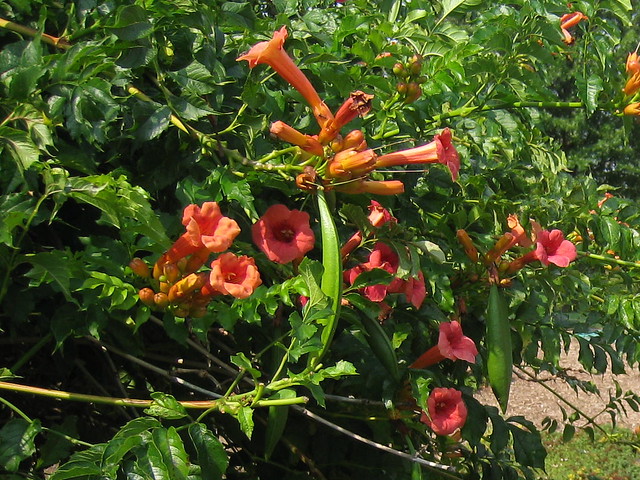
Trumpet creeper is a hummingbird magnet for a reason. In a 2003 article in LOS News, the newsletter of the Louisiana Ornithological Society, Dennis Demcheck wrote about the “Sugar Content of Hummingbird Plants in Louisiana Gardens.” Demcheck used a refractometer to measure the concentration of sugar in the nectar of blossoms in his garden—the same equipment used by wine makers. He found that, among wild/native plants, the trumpet creeper had the highest concentration of sugar at 34.3%, with each bloom producing a large volume of nectar. To reach that nectar, the bird must actually climb inside the 3-inch long bloom. It’s quite a risk for a bird to limit its vision like that, but obviously worth it.

If you’re thinking about adding trumpet creeper to your home garden, linger on this blog a little longer. Trumpet creeper is a big plant; every bit as aggressive as the hummers that love it. The main stem can be wider than your hand and all those branches in summer are heavy as they lie on the roof of your garage or branches of your prized specimen tree. Maybe you can persuade your neighbor to grow it.

Tuesday, September 14, 2010

Baby Hummingbirds


Hummingbird Clearwing moth Photo by Joe Holmes

Being a birder, I usually remember vividly where I was when a see a new bird for the first time, but seeing a new insect doesn’t usually stand out as well for me. Not so the hummingbird moth! I remember bright sunshine as I climbed up a small rise to a gravel road. There in the roadside wildflowers was the most bizarre sight. It behaved like be a hummingbird, but it was too small. It didn’t have the right attitude either. Hummingbirds often stand up vertically as they zip in and out of flowers. This creature was definitely visiting flowers, but it didn’t hold itself vertically. The wings weren’t right either. They were almost visible; hummingbird wings seem to disappear at times as they zoom past. Then the little creature disappeared.

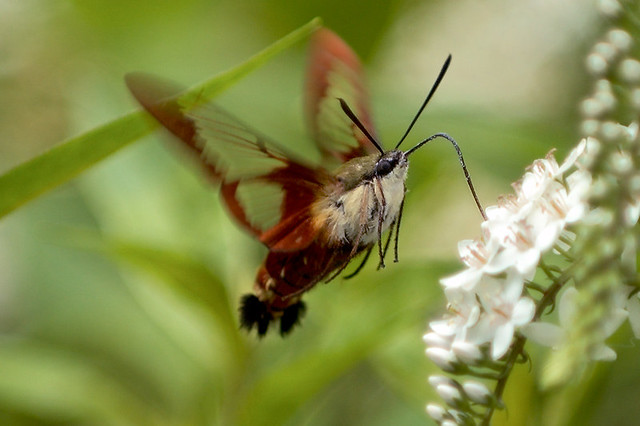
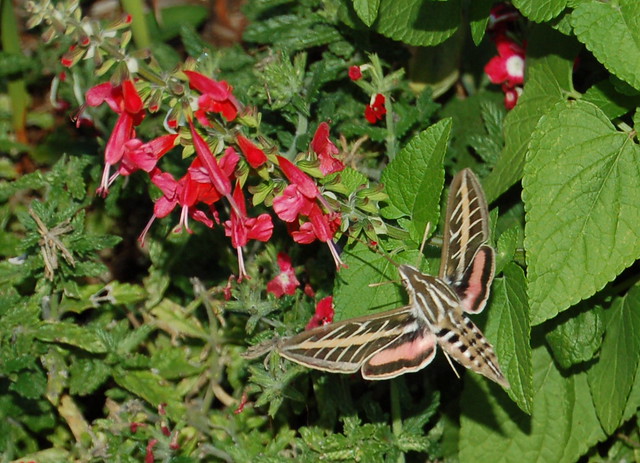
It took some time to discover that my little mystery critter was a sphinx moth. Day-flying moths, the sphinx family feed on flower nectar. Some, like the Hummingbird Clearwing Moth, mimic the markings of bumblebees to discourage predators. They may look like bumblebees, but they behave like hummingbirds, using a proboscis instead of a long tongue to lap up the nectar of blossoms.

Their flight is faster and more direct than most moths—like a hummingbird, but not as fast by my reckoning. Like hummingbirds and bees, they are pollinators. According to David Wagner (Caterpillars of Eastern North America) the female Hummingbird Clearwing moth lays eggs on viburnum or honeysuckle and the bright green caterpillars thrive, growing to 2 inches. I haven’t found the caterpillars in my yard, though I grow both of these. I see the adults sometimes, so I’ll be on the lookout.

The Hummingbird Clearwing’s scientific name is Hemaris thysbe. According to the Bug Guide, the specific name of Thysbe was chosen because of the blood red color of the wing edges and tail of the moth. You would probably have to have a played a part in Shakespeare’s Midsummer Night’s Dream to remember that Thysbe’s veil was found by her lover Pyramus, blood-stained after a lion mouthed it. Poor Pyramus jumps to the conclusion that his darling is deceased and kills himself. I know it doesn’t sound funny, but it’s hysterical in the play. I prefer to believe that this moth was named for the comic reaction it provokes, rather than it’s rusty color.

White-lined Sphinx moth Photo by Katrina Wiese
When people find that I’m interested in hummingbirds, they sometimes say, “Oh, yes, we had baby hummingbirds in our garden this summer.” However, my friend Lanny Chambers, a hummingbird bander, tells me that except for very minor differences, juvenile hummers are the same size as adults. A very small “hummingbird” is most likely a moth. Check out this fun website dedicated to hummingbird moths.

Hummingbirds are notoriously territorial. It seems they would rather fight with other hummers than eat. Hummers will chase away other birds, even those many times their size. I once watched a Rufous Hummingbird chase a Blue Jay down the block! Yet this same bird tolerated a Hummingbird Clearwing moth that was nectaring alongside it. Apparently it did not recognize the moth as a competitor.

Sunday, August 29, 2010

Attracting Hummers

Adult male Ruby-throated hummer flashes his gorget at the camera. Photo by kmaraj


Everyone has a hummingbird story—everyone who’s ever seen one that is. I took it for granted that everyone had seen a hummingbird, but a few years ago, I dragged a neighbor over to my yard to look at an unusual hummer. She was an older person who had grown up in the Ozarks, yet this was the first hummer she’d ever seen. The only reason she saw this bird was because of the feeder. The feeder is a place to look—a predictable spot for the hummer’s brief visit. This is why I prefer feeders that attach to a window. I know many people who have glimpsed a hummer, but weren’t sure it was actually even a bird. When a bird flies right up to the glass and for a pause that refreshes, you can really see it—ruby-colored gorget and all. (“Gorget” is a term that describes the iridescent feathers of the throat of the adult male.)

I visited Big Bend National Park one summer. A bit like visiting Hades, but wow—the hummers! There were Black-chins with purple throats, Broad-tails with wings that make a ringing sound, and the largest US hummer, the Blue-throated. Most exciting of all was the Lucifer Hummingbird male with his brilliant hot pink gorget. Most visitors to the park never saw any of these however, since most don’t know hummers are abundant there, don’t have binoculars, and don’t know where to look. The park, you see, does not allow feeders. I understand why people shouldn’t feed wildlife in a national park, but applied to hummingbird feeders, it’s a rule that diminishes the experience of some visitors to Big Bend.

I’ve talked to numbers of people who live in good areas for hummers, put out feeders and plant hummingbird-attracting flowers, but have no birds. I suspect they do, but of that feeder and red salvias are any distance from the house, it’s easy to miss a 3.2-inch green-backed bird. The moral of the story: get a feeder and put it where you’ll see it!

Young male Ruby-throat. Above the feeder, an “ant moat” keeps ants at bay. AMcC
The formula: Keep a jar that has cup measurements on the side. I fill it with 2 cups of warm water, then add 1/2 cup of sugar. I put the lid on and shake. I keep one or two in the fridge so I’m always ready to refill or replace nectar. I know a lot of articles recommend boiling the water, but the only reason for that is to reduce the bacteria load. I save a step by using tap water, which presumably has little bacteria. I replace the solution often—at least every 3 days. If the temperature climbs near 100°, I replace it daily. That’s a lot of work if you have several feeders, so save steps where you can.

There is some evidence to suggest that cane sugar is better than beet sugar. If the package is just labeled “Sugar,” it’s probably beet sugar. Only sugar from sugar cane can be labeled “Cane Sugar.” There’s tons of evidence that shows that honey is very bad for hummingbirds. The feeder is supposed to replicate the nectar produced by flowers that attract hummingbirds as pollinators. Nectar produced by flowers is sucrose, a disaccharide, whereas honey is monosaccharide fructose. In the wild, hummingbirds feed on flowers; they don’t raid beehives.

What about the red food color? I know commercial hummingbird nectar is dyed red, but dye is not recommended. It’s true that hummers are attracted by the color red, but that’s why hummingbird feeder should be red at the business end. The feeder port is analogous to a red blossom, but the nectar inside a flower is colorless. For more about feeders, check Lanny Chambers excellent website.

It’s important to keep any bird feeder clean, but doubly important for hummingbird feeders. It doesn’t take long for colonies of bacteria to foul the mixture and this can do real harm to the bird. If you don’t have the time to maintain clean feeders, consider feeding only during times of greatest abundance. Here in Missouri, that’s spring migration—April and May, and especially August through late September. I actually keep my feeders up till Christmas—but that’s another post.

Friday, July 9, 2010

Rootin’ Tootin’ Rufous!


View Larger Map

On January 13 of this year, Fred Dietrich banded a female Rufous Hummingbird in Tallahassee, Florida. As he released it, no one dreamed this little female would break more records than Virgin America airline’s discount! On June 28, it was recaptured by another hummingbird bander in Chenega Bay, Alaska. That’s 3,523 miles in 166 days. If she traveled in a straight line, and didn’t fly on the weekends, that would be slightly less than 30 miles a day for 24 weeks. All this for a bird that weighed 13 hundredths of an ounce when banded! That straight-line path would have taken her over the Canadian Rockies, including Banff and Jasper National Parks, and then the largest national park in the US, Wrangell-Saint Elias NP, with it 18,000-foot peak.

I never hear of Chenega Bay. It’s roughly 100 miles by air east of Anchorage. I say roughly, because there are no roads between the two, so Google “couldn’t calculate directions.” Chenega is the only town on Evans Island. I counted less than 30 buildings. Main Street leads northeast into the Chugach National Forest, then dead ends at Chenega Bay Airport. According to Cornell’s Lab of Ornithology, Rufous hummers have the “northernmost breeding range of any hummingbird in the world.” By the range map in The Sibley Guide to Birds, this little lady had arrived at the absolute extreme northwestern tip of the Rufous’s summer range.

There are many amazing things about this story. The fact that this bird beat the previous record of 2,200 miles is incredible. The fact that there are people on an island in the Gulf of Alaska banding hummingbirds is mind-blowing. But what are the odds that any hummingbird will be recaptured? I asked my friend my friend Lanny Chambers about it. He’s a hummingbird bander and maintains the best hummingbird site on the web! Lanny captured a female Rufous hummingbird in my yard in November 1999 and we were thrilled that day to find that she already had a band. His take: “This spectacular recapture is like a blind golfer making a hole-in-one on a million-yard hole! I've banded about 2500 hummers in 10 years. Exactly two have been recaptured elsewhere.”