Showing posts with label names. Show all posts

Saturday, August 6, 2011

Emma Peel as a Butterfly

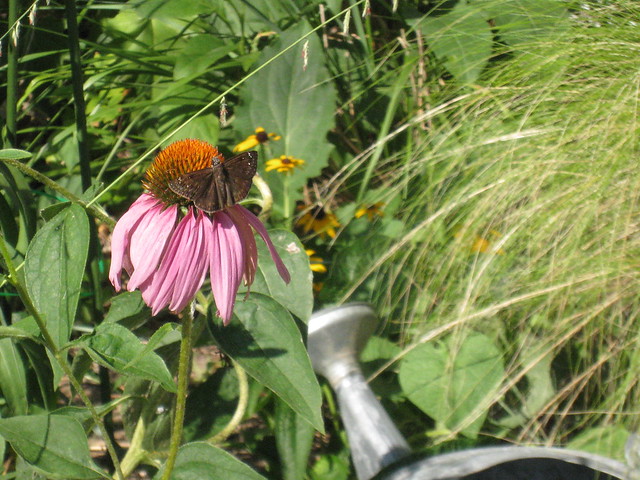
Tiger Swallowtails are more beautiful, but when I spot a small, dark butterfly, I run for the camera! Small, dark butterflies include some of the most challenging identifications in our area, including the duskywings.

Jeffrey Glassberg, in Butterflies Through Binoculars; The East,  has the best quotation for this family in the spread-wing skipper butterfly group. He references a mysterious, unpublished text, The Rites of an Ancient Aurelian, by an anonymous author:
…and rising up like a dark cloud—the duskywings spread across the land, sowing confusion and dissension about butterfliers, the instrument of Erinnyes revenge.

Duskywing butterflies are tough to tell apart, but my task was somewhat limited by date and range for the butterfly in the photo above. I ruled out Juvenal's Duskywing, since it is only seen in spring in Missouri, and this fellow arrived on July 25. There is no dark band in the middle of the hind wing, so that eliminates Mottled Duskywing. Markings aren't right for Wild Indigo Duskywing, and in our area, we're too far south for Columbine and Persius; too far north for Zarucco and Funeral—though all 4 of these duskywings have occured here.
   
That leaves us with Horace's Duskywing—in this case, a male. However, I won't be offended if you find fault with my identification. Please leave your criticism in the comments!
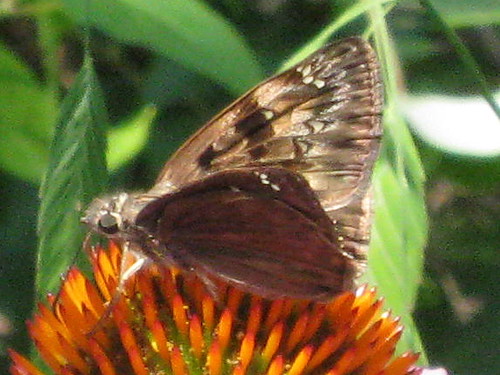
I was lucky enough to have females in my yard this summer too, on July 11 and again on July 26. The female Horace's on July 26 was nectaring on one of the plants we love to hate, anglepod or climbing milkweed (Cynanchum laeve), which I wrote about in an earlier post.

What's up with the names of these butterflies? They must have been named by a classics scholar. Horace, Juvenal, and Persius were poets of ancient Rome.

Horace is most famous for the phrase, "Carpe diem!"—Seize the day! Juvenal's best known phrases include "A sound mind in a sound body," and—my favorite—"rare bird." Persius coined another great aphorism "Out of the frying pan, into the fire!" Though some sources suggest that all duskywings are named for Roman poets, I believe only these three are, though Columbine is a character in Medieval Commedia dell'Arte. The genus name, Erynnis, however is a reference to the three ancient Greek goddesses. The Erinyes, known to the Romans as "the Furies," punished criminals, especially murderers and those who were rude to his mother—Orestes, for example.

Emma Peel

The Erinyes are often depicted in black robes with short skirts, wearing boots, and carrying a whip—a bit like Emma Peel in The Avengers. A pretty intense name for an innocent little butterfly, don't you think?

You might also enjoy:
Those Ever-lovin' Vines
Checkered White
Reincarnated Cowboys


Wednesday, June 15, 2011

Songs of Summer and Scarlet

On June 11 and 12 I did more breeding bird surveys at Busch Memorial Conservation Area in St. Charles Co., Missouri, with my friend Kevin Renick. We didn't see the numbers of butterflies I mentioned in my previous post, but we saw and heard some great birds, including two not commonly seen: a Blue Grosbeak along the dam at Lake 37, and a brief view of a Blue-winged Warbler at the same spot.

Kevin is a singer-songwriter as well as a whiz at birding; his musical abilities extend into his nature hobby. What impressed me most this weekend was Kevin's ability to consistently tell the difference between the songs of the Scarlet Tanager and the Summer Tanager. Both birds nest here in oak-hickory forests of Missouri, and although their calls are very different, their songs are very much alike. I asked him to summarize the differences between the two songs. I'm accompanying Kevin's summary with video from the incomparable recordist of nature sounds, Lang Elliot.


Kevin's hints: "The Scarlet Tanager's song has sometimes been described as being like a 'robin with a sore throat.' It's a melodic warble, but it has a prominent screechy or raspy sound on one or two notes of its phrasing. The Summer Tanager on the other hand, is not raspy at all. It's a clear, sweet warble, a bit gentler than the Scarlet."


If you hear the bird's call—as opposed to its song—you've got it made. The Summer's call begins this video: "Picky-tucky-tuck." The Scarlet Tanager call, heard in the middle of his video, is "Chick-burrr. Chick-burrrr." David Sibley, author of The Sibley Guide to Birds, says that the Summer's song includes, "brief but distinct pauses between phrases." The Scarlet's by contrast is made up of a "fairly rapid, continuous series."

Thanks to Kevin Renick for his song analysis and to Lang Elliot for making his videos available.

Wednesday, July 21, 2010

Leaping Lepidopterists, Batman!

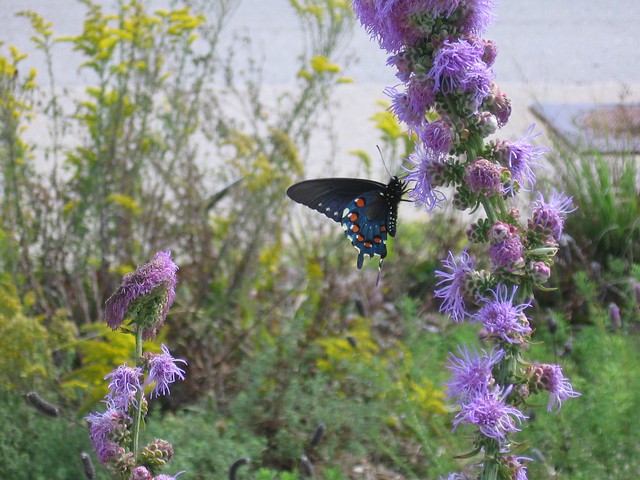
Pipevine Swallowtail on Liatris, Yvonne Homeyer ©
Pipevine Swallowtail is one of the most exciting butterflies anyone can have in their garden. Pipevine Swallowtails are large, with a wingspan of 3-5 inches or so. Their hind wings are iridescent turquoise blue, which is fabulous, but hard to see because they “batter” their wings so rapidly. I just can’t stop chasing them around the yard, as they dart over, under, tilting, and disappearing. This is probably the butterfly that prompted the stereotype of the leaping lepidopterist.

I saw my first Pipevine Swallowtail of the year here in Missouri on June 18. Her black wings were just a blurs as she fluttered along my pipevine. Pipevine is the only plant that Pipevine Swallowtails use as a host. The only other member of its genus in the US is the Polydamas Swallowtail, which also uses pipevines. It’s interesting that the world’s largest butterfly, the Queen Alexandra Birdwing of eastern Papua New Guinea also lays her eggs on a pipevine relative.

Linnaeus, who gave our Pipevine Swallowtail its scientific name, Battus philenor, could have seen a relative of the butterfly in Europe. At first I thought that Battus might refer to its flight pattern, which actually is kind of bat-like. However, the Latin word for bat is “vespertilio,” so that can’t be right. “Battus” or “Battuti” refers to a 14th Century group of folks who paraded through town whipping themselves. Possibly the color of the butterfly is related to the costumes of the Battuti? No, reportedly, the Battuti did not wear shirts at all. Hmm. Could the rapid wing beat of Pipevine Swallowtail suggest the French “battus,” that is, “beaten”?

My own theory is that Linnaeus named the genus after Battus of Cyrene, who was worshipped after his death as Aristaeus. Aristaeus is described as a one of the Greek’s minor gods, who taught humans to raise bees and make cheese. “Aristaeus” also means “the best”—well deserved if he’s responsible for cheese—and a word that seems suspiciously like Aristolochia, the genus name of the plant that Pipevine larvae eat. Still with me? Thus, it could be that Battus is the synonym for the genus name, Aristolochia, which the insect requires. More about that plant in later posts.

Philenor, the specific name, comes from the Greek for “loving one’s husband.” Linnaeus didn’t explain that one either.

A warm thank you to Yvonne Homeyer who sent me a photo above from our fieldtrip with St. Louis Chapter of North American Butterfly Association. It shows a Pipevine Swallowtail on Liatris. What a sight Jeff Pippin saw at this “puddle party” of Pipevines! Apparently, these guys are sipping minerals from the damp sand—sort of like meeting at Starkbucks.
Puddle Party of Pipevine Swallowtails, Buncombe Co., NC by Jeff Pippin

Tuesday, July 13, 2010

Are they edible?


Those pesky stinkhorns sure are conversation-starters! I’ve had several people ask if they are edible, and the answer seems to be “Yes,” and “No.” Tom Volk’s  “Fungus of the Month” article says that they are, with certain cooking techniques. Another source, “Wildman” Steve Brill found them to be revolting, even when cooked in broth. The totally amazing 2006 BBC series Planet Earth had a time lapse video of a Netted Stinkhorn’s growth. I’d love to embed the video, but the embedding is disabled. Click this link, or better yet, watch Planet Earth. I came across a discussion on this topic at GardenWeb. I was glad to see at least one gardener recognized that they are harmless, interesting mushrooms. Just think of them as “fun-guy!” Thanks for all the comments and photos!