Showing posts with label hummingbird feeder. Show all posts

Saturday, August 13, 2011

Juice from a Thousand Flowers

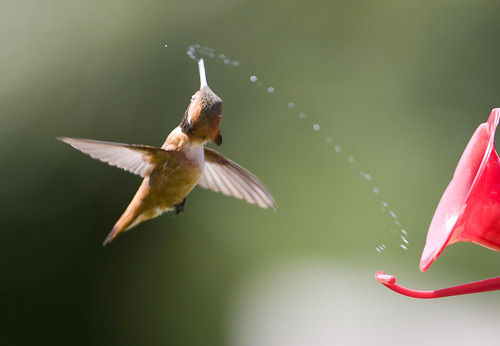
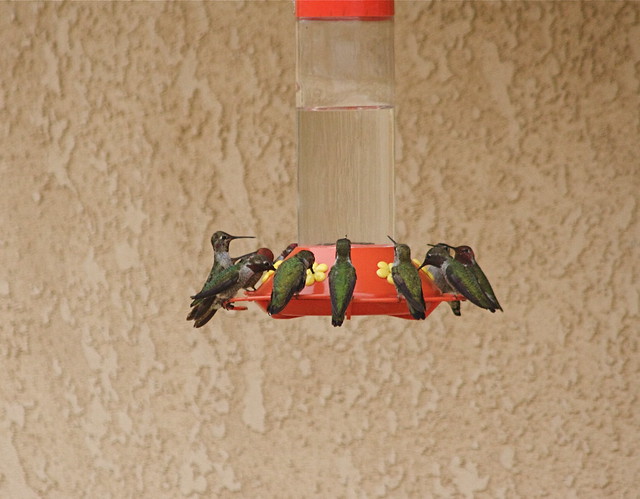
So many hummers! This is my goal! Thanks to Teddy Llovet for the photo.
If you want to attract hummingbirds to your yard, keep in mind that hummers may need up to 1,000 blooms a day. As I mentioned in my previous post, those of use who live in the city or suburbs are going to need nectar feeders! How do I go about filling my hummingbird feeders? Well, I'm glad you asked:
2 cups hot tap water
1/2 cup sugar
That's really all there is to it, but I do have some refinements.

Now that I'm filling so many feeders, I mix up 6 cups at a time and store it in a juice pitcher in the fridge. I've read that it may be better for the birds to use sugar made from cane, not sugar made from beets, so I look for "cane sugar" on the package. Other than that, I buy what's on sale.


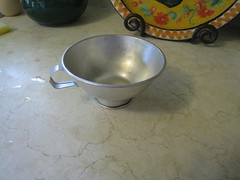
I use a jar funnel on the pitcher when I throw in the sugar. It reduces the mess a bit. Look for this type of funnel with the canning supplies in summer and fall. I put the lid on the pitcher and shake.
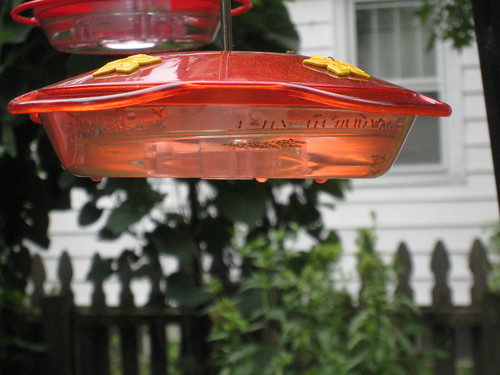
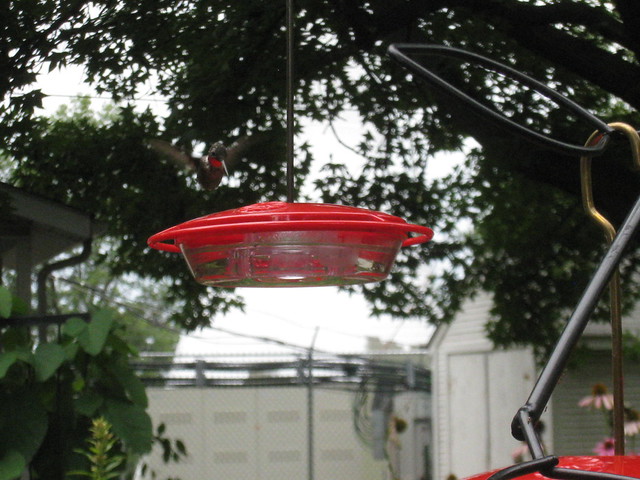
Some feeders have a built-in "ant moat." Not this one.
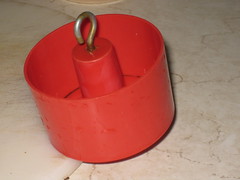
Do you find rafts of ants floating in your nectar feeder? You need an "ant moat." Ants follow a path down the wire/hook/hanger into the nectar, but they can't swim across a water barrier. Look for a feeder that has a "built-in ant moat" that you fill with plain water, or buy a separate moat.
Stand-alone "ant moat." Just fill with water.
Another cool thing about an ant moat with water is that it serves as a bird bath for small birds. I advise against using something called an "ant barrier." Usually it contains chemicals to deter the ants.

Some fallacies about hummingbird nectar:
Not true: You have to boil the water.
If your tap water is safe for you to drink, it will be safe enough for the birds.

Not true: Use commercial nectar, which is red.
Natural nectar is never red, although the flower may be. Don't add artificial dyes to a hummingbird's diet needlessly. Just get a red feeder.

Not true: Honey is more natural than sugar.
Hummingbirds do not raid bee hives. They drink the nectar produced directly by plants. That nectar is sucrose, as is table sugar. Honey is a different type of sugar; mostly glucose and fructose. Even worse, honey can cause harm to the birds as it ferments.

Not true: You should train your hummers to use a more dilute solution by gradually decrease the amount of sugar.
First of all, you can't train "your hummers." Hummingbird banders tell me that most birds stay only a few days in an area before moving on.
This fallacy is based on the assumption that more sugar is bad for the bird. But most hummingbird-pollinated flowers have a 20% solution in their nectar, though some, like trumpet creeper (Campsis radicans) have up to 34%! See the Louisiana Ornithological Society's Newsletter, March 2003, "Sugar Content of Hummingbird Plants in Louisiana Gardens," by Dennis Demcheck here.
For a more thorough discussion of the proper concentration of sugar in a nectar feeder, check this discussion from the HumNet listserve.
  
PS: I received a comment through Facebook from Sheri Williamson, co-director and founder of Southeastern Arizona Bird Observatory. She suggested using cold tap water, since hot water may contain lead. The only reason I used hot water was to speed up the mixing of the sugar solution, so I can easily switch to cold water. 

You might also enjoy:
               
They'd Rather Fight Than Switch

Mexican Sage is a Hummer Magnet

Tuesday, August 9, 2011

A Rabble of Ruby-throats?


I love my hummingbird plants, but when I read that hummers may need up to 1,000 blooms a day, I knew I was going to need feeders! A little more investigation into hummingbird calorie requirements at Hummingbirds.net is really instructive—and a bit overwhelming for a gardener.

I recently came across the blog of Susan and Richard Day, Daybreak Blog. Susan is one of the authors of a favorite book, The Wildlife Gardener's Guide to Hummingbirds and Songbirds From the Tropics (Collins, 2003) and Richard is a photographer and leader of photo workshops. A few years ago, I had a chance to tour their property in central Illinois with the St. Louis Chapter of the North American Butterfly Association (NABA). We were really inspired by their work to create and improve wildlife habitat on their farm. I asked Susan many questions about her hummingbird and butterfly gardens and I was glad to see her recent post about "Hummingbird Wars."

I was surprised to though that she was talking not about flowers, but feeders. I have lots of hummingbird-attracting plants—also known as "humplants"—and two feeders, one in the front and one on the kitchen window. As I mentioned in a recent post, Susan Day interviewed Bob Sargent, well-known hummingbird bander and the found of the Hummer/Bird Study Group. His suggestion to those who would like to attract more hummingbirds and solve the problem of one bird guarding a feeder or driving other hummers away from your Cardinal Flower patch is simple: Add more feeders! Susan add 10 more.

I added 5. Naturally, I expected a rambunctious rabble of Ruby-throats the next morning.


Actually, I'm slightly more patient than that. I've had the extra feeders up for two days. So far I think that my feeder collection has made it more fun to watch the hummers because they're so easy to find. I've seen as many as 3 at a time—not unusual in my yard at this time of year even before adding feeders. When I see more than birds sharing a feeder at the nectar station, I'll feel that my experiment has succeeded. More hummingbird posts to come!

Rootin' Tootin' Rufous                

You might also enjoy these posts:
                    
Hole in One!
Golden Currant & Friends

Tuesday, April 19, 2011

Red Hot Sally Rides Again!

Josey—my long-haired dachshund—and I stepped out the backyard at dusk this evening, just ahead of a huge storm. I bought a few salvias that were already in full bloom, and I wanted to be sure that the predicted hail didn't grind their bones to make its bread. I'm not really very fond of Salvia splendens and its varieties ('Red Hot Poker,' Red Hot Sally,' etc.) Actually, I probably would love it except that I've seen it too often at gas stations and convenience stores. This plant reminds me of a song that I liked till they french-fried it on the radio a million times a day. Please nominate your own "song that gets too much airtime" in comments below. Or plant.

I always get a few quart or two-quart sized containers of red salvia because hummingbirds love them and  there's not much else in bloom for early birds. Lanny Chambers at Hummingbirds.net recommends surveyor's tape fluttering from your feeders to bring in the hummers (see my review of his site).  I prefer 'Sally.'

Back to nature. Josey and I were out in the back, protecting the Salvias, as I said, when I spotted a large insect in flight. The twilight and impending storm made it impossible to see much detail and for once, I hadn't brought my binoculars with me. Yet it seemed too early for an insect this large to be flying through the yard. Then I saw its silhouette pitch up, in a very non-insect-like flight, and drop onto a twig. My first hummingbird of 2011!

Thanks to *~Dawn~* for licensing her fascinating photo with Creative Commons!

Wednesday, March 9, 2011

Hole in One!

Whoopee! Rufous Hummingbird photo by Rick Leche


If your yard has hummingbirds, you've got more action than Smokey and the Bandit! More mischief than a barrel full of cairn terriers! Hummingbirds tear around the feeders like Steve McQueen in a green Mustang fastback! That's why many of us are counting the days till the little winged hellions return.

Which brings me to today's "Website Wednesday": hummingbird bander Lanny Chambers' web-site, Hummingbirds.net. Every time I write about hummingbirds, I have to give credit to Lanny. When I posted about the recapture of a Rufous Hummingbird with a record-breaking migration,  he told me, “This spectacular recapture is like a blind golfer making a hole-in-one on a million-yard hole! I've banded about 2500 hummers in 10 years. Exactly two have been recaptured elsewhere.” 

Over the years that I've known him, he's given me plenty of information about nectar feeders, which he makes available on the site. He explains why the structure of the feeder is important, as I mentioned in my post about feeders last August. He's given us information about hummingbird babies, and their look-alike neighbors, the hummingbird moths. For my post "They'd Rather Fight than Switch," Lanny told me about Dennis Demcheck's article, “Sugar Content of Hummingbird Plants in Louisiana Gardens.” Demcheck used a refractometer to measure the concentration of sugar in the nectar of blossoms in his garden—information used by many a hummingbird gardener to improve the crop!

Lanny's site was featured by the Librarians' Internet Index—now the Internet Public Library. The popular education website Journey North: A Global Study of Wildlife Migration and Seasonal Change asked him to write their Frequently Asked Questions page. He's a frequent contributor to the HumNet forum. His website includes information you'll have a hard time finding anywhere else, but my favorite page is the migration map. I check it often to see how close Ruby-throated Hummingbirds are to me. I always try to be the first in my area to report one to Lanny, but no luck so far. Last year, 4,122 people sent him a "first of the year" hummingbird report! 

Type "hummingbirds" into the Google search box and see what comes up first out of 3.25 million results. Go on—I dare you!

Sunday, August 29, 2010

Attracting Hummers

Adult male Ruby-throated hummer flashes his gorget at the camera. Photo by kmaraj


Everyone has a hummingbird story—everyone who’s ever seen one that is. I took it for granted that everyone had seen a hummingbird, but a few years ago, I dragged a neighbor over to my yard to look at an unusual hummer. She was an older person who had grown up in the Ozarks, yet this was the first hummer she’d ever seen. The only reason she saw this bird was because of the feeder. The feeder is a place to look—a predictable spot for the hummer’s brief visit. This is why I prefer feeders that attach to a window. I know many people who have glimpsed a hummer, but weren’t sure it was actually even a bird. When a bird flies right up to the glass and for a pause that refreshes, you can really see it—ruby-colored gorget and all. (“Gorget” is a term that describes the iridescent feathers of the throat of the adult male.)

I visited Big Bend National Park one summer. A bit like visiting Hades, but wow—the hummers! There were Black-chins with purple throats, Broad-tails with wings that make a ringing sound, and the largest US hummer, the Blue-throated. Most exciting of all was the Lucifer Hummingbird male with his brilliant hot pink gorget. Most visitors to the park never saw any of these however, since most don’t know hummers are abundant there, don’t have binoculars, and don’t know where to look. The park, you see, does not allow feeders. I understand why people shouldn’t feed wildlife in a national park, but applied to hummingbird feeders, it’s a rule that diminishes the experience of some visitors to Big Bend.

I’ve talked to numbers of people who live in good areas for hummers, put out feeders and plant hummingbird-attracting flowers, but have no birds. I suspect they do, but of that feeder and red salvias are any distance from the house, it’s easy to miss a 3.2-inch green-backed bird. The moral of the story: get a feeder and put it where you’ll see it!

Young male Ruby-throat. Above the feeder, an “ant moat” keeps ants at bay. AMcC
The formula: Keep a jar that has cup measurements on the side. I fill it with 2 cups of warm water, then add 1/2 cup of sugar. I put the lid on and shake. I keep one or two in the fridge so I’m always ready to refill or replace nectar. I know a lot of articles recommend boiling the water, but the only reason for that is to reduce the bacteria load. I save a step by using tap water, which presumably has little bacteria. I replace the solution often—at least every 3 days. If the temperature climbs near 100°, I replace it daily. That’s a lot of work if you have several feeders, so save steps where you can.

There is some evidence to suggest that cane sugar is better than beet sugar. If the package is just labeled “Sugar,” it’s probably beet sugar. Only sugar from sugar cane can be labeled “Cane Sugar.” There’s tons of evidence that shows that honey is very bad for hummingbirds. The feeder is supposed to replicate the nectar produced by flowers that attract hummingbirds as pollinators. Nectar produced by flowers is sucrose, a disaccharide, whereas honey is monosaccharide fructose. In the wild, hummingbirds feed on flowers; they don’t raid beehives.

What about the red food color? I know commercial hummingbird nectar is dyed red, but dye is not recommended. It’s true that hummers are attracted by the color red, but that’s why hummingbird feeder should be red at the business end. The feeder port is analogous to a red blossom, but the nectar inside a flower is colorless. For more about feeders, check Lanny Chambers excellent website.

It’s important to keep any bird feeder clean, but doubly important for hummingbird feeders. It doesn’t take long for colonies of bacteria to foul the mixture and this can do real harm to the bird. If you don’t have the time to maintain clean feeders, consider feeding only during times of greatest abundance. Here in Missouri, that’s spring migration—April and May, and especially August through late September. I actually keep my feeders up till Christmas—but that’s another post.