Showing posts with label insects. Show all posts

Sunday, June 5, 2011

The Sweet Gum Ball of the Insect World

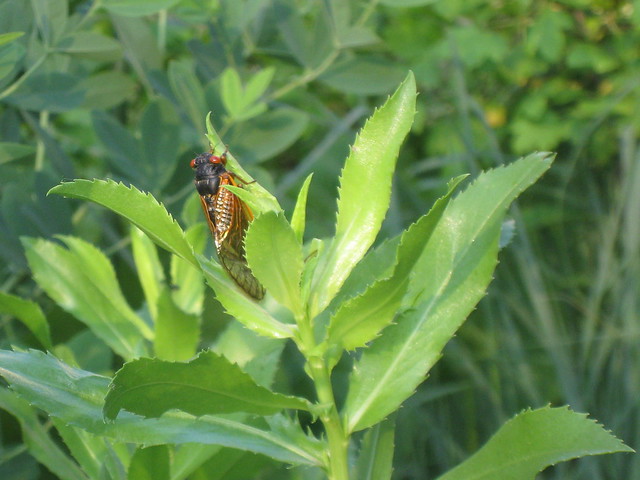
13-year cicada rests on Gum Plant (Grindelia lanceolata) AMcC
I usually remember the details of the first time I saw a new bird species—where I was, what the weather was like, who I was with—but I don't usually recall the first time I observed a new insect. The cicada is the exception, and it's exceptional in so many ways. We had just moved to the west part of St. Louis County, and there were still vestiges of rural Missouri there then. We had a magnificent apple tree in our back yard since our subdivision had once been an orchard. I was picking up apples when I a saw something clinging to the trunk: a large, translucent insect with enormous eyes and hook-like legs. I fell back in horror at the ugliest thing I had ever seen. (I was 13 and my journey to appreciate insects had not yet begun.) Later I learned that what I had seen was the "exuvia," or molted exoskeleton left behind as an adult annual cicada emerged.

This year our area is overrun with the "Great Southern Brood," also known as Brood XIX—periodical cicadas, 3 different species in the genus Magicicada. Here's the story: A female periodical cicada lays eggs in a slit she makes in the bark of a twig. The eggs hatch, and the larva drop to the ground, and burrow down to feed on the meager resources of tree roots. In the case of Brood XIX, they will feed for the next 13 years! Then they all emerge, molt into the adult form, mate, and lay eggs. The emerging, molting, and egg laying in my area must all be completed between mid-May and early July.

Why the tag "Great Southern Brood"? First, here's a terrific map of reported sightings, sponsored by the Magicada Mapping Project. As you can see from the map, the greatest cluster of reports comes from midwestern and southern states of the US. Why "great"? Well, the periodical cicada is the sweet gum ball of the insect world. I took a photo of the first ones I noticed on May 17. By May 21, they were everywhere. Hundreds and hundreds of dead cidadas and their exuvia filled my driveway--just like sweet gum balls. Unlike gum balls, however, birds and squirrels helped me clean up.
  
This week I watched a squirrel climbing a tree. With each bound upward, another 2 or 3 dozen Magicicadas popped out of the top of the tree, till there were hundreds flying over the roofs. So many fly clumsily around me as I work in the yard, they frequently land in my hair or crunch underfoot. Last week I took the dog out in the middle of the night. The next morning I found a dead cicada in my bed. Apparently, I'd acquired a hitchhiker on my back during our short trip, and I'd crushed him overnight.

I was cleaning out my little pond when one dropped dead into the water. No doubt it had fallen from the beak of a Common Grackle, too stuffed with cicada chow to swallow his most recent catch. This is likely the strategy of their almost simultaneous emergence: overwhelm the predators.

Predators may be overwhelmed, but they try to keep up. On the MOBirds listserve, a friend in Columbia, MO. (about 116 miles west of here), reports that she observed Cedar Waxwings gobbling up newly molted cicadas. Their tactic was to perch against the trunk of the tree as a woodpecker might, snatching these delicacies before the exoskeleton hardens. The cicadas have the last laugh however. Predators, such as Cedar Waxwings may raise more young this year because of the bounty, but in 2012 there will be no Brood XIX to feed on.
  
How can I describe their song? Imagine one of those "rain stick" instruments tipping back and forth. Now imagine about 10,000 more. The males vibrate a membrane on the abdomen called the tymbal to create their own kind of music. The singing can reach over 100 dB, according to the "tymbal" article in Wikipedia. In a different entry, Wikipedia notes that periodical cicadas may number "more than 1.5 million individuals per acre." In my yard, it's comparable to the noise of a nearby lawn mower. Fortunately, Magicicadas are comparatively late risers. By 8:30 AM they're just getting started. They knock off for the day when the shadows get long. By 7:45 PM, not a tymbal was stirring.
  
The most recent post on Beetles in the Bush describes some differences in the songs of the Magicicada species. Ted has some great photos too, as always. For a recording of the song, check out "Singing Insects of Missouri," published by the Conservation Commission of the State of Missouri, 1998.

Wednesday, January 19, 2011

Website Wed: Illinois Wildflowers

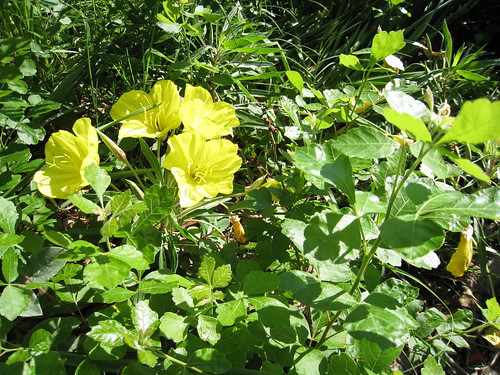
Missouri Evening Primrose is pollinated by Sphinx moths. AMcC
I use lots of references for my blog posts; books of course, and websites. The websites have some advantages:
  • I don't have to buy any bookshelves for them.
  • They aren't heavy.
  • They don't pile up on my desk.
  • In most cases, they're free.
One of my favorite reference websites, and the subject of this week's "Website Wednesday," is Illinois Wildflowers. True, I don't live in Illinois, but I'm only about a 20 min. drive away and our states share most plants. Written by Dr. John Hilty the home page offers categories or chapters, including, wildflowers of Prairie, Savannah and Thicket, Wetland, and Woodland. If you're not sure which category the plant fits into, scroll to the bottom of the page and use the "custom Google search" to go through the whole site. 
Once you've chosen a category, you'll see an alphabetical list of scientific names, each with an common name. Click on your plant of choice and you see a full-page article. Not only is there a color photo and written description, but he gives advice for growing the plant in a garden. Click on the hyperlink "Distribution Map" and a map of Illinois pops up, with shading on the counties in which the plant is found. My favorite part is "Faunal Association." Hilty lists the birds, mammals, and insects that use the plant for food. If you like to see butterflies in your garden, this is really helpful for finding plants that caterpillars love! 

Thursday, November 18, 2010

How I Learned to Stop Worrying & Love a Scorpion

Striped Bark Scorpion, photo by Ted MacRae
Earlier this month, one of my favorite blogs, Beetles in the Bush, had a popular post about scorpions. Seeing Ted’s scorpion photos—which he generously loaned to me—reminded me of my own limited experiences with these arachnids. The difference is I didn’t stick around to take photos. I skedaddled. Except once…

I worked for more than 20 summers at youth camps, most of that time at the same camp in Missouri. The camp is situated in the foothills of the Ozarks, four valleys surrounded by seven hills. West and south-facing slopes have comparatively sparse vegetation; cedar trees (Juniperus virginiana), post oaks (Quercus stellata), and fragrant sumac (Rhus aromatica), and an occasional patch of prickly pear cactus. In between are enormous limestone ledges, some like small cliffs, sparse grass, and butterfly weed. When I took a field zoology class from Dave Tylka I saw what was underneath those slabs of limestone. Until that first field trip, I never dreamed of turning over a rock to see if a black widow waited in ambush underneath.

So much for the ecological background.

This particular summer, I worked in the camp office. Along with 3 others, I stayed in a split-level cabin. On the upper level were 2 small bedrooms, an ancient bath and shower, and a phone that never stopped ringing. The lower level was a meeting area/kitchen, furnished with a couch and chairs made of a clunky log framework and a vinyl-covered cushions, fiesta orange. The walls and ceilings were stained lumber. Some described the style as “Early Adirondack.” Others noted its resemblance to a coffin.

We had a bigger problem than orange furniture in our cabin—roaches. They were everywhere, and I’m talking about big roaches. Flying roaches! My horror knew no bounds. The assistant director was a young woman from south Texas, who went by “Tex.” She was a fun-loving person, but not one to suffer a fool lightly. And I was being very foolish.

“Well my goodness, it’s nothin’ but a li’l billy ole roach!” she’d say with disdain. “Such a fuss over a li’l billy ole roach, cain’t even hurt nobody. Now if it was a stangin’ scorpion I could understand it, but this is jus’ a li’l billy ole roach!”

The next morning, I pulled a clean T-shirt out of the chest. If you’ve ever spent time at camp, you know the tremendous value of a clean shirt. Out of that shirt leaped a roach! They heard me screaming on the next hillside. Tex was not impressed. “The way you carry on over a li’l billy ole roach, cain’t even hurt nobody. I could understand it if it was a stangin’ scorpion, but that’s nuthin’ but a li’l billy ole roach! Back home, we had stangin’ scorpions. Now if it was a stangin’ scorpion, that’d be different, but this is nuthin’ but a li’l billy ole roach, cain’t even hurt nobody.” We replayed this scene every day. Every day for 4 weeks. It was beginning to undermine my self-confidence.

One evening we had a meeting of camp counselors in the big room on the lower level. There was lots of laughter, some yawning, and a bit of arguing over the campfire plans. Just as the meeting was about to break up, I noticed something scuttling across the floor. The screen door no longer met the threshold and through that gap marched the biggest scorpion I ever hope to see. In a flash, weeks of humiliation overcame my cultural bias against invertebrates, and I called out cheerily, “Oh Tex! There’s someone here to see you!”

She bounded down the short steps into the room, and made eye contact with all eight eyes of our very own stangin’ scorpion. She screamed for days…

You don't find satisfaction like that every day. I grabbed a broom, encouraging “Little Stangie” to climb onto the bristles. Puzzled and amazed counselors watched as I gently carried it out to the dark rocky glade by the door. I didn’t want some insect-phobe trampling this misunderstood arachnid. I might need him again one day.

The only species of scorpion in Missouri is the striped bark scorpion (Centruroides vittatus). Along with other species of plants and animals of the glades, it’s a relic of Missouri’s ancient past as a desert. Missouri Department of Conservation says that our species averages between 1 and 1 and a half inches. No way! This big daddy was twice that! They also note that the sting is no more dangerous than that of a wasp. An article by Darryl Sanders on Missouri University Extension website states that they can be “up to 2.5 inches long.” MDC tell us its favorite meal might be spiders, beetles, or smaller scorpions. And li’l billy ole roaches.

Sunday, August 15, 2010

Photos & Friends, Skippers & Moths

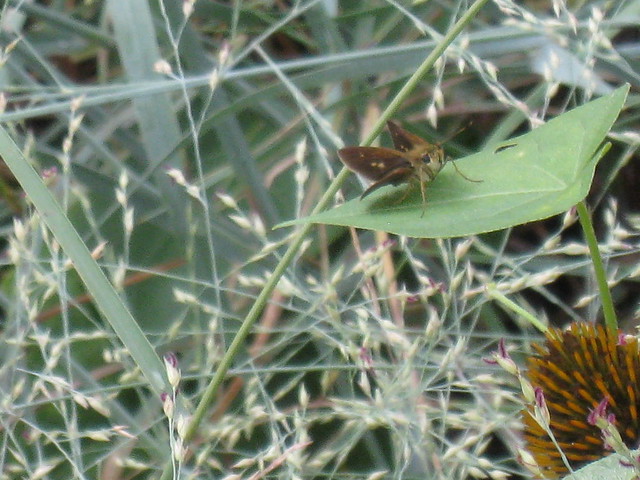
Northern Broken-Dash Skipper? AMcC

I had planned to do a third post on Silphiums, but there are too many butterflies in the garden for that! It’s all the more exciting since this summer has not been the best for butterflies. I don’t know if it’s been the weather, my garden, or the truck that sprayed mosquitoes (and every other living thing) on my street in late June. Whatever the problem, butterfly numbers seem to be recovering. Skippers are everywhere.

Skippers are small, fast-flying butterflies. Compared to the wings, the head is large—kind of cute if you get to see it well. Most are golden-brown or brown and frustrating to identify. It’s been said that skippers are the Empidonax of the butterfly world. (That last sentence actually means something to birders.) If you’re going to have any chance at all identifying skippers, you’ll need a good butterfly book with range maps and a close focusing set of binoculars. See my list of “Favorite Nature and Gardening Books” below. Having a digital camera and an expert friend to study the photo are probably required for some skippers.

I’ve had a new species in the yard this week that I tentatively identified as Northern Broken-Dash Skipper. I sent a photo to my friend Yvonne to see what she thinks. Northern Broken-Dash and Little Glassywing are very similar and my yard is within the range of both. The larvae of both eat grass. According to Glassberg’s Butterflies through Binoculars: The East, Little Glassywing’s caterpillars eat purpletop grass. I don’t have any purpletop in my yard, but it is common and probably can be found 1/2 mile from my house. Northern Broken-Dash caterpillars prefer switch grass. I have switch grass; in fact, it’s growing all around the skipper in the picture. The plant is Panicum virgatum ‘Prairie Sky.’ Maybe you have an opinion about the skipper in the photo you’d like to leave as a comment!

Female Fiery Skipper AMcC

My most common little guy is the Fiery Skipper. The one in this photo is a female, and she really confused me for a while. I seem to see mostly males.

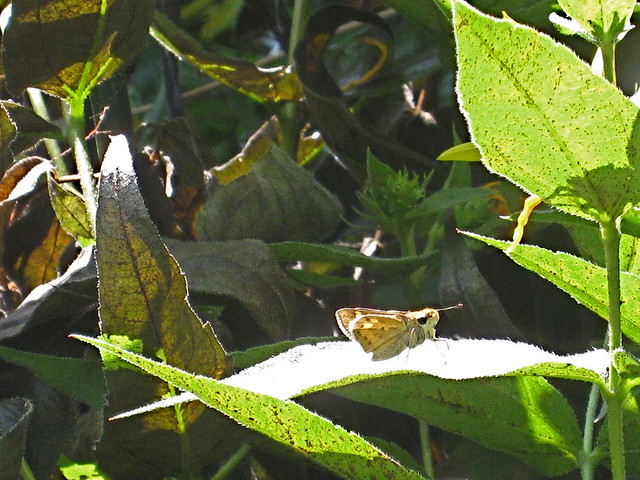
Early this morning I saw a new species visiting my cup plant. It looked like a moth, but was behaving very much like a butterfly. I looked through Butterflies and Moths of Missouri, but couldn’t find it. I sent a shot of it to one of my favorite Flickr groups, ID Please. Members view the shared photos and give their opinion through the comments below the photo. To use this tool, you first need to join Flickr (it’s free), upload your photo, join the group, and then share it. I also sent the photo to What’s that Bug?, a website that features pages of insect photos and discussion. If you have an insect you’d like to identify, look for the “Ask What’s that Bug” page. Two more great sites to exploe are The Bug Guide and the North American Moth Photographers Group.

Corn Earworm Moth AMcC

While waiting for a response from these websites, I tidied up my desk. That when I accidentally came across a photo in Kaufman’s Field Guide to Insects of North America. I’d forgotten that 35 pages of moths are included in that book. So I’ve identified my mystery moth as one of the Owlet Moths, the Corn Earworm moth. I’ve mentioned two good books for butterfly identification but books devoted to moths, with photos or drawings of living critter are not so easy to find. I’m looking forward to the spring 2012 publication of Moths of Northeastern North America by David Beadle and Seabrooke Leckie. While you’re waiting, you might want to check out Seabrooke’s blog, “the Marvelous in Nature,” “North American Moths,” or the “blog carnival” dedicated to moths, “The Moth and Me,” most recently hosted at “The Skeptical Moth.”


Wordle