Showing posts with label winter. Show all posts

Sunday, March 2, 2014

Weldon Spring MO Christmas Bird Count 2014

Eastern Phoebe, photo by John Benson, from Wikipedia

Thanks to all who helped with the Weldon Spring Christmas Bird Count, Jan. 4, 2014! We had 18 participants, 63 species, 8774 birds, and some really decent weather for the season. The Weldon Spring Count (also known as the "Busch count," officially labeled by National Audubon Society as "MOWS") has been held every year since 1952, sponsored by Webster Groves Nature Study Society. The count, like all Christmas Counts, is held between Dec. 14, 2013, and Jan. 4, 2014, and covers a 15-mile-diameter circle. In our case, the circle is centered on the town of Weldon Spring in St. Charles County, Missouri. It includes some of the best land-birding in the greater St. Louis area: Busch Memorial Conservation Area and, bordering the Missouri River,  Weldon Spring Conservation Area.

Only one species had an unusually high count this year: Red-shouldered Hawks totaled 22, topping the previous high of 18 in 2008. Out of 62 counts, Red-shouldered Hawk has occurred only 28 times.

Several species were unusually low. Only 2 Red-headed Woodpeckers were reported. The previous low was 1 in 1964, occurring 51 out of the 62 counts. Red-headed Woodpecker is a "species of concern;" one of 117 species on the "yellow list" in the 2007 WatchList. Only 1 Ruby-crown Kinglet was reported—previous low of 1 in 2012. Only 2 Cedar Waxwings and 2 Purple Finches were seen. The low for Purple Finch was a single bird in 2012. The House Sparrow count was also low—only 6. (Most of us feel that’s a good thing.) The all-time low for House Sparrow on our count was 5 in 2007.

A highlights for me were Hermit Thrush and Fox Sparrow, found along a seldom-used road in the north-east section of Busch. Another Hermit Thrush was found in Babler State Park. Hermit Thrushes are listed as "rare" in winter, and although the Fox Sparrow is considered "uncommon," but not rare, I've missed it a number of times on the count.

Our rock star was an Eastern Phoebe, found independently in the Weldon Spring area by two different groups. This is only the third occurrence out of 62 counts—one in 1986, one in 2005. Birds of the St. Louis Area: Where and When to Find Them describes the Eastern Phoebe as "hardiest of the flycatchers" on our area. The complete report is available to download at the bottom of the Birding page of the Webster Groves Nature Study Society's website. Happy birding in 2014!

Thursday, February 3, 2011

Thunder Sleet and Snow


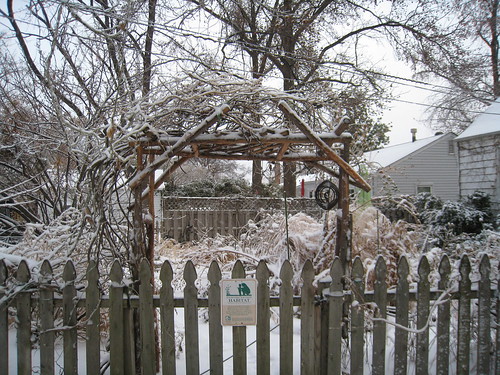
In the last 2 days, our area got hammered with 3 inches of sleet, accompanied by thunder, followed by freezing rain, then dusted with an inch or so of snow. A few minutes drive north, they got 12 inches of snow! Most businesses and schools are closed--even interstate highway 70 was closed till this morning.

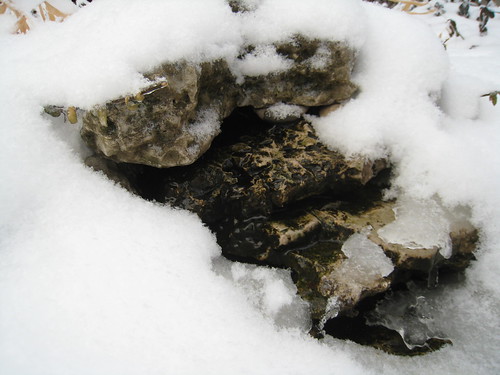
I try to keep the pond flowing a bit. The pump is hanging in there, but sometimes I pour some hot water over the ice to open a hole. All day long there's a steady stream of Dark-eyed Juncos and White-throated Sparrows dropping in for a drink. The neighbor's cat hops over the fence every day too.
I'm a bit worried about the Carolina Wrens. Freezing rain is particularly hard on them. On the MObirds listserve, Bill Eddleman reminded us that after the hard winter of ’76-77 their population plunged.


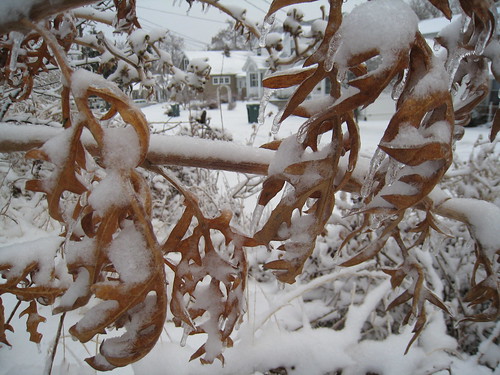
Leaves of Compass plant (Silphium laciniatum) are beautiful in snow. I would miss these if I followed the usual practice and chopped off my plants for the fall "cleanup."


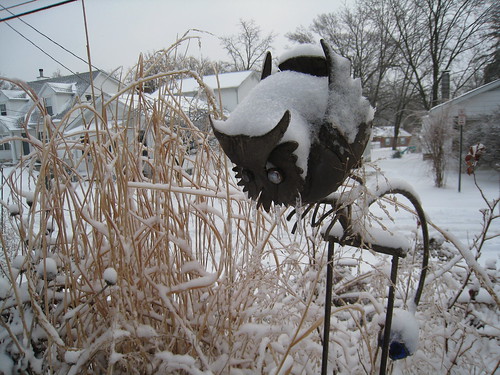
One of my favorite garden tschotskes is this screech owl made with a copper float ball from a toilet tank. Normally, he teeters back and forth with the wind. We have wind today, but the poor wee thing is frozen solid.


Kokopelli is the god associated with agriculture, fertility, and music. How long till spring, Koko?

Sunday, December 12, 2010

Pokey Hat

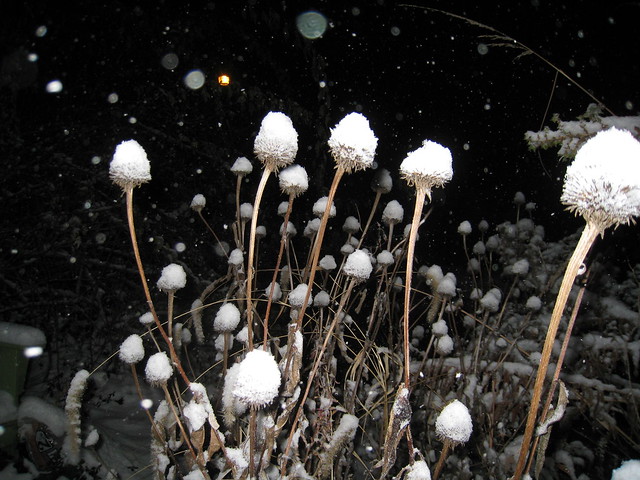
Pokey hats, early on a snowy Sunday. AMcC

Some years ago I had the opportunity to visit a state park with a friend from Scotland. Montauk State Park is a beautiful spot on the banks of the upper Current River. After a long day of watching people fish for trout, we visited the lodge. My friend stepped up to the snack bar and in a heavy Glaswegian accent ordered a “pokey hat.” It took some effort to discover that she meant an ice cream cone. Hilarious!

Cup Plant hangs on to the snow too,
almost as well as it does rain water. AMcC
Hold on now, Scottish readers! I got my comeuppance when that same friend and I dropped into a Glasgow curry shop and I ordered “nan bread.” In my Saint Louis accent, “naan” rhymes with Anne. The clerk could hardly take my order he was laughing so hard. He called the cooks to come out and begged me say it again!


I saw a pokey hat in my front yard early this morning. The prickly seedhead of Purple coneflower (Echinacea purpurea) is especially good at showing off the beautiful snow. It’s afternoon now and gusts of 40 mile-per-hour winds haven’t yet knocked the hat off.


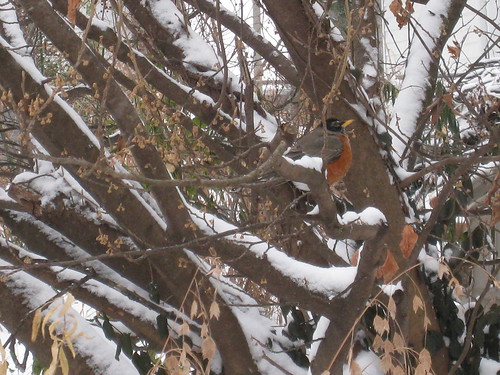
Male American Robin rides the storm out in the witch hazel tree. AMcC
About 3 months from now, a meteorologist on local TV will proudly display a photo documenting the arrival of the first robin of the year. Actually, American Robins are present in our area all year long, but they aren’t quite as conspicuous to non-birders as they are in spring.

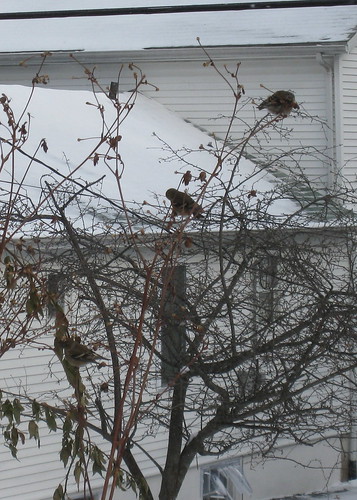
Am. Goldfinches hard at work on
the seeds of Prairie Dock. AMcC


In spite of a temperature of 19° F (wind chill of 2°), Slate-colored Junco, Carolina Chickadee, Downy Woodpecker, and White-throated Sparrow are busy in the back yard. In the front, American Goldfinches tease the last seeds out of Prairie Dock seedheads (Silphium terebinthinaceum). 

All this activity is missing from gardens where the owner tidies up in fall. That’s one less chore for those who garden with binoculars.

Monday, December 6, 2010

Waxwing Party at the Pond

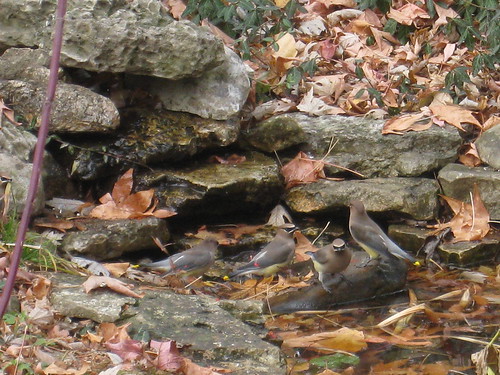
White lines on the back and red "wax" AMcC
The Cedar Waxwing is a lovely bird with silky smooth feathers, a jaunty crest. and a mask that makes him look like Zorro the Avenger. They are expectable in winter, but unpredictable and easy to miss when you’re out birding in my area. So when a flock of Cedar Waxwings dropped by my yard some days ago to visit my little swimmin’ hole, I grabbed my point-and-shoot camera a got a few shots.

I never really noticed the striking white lines on the back that show in this photo, but then I don’t often have a view looking down on Cedar Waxwings. The white edge is formed by wing feathers close to the body (the tertials). Usually I see them high in the sky, calling to each other in the flock with a high-pitched “Seeeee!”

Joined by a few Dark-eyed Juncos and a small group of Pine Siskins, the waxwings bathed the way they do everything; enthusiastically, and with friends. The Birder’s Handbook; A Field Guide to the Natural History of North American Birds, by Ehrlich, Dobkin, and Wheye, describes the exact behavior we see in this photo. They use their wings to splash water up onto the back, while holding the tail up and head back to “form a cup” (Birder’s Handbook, 1988, 429).

This waxwing uses his wings and tail to form a cup. AMcC 
Cedar waxwings are very fond of the blue “berries” of Eastern Red Cedar (Juniperus virginiana). Although they are round and appear as berries, they are really the female cones of this evergreen tree. According to Dave Tylka, in Native Landscaping for Wildlife and People, the cones are low-fat and low-sugar, which means that birds will ignore them until late winter when all the high-fat dogwood, sassafras, and black gum berries have disappeared into the crops of fall-migrating birds. Cedar berries are a reliable reserve food--sort of like oatmeal. If you can’t get a Belgian waffle, you take what you can get.

Waxwings have been found to digest cedar berries in 12 minutes flat! Research shows that seeds that take the short outing through a waxwing’s digestive tract triple their chances of germination. Of course, within 12 minutes the bird may travel, depositing the seed many yards away from the shade of the parent plant.

The fondness for cedar berries accounts for the first part of the English name, but what about that strange surname? Waxwings are named for the waxy material on tips of the secondary wing feathers of adults (The Sibley Guide to Bird Life and Behavior, Elphick, Dunning, and Sibley, ed. 2001, 484). Only adult birds have this, and it’s very hard to spot, in spite of the fact that the Wikipedia article on Cedar Waxwing calls it “the bird’s most prominent feature.” Birds were named during the era when devotees of birds carried shotguns, not binoculars. Those early “birders” named birds for features that stood out as unique while holding the bird in hand, not for field marks as we think of them today. Sibley says that this material feels “more like plastic,” so I’m guessing he’s handled a few waxwings in hand too. This red “wax” is visible in my first photo.

Cedars provide wildlife with food and shelter. AMcC
Cedars are an important wildlife plant in my area. Tylka calls the cedar the number-one winter roost for birds. Besides providing winter dining for fruit-eating birds, the cones/berries are used to flavor gin, of all things. Wikipedia records that the oldest red cedar was found in Missouri. It was 795 years old.

Cedars are a “pioneer” species, meaning that they thrive in open, disturbed areas. They have invaded the open glade habitats found on west and south-facing slopes throughout the Ozarks, shading out rare glade plants. In the past, wildfire would have controlled the advance of cedars. Between habitat loss to roads and parking lots and the suppression of fire, glade species have declined while cedars increased.

The Wikipedia article on cedar also mentions their use as Christmas trees in the Ozarks, a fact confirmed by my brother-in-law. He grew up in Rolla, Missouri, in the heart of the Ozarks. They would cut a cedar on Grandma’s farm, then cut the top out. The lower portion of the tree is too scraggly to use a decoration. The house would fill with scent of the fresh cut cedar heartwood.