Showing posts with label warbler. Show all posts

Sunday, May 1, 2011

Victoria Glades

If I had to pick a favorite habitat, it would be glades. Open sky, tough plants, rocks that invite you to sit and look, that's what I'm talkin' about! To officially qualify as a glade, the area must have all or most of these characteristics:

  • thin, rocky soils
  • exposed bedrock
  • steep slope
  • facing south, west, or southwest
  • dry, fast draining soils
  • fire adapted plants
  • scarcity of trees

Spring is busy for gardeners with binoculars, but I decided to make time for "Missouri's Glades," a continuing education class at St. Louis Community College, sponsored by Missouri Native Plant Society (MONPS), and taught by their past-president, Rex Hill. Our first field trip was to a dolomite glade less than an hour from me,  Victoria Glades in Jefferson County. One portion of the glades is managed by The Nature Conservancy, the other by Missouri Dept. of Conservation.

Let's get right to the amazing plants and animals: I have never seen so much Indian Paintbrush (Castilleja coccinea)! The whole hillside had a reddish cast. Alongside the paintbrush, Fremont's Leather Flower (Clematis fremontii) bloomed. This is a non-climbing clematis, rare and protected in Missouri. I have never seen it in  bloom before.
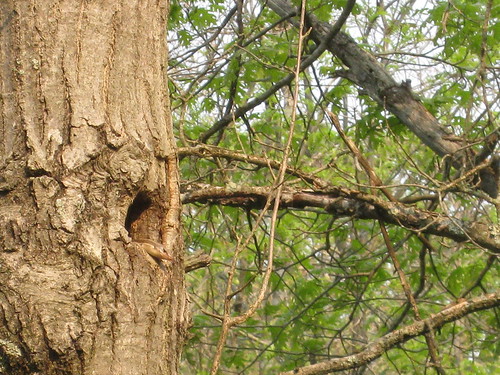
A female broad-headed skink warms in the sun from a tree cavity on the edge of the glade.
Down by the creek, the Louisiana Waterthrush sang his beautiful, slurred complex song. Up in the glades, Prairie Warblers sang from thickets of fragrant sumac (Rhus aromatica). Eventually, one danced to the edge and gave us great views. Blue-winged warbler, another species that likes open or shrubby habitat, popped up to the top of a tree, threw back his little yellow head, wheezing his sleepy, "Beee-buzzzzz."

In spite of strong breezes, we saw butterflies too.We watched a very faded, transparent Monarch nectaring on leather flower. There were Eastern Tailed Blues on False Toadflax, and we saw several Pearl Crescents.  I just managed to get a poor photo of a dark butterfly, which I think was a lifer for me, a Dusted Skipper!

One of the group found a Wild Turkey egg in the dry grass. A good part of the egg was missing, and as we look inside, we could see a large beetle that apparently was eating what was left of the yolk, or possibly, was eating whatever was eating the yolk. After following Beetles in the Bush and taking my first tentative steps toward appreciating insects, I was excited that I identified it as a carrion beetle, Necrophila americana.

John managed to find us a striped bark scorpion, a Western Slimy Salamander,  and this little dandy, an Eastern Hog-nosed Snake. Non-venomous hog-nosed snakes are the entertainers of the reptile world. A hog-nose can play possum, rolling over belly-up leaving its tongue out. When being "dead" doesn't seem the best defense, it will try to bluff its way out of the jam. It can pull its head and front portion upright, spreading its neck in a thoroughly convincing imitation of a cobra; when I happened to come upon one of these tricksters, it made my hair stand on end! Pat, who volunteers at a St. Louis County conservation area, told me that they had reports of 3 cobras just that week!

I took about 100 photos--seriously. I shared a few of them here.


Sunday, October 31, 2010

Mourning Warbler Meets Madison Avenue

Mourning Warbler, female (above), male (below)
by Louis Agassiz Fuertes Wikipedia

Although it was warm, it wasn’t the heat that made me so exhausted. I just couldn’t keep up with my 19-year-old boss. I earned $5 and hour that June surveying birds in scraps of habitat that remain in industrial Saint Louis, Missouri. He trotted through a mile of remnant prairie along the edge of Calvary Cemetery, never drawing a short breath, reaching our lunch spot well ahead of me. When I finally arrived at the thicket of walnut trees and sumacs, I had a horrible allergy attack—in fact, the only one I’ve ever had. In spite of my sneezes, I could hear the most amazing bird. Thankfully, he kept on singing while I wiped my eyes and wracked my brain trying to match the song to my bird tape. Peering through a spiny clump of Hercules Club (Aralia spinosa), I caught just a glimpse of a Mourning Warbler!

According to Birds of the St. Louis Area: Where and When to Find Them, the Mourning Warbler is a migrant only, “sparingly recorded” in most of May and September. The best shot at seeing one is mid-May, when the “seasonal occurrence bar graph” shows it as “easily missed”—a step up from rare. It isn't expected at all in June, and certainly not a singing male! It’s a beautiful and distinctive song—still, it’s hard to put a name to a song, especially if you haven’t watched the bird sing. Of course, it shouldn’t have been that hard to recognize the song of the Mourning Warbler.

Rare though the bird is in my area, the song is all too common. Every TV commercial or film director that aspires to add a little outdoor atmosphere throws the Mourning Warbler’s song into the sound track. As you read my list of TV ads and shows where I've heard it, keep in mind that Mourning Warbler prefers tangled, second-growth forests. Read more about this shy bird in Seabrooke Leckie's blog, The Marvelous in Nature.
Mourning Warbler in its favorite habitat
photo by Seabrooke Leckie

  • In a SUV commercial as the car drives along a lakeshore.
  • As detectives investigate a crime scene in a high elevation spruce and fir forest in Montana (about 300 miles west of its expected migration route).
  • In the “allergy eyes” commercial, when the allergy sufferer applies the product. (This one might not be too far fetched.)
  • In a manicured backyard, as Michael Jordan advertises hot dogs.
  • In an ad for the St. Louis Zoo, as 2 llamas sing, “Waltzing Matilda.”
  • Among the monuments and government buildings of Washington, D. C., in an antacid commercial.
  • In a baseball stadium, in an ad for a sports show.
  • In Manhattan, as a morning-news show host talks about pigeon control.
  • And my favorite: in a carpet commercial, along with the songs of Hermit Thrush and open-field loving Savannah Sparrow.
  • Listen for it, in a theatre near you!