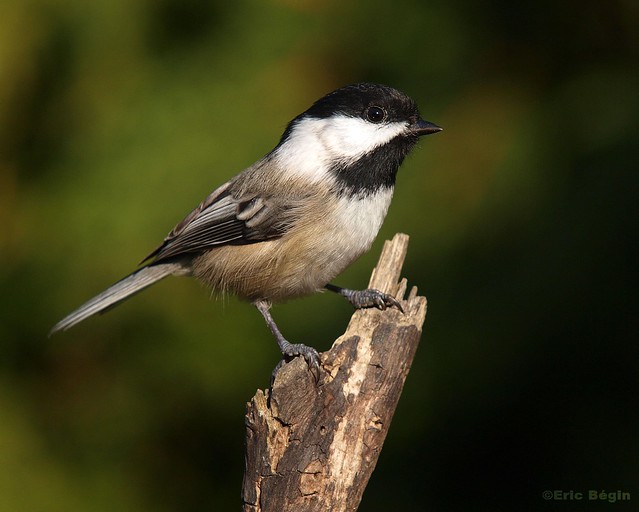
Notice the fearful claws & and the murderous look in his eye? Black-capped Chickadee photo by Eric Bégin.
Yesterday, as I pulled out of the garage, something in the
driver’s side view mirror caught my eye. A fuzzy ball of black and white—a bit
larger than a prickly gumballs—came crashing down from the sweet gum tree. Then the ball broke apart into at least three Carolina Chickadees. They rolled on the ground,
kicking, punching, and talking about each other’s mommas.
Now I hadn’t really thought of pterosaurs as the direct
ancestors of birds. They looked like bats to me. I didn’t realize they had the modified scales we call
feathers. Think of Quetzalcoatlus—the largest pterosaur, with a 40-foot wingspan, a spear-shaped head, and a ring finger that
functioned as the wing. It looked even less like a bird when Peters analyzed
the fossils of its tracks, demonstrating that it walked on its wings/knuckles
like a reptile walks with its front limbs.
When he showed Nemicolopterus crypticus, another
pterosaur with a wingspan roughly the same as a chickadee’s, I began to see the
family resemblance. The ruckus under the sweet gum makes more sense now that I no longer see them as charming chickadees, but tiny, terrible, pterosaurs.
Thanks to Eric Bégin and Mark Witton for licensing their photos with Creative Commons.
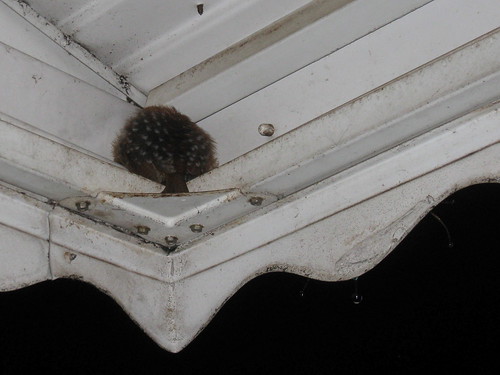
My 16-year-old dachshund needs help with the steps when it's time to go outside. I am usually focused on carrying her and avoiding a fall, but Sunday night I was startled with I noticed what looked like a dark ball tucked into the corner of my awning. Was it a mouse? A chipmunk? A tangled mass of sweet gum balls? Some horrible growth of fungus?
Because of the dire predictions of storms crawling across the bottom of the TV screen all day, I had my flashlight ready. With the added light, I recognized the color. It was not a rodent or ball of goo, it was a Carolina Wren!
In spite of my closeness, the wren didn't budge. She even tolerated the flash of my camera. Was she sound asleep, or just riding the storm out? We had straight-line winds that night—March 4—and nearby Illinois had numerous tornadoes.
Tolerant as she was, it's unlikely that the bird was unaware of my presence. Mike O’Connor, in his 2007 book Why Don't Woodpeckers Get Headaches? And Other Answers to Bird Questions You Know You Want to Ask (p. 188), tells us that birds sleep lightly, ready to fly if danger threatens. He explains that a bird often sleeps by turning its head towards its back and settling its beak onto its shoulder. I can't say if my little feathered friend is using this method in the photo above, but I can at least see that her feathers are fluffed to help trap warmth. I'm sure she appreciated the awning that night, since in addition to the high winds and rain, the temperature was in the high 30s F. By the way, O’Connor is a lively and entertaining writer. I really get a kick out of this book!
Birds need to take advantage of every opportunity for shelter left to them in the suburbs. Tom over at Mon@rch's Nature Blog, wrote about an American Goldfinch that he spotted as it turned in for the night in the gap between his foundation and a snow bank. The "Father of English Literature" also wrote about napping birds in the "Prologue":
And smale foweles maken melodye,
That slepen al the nyght with open eye
Back in the day, Geoffrey Chaucer and his pilgrim friends would have pronounced that last word as "ee," so it really did rhyme with "melodye." Old Geoff was more accurate than we thought. Former St. Louisan and Big Day birding teammate of mine, Niels Rattenborg, demonstratted in his research that birds can put one half of the brain to bed, while leaving the other half—and the eye that it controls—alert to danger. Using this unihemispheric form of sleep even allows some birds to fly while they sleep!
Since the confirmed sighting of a mountain lion in St. Louis County, I've been thinking a lot about charismatic megafauna—or big, scary carnivores—depending on how close the animal is. Mike, from Slugyard, commented that he had never seen a mountain lion, then added that unsettling thought that he was sure that a mountain lion had seen him. He reminded me of something that I experienced. I've seen wolves and grizzly bears in Yellowstone, always from a vehicle. It's a different experience when you're on foot.
One summer my brother and I visited one of the most beautiful places on earth, Yosemite National Park. We couldn't stay long, and he wanted to sleep in, so that morning I decided to head down a trail by myself. I was anxious to see the giant trees, so I picked up my pace. As a jogged up the path, I stopped. About 50 feet ahead of me was a bear. The wind must have been blowing toward me, because he was unaware of my presence. He—or she—stood, grasping the trunk of a huge tree, tucking his head down. I should have been frightened, but something about the bear's posture was reassuring. He didn't seem like a vicious beast, waiting to pounce. He seemed to be hiding from something much more frightening than a bear.
Just then, three women appeared, walking side by side down the trail toward the bear and me. They were happily chatting and laughing as they passed the tree that concealed the bear. They walked on past me without a moment's lull in the conversation. The bear was still unaware that I was watching him, just as the women never suspected that they were watched. As they disappeared down the hill, the bear broke from his hiding place and loped away without a backward glance.
Black bears are quite variable in size in color. The bear I saw seemed to be an adult, but not a large one. According to Wikipedia, bears on the Pacific side of the US are smaller on average than those in the East. Like 91% of bears in Yosemite, his coat was cinnamon, just a bit lighter than the one in the above photo by Ed Coyle Photography, taken one June in Yosemite. Check out this pool of Flickr photos, The Yosemite Bear Project.
Sapsucker Woods, Cornell University photo by eflon
We were just settling in for the night. We had already tested the hammocks to see how far you could swing someone before she'd land with a thump. Our scout leaders were tucked into a cabin, farther down the hill. We were on our own. Suddenly, we heard the most hair-raising sounds! We had no idea what creature it was, but there would be no sleep that night.
I've wondered about those shrieks for a few short decades, and I think now I can identify the shrieker. After searching the Macaulay Library of Animal Sounds from Cornell University, I can say that we probably were hearing two wrangling raccoons, although there was more screaming than you hear in this recording. The Macaulay Library is, "The world's largest natural sound and video archive of animal behavior."
There are other sounds on my Website Wednesday featured site that are not conducive to sleep, like this Western Diamondback Rattlesnake, recorded in--of all places--Sapsucker Woods, Ithaca, New York. Another animal sound that scared the living daylights out of me was the snort of a white-tailed deer. Call me a wimpy kid if you must, but that snort can be spine-chilling!
You can select broad categories like arthropods, or fish, or search by common or scientific name. Notes are available giving details of the equipment used and sometimes the recordist or videographer. One recording I found is an 87 minute interview about amphibians held in Buenos Aires Wildlife Refuge, a really fascinating place in southern Arizona. Frogs caterwaul in the background.
There's lots of video too, including this one of a beautiful mountain lion. The video was shot by Tim Barksdale, former St. Louisan and Webster Groves Nature Study Society member. Video and audio from this site is copyrighted, so I can't post it, but hopefully you'll use these links and enjoy them.
I was able to embed the mountain lion audio from the Missouri Dept. Conservation's article about the confirmed cougar sighting in Chesterfield (St. Louis County, MO), that I wrote about a few days ago. Click the play button below. If we had heard anything like this, we would never have camped again!
It seems like everyone hate crows. Throughout much of the world, crows--ravens, carrion crows, jackdaws, rooks, choughs--fill the same niche as vultures. Garbage collectors are indispensable of course, but not celebrated. Associated with death and bad fortune in European folklore, crows have been an object of persecution. Then there's that voice. I once worked with a nun who had some very uncharitable things to say about crows. She complained that they perched at the top of the chapel's cross and screamed! And they did. After Macbeth murdered his king, he plans more killings with these lines (3.2.50-53):
Light thickens, and the crow
Makes wing to the rooky wood:
Good things of day begin to droop and drowse;
While night's black agents to their preys do rouse.
(Of course, crows and rooks are not nocturnal, but this is Shakespeare, not ornithology.) Kevin McGowan has been studying crows for 20+ years, and his research shows that those groups we see as feathered juvenile delinquents are actually families. Just as we wouldn't tolerate a dangerous snake or spider in our home, crows vigorously defend their nesting area against predators. In winter, when crows gather at night in roosts, sometimes in the hundreds or thousands, what could be more terrifying than an owl swooping through the dark to take a one as prey? No wonder crows take every opportunity to drive owls away. Studies show that American Crows are at or near the top of the intelligence quotient of all birds, and those calls, which seem so offensive, have variety and meaning.
Birders know that a flock of screaming crows often means that an owl is nearby. Sometimes the owl will flee its tormentors, sometimes--as in the amazing photo above, by Jerry DeBoer--they stay put, stoic and grumpy. Why doesn't the owl attack? Great Horned Owls are the top bird predator in our region, with a wing span up to 5 feet. For a bird, it's quite heavy: around 3 pounds--triple the weight of an American Crow. Beyond the fact that owls are most adept at maneuvering in the dark and crows have some advantage in daylight, the answer to that question remains a mystery.
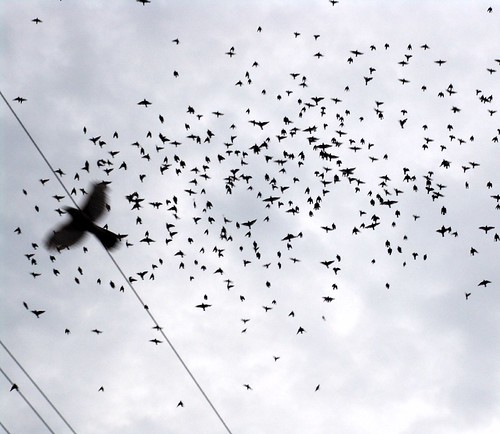
Birding while driving is never a good idea, but while flocks of starlings wheel and twist over the highway, I give them a quick glance. When the flock is behaving this way, I suspect there’s a hawk nearby. Here it is, a red-tail, high and outside. As I leave the highway, I see another flock gathering, preparing to roost in the neighborhood. Blocks away, I arrive at my destination, still hearing the cacophony of chatters and whistles. At one point, some called European Starlings the most abundant bird in North America. It wasn’t always so. The Acclimatization Society of New York, NY, is responsible for turning them loose on this continent in 1890. Their stated goal was to introduce to North America all the birds mentioned by Shakespeare. Henry IV, Part I is play responsible. The character Hotspur, furious at the King over his refusal to ransom Hotspur’s brother-in-law Mortimer, raves that he’ll train a starling to say “Mortimer” and give it to the King as a gift. It’s a good idea. Starlings are great mimics, as befits a member of the myna family, as this video shows.
Cooper's Hawk with flock of European Starlings
photo by zen Sutherland
European Starlings are aggressive, noisy cavity nesters. In winter, they like to roost with about 999 of their closest pals. This has not endeared them to human communities. If you have to endure these gatherings, Cornell has some advice for you, and best of luck.
Our relationship with the starling may be an uneasy one, but that doesn’t diminish our fascination with those amazing flocks. An article in Wired Science, June 2010 explains their behavior as “synchronized orientation…in a critical system,” meaning that members of the flock can communicate so well that if a single bird turns, the flock of thousands can follow. The behavior dazzles humans, as well as avian predators.
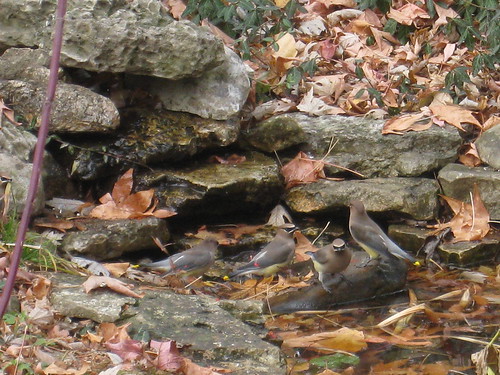
The Cedar Waxwing is a lovely bird with silky smooth feathers, a jaunty crest. and a mask that makes him look like Zorro the Avenger. They are expectable in winter, but unpredictable and easy to miss when you’re out birding in my area. So when a flock of Cedar Waxwings dropped by my yard some days ago to visit my little swimmin’ hole, I grabbed my point-and-shoot camera a got a few shots.
I never really noticed the striking white lines on the back that show in this photo, but then I don’t often have a view looking down on Cedar Waxwings. The white edge is formed by wing feathers close to the body (the tertials). Usually I see them high in the sky, calling to each other in the flock with a high-pitched “Seeeee!”
Joined by a few Dark-eyed Juncos and a small group of Pine Siskins, the waxwings bathed the way they do everything; enthusiastically, and with friends. The Birder’s Handbook; A Field Guide to the Natural History of North American Birds, by Ehrlich, Dobkin, and Wheye, describes the exact behavior we see in this photo. They use their wings to splash water up onto the back, while holding the tail up and head back to “form a cup” (Birder’s Handbook, 1988, 429).
This waxwing uses his wings and tail to form a cup. AMcC
Cedar waxwings are very fond of the blue “berries” of Eastern Red Cedar (Juniperus virginiana). Although they are round and appear as berries, they are really the female cones of this evergreen tree. According to Dave Tylka, in Native Landscaping for Wildlife and People, the cones are low-fat and low-sugar, which means that birds will ignore them until late winter when all the high-fat dogwood, sassafras, and black gum berries have disappeared into the crops of fall-migrating birds. Cedar berries are a reliable reserve food--sort of like oatmeal. If you can’t get a Belgian waffle, you take what you can get.
Waxwings have been found to digest cedar berries in 12 minutes flat! Research shows that seeds that take the short outing through a waxwing’s digestive tract triple their chances of germination. Of course, within 12 minutes the bird may travel, depositing the seed many yards away from the shade of the parent plant.
The fondness for cedar berries accounts for the first part of the English name, but what about that strange surname? Waxwings are named for the waxy material on tips of the secondary wing feathers of adults (The Sibley Guide to Bird Life and Behavior, Elphick, Dunning, and Sibley, ed. 2001, 484). Only adult birds have this, and it’s very hard to spot, in spite of the fact that the Wikipedia article on Cedar Waxwing calls it “the bird’s most prominent feature.” Birds were named during the era when devotees of birds carried shotguns, not binoculars. Those early “birders” named birds for features that stood out as unique while holding the bird in hand, not for field marks as we think of them today. Sibley says that this material feels “more like plastic,” so I’m guessing he’s handled a few waxwings in hand too. This red “wax” is visible in my first photo.
Cedars provide wildlife with food and shelter. AMcC
Cedars are an important wildlife plant in my area. Tylka calls the cedar the number-one winter roost for birds. Besides providing winter dining for fruit-eating birds, the cones/berries are used to flavor gin, of all things. Wikipedia records that the oldest red cedar was found in Missouri. It was 795 years old.
Cedars are a “pioneer” species, meaning that they thrive in open, disturbed areas. They have invaded the open glade habitats found on west and south-facing slopes throughout the Ozarks, shading out rare glade plants. In the past, wildfire would have controlled the advance of cedars. Between habitat loss to roads and parking lots and the suppression of fire, glade species have declined while cedars increased.
The Wikipedia article on cedar also mentions their use as Christmas trees in the Ozarks, a fact confirmed by my brother-in-law. He grew up in Rolla, Missouri, in the heart of the Ozarks. They would cut a cedar on Grandma’s farm, then cut the top out. The lower portion of the tree is too scraggly to use a decoration. The house would fill with scent of the fresh cut cedar heartwood.
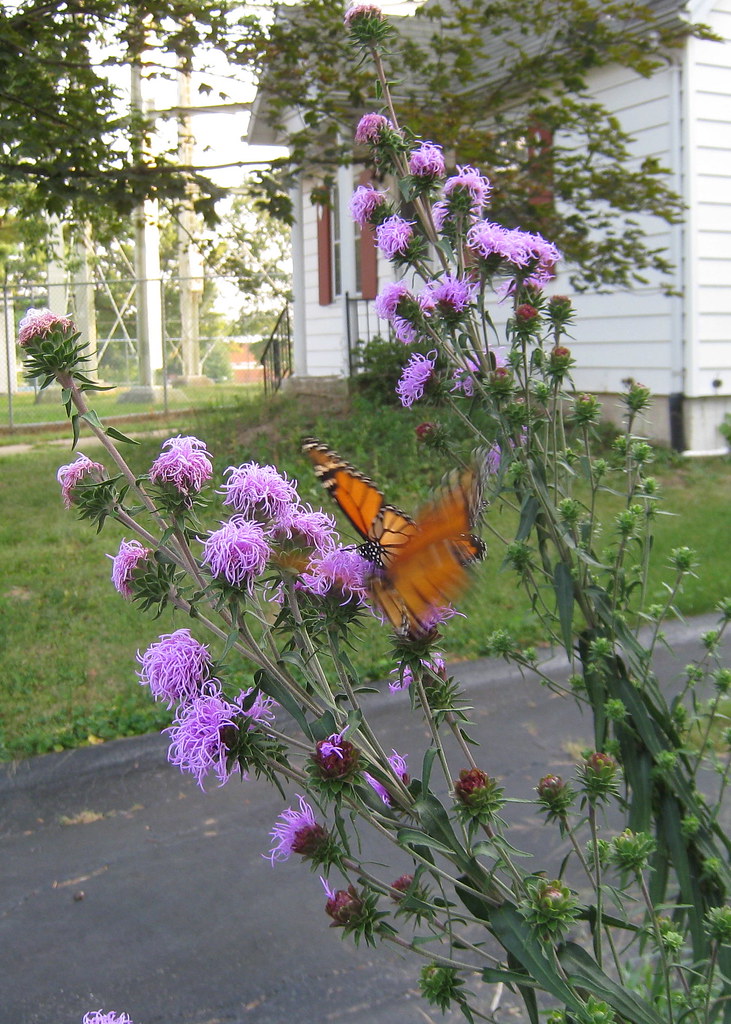
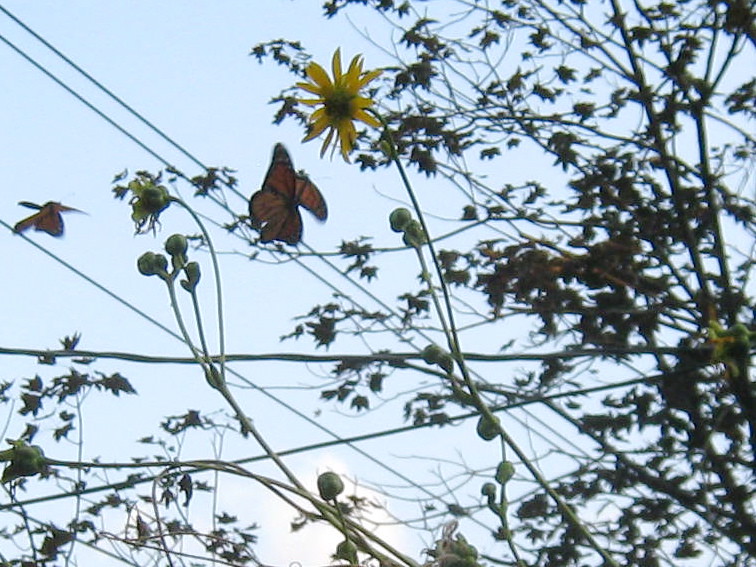
Seen through the rose-colored binoculars of the romantic nature-lover, butterflies are the very embodiment of harmony, as they flutter from one fragrant blossom to another. So how come I came home from work last week to find a brawl in my front yard? Three Monarch butterflies were duking it out, paying little attention to cars or photographers. These butterflies were not just circling each other in a “duel,” they were actually making contact!
Of course, butterflies have to struggle to survive and pass on their genes, the same as other wild creatures. Male Monarchs use a strategy for finding mates called “patrolling.” The male patrols an area, perhaps the top of a small hill were views are unobstructed, looking for females. I use the word look, because although moths are known to find mates through scent, butterflies rely primarily on sight (Boggs, Watt, Ehrlich, Butterflies: Ecology and Evolution Taking Flight, 75). Once the male detects a female, he gives pursuit and tries to mate. If however he encounters another male, he may attempt to drive off the interloper.
I remember spotting a male Monarch in my mom’s garden. When I pointed it out to her, she looked at me suspiciously. “How can you tell?” she asked.
“Well,” I said, still watching the butterfly in my binoculars, “you have to have a pretty good look.” (Bah-dum-bum.) She laughed hysterically. She didn’t even hear me explain that males have a small black scent patch on the hind wing, close to the rear of the abdomen.
I doubted whether I could get a photo of rock-’em-sock-’em Monarchs, but I headed out with my point-and-shoot camera anyway. I snapped off about 20 worthless shots of orange blurs above purple and yellow blurs. Finally, as I stepped up to a cooperative Monarch on my Rough Blazing star, another one dropped vertically into the frame, landing directly on to the first. I actually heard the collision! The first Monarch was definitely a male, but I can’t be positive about the attacker. However, of the three Monarchs I observed over the course of 2 hours, all the ones I saw well were male.