On June 11 and 12 I did more breeding bird surveys at Busch Memorial Conservation Area in St. Charles Co., Missouri, with my friend Kevin Renick. We didn't see the numbers of butterflies I mentioned in my previous post, but we saw and heard some great birds, including two not commonly seen: a Blue Grosbeak along the dam at Lake 37, and a brief view of a Blue-winged Warbler at the same spot.
Kevin is a singer-songwriter as well as a whiz at birding; his musical abilities extend into his nature hobby. What impressed me most this weekend was Kevin's ability to consistently tell the difference between the songs of the Scarlet Tanager and the Summer Tanager. Both birds nest here in oak-hickory forests of Missouri, and although their calls are very different, their songs are very much alike. I asked him to summarize the differences between the two songs. I'm accompanying Kevin's summary with video from the incomparable recordist of nature sounds, Lang Elliot.
Kevin's hints: "The Scarlet Tanager's song has sometimes been described as being like a 'robin with a sore throat.' It's a melodic warble, but it has a prominent screechy or raspy sound on one or two notes of its phrasing. The Summer Tanager on the other hand, is not raspy at all. It's a clear, sweet warble, a bit gentler than the Scarlet."
If you hear the bird's call—as opposed to its song—you've got it made. The Summer's call begins this video: "Picky-tucky-tuck." The Scarlet Tanager call, heard in the middle of his video, is "Chick-burrr. Chick-burrrr." David Sibley, author of The Sibley Guide to Birds, says that the Summer's song includes, "brief but distinct pauses between phrases." The Scarlet's by contrast is made up of a "fairly rapid, continuous series."
Thanks to Kevin Renick for his song analysis and to Lang Elliot for making his videos available.
Showing posts with label swallowtail. Show all posts
Showing posts with label swallowtail. Show all posts
Wednesday, June 15, 2011


Tuesday, July 27, 2010
Way down yonder in the Pawpaw patch
 |
| Zebra Swallowtail nectars on Dogbane, photo by Joby Joseph |
The only place I seen Zebra Swallowtails in numbers is at Shaw Nature Reserve in Gray Summit, Missouri, where they were doing exactly what Glassberg describes in Butterflies through Binoculars. The group flew close to the ground, and they made quite an impression with better than 3-inch wingspan and “tails” up to an inch long. In my own yard however, I usually see a single Zebra flying near the top of my pawpaw tree.
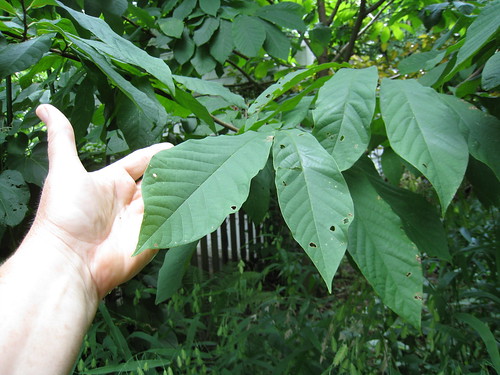 |
| Pawpaw leaves are large and tropical looking AMcC |
I got my pawpaw at the spring native plant at Shaw Nature Reserve. It took some teamwork to get it in the car. My friend Pat and her sister helped pack the tree, all the trays of plants, and me into the back seat. We rode back home with the tip of the tree peeking out the window of the car. My motivation for planting it a shady corner of the yard was Native Landscaping for Wildlife and People. Author Dave Tylka writes that pawpaw is the “only Midwest larval food for zebra swallowtail.” Like Pipevine Swallowtail and Monarch caterpillars, Zebra Swallowtail larvae chow down on a plant that other plant predators can’t abide. In an article on Beetles in the Bush, Ted MacRae mentions the alkaloids that protect the plant’s bark and seed from insects.
Besides Zebra Swallowtail caterpillars, I would dearly love to see some fruit on the tree. At the camp where I worked many summers, a grove of pawpaws grew at the base of the hill we called Sunnytop. Remembering the song—“pickin’ up pawpaws, put ’em in your pocket”—I looked for the fruit every summer. No luck. Knowing that he had grown up in rural Jefferson/Ste. Genevieve Counties near camp, I asked the property manager, Jim LaPlant, about the fruit. Jim laughed and told me that as a boy, others had called him “a Pawpaw-eatin’ Frenchman.” Exactly what that meant I don’t know. Reportedly pawpaws are messy to eat. Is that what these mean kids were talking about? Or was it because supposedly only unpopular people would eat them? Or was it just another in the long and regrettable tradition of insulting a person by referring to his ethnic food? Well, lots of folks do like pawpaws. By golly, Pawpaws have their own Flickr group. What’s more, on September 17-19 this year, Lake Snowden, Ohio, holds its 12th Annual Pawpaw Festival. They have an atalatal-throwing contest there too and you just don’t see that every day!
 |
| Photo by Beautiful Rust |
To grow fruit, a tree needs a pollinator. In the case of the pawpaw, it’s not butterflies, though it is a type of fly. Being an understory tree, pawpaw blooms early, before the canopy of trees block most of the light. It’s strange maroon/brown blossoms hang off the bare limbs. The scent has been described a rotting meat or, as Don Kurz describes it in Trees of Missouri, like fermenting grapes. I’ve never noticed any scent myself, but if I did, I don’t think I’d be confused between rotting meat and rotting fruit.
Kurz also explains a bit about the scientific name, Asimina triloba. “Triloba” refers to the 3-lobed shape of the flower. “Asimina” is a Latinized version of the French rendition of an American Indian name for the tree. I didn’t find any explanation of what that American Indian word was or what it mean. I didn’t find any satisfactory explanation of the word “pawpaw” either, except that it is also applied to papaya, a unrelated fruit tree.
 |
| Pawpaw Sphinx moth, photo by Seabrooke Leckle |
Whether or not my tree ever bears fruit, it will one day host larvae of either the Zebra Swallowtail or the Pawpaw sphinx moth, Dolba hyloeous. Seabrooke Leckle writes about this gorgeous moth and other large moths in a 2009 post in her blog, the Marvelous in Nature.
Special thanks to my Flickr friends (credited in the caption under the photos) who were kind enough to license their photos through Creative Commons.
Sunday, July 25, 2010
Pipe Dream
 |
| Pipe vine casts deep shade. AMcC |
I first read about pipevines—the plants—and its relationship to Pipevines—the butterflies—from an article in American Butterflies, Summer 2001, written by Jeffrey Glassberg. American Butterflies is the quarterly journal of the North American Butterfly Association (NABA). NABA launched its “Pipe-dream Project” that year. The North American Bluebird Society (NABS) promotes nestboxes and habitat suited to bluebirds, and along with other organizations, has successfully expanded the range, increased populations and public awareness of Eastern, Western, and Mountain Bluebirds. NABA hoped to do the same for the Pipevine Swallowtail and its southern cousin, the Polydamas Swallowtail. Glassberg recommended growing the host plant, pipevine, either Dutchman’s Pipe, Aristolochia macrophylla, or a pipevine species native to your area. I had never had a Pipevine Swallowtail in my yard so I couldn’t wait to try it. Dutchman’s Pipe is native to the Eastern US, and I would have preferred to plant Missouri’s species, Wooly Dutchman’s Pipe, A. tomentosa, but I was unable to find a source at the time. I planted two Dutchman’s pipe vines on a metal arch, set in concrete. I had intended that arch for climbing roses, but that another story.
The species name, macrophylla, means “large leaf.” Many of the leaves are 6 inches wide and more than 7 inches long. They arrange themselves like shingles on a roof, casting a deep shade. When people sat outdoors to cool off in summer, folks planted it to cover the porch. Now that most of us enjoy air-conditioning in the heat, the plant is rare in suburbs and towns.
The first season the vines looked acceptable, but weak. By late summer, I had seen a few Pipevine Swallowtail adults, but no eggs or caterpillars. The next summer, I had more adults, but still no “cats.” Just before the plants’ third season, I met a woman who had grown the plant for years. She advised me to prune it to around one or two feet in the spring. I was horrified. Perhaps you’ve heard the old garden wisdom about vines, “First they sleep, then they creep, then they leap!” That summer, mine leapt. The vine covered the arch, headed down the fence, and made a grab for the gutters. I do prune my pipe vines in late winter now, and trim during the growing season if they misbehave. The plant laughs at pruners, and the butterflies seem to prefer to lay their eggs on the fresh growth.
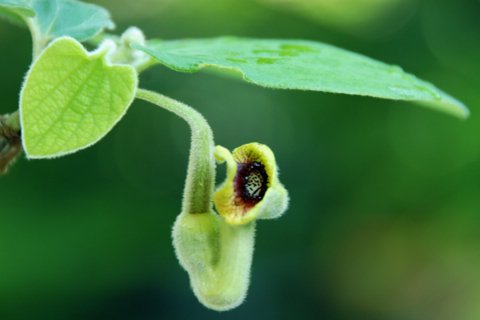 |
| Dutchman's Pipe bloom. Photo by Margy Terpstra © |
My plants bloom well in spring, though the flowers are small. They’re not showy, but their strange shape (like a meerschaum pipe) has an even more bizarre function. According to the Plant Diversity Website, the flower is perfumed like road kill. Fear not, gentle gardener! I have never detected this odor. A hungry fly enters the bloom and finds itself trapped in the convoluted shape. There the fly stays till it is covered with pollen and the flower matures, releasing it to play London Bridge once more.
This summer, Pipevines been particularly abundant. I can see them all day long. It took a long time for me to find the cats. Last summer I had several “hatch outs” and I learned what to look for. If you see a leaf with damage, try looking underneath it. Sometimes a dark shadow turns out to be a group of larva. For more about the caterpillars, see “Botanical Arsenic and Old Lace.” For more about the adult, see “Leaping Lepidopterists, Batman!”
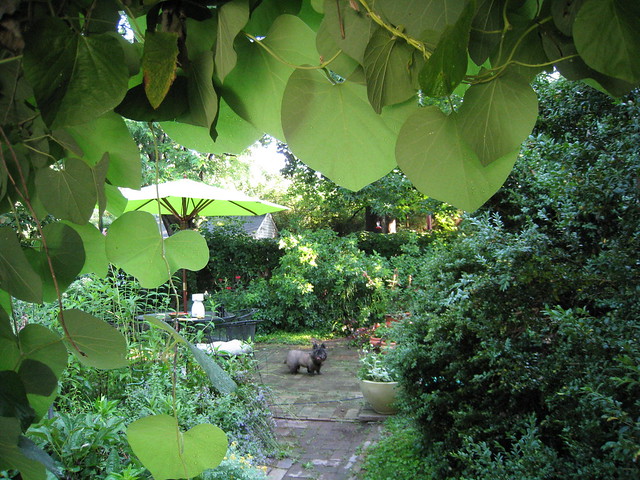 |
| Dutchman's pipe grows on an arch. AMcC |
Friday, July 23, 2010
Botanical Arsenic and Old Lace
Take a few minutes to watch this amazing time-lapse video by JCMegabyte. It covers the entire life cycle of the Pipevine Swallowtail butterfly. Video footage is courtesy of JCM Digital Imaging.
Plants have a fascinating variety of strategies to defend themselves against herbivores, including ourselves. If a species is to survive in the wild it needs thorns or spines, or armor, such as thick bark or nutshells. One of the most intriguing is the use are the poisons plants manufacture and concentrate in their leaves or seeds. Sort of like a botanical Arsenic and Old Lace.
Of course, Aunts Martha and Abby used elderberry wine with cyanide, while Pipevine (Aristolochia macrophylla) leaves contain a toxin called aristolochic acid. If you were to eat enough of it, it could be fatal. This is the plant that Pipevine Swallowtails require in their larval stage. How can a small caterpillar thrive on a plant that could kill great big humans? Co-evolution my friends—eons of it. The caterpillars are able ingest the toxin without any ill effects, making both the larva and adult taste terrible. Birds and other predators learn to avoid them.
Aunt Martha: One of our gentlemen found time to say, “How delicious!”
The larvae are black, with hornlike protuberances of orange or red. They also like to hang out in gangs, which is actually pretty intimidating to see if you don’t know what they are. The bright orange spots set off by blue on the adult are warning colors too. Kenn Kaufman and Jim Brock’s book, Butterflies of North America, lists 6 other black butterflies of the Midwest that gain protection by mimicking the Pipevine Swallowtail’s coloration. The colors are effective for me too. I’ve never been tempted to eat a Pipevine Swallowtail.
 |
| Late instar of Pipevine Swallowtail caterpillar, on pipevine of course! |
Wednesday, July 21, 2010
Leaping Lepidopterists, Batman!
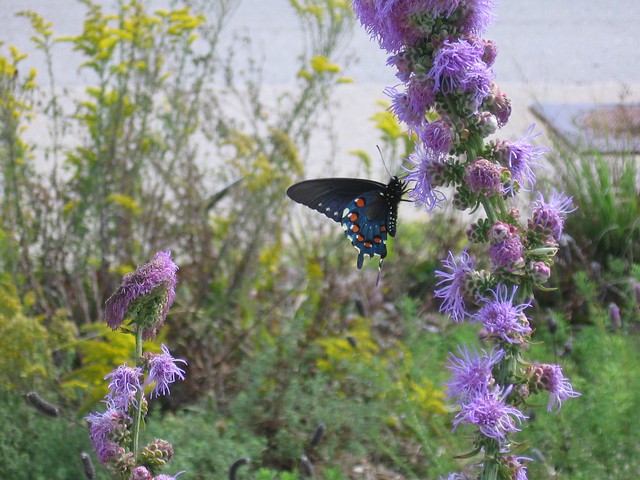 |
| Pipevine Swallowtail on Liatris, Yvonne Homeyer © |
I saw my first Pipevine Swallowtail of the year here in Missouri on June 18. Her black wings were just a blurs as she fluttered along my pipevine. Pipevine is the only plant that Pipevine Swallowtails use as a host. The only other member of its genus in the US is the Polydamas Swallowtail, which also uses pipevines. It’s interesting that the world’s largest butterfly, the Queen Alexandra Birdwing of eastern Papua New Guinea also lays her eggs on a pipevine relative.
Linnaeus, who gave our Pipevine Swallowtail its scientific name, Battus philenor, could have seen a relative of the butterfly in Europe. At first I thought that Battus might refer to its flight pattern, which actually is kind of bat-like. However, the Latin word for bat is “vespertilio,” so that can’t be right. “Battus” or “Battuti” refers to a 14th Century group of folks who paraded through town whipping themselves. Possibly the color of the butterfly is related to the costumes of the Battuti? No, reportedly, the Battuti did not wear shirts at all. Hmm. Could the rapid wing beat of Pipevine Swallowtail suggest the French “battus,” that is, “beaten”?
My own theory is that Linnaeus named the genus after Battus of Cyrene, who was worshipped after his death as Aristaeus. Aristaeus is described as a one of the Greek’s minor gods, who taught humans to raise bees and make cheese. “Aristaeus” also means “the best”—well deserved if he’s responsible for cheese—and a word that seems suspiciously like Aristolochia, the genus name of the plant that Pipevine larvae eat. Still with me? Thus, it could be that Battus is the synonym for the genus name, Aristolochia, which the insect requires. More about that plant in later posts.
Philenor, the specific name, comes from the Greek for “loving one’s husband.” Linnaeus didn’t explain that one either.
A warm thank you to Yvonne Homeyer who sent me a photo above from our fieldtrip with St. Louis Chapter of North American Butterfly Association. It shows a Pipevine Swallowtail on Liatris. What a sight Jeff Pippin saw at this “puddle party” of Pipevines! Apparently, these guys are sipping minerals from the damp sand—sort of like meeting at Starkbucks.
 |
| Puddle Party of Pipevine Swallowtails, Buncombe Co., NC by Jeff Pippin |
Tuesday, July 13, 2010
Are they edible?

Those pesky stinkhorns sure are conversation-starters! I’ve had several people ask if they are edible, and the answer seems to be “Yes,” and “No.” Tom Volk’s “Fungus of the Month” article says that they are, with certain cooking techniques. Another source, “Wildman” Steve Brill found them to be revolting, even when cooked in broth. The totally amazing 2006 BBC series Planet Earth had a time lapse video of a Netted Stinkhorn’s growth. I’d love to embed the video, but the embedding is disabled. Click this link, or better yet, watch Planet Earth. I came across a discussion on this topic at GardenWeb. I was glad to see at least one gardener recognized that they are harmless, interesting mushrooms. Just think of them as “fun-guy!” Thanks for all the comments and photos!
Subscribe to:
Posts (Atom)