Showing posts with label website. Show all posts

Sunday, July 31, 2011

Color Variation in a Butterfly


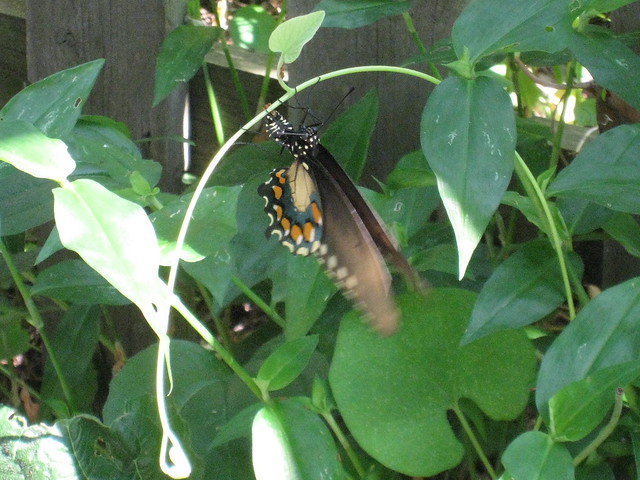
I snapped this pic while talking with my neighbor because the butterfly was close and appeared to be different. When I uploaded it to my computer, I found that this female Pipevine Swallowtail (Battus philenor) was laying eggs, and was indeed different. Seen from below, as in the photo, she has a tan area of her hindwing which would normally be black. The forewing appears to have a tan area too, but it's blurred by her movement.

I've now spent the better part of the day searching for other photos of aberrantly colored butterflies, without much success. I've also searched the internet from information on this phenomenon. As nearly as I can decipher from a number of websites, the condition is called hypomelanism, a partial lack of the dark pigment, melanin, which should be present.

I posted it on BugGuide to get some feedback on the unusual coloration. BugGuide is a fascinating website that provides a catalog of insect photos & forum for topics, including identification. Submit a photo of the insect you'd like more information about, as I did on my BugGuide page. Other registered users can submit their comment or identification below your photo. Registration is free (donations accepted). Submit photos of the insect only. Forget about artistic composition, just crop away.

BugGuide member Kelly Fiegle had better luck than I did in finding other examples of Pipevine Swallowtails with similar tan on the wings or at least, less black. Kelly found three photos which I will link to, since all are copyright restricted. The first is a beautiful shot of a female Pipevine Swallowtail from Florida with slightly reduced color in the same area of the hindwing as my female. The second photo, from Texas, is a worn individual, but is her age enough to explain the reduced color of the hindwing cell as well as the lack of orange in the hindwing spots? The third photo of another worn individual, has a similar area of reduced color.

Genetic color variation? Fading caused by to unknown conditions? I have no idea. But I'm proud to say that of the 5 billion images on the photo sharing site Flickr, mine is the only insect photo tagged with "amelanism."

You might also like:
Royal Catchfly and Pipevine Swallowtail
   Pipevine Swallowtail, by Yvonne         Pipevine     Pipevine
Royal Catchfly                        Leaping Lepidopterists                        Botanical Arsenic         Pipe Dream  

Wednesday, March 9, 2011

Hole in One!

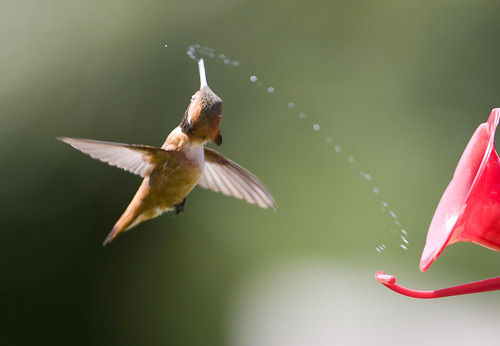
Whoopee! Rufous Hummingbird photo by Rick Leche


If your yard has hummingbirds, you've got more action than Smokey and the Bandit! More mischief than a barrel full of cairn terriers! Hummingbirds tear around the feeders like Steve McQueen in a green Mustang fastback! That's why many of us are counting the days till the little winged hellions return.

Which brings me to today's "Website Wednesday": hummingbird bander Lanny Chambers' web-site, Hummingbirds.net. Every time I write about hummingbirds, I have to give credit to Lanny. When I posted about the recapture of a Rufous Hummingbird with a record-breaking migration,  he told me, “This spectacular recapture is like a blind golfer making a hole-in-one on a million-yard hole! I've banded about 2500 hummers in 10 years. Exactly two have been recaptured elsewhere.” 

Over the years that I've known him, he's given me plenty of information about nectar feeders, which he makes available on the site. He explains why the structure of the feeder is important, as I mentioned in my post about feeders last August. He's given us information about hummingbird babies, and their look-alike neighbors, the hummingbird moths. For my post "They'd Rather Fight than Switch," Lanny told me about Dennis Demcheck's article, “Sugar Content of Hummingbird Plants in Louisiana Gardens.” Demcheck used a refractometer to measure the concentration of sugar in the nectar of blossoms in his garden—information used by many a hummingbird gardener to improve the crop!

Lanny's site was featured by the Librarians' Internet Index—now the Internet Public Library. The popular education website Journey North: A Global Study of Wildlife Migration and Seasonal Change asked him to write their Frequently Asked Questions page. He's a frequent contributor to the HumNet forum. His website includes information you'll have a hard time finding anywhere else, but my favorite page is the migration map. I check it often to see how close Ruby-throated Hummingbirds are to me. I always try to be the first in my area to report one to Lanny, but no luck so far. Last year, 4,122 people sent him a "first of the year" hummingbird report! 

Type "hummingbirds" into the Google search box and see what comes up first out of 3.25 million results. Go on—I dare you!

Wednesday, March 2, 2011

GAP: Gap Analysis Program

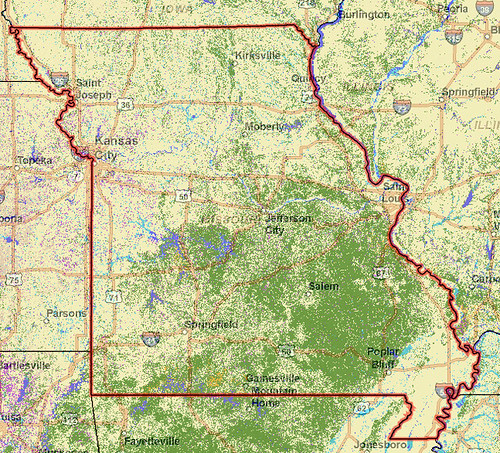
It's Website Wednesday again, but it's going to take me more than a week to study all the aspects of this site! GAP, or Gap Analysis Program is directed by the US Geological Survey. They coordinate with other agencies to create a database of information about the terrestrial and aquatic communities of plants and animals. This information is then mashed together and displayed on incredibly detailed maps.

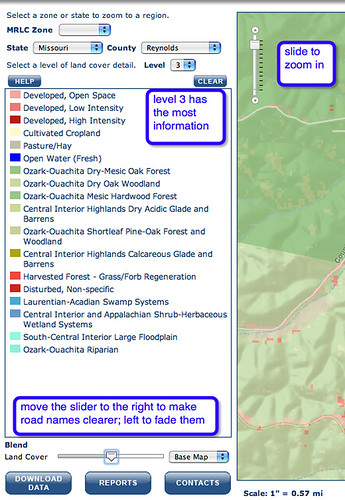
Click on "National Land Cover View and Data" at lower left to begin. From the pull-down menu, you can choose to see a state, or a certain county within a state.

Set the level of detail you'd like to see on the map. Level 1 displays 8 different descriptions of the areas, such as "Riparian and wetland systems." Get more information on Level 2, which displays up to 43 different types of plant communities, such as "Deciduous dominated savannah and glade." Level 3 can indicate up to 590 plant communities if they are present.


The purpose of the project is to reveal those plant communities which are underprotected.  For example, a state agency or organization could see which plant communities exist in the state, and which of these types are adequately represented in protected areas and which are not. Once a vulnerable plant or animal community is identified, the next step is to locate examples of this type. These maps can inform management decisions and help states prioritize which areas to protect.

This example is from Reynolds County, not far from The Nature Conservancy's Grasshopper Hollow. 17 ecotypes are listed. Grasshopper Hollow is a fascinating area of fens, with some rare plants and animals. In 2000, a breeding population of the endangered Hine's Emerald dragonfly was discovered here. It's also known for rare amphibians and orchids.


I couldn't resist snapping a screenshot one of my favorite spots in Missouri. It's interesting to see the official description of the ecotype of camp where I spent 20 summers. They're right. It is pretty dry. The rainwater runs into sink holes and losing streams among the limestone ledges. I wrote about one of those special places in "Wild Hydrangea."

Investigate your favorite spot, and check out your own neighborhood too. Learning about the natural habitat of the area can inform your decisions about your own yard or community garden, giving clues to which plants to include in a native plant garden.

Sunday, February 20, 2011

The Crossley ID Guide

Cape May Warbler in The Crossley ID Guide, p. 411 alongside Birds of America, plate 95
I got my copy of The Crossley ID Guide: Eastern Birds this week. Lots of well-known bloggers and experts have reviewed it as well, which I have linked to below. I'm not qualified to debate whether a the photo for the 1st-winter Glaucous-winged Gull is adequately differentiates it from the 1st-winter Thayer's Gull. However, if the target audience for this book is the average birder who gets out into the field when the demands of work and family allow; an average birder who'd like to improve her birding skills, then I'm eminently qualified. A better question might be, given that there are already a half-dozen excellent field guides to birds of the US, is this new book useful to me? I answer, enthusiastically, yes!

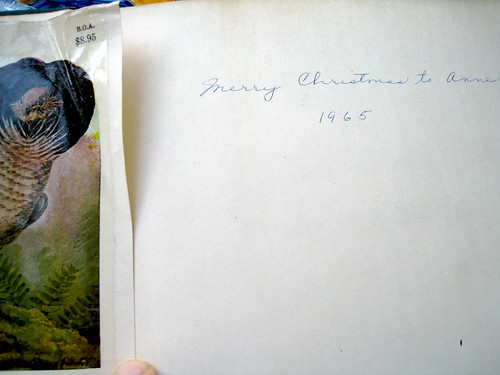
You're not gonna get this book into the pocket of your birding vest—it's bigger than The Joy of Cooking. I own only one bird book that larger and heavier than The Crossley ID Guide: the reprint of the 1917 Birds of America I got for Christmas in 1965. Edited by T. Gilbert Pearson, with color plates by Louis Agassiz Fuertes, its dust jacket proclaims in all caps, "This is the perfect, permanent bird book for all ages." Did the publisher mean it was perfect for a 14-year old as well as a 41-year old? Stone Age as well as Bronze Age? Industrial as well as Digital?

Like Fuertes' published paintings in Birds of America, Richard Crossley's plates are large, showing the species shown in its typical habitat. Crossley is not a painter however, his color plates are composite photos. Numerous photos of the bird are set against a background of the typical habitat. In the foreground of the of the composition appear a few close-up photos of the bird, each in a different plumage. In many plates, the middle ground displays several images of the bird in flight. In the distance are proportionally small images of the same species. Crossely's purpose is to pack as much identification information about the species into one scene as he can; how it may appear in flight, at rest from the side, viewed from the front when feeding, in the distance where streaks seem to blend into a wash of color.

At first I found these scenes a bit like a backlot studio shot in an old movie—I was distracted by the background. The more I looked at the page however, the more the images appeared 3-dimensional. Crossley is not trying to depict field marks. He asks the reader to look over the complete image, focusing first on this bird, then that, putting those photos of variable plumages and postures into context. In Japanese films, the director often gives the audience a wider shot than we're used to with Hollywood movies; the viewer, not the director, decides what to look at within the frame. Crossley's approach is more Kurosawa than Corman.

It will take me a long time to go through this book, but I'll use one plate as an example of the role this book can play in your birding toolbox. When I first moved to Kirkwood in the 80s, I occasionally saw what I called "the mystery bird." Its wings were swept back like a gull, but the tail wasn't the right shape for a gull. Sometimes I'd see a distant bird with a leading edge so straight that it appeared to be headless. It's flight was so effortless and acrobatic, I thought it might be a falcon. All of these are shown in the tiny distance shots on page 239

Ruffed Grouse peers in from the dust jacket
to read the 1965 version of an interactive comment.

The fact that I can point you toward that page whether you own the book or not is another feature of this birding guide that Peterson and Pearson never dreamed of; it's interactive! I can try to soak it all the images on the printed page, but if I need more information, I can find it with a click on the website. The web version has labels, comments, and questions not included in the book. Of course, you can "like" it, make comments, or leave questions for the author on Facebook too. Adjusted for inflation, at $8.95, Birds of America was roughly 3 times the Amazon price of The Crossley ID Guide!


If you wrote about this book on the web and I haven't listed you below, I'd love it if you'd comment and give us the link!
10,000 Birds
The Bird Chaser and second post
Audubon Magazine
Birdzilla.com
Monarch's Nature Blog
The Bird Booker Report
Sapsucker Woods (gift shop of Cornell U)
What Bird Forum


Wednesday, February 9, 2011

The Macaulay Library of Animal Sounds

Sapsucker Woods, Cornell University          photo by eflon
We were just settling in for the night. We had already tested the hammocks to see how far you could swing someone before she'd land with a thump. Our scout leaders were tucked into a cabin, farther down the hill. We were on our own. Suddenly, we heard the most hair-raising sounds! We had no idea what creature it was, but there would be no sleep that night.

I've wondered about those shrieks for a few short decades, and I think now I can identify the shrieker. After searching the Macaulay Library of Animal Sounds from Cornell University, I can say that we probably were hearing two wrangling raccoons, although there was more screaming than you hear in this recording. The Macaulay Library is, "The world's largest natural sound and video archive of animal behavior."

There are other sounds on my Website Wednesday featured site that are not conducive to sleep, like this Western Diamondback Rattlesnake, recorded in--of all places--Sapsucker Woods, Ithaca, New York. Another animal sound that scared the living daylights out of me was the snort of a white-tailed deer. Call me a wimpy kid if you must, but that snort can be spine-chilling!

You can select broad categories like arthropods, or fish, or search by common or scientific name. Notes are available giving details of the equipment used and sometimes the recordist or videographer. One recording I found is an 87 minute interview about amphibians held in Buenos Aires Wildlife Refuge, a really fascinating place in southern Arizona. Frogs caterwaul in the background.

There's lots of video too, including this one of a beautiful mountain lion. The video was shot by Tim Barksdale, former St. Louisan and Webster Groves Nature Study Society member. Video and audio from this site is copyrighted, so I can't post it, but hopefully you'll use these links and enjoy them.

I was able to embed the mountain lion audio from the Missouri Dept. Conservation's article about the confirmed cougar sighting in Chesterfield (St. Louis County, MO), that I wrote about a few days ago. Click the play button below. If we had heard anything like this, we would never have camped again!


Courtesy of Missouri Dept. of Conservation.

Wednesday, January 19, 2011

Website Wed: Illinois Wildflowers

Missouri Evening Primrose is pollinated by Sphinx moths. AMcC
I use lots of references for my blog posts; books of course, and websites. The websites have some advantages:
  • I don't have to buy any bookshelves for them.
  • They aren't heavy.
  • They don't pile up on my desk.
  • In most cases, they're free.
One of my favorite reference websites, and the subject of this week's "Website Wednesday," is Illinois Wildflowers. True, I don't live in Illinois, but I'm only about a 20 min. drive away and our states share most plants. Written by Dr. John Hilty the home page offers categories or chapters, including, wildflowers of Prairie, Savannah and Thicket, Wetland, and Woodland. If you're not sure which category the plant fits into, scroll to the bottom of the page and use the "custom Google search" to go through the whole site. 
Once you've chosen a category, you'll see an alphabetical list of scientific names, each with an common name. Click on your plant of choice and you see a full-page article. Not only is there a color photo and written description, but he gives advice for growing the plant in a garden. Click on the hyperlink "Distribution Map" and a map of Illinois pops up, with shading on the counties in which the plant is found. My favorite part is "Faunal Association." Hilty lists the birds, mammals, and insects that use the plant for food. If you like to see butterflies in your garden, this is really helpful for finding plants that caterpillars love! 

Wednesday, January 12, 2011

Heavens Above

Northern Lights and Iridium Satellite flare light up the Alaskan sky-photo by Jason A

A few years ago, as part of St. Louis Community Colleges “Master Naturalist” certificate program, I signed up for a short course on night sky viewing, sponsored by St. Louis Astronomical Society. Our instructor, Mike Malolepsky, took us out to the center of campus in the twilight to see an Iridium flare. He explained that the Iridium communication satellites—there are 66—have flat-surfaced antennas, shielded with shiny aluminum. As the satellite rotates, sunlight glints off these mirror-like panels. When the angle between the panel and the sun is just right, that flash hits a small area of the planet, visible to anyone looking in the right spot.
Mike pointed to the right spot and we stood around, looking up. A small crowd of curious students began to gather around us. Then POW—a small but brilliant flash of light appeared in a sky that was still bright. Two young women in the crowd, who had not heard the explanation, actually clutched each other in fear. Possibly they envisioned an impending alien abduction. The flare lasted for several seconds, and those of us who were informed were just as stunned as those who weren’t.
The magnificent photo above, taken by Jason A. about 30 miles east of Fairbanks, Alaska, shows an Iridium satellite flare in a sky colored green with the aurora borealis. The view in the photo is not quite the same as what we see. Jason left the shutter open for 15 seconds in order to capture the light. The observer sees a burst of light, but the photo shows a streak as the flare moves from left to right, as Jason explains. Just as wonderful is the reflection of the flare and the green sky in the lake. Thanks for making this photo available to us, Jason!
How in the world did he get such an image? Was it just luck that his camera was pointed at this precise area of the sky? And how did Mike know where and when to tell us to look? The answer to this riddle is our Wednesday website: Heavens Above. Chris Peat maintains this site that gives predictions for the movements of satellites, International Space Station, planets, sun, moon, and even minor planets.
Heavens Above
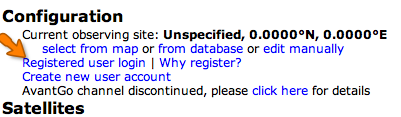
For accurate information, you’ll want to register and log in. Seeing a flare depends on your latitude, longitude, and elevation, all of which you record for your location when you register. The prediction is given in local time, using the 24-hear clock, and intensity or magnitude. For those new to astronomy like myself, lower numbers mean a brighter flare. Thus, a flare of a –8 magnitude is predicted to be brighter than a –4. The table also provides the altitude, or angle from the horizon to the point of the flare, and the azimuth, or direction in which to look, measured in degrees of the compass; north is 0°, east is 90°, and so on. Peat even tells you which satellite you’re viewing! Global Positioning Systems (GPS) are helpful I’m sure, but not necessary. Bring your binoculars along when you step out to view an Iridium flare—amazing!
Can’t get enough Iridium flares? Explore the photos in the Flickr group, “Iridium Flares!” Many of the members in this group share advice to photographers about exposure, etc. For more links and diagrams, check out the Visual Satellite Observer’s pages.

Wednesday, January 5, 2011

Website Wednesday: The Owls of Harry Potter

Laura Erickson and Archimedes share their love of birds
and Harry Potter with children. 

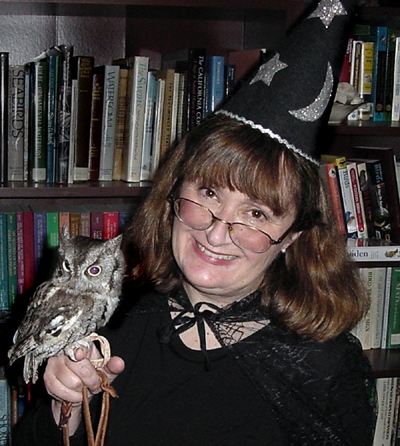
Laura Erickson, seen here as “Professor McGonagowl,” is a well-known author of The Bird Watching Answer Book: Everything You Need to Know to Enjoy Birds in Your Backyard and Beyond, 2009, Sharing the Wonder of Birds with Kids, 2002, and For the Birds, An Uncommon Guide, 1993. Her web page, The Owls of Harry Potter, packs a lot of information into a small space. Designed to appeal to young fans of J. K. Rowling’s books, “The Owls of Harry Potter” introduces each owl that’s a character in the novels, then provides a photo and its proper name. She discusses the natural—as well as magical—range of each owl.

The owl people most often associate with the Harry Potter movies and books is Harry’s own messenger owl and pet, Hedwig. Hedwig is a Snowy Owl, a bird of the Arctic tundra. Hedwig is of course female, but Erickson points out that she is played by a male bird—actually, 7 of them—in the films. Female snowies have black barring on the crown, back, and chest. Young males are barred, but usually not as much as females. As they mature, the plumage grows white. Presumably the director felt that a pure white bird would look “snowier.” They are magical birds, especially when the French horns and celesta of John Williams’ “Hedwig’s Theme” play in the background.

Whether Snowy, Great Grey, or Scops, an owl is a wizard’s letter carrier of choice, but we notice there is no junk mail in the wizard world. Muggles like ourselves are annoyed by it and, more to the point, millions of trees are destroyed so that our mailboxes can be filled with useless, unread messages. As you would expect from the author of 101 Ways to Help Birds (2006), Erickson includes ways to help owls by precycling, that is reducing the stream of junk mail and excessive packaging. She even includes a link to a publisher that uses 100% recycled paper in the printing of Harry Potter!

Really—which one is cuter, Laura or Archimedes? I contacted her to ask for permission to use this photo and inquire after her Screech Owl. She replied, “Archimedes is my own licensed education owl—I’ve had him since 2000. He was unreleasable after an illness as a nestling, and the rehab center had to find a safe place to transfer him right when my license had been approved but I didn’t yet have an owl. He’s still doing well.” Erickson maintains 2 blogs worth visiting too: Twin Beaks, and Laura’s Birding Blog.

Wednesday, December 29, 2010

Website Wednesday: Views of the Ock


View Otters 2010 in a larger map
40 years ago, Arthur C. Clarke predicted that data transfer would “bring the accumulated knowledge of the world to your fingertips.” Substantially, Clarke was correct, if only it could all be found. A year and a half ago it was estimated that there were something close to 110 million websites, and that’s just in the surface layer of the web that search engines survey. I throw my hat into the Internet search arena with “Website Wednesday!” Each Wednesday, I will try to find a site for the nature-lover that is useful, surprising, entertaining or just plain gorgeous. Let’s go to Views of the Ock for a start.
  
I enjoy reading blogs about travel to exotic places, about people who compete for the longest list of birds, but there’s a lot to be said for appreciating and adding to the understanding of your own back yard. Richard is a “back yard blogger” in Britain. The Ock is a tributary of the River Thames, which flows through the Richard’s neighborhood.
  
Just because the territory is limited doesn’t mean the subject is narrow. He covers a great variety of topics, all accompanied by beautiful, or sometimes interesting photos. Did you know there is a special word that means “otter poo”? Neither did I! You gotta love a guy who creates a Google map of otter spraint (seen above). He shares photos of tracks and signs he finds in monthly otter surveys of the Ock, as well as water vole surveys. There are lovely photos of the countryside as well as the town of Abington in snow. He explores an ancient beech forest, full of trees in fantastic shapes, rare insects and even a rare fungus. He studies cuckoo bumble bees, mushrooms, damselflies and moths.
  
I first became aware of Views of the Ock when Richard left a comment on my post about European Starlings and their behavior in flocks. Unbeknownst to me, he had written about Starling flocks some weeks earlier. My vocabulary expanded again, when I found there is a special word for startling flock: “murmuration.” And I have to say, I was thrilled when he included my post in his list of “favourite blog posts over the last 12 months.” Be sure to check out Views of the Ock as well as the other blogs he links to in his “Blog Roll Review of the Year.