Showing posts with label tree. Show all posts

Tuesday, July 12, 2011

Fruits of Summer


Indian Cherry, Rhamnus caroliniana, is a shrub or small tree of dry, rocky glades, but it's also found near streams. It has a patchy distribution, show in the US Geological Survey map below. In Missouri, it's found south of the Missouri River, mostly in the Ozarks.
Range of Indian Cherry, USGS

The photo above was taken just a week ago. Now some of the fruit is beginning to turn red. The "Indian" part of it's name may be related to it medicinal use by Native Americans. According to Don Kurz in Trees of Missouri, they used it to induce vomiting. It's surprising how many plants were used as emetics in traditional medicine. I really don't get that.

Indian Cherry is also known as Carolina Buckthorn, even though it has no thorns. Wikipedia says its fruit ripens in summer, Dave Tylka, in Native Landscaping for Wildlife and People, says fall. This is the first time my little tree has fruit, so I'll let you know.


Pipevine fruit

Here's a mysterious fruit! My pipevine, Dutchman’s Pipe, Aristolochia macrophylla, is 5 or 6 years old and it's also bearing fruit for the first time. I haven't been able to find anything about the fruit, except that like the rest of the plant, the fruit is poisonous. Pipevine blossoms are pollinated by tiny flies that get temporarily trapped in the weird little flower, so who knows? Perhaps some of the flies that pollinated my pawpaw tree performed the same service for the pipevine. Of course, I grow pipevine for the butterflies it attracts, not the poisonous products. I've written about the vine and the fascinating butterfly in earlier posts.

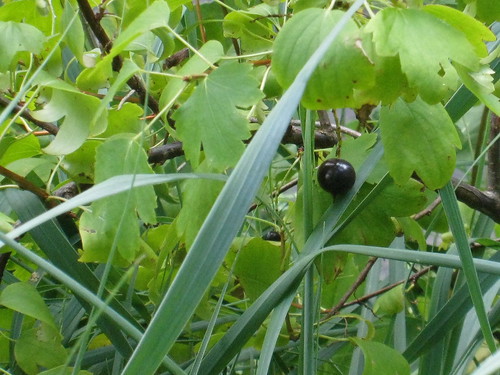
But wait! there's more! Not only have my Pawpaw (see previous post), Indian Cherry, and Dutchman's Pipevine borne fruit for the first time this year, my Golden Currant, Ribes odoratumhas joined in! There are four members of the Ribes genus native to Missouri, two gooseberries and two currants, but unlike its cousins, this shrub has no thorns. I wrote about Golden Currant's pollinators and fragrance this spring. It's fruit is ripe right now.
Golden Currant

Productivity in my small native plant landscape is pretty gratifying—a bit like my blog, which is now 1 year old! 


Friday, May 13, 2011

Pawpaws and Pollinators

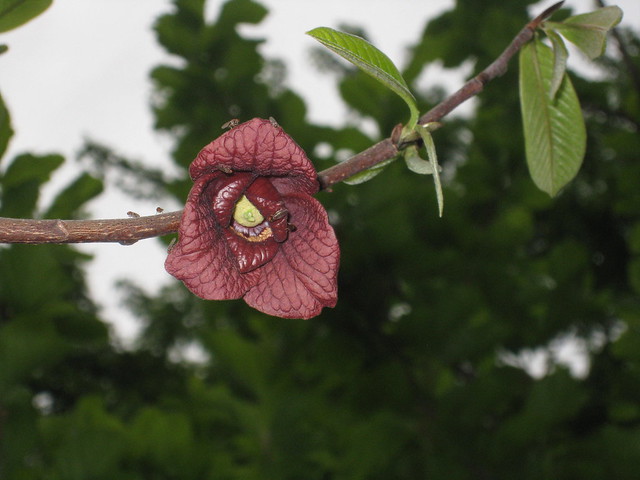
With large, tropical-looking leaves, and a dark, mysterious flower, the Pawpaw (Asimina triloba) is the kind of tree Tennessee Williams would have planted next to the magnolias, if he had been into gardening. The blooms look like a dark red bell hanging below the branch. The dark color makes them less than showy than a Flowering Dogwood, but attractive, especially when backlit by the afternoon sun. It’s the classic Missouri bottomland tree, but when I mention that it’s pollinated by flies because the bloom looks like roadkilll—well, it turns people off.

I wrote about Pawpaw’s relationships with butterflies and moths last July. Still, people imagine, as I did, a Pawpaw in bloom, swarming with big hairy flies and a putrid odor wafting on the wind. Nothing could be farther from the truth. I took the photo above on April 20, but when I downloaded it from the camera and the photo filled the screen, I saw the flies for the first time. The flower was about 2 inches across at its widest point. I would have had to wear my reading glasses to see the flies.

Pawpaws don’t make it easy on a pollinator. To bear fruit, the bloom needs pollen from an unrelated Pawpaw. What’s more, process depends on a pollinator that is believed to be inefficient, sloppy, and promiscuous—that is, it’s like to visit many things other than a bloom of a Pawpaw.
Gosh, the flower looks alarmingly fleshy in this extreme crop! Those flies look pretty scary too, but the red eyes in the photo are caused by the flash.
  
Ted MacRae at Beetles in the Bush wrote about Pawpaws last May. In comments,  James Trager, entomologist and restoration biologist at Shaw Nature Reserve, wrote that the tree is likely pollinated by fungus gnats. Fungus gnats are important pollinators, but the critters in my photo don’t have the comparatively long legs I associate with gnats.

I posted my photo on Bug Guide to ask for some ID help.  One person suggested that they could be lesser dung flies. I estimated that the fly was 2 mm long or less—about the right size for dung fly family (Sphaeroceridae).  The Wikipedia article states that dung fly larvae eat fungus or bacteria on rotting vegetation. Another user on Bug Guide suggested that because the blossoms are stinky, they must be some type of carrion fly. That brings us to the next question, what does a Pawpaw blossom smell like? 

I headed out to the tree again and got up close and personal with the flower. It didn’t smell like roadkill, or dung—it had just the faintest odor of yeast. I could only detect the scent when my nose touched the bloom. Of course, yeast is a fungus, so fungus gnats and lots of other decomposers should find the fragrance attractive. But why be shy about the aroma if the plant really wants to be pollinated? 

I have some ideas about that. First, just because the odor is hard for me to detect doesn’t mean that it’s hard for insects to find. Although I had been thinking that there was only one specialized organism that pollinated Pawpaws, I found this statement in a 2001 article in Ecology and Society by Carol Ann Kearns:  "Many species of flies are generalists that visit multiple plant species." There are probably a number of different fly families that offer their pollination services to Pawpaw, though the flies don't seem to get any reward. 

Second, it's possible Pawpaw is a bit conflicted about this whole fruiting process. According to California Rare Fruit Growers, because each bloom has more than one ovary, "a single flower can produce multiple fruits." Add to that this advice to growers resorting to hand pollination, from a 1990 article from 
Kentucky State University Cooperative Extension Program: "
Do not overburden the tree with fruit, as this will stress the tree, resulting in smaller than normal fruit, and may cause limbs to break under excessive weight." Perhaps half-heartedly attracting an inefficient pollinator is Pawpaw's adaptation to it's own heavy fruit.

Thursday, March 24, 2011

For a Few Bags of Gumballs

Into each life, some Sweet Gum balls must fall. AMcC
Spray them gold if you must, but how many can you really use for decorations? Over at Nature in the Ozarks, Marvin has quite a list of nicknames for them, like "monkey ball" and "bommyknocker." Here is suburbia, we often use names that are, well, less polite. I'm talking, of course, about the dreaded, despised, despicable Sweet Gum ball. I spent hours this week scooping up the winter's load of gum balls, filling more than 4 huge paper "yard waste" sacks. After yesterday's high winds, the yard and driveway are just as covered as they ever were. This morning, my poor old long-haired dachshund came in with a half-dozen stuck in her tail. Steve Niks, at About.com, found that Sweet Gum tied with the misnamed Tree of Heaven for "Most Hated Tree in America." So reviled is this barbed ball, that home owners sometimes lay out thousands of dollars to have the tree removed.

That's too bad because Sweet Gum, Liquidamber styraciflua, is really the archetype of trees. It's a big, healthy tree, and if utility company tree-trimmers don't come after it, the Sweet Gum will grow into a perfect pyramid. It doesn't have disease problems like crabapples. It won't split up in a storm, like Bradford pears. It doesn't stain your car, sidewalk, and white siding like mulberry; doesn't stink to high heaven like a Gingko. It's not invasive; in fact, it's native to Missouri and the East all the way south to Central America. What's more, according to USDA Forest Service, it won't produce the dreaded "cukoo bir" till it's 20 years old. So, if you're planning on moving within 19 years, go ahead and plant one! If not, be advised that Trees of Missouri, by Settergren and McDermott, records a tree in Tywappity Bottom (now Scott County in southeast Missouri) that was 140 feet tall and 5 feet wide at the trunk.
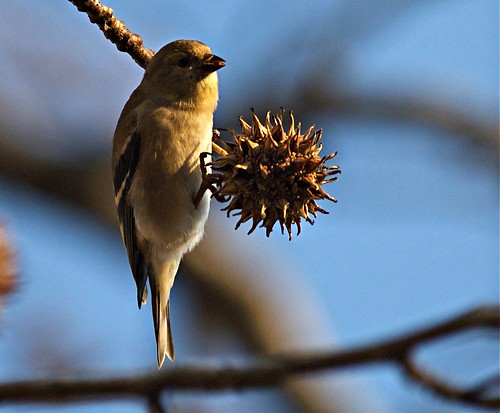
Tom Davis managed to capture an image of a winter-plumaged Am. Goldfinch with a Sweet Gum seed in its beak!
The leaves are five-pointed stars, a beautiful deep green in summer. Fall color is red and purple—out of this world! Sweet Gums are excellent shade trees. My neighbor's trees shade my roof, according to the USDA Forest Service, reducing my cooling costs by 30%, and 10-50% reduction in heating, according to the Missouri Dept. of Conservation

Saint James is the Sweet Gum Capital of Missouri, although even in that fair city, there seems to be some controversy about the "conkleberry."
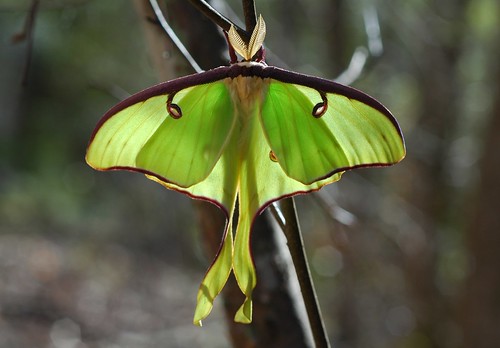
Freshly emerged Luna Moth, photo by Sophro
There are creatures that love Sweet Gums: finches, squirrels, luna moths and, reportedly, a few suburban humans. In his book, Caterpillars of Eastern North America, David Wagner lists Sweet Gum as one of the hosts of Luna, Regal (Royal Walnut), and Promethea moths. Worth a few bags of gum balls, don't you think?

Sunday, February 27, 2011

The Phantom Forest

The name is intriguing: The Phantom Forest Conservation Area. Is it a wooded area troubled with ghosts? Does it seem to be a forest, but when visited, it vanishes into thin air? I've been wanting to check it out since I first spotted the sign last spring, but road construction made it impossible to access, then school started, etc. Today I was nearby, and the temperature reached the low 60s.

I've been wanting to apply the techniques I've learned from Forest Forensics: A Field Guide to Reading the Forested Landscape, by Tom Wessels (2010). The title of the book is well chosen, because Wessels's expertise is deducing the the history of the land using evidence of human use (or lack thereof).  The book is organized as a dichotomous key.
1A. Is the land smooth and even? Go to 2A.
1B. Is the land not smooth and even? Go to 2B.
I'm just a beginner at these techniques, but here's a few things I found in the Phantom Forest Conservation Area:
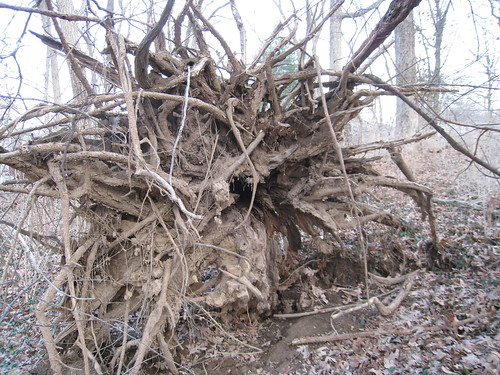
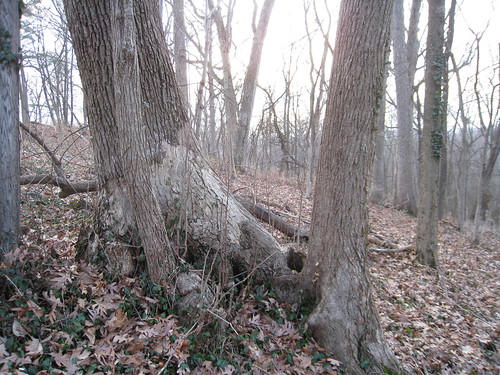
The ground is not smooth and even. When live trees are blown down in storms, the base is pulled from the ground roots and all. As in the photo above, as cavity or "cradle" is left where the tree once stood. As the roots and trunk decay and the dirt falls away, a mound or "pillow" is left. This area is too uneven to have ever been plowed crop land, but neither is the forest old growth. The windblown trees are not decayed and there is no evidence of old, eroded pillows and cradles.
There are many double and multiple-trunked trees, which can be evidence of past logging. The main trunk was harvested, and sprouts—now mature trees—grew from the roots. Like almost every inch of Missouri, this site was probably logged in the first half of the 20th Century.

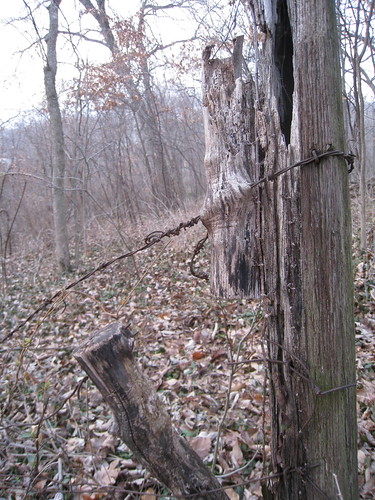
Barbed wire suggests that after logging, at least the downhill portion of this site was once a cow pasture. I don't know how to age the barbed wire, but the fence has been long abandoned.
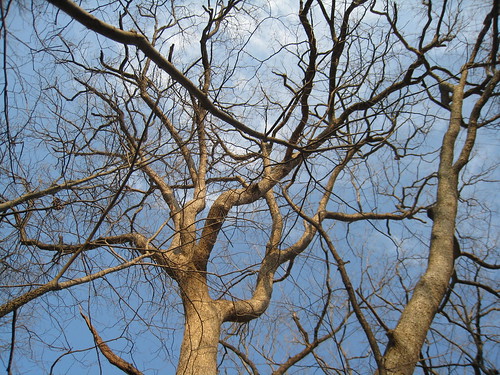
The spreading limbs of the mature oaks also show that the tree grew in an open field, not shaded in a thick forest.
Next to an old, cement foundation, an abandoned tub is overrun by non-native winter creeper. Other non native plants such as yucca and white pine grow near the old home site. 
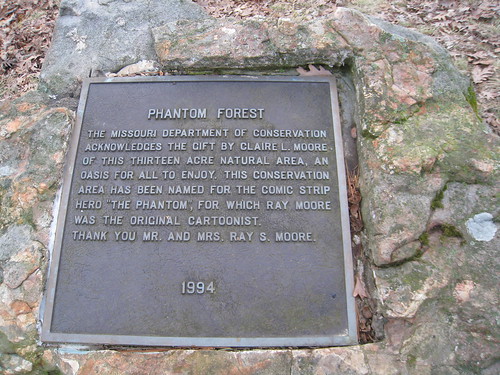
Above the old home, I came upon this plaque. I didn't expect to find the answer to the riddle of the name of the conservation area so easily. The mysterious Ray Moore was a Missourian. The Phantom strikes again!
Image courtesy of Wikimedia Commons


Wednesday, February 23, 2011

Earliest of Trees

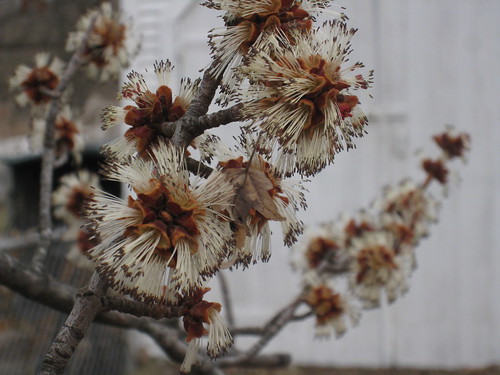
Housman called the cherry, "The loveliest of trees." Well, the Silver Maple (Acer saccharinum) may not be the loveliest, but it is one of the earliest bloomers. According to Don Kurz' Trees of Missouri, it may bloom as early as January in our state! It prefers moist soil and is common along creeks and streams. It is a prolific seeder, and the "whirlibird" seeds (samaras) find their way into urban yards, alleys, and vacant lots. Those early flowers are not showy, but nevertheless they're welcome, especially after the amount of snow and ice we've had in the midwest this year. They must be even more welcome to the hardy insects that venture out in the short winter thaw.

Silver Maple gets its name from the underside of the leaves, which shows white and pale green. When the wind whips these leaves, displaying that silvery underside, you know you're in for another summer cloudburst.  Limbs are likely to crash down to the yard during that storm since the wood is brittle. Ice storms take their toll too. After a limb splinters, the tree often develops heart rot. In a few years, screech owls or starlings might make a home in the cavity.

I've never heard of anyone tapping Silver Maples for sugar, but according to GardenGuides.com, although its sugar content is low, the syrup has been used to treat coughs and liver disease.

I snapped my photos of the maple blooms last weekend. Houseman said in A Shropshire Lad:
And since to look at things in bloom
Fifty springs are little room,
About the woodlands I will go
To see the cherry hung in snow.

Monday, December 6, 2010

Waxwing Party at the Pond

White lines on the back and red "wax" AMcC
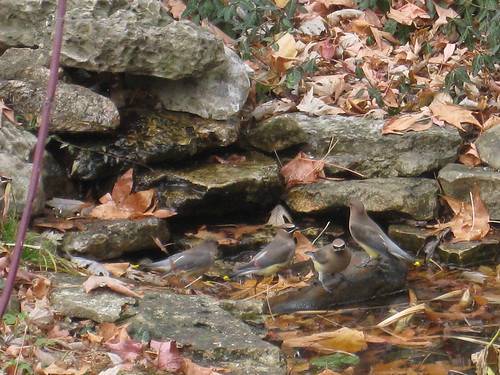
The Cedar Waxwing is a lovely bird with silky smooth feathers, a jaunty crest. and a mask that makes him look like Zorro the Avenger. They are expectable in winter, but unpredictable and easy to miss when you’re out birding in my area. So when a flock of Cedar Waxwings dropped by my yard some days ago to visit my little swimmin’ hole, I grabbed my point-and-shoot camera a got a few shots.

I never really noticed the striking white lines on the back that show in this photo, but then I don’t often have a view looking down on Cedar Waxwings. The white edge is formed by wing feathers close to the body (the tertials). Usually I see them high in the sky, calling to each other in the flock with a high-pitched “Seeeee!”

Joined by a few Dark-eyed Juncos and a small group of Pine Siskins, the waxwings bathed the way they do everything; enthusiastically, and with friends. The Birder’s Handbook; A Field Guide to the Natural History of North American Birds, by Ehrlich, Dobkin, and Wheye, describes the exact behavior we see in this photo. They use their wings to splash water up onto the back, while holding the tail up and head back to “form a cup” (Birder’s Handbook, 1988, 429).

This waxwing uses his wings and tail to form a cup. AMcC 
Cedar waxwings are very fond of the blue “berries” of Eastern Red Cedar (Juniperus virginiana). Although they are round and appear as berries, they are really the female cones of this evergreen tree. According to Dave Tylka, in Native Landscaping for Wildlife and People, the cones are low-fat and low-sugar, which means that birds will ignore them until late winter when all the high-fat dogwood, sassafras, and black gum berries have disappeared into the crops of fall-migrating birds. Cedar berries are a reliable reserve food--sort of like oatmeal. If you can’t get a Belgian waffle, you take what you can get.

Waxwings have been found to digest cedar berries in 12 minutes flat! Research shows that seeds that take the short outing through a waxwing’s digestive tract triple their chances of germination. Of course, within 12 minutes the bird may travel, depositing the seed many yards away from the shade of the parent plant.

The fondness for cedar berries accounts for the first part of the English name, but what about that strange surname? Waxwings are named for the waxy material on tips of the secondary wing feathers of adults (The Sibley Guide to Bird Life and Behavior, Elphick, Dunning, and Sibley, ed. 2001, 484). Only adult birds have this, and it’s very hard to spot, in spite of the fact that the Wikipedia article on Cedar Waxwing calls it “the bird’s most prominent feature.” Birds were named during the era when devotees of birds carried shotguns, not binoculars. Those early “birders” named birds for features that stood out as unique while holding the bird in hand, not for field marks as we think of them today. Sibley says that this material feels “more like plastic,” so I’m guessing he’s handled a few waxwings in hand too. This red “wax” is visible in my first photo.

Cedars provide wildlife with food and shelter. AMcC
Cedars are an important wildlife plant in my area. Tylka calls the cedar the number-one winter roost for birds. Besides providing winter dining for fruit-eating birds, the cones/berries are used to flavor gin, of all things. Wikipedia records that the oldest red cedar was found in Missouri. It was 795 years old.

Cedars are a “pioneer” species, meaning that they thrive in open, disturbed areas. They have invaded the open glade habitats found on west and south-facing slopes throughout the Ozarks, shading out rare glade plants. In the past, wildfire would have controlled the advance of cedars. Between habitat loss to roads and parking lots and the suppression of fire, glade species have declined while cedars increased.

The Wikipedia article on cedar also mentions their use as Christmas trees in the Ozarks, a fact confirmed by my brother-in-law. He grew up in Rolla, Missouri, in the heart of the Ozarks. They would cut a cedar on Grandma’s farm, then cut the top out. The lower portion of the tree is too scraggly to use a decoration. The house would fill with scent of the fresh cut cedar heartwood.

Thursday, December 2, 2010

It’s Tupelo, Honey!

Black Gum in October AMcC
Like Nancy Drew, I’m closing in on The Mystery of the Black Gums. Besides the puzzle of identification I talked about in my last post, whats up with the mysterious name and many aliases? This tree of moist soil has a genus name “Nyssa,” which according to Kurz refers to the home of the mythical water sprites of ancient Greece--although their home is located in the country we now call Turkey. “Sylvatica” is from the Latin word for forest.

One of its many common names is Black Tupelo. The black in black gum and tupelo I believe refers to the dark bark. According to HortNet, “Tupelo” stems from a Muscogee word meaning “swamp tree”--not very different from the scientific names. The “gum” part of the name is unexplained. I could find no reference to resin or gum obtained from this tree, though there must be some since it’s known as Black Gum, Sour Gum, Bee Gum, and Upland Yellow Gum in different parts of its range. In Martha’s Vineyard, Massachussets, says Wikipedia, it’s called Beetlebung. I know you’re thinking, “Wasn’t Beetlebung the horse that wins the race in Spike Jones’ version of  ‘The William Tell Overture ?” I thought so too, but evidently this is a reference to the toughness of the wood; tough enough to use as a mallet to drive in the stopper (bung) of a barrel. Yet another common name is Pepperidge. Except for the famous farm that produces wonderful cookies, I found nothing to explain that why a lowland tree would be growing on a ridge. The abundance of popular names suggests that human culture in all its regional variation has taken note of this tree.
photo by TW Collins

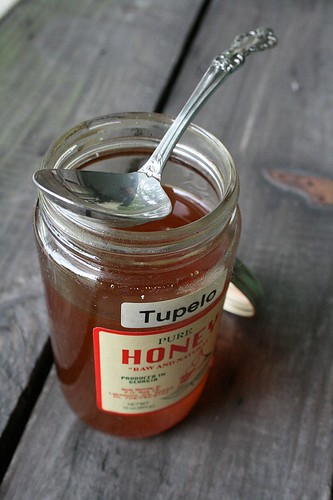
The Sibley Guide to Trees says that Tupelo has “a relatively high fructose content” (Sibley, 359), which is another way of saying, “sweet as Tupelo honey.” So perhaps the song you were thinking of wasn’t done by Spike Jones, it was written and sung by Van Morrison. Tupelo honey is a high-quality variety of honey, as well as the title of Morrison’s 1971 hit. According to the Wise Geek, the best honey is from the swamp-loving white tupelo or water tupelo, Nyssa aquatica, though both Tupelos are famed for their nectar and both are sometimes called Sour Gum. National Wildlife Federation’s site American Beauties recommends Black Gum as a bee tree, call it a “heavy nectar producer.” Thanks TW Collins for licensing your photo with Creative Commons.

Though its range just touches Vermont’s border with Canada, here in the Midwest, St. Louis is the northern limit of Black Gum’s range. Water tupelo’s range is more limited, as you would expect for a tree that requires standing water for at least part of the year. It’s found along the Atlantic and Gulf coasts, and along the Mississippi River, though it stops about 150 miles south of St. Louis.


Black Gum for the gums? AMcC


One last mystery was solved in my Black Gum research. A few short decades ago I attended a Girl Scout event that featured a competition for “Most Useful Item Made from Nature.” I met an older scout who told me that her entry was a toothbrush. Fascinated, I asked her to let me see it, but oh no, it was her secret. Then, way at the bottom of Duke University’s article on Black Gum, the answer. Too bad it doesn’t taste like Dentyne.

Sunday, November 28, 2010

The Mystery of the Black Gums

My neighbor's mystery tree in early October. AMcC
In the back of a neighbor’s property stand the mystery trees. They certainly must be wild trees. Instead of being installed in the center of the lawn, as human landscapers like to plant, these trees grew in a group along an unmowed property line. Perhaps birds dropped the seeds, along with a bit of fertilizer, while perched on the rusting remains of a fence.


At first I thought of persimmon. The chunky, dark bark seemed right. The leaf seemed right, but where were the fruits? What is with that 45° turn about a third of way down most branches? It looks like each branch has a bent elbow with palms up, saying “I dunno.”  


I suspected Black Gum, but thought of that as a swamp tree. These grew in soil that was average in moisture. I even looked with binoculars, searching for small berries without success. And I had read about Black Gum’s spectacular fall color, something that I had never noticed in these.

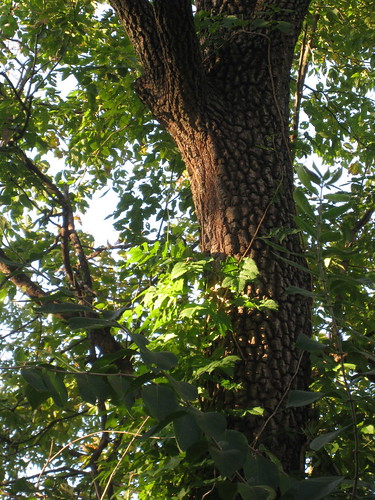
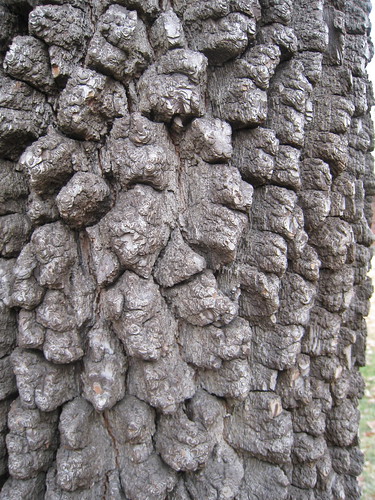
The mystery began to unravel when I read Don Kurz’ description of Black Gum’s bark as “alligator hide,” a description I had previously read applied to persimmon. He also mentions that Black Gum is “the first tree to turn color, typically beginning in August, and one of the first to drop its leaves” (Kurz, Trees of Missouri, 218). No wonder I had missed the autumn show! HortNet helped with the mystery of the invisible fruit. They note that only female trees bear fruit, the fruit blends with dark green leaves in summer, and any ripe fruit is quickly gobbled up by birds in late summer or early fall.
The Hebrew Moth, photo by Jenn Forman Orth

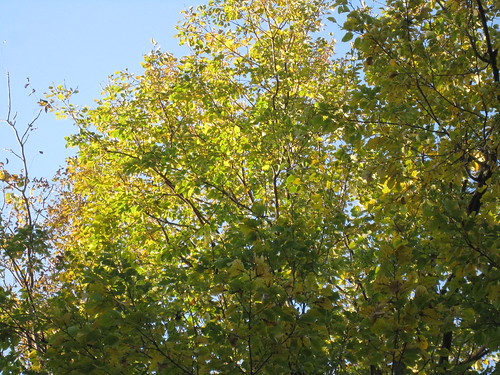
Many sources describe spectacular red fall color. This is variable. Most trees in my neighborhood--now that I recognize them--have yellow leaves in fall. I saw one young tree however that had the most beautiful red leaves, and these persisted until late October.
Most often, Black Gum is a lowland tree, but not a tree of the swamps as I had thought. It's characteristic elbow branches are interesting in winter and a great help in identifying it.

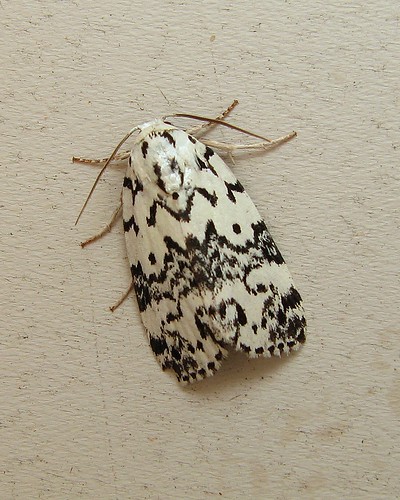
Besides being a great nectar-producer in spring and fruiting tree for fall migrating birds, Black Gum is the host plant for an interesting underwing moth, called the Hebrew moth,  Polygrammate hebraeicum. Heitzman, in Butterflies and Moths of Missouri mentions that the  larvae “conceal themselves by pressing into crevices in the bark of the host plant” (263). My moth photo comes from Flickr friend Jenn Forman Orth. Check her original in full size along with a lively discussion about the origin of its name.
The "alligator-hide" bark of the Black Gum AMcC

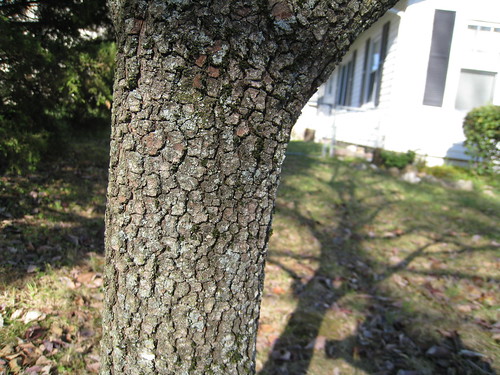
Bark of a young Flowering Dogwood forms squares AMcC
Persimmon tree bark forms rectangles AMcC


David Sibley, in The Sibley Guide to Trees, compares the bark of three similar trees. The related Flowering Dogwood has scaly bark in square blocks, the unrelated Persimmon’s bark is rectangular blocks, while Black Gum’s bark on mature trees is “deeply furrowed.” I see this not only on the trunk but also on large limbs. Perfect for hiding a caterpillar! 


More mysteries to come in my next post…

Sunday, November 7, 2010

Binoculars for Your Nose

Eastern Witch Hazel is the last tree to bloom in the Midwest. AMcC

I stepped outside on a calm autumn night last week. A fresh, citrus scent was in the air. It reminded me of witch hazel in bloom. That couldn’t be, of course, because my big hybrid witch hazel (Hamamelis x intermedia ‘Arnold Promise”) blooms in February. Then I remembered my other witch hazel tree, a scrawny little guy, completely overshadowed by big brother Arnold and my neighbor’s silver maples. When I bought my home in the 1980s, I knew I wanted a witch hazel tree. I was in love with the one that bloomed by the east wall of the Missouri Botanical Garden in late winter. I knew there was a native variety, but I wasn’t aware of any native plant nurseries in my areas at the time. I ordered Eastern witch hazel (Hamamelis virginiana) from a native plant nursery in the Appalachian Mountains and planted it about the same time as the Asian hybrid. According to Don Kurz’ book, Trees of Missouri, I ended up with a tree that is native to the Ozarks, though not to St. Louis County, Missouri. Two short decades zipped by with only the puniest of blooms, on the slenderest of twigs. Now this fragrance in November…

The next morning I confirmed it; my skinny 12 foot-tree was covered in bloom! The scent is wonderful, but it can be elusive. You can stand right next to a branch in full bloom and not be aware of it. You can be twenty feet away in the dark and know it instantly. Like all scent, it’s hard to describe with words: something like an orange, but lighter. I say full bloom, but that’s “full” by witch hazel standards. The petals are narrow ribbons of yellow, half-inch-long or a bit more. The blooms are often clustered together, without stems. 

With a shovel and a bit of determination, it’s not too hard to remake your perennial border. It’s a little tougher to remedy mistakes with trees and shrubs. If I were to remake the trees in my yard, I’d give my Eastern witch hazel a spot with more light, farther away from it’s winter-blooming relative. Both are covered in golden leaves in fall. One is the last tree of the year to bloom; the other is the first. 

According to John Hilty’s website, “Illinois Wildflowers,” Eastern witch hazel is pollinated by flies, but also a few moths, wasps and beetles. The plant doesn’t need showy petals, streaked with guides to direct butterflies and honey bees to the goodies. It does need scent, and so do I.

Scent may be the most neglected of human senses, but it’s more important than we admit. Grocery store shelves are filled with scented candles, scented oils, scented gel sticks, scented night lights, and scented trash bags. A popular fabric softener comes in 23 different varieties. On their website, you can search by “scent type”: “airy fresh” or “modern exotic.” 100 ml. spray bottles of perfume (3.4 oz) can sell for $100 and up. Gas stations sell air fresheners too. They say “New Car Scent” just flies off the shelf. Fragrance is of the essence in the garden for both humans and pollinators, as I mentioned in “Creatures of the Night.” It might be nice to have a device to amplify our sense of smell. Binoculars for your nose, perhaps?

Tuesday, July 27, 2010

Way down yonder in the Pawpaw patch

Zebra Swallowtail nectars on Dogbane, photo by Joby Joseph

The only place I seen Zebra Swallowtails in numbers is at Shaw Nature Reserve in Gray Summit, Missouri, where they were doing exactly what Glassberg describes in Butterflies through Binoculars. The group flew close to the ground, and they made quite an impression with better than 3-inch wingspan and “tails” up to an inch long. In my own yard however, I usually see a single Zebra flying near the top of my pawpaw tree.

Pawpaw leaves are large and tropical looking AMcC
I got my pawpaw at the spring native plant at Shaw Nature Reserve. It took some teamwork to get it in the car. My friend Pat and her sister helped pack the tree, all the trays of plants, and me into the back seat. We rode back home with the tip of the tree peeking out the window of the car. My motivation for planting it a shady corner of the yard was Native Landscaping for Wildlife and People. Author Dave Tylka writes that pawpaw is the “only Midwest larval food for zebra swallowtail.” Like Pipevine Swallowtail and Monarch caterpillars, Zebra Swallowtail larvae chow down on a plant that other plant predators can’t abide. In an article on Beetles in the Bush, Ted MacRae mentions the alkaloids that protect the plant’s bark and seed from insects.

Besides Zebra Swallowtail caterpillars, I would dearly love to see some fruit on the tree. At the camp where I worked many summers, a grove of pawpaws grew at the base of the hill we called Sunnytop. Remembering the song—“pickin’ up pawpaws, put ’em in your pocket”—I looked for the fruit every summer. No luck. Knowing that he had grown up in rural Jefferson/Ste. Genevieve Counties near camp, I asked the property manager, Jim LaPlant, about the fruit. Jim laughed and told me that as a boy, others had called him “a Pawpaw-eatin’ Frenchman.” Exactly what that meant I don’t know. Reportedly pawpaws are messy to eat. Is that what these mean kids were talking about? Or was it because supposedly only unpopular people would eat them? Or was it just another in the long and regrettable tradition of insulting a person by referring to his ethnic food? Well, lots of folks do like pawpaws. By golly, Pawpaws have their own Flickr group. What’s more, on September 17-19 this year, Lake Snowden, Ohio, holds its 12th Annual Pawpaw Festival. They have an atalatal-throwing contest there too and you just don’t see that every day!

Photo by Beautiful Rust

To grow fruit, a tree needs a pollinator. In the case of the pawpaw, it’s not butterflies, though it is a type of fly. Being an understory tree, pawpaw blooms early, before the canopy of trees block most of the light. It’s strange maroon/brown blossoms hang off the bare limbs. The scent has been described a rotting meat or, as Don Kurz describes it in Trees of Missouri, like fermenting grapes. I’ve never noticed any scent myself, but if I did, I don’t think I’d be confused between rotting meat and rotting fruit.

Kurz also explains a bit about the scientific name, Asimina triloba. “Triloba” refers to the 3-lobed shape of the flower. “Asimina” is a Latinized version of the French rendition of an American Indian name for the tree. I didn’t find any explanation of what that American Indian word was or what it mean. I didn’t find any satisfactory explanation of the word “pawpaw” either, except that it is  also applied to papaya, a unrelated fruit tree.

Pawpaw Sphinx moth,
photo by Seabrooke Leckle

Whether or not my tree ever bears fruit, it will one day host larvae of either the Zebra Swallowtail or the Pawpaw sphinx moth, Dolba hyloeous. Seabrooke Leckle writes about this gorgeous moth and other large moths in a 2009 post in her blog, the Marvelous in Nature.

The scent is not the only confusion. California Rare Fruit Growers state that it is pollinated by  “unenthusiastic” flies & carrion beetles. James Trager mentions that the flowers a probably pollinated by fungus gnats, a type of fly that feeds on decaying plant material. Either way, the flowers are self-incompatible—that is, they need to be pollinated from an unrelated tree if the fruit is to form. I actually found an “unrelated” pawpaw about a thousand feet from my tree. I wonder how far a 1/8th of an inch-long fungus gnat can fly?


Special thanks to my Flickr friends (credited in the caption under the photos) who were kind enough to license their photos through Creative Commons.