Showing posts with label native plants. Show all posts

Monday, May 9, 2011

Fire Pink

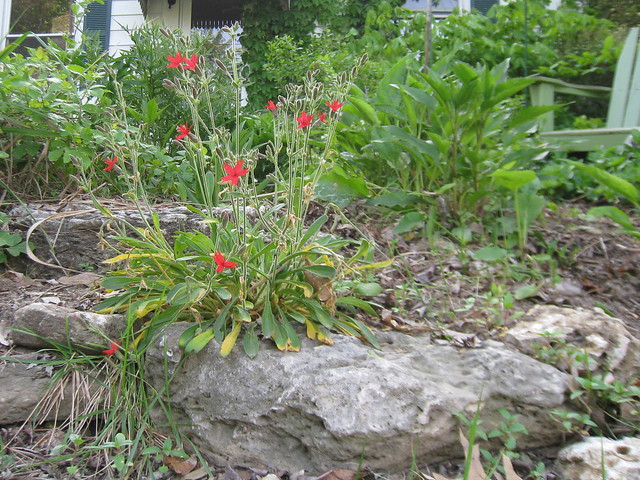
Besides having a stunning red flower, Fire Pink (Silene virginica) attracts hummingbirds, and I'm all about that! So I made a number of clumsy attempts to grow it in my garden and always failed, until last year. That's when I decided to get serious about imitating the habitat where I first found it: on a dry, rocky, west-facing hillside in Jefferson County, Missouri.

A glade garden may seem an odd choice in an east-facing, suburban front yard, but that's where I have a slope and the greatest hours of sunlight. I started by removing the Bermuda grass, and some of the dry, clay soil. I replaced it with crushed limestone, and topped that with the rocks. I had to purchase rocks that I could lift, so I looked for ones that could fit together to give the impression of a rock shelf. Then I tamped and pounded till they seemed stable. Once you install an artificial limestone/dolomite ledge, you're pretty well committed, so I really needed a success.

I had a moment of panic when I reread Kurz' description of the typical habitat in Ozark Wildflowers: "wooded slopes in sandstone, chert, or igneous soils." That suggested acid soil, not clay and limestone. As they say though, the plants don't read the books, and the Silene gods smiled on me. My Fire Pink bloomed well last year and returned for an even stronger show this year. Dan Tenaglia's website, MissouriPlants.com, has really great photos of this plant in the wild, and the rocks in his photo look suspiciously like limestone/dolomite.

The stem and calyx of Fire Pink or Catchfly are sticky. John Hilty's website, Illinois Wildflowers (which I talked about in January 2011), says that the purpose of that sticky substance is to discourage ants from "stealing" the nectar. An animal "steals" nectar when it takes nectar without pollinating the flower. Hilty says however that little is known about Fire Pink's pollinators, although is is presumed to be hummingbirds. Even though I've only seen a hummer at the blooms once, I don't have any doubt Silene is a hummingbird plant.


Saturday, January 22, 2011

Wild Hydrangea

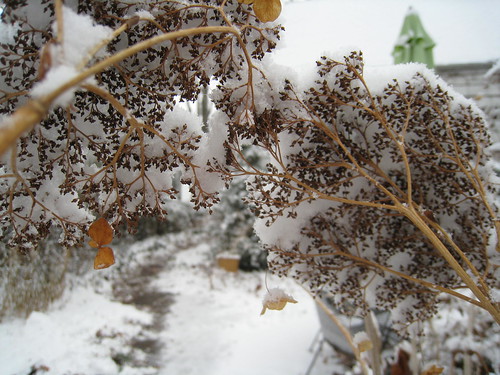
Wild Hydrangea holds on to the snow. AMcC
Low on a north-facing hillside at Girl Scout camp in the Missouri Ozarks, a large shelf of limestone protruded from the hill. Along a shallow ravine, it broke up into white, pitted boulders--some the size of a refrigerator, some the size of a pickup truck. In the deep shade grew ferns, mosses, and a few wild hydrangeas (Hydrangea arborescens). The quiet, the shafts of light through the high canopy of maples, soothing greens of the fern and hydrangea leaves, combined with the dramatic rocks to earn the area its name, "Green Cathedrals."
When no one will volunteer to crank the ice cream maker and best friends refuse to accompany each other to the latrine at night, it's time to go to Green Cathedrals. One counselor begins, saying, "On my honor, I will try." Another reads a poem about friendship. If it's the second week of the session, better sing all four verses of "Kumbyah" too--guaranteed to restore harmony in the group for a good 30 or 40 minutes.
 I don't have the same karst topography in my yard, but I can still enjoy wild hydrangea. Native bees love the flowers, because, unlike many cultivated hydrangeas, the large flower heads produce lots of pollen. Surrounding the flower head are "false" or sterile flowers with three relatively large petals. They open before the "true" flowers, and are still hanging on to my plant in the above photo, adding to the charm of this shrub. Tried and True Missouri Native Plants for Your Yard (Barbara Fairchild, ed., Missouri Dept. of Conservation, 2007) recommends pruning back branches in early spring, since most of the blooms appear on new growth. 
For a look at wild hydrangea through the seasons, click on one of these photos.

June Morning wild hydrangea June garden wild hydrangea Morning Snow on Christmas Eve

Wednesday, November 24, 2010

Bittersweet


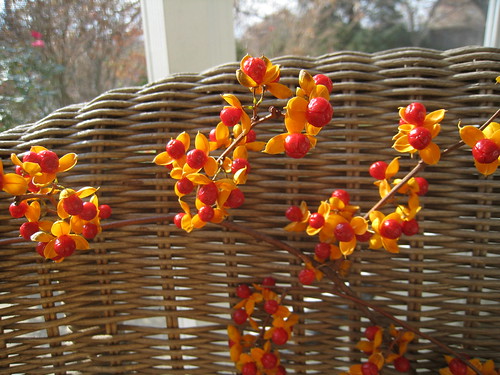
American Bittersweet AMcC
Spring is a time of easy metaphors for renewal, hope, life. Autumn, well, not so much. Lovely fall colors are cheery, but brief. Just as Goldengrove is unleaving, a magnificent vine is revealed, covered with clusters of small, shiny red fruits, surrounded by open capsules of orange. We call it American Bittersweet, Celastrus scandens. Kurz notes in Shrubs and Woody Vines of Missouri that Celastrus is a Greek name for a tree and scandens means climbing. But how did it get its melancholy English name? Perhaps its autumnal display associates it with the demise of summer, the season of loss.

We humans like to ascribe meaning to natural phenomena. The albatross symbolizes guilt; the raven, death; the lark, “blithe spirit;” bittersweet, remembrance.

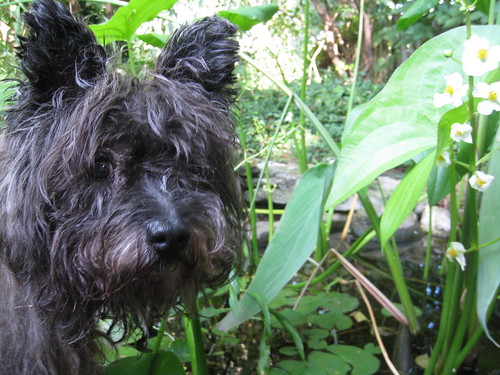
The contradictory name has been on my mind, since the furry friend you see in my profile picture died this week. For those who have experienced the death of a dear pet, I don’t need to explain my feelings. For those who have not, I don’t think I can adequately describe it. Instead, I’ll focus on the sweet memories.

Rosie and I went everywhere together for more than 16 years. She accompanied me on many birding trips, though she really preferred chipmunks, moles, and other mammals. She camped with us in the Rocky Mountains one June, and I was surprised to see her barking at two Gray Jays. She didn’t usually pay attention to birds. Then I saw one dart in and snatch a bit of her fur while the other stole a kibble from her bowl.

Rosie the Fishin' Dog AMcC
My brother-in-law called her “the fishin’ dog.” Her favorite spot was the tiny pond in my back yard. I keep a few goldfish there to eat mosquito larvae, and once she spotted them, she wanted them. She tried to catch a fish every day of her life and never succeeded. Far from being discouraged, she came back to the job fresh every time. She spent so much time in the water that one summer I had to take her to the vet for swimmer’s ear.

Like a true a terrier, she was independent. She seldom asked to sit in my lap as I watched TV, but she did like a good nature show now and then, especially if there were bears to bark at. When she was a puppy, she sat up on the bed while I watched Turner and Hooch; starring the tidy detective Tom Hanks and the untidy Dogue de Bordeaux named Hooch. She barked and jumped and generally went nuts every time Hooch came on the screen. That video was like a Jane Fonda exercise tape for Rosie.

If you grow bittersweet in your woodlot or on an arbor, be sure you get the native variety, not Celastrus orbiculatus, Round-leaved or Asiatic bittersweet. The fruits of Round-leaved bittersweet are less showy, and the plant is aggressive. As the name suggests, the easiest way to determine if the vine is native to the US or an invasive invader is the shape of the leaves. American bittersweet’s leaf is not round, but an elongated oval with a pointed tip. Sweet as they are to look at, the fruits are poisonous.

Sunday, November 14, 2010

Fragrant Sumac in the Winner's Circle


Fragrant Sumac shows great fall color AMcC
If there were a triathlon of Midwestern native plants, Fragrant Sumac (Rhus aromatica) would be in the winner’s circle.

In the first leg of the triathlon, Wildlife Use, sumac’s performance is outstanding. Fragrant Sumac is one of the earliest blooming plants in our area (Midwestern US). Small yellow flowers appear in March, which, according to the US Forest Service, are pollinated by native bees. The red, hairy little red fruits are gobbled up by mockingbirds and others, since it is one of the first fruits available in summer. Caterpillars of the Red-banded Hairstreak eat fallen, decomposing sumac leaves (Brock and Kaufman, Butterflies of North America). I have seen this butterfly in my yard, but have never observed the caterpillar among the leaf litter.

Sumacs are host plants for two spectacular moths, both with outlandish caterpillars. The Showy Emerald Moth (Dichorda iridaria) caterpillar mimics a crumpled, dead sumac leaf. I haven’t seen this caterpillar yet, and I was unable to find a photo of one online, but nature-lovers should get a copy of David Wagner’s Caterpillars of Eastern North America just to see it. The adult Showy Emerald moth is beautiful. According to ButterfliesandMoths.org (hosted at Montana State University), its range centers on Missouri.

Hickory Horned Devil, photo by Tom Woodward
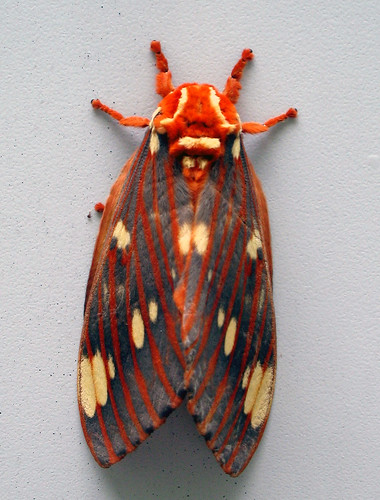
The startling Hickory Horned Devil can be almost 5 inches long! ButterfliesandMoths.org lists its food plant is “sumac.” It’s the larva of the Royal Walnut Moth, also known as Regal Moth. I haven’t seen these on my plants yet, but I’ve seen the adult moth nearby.

Fragrant sumac is a contender in the Garden Use leg of the competition. It’s a small shrub, drought-tolerant, native to glades and prairies. Dave Tylka recommends it as a good shrub for the understory of your wildlife garden (Native Landscaping for Wildlife and People). More than 10 years ago I purchased several plants of the variety named Gro-Low, named a Plant of Merit by Missouri Botanical Garden. It has formed a thick groundcover, just like I’d hoped it would. However, my plants have never borne fruit. Even though the Garden shows it with fruit, I think it is a sterile hybrid. Recently I bought three unimproved plants from a native plant nursery. They bloomed well their first spring and immediately bore fruit. In addition, I decided to experiment with a variety named ‘Konza Prairie,’ selected from the wild by the Kansas Forest Service for “its superior fruit production.” I think the natives have better fall color too, which leads me to the final leg of our triathlon.

Royal Walnut moth, photo by Cherie Priest
We’ve had a good fall for leaf color this year, though not perfect. According to Missouri Environment and Garden, Oct. 2010, (newsletter of the University of Missouri’s Plant Protection Programs) the best fall color occurs when days are warm and nights are cool. We’ve had too many warm nights in October and November this year for optimal color, but it’s still been great. The first picture above is one of my “unimproved” fragrant sumacs and its purple leaves show that the anthocyanins have done their job. In the interest of full disclosure though, there is one plant that may outrun my little Rhus aromatica
—its cousin, Smooth Sumac (Rhus glabra). This small tree has tropical-looking leaves that are dazzling red in fall. I may have to add it to my collection.

A big shout out to my Flickr friends Tom Woodward and Cherie Priest for the use of their Creative Commons photos!

Smooth Sumac's autumn show is hard to beat. AMcC


Wednesday, August 11, 2010

A Compass on the Lone Prairie

Compass Plant blooms at Howell Prairie, St. Charles Co., MO AMcC

My first reason for wanting to find Compass plant for my yard is the tale that it can be used as a compass. Now that my plants are large, I can say that the tale is true—mostly. Compass plant (Silphium laciniatum) is a plant of tall grass prairies and glades and everything about it shows is adaptated to dry conditions with blazing sun. Leaves and stem are hispid, as the botanists say; or covered with “little tiny hairs,” as Jonathan Winters would say. The stiff white hairs reflect light, effectively protecting the plant’s tissues against the sun.

Presumably, they also discourage deer and antelope from snacking on it as they play on the range. Instead of large, light-gathering leaves on a tropical philodendron, Compass plant’s leaves are large but deeply cut, reducing the surface area. Merv Wallace at Missouri Wildflowers Nursery says they look like “green flames.” The plant’s best trick is to move those leaves around during the day so that they face east and west, presenting only a narrow edge to the scorching south. Now the leaf points north, hence, the name. Of course, if the plant is shaded by something, the leaves may face any direction, so navigators beware!

Leaves point north AMcC
I wonder what the first Europeans thought of Compass plant when they first explored the tall grass prairies of the Midwest. It towers up to 8 feet, with a tough, thick stem, topped with 2 to 3 inch sunny flowers. Many sources mention that the Indians used the resin in the top part of the stem for chewing gum. The Pawnee used the dried root as a medicine, given in tea. I don’t envy the job the Pawnee women had, trying to dig the huge taproot in dry soil, using only a sharpened stick.

In Ozark Wildflowers, Kurz tells us that the Omaha and Ponca believed the plant attracted lightning and would not camp near it. It makes sense if you image mile after mile of treeless, tall grass prairie. Compass plant could very well be the tallest structure out there. Tall things can be at a premium for birds on the prairie. Meadowlarks and sparrows need to make their presence known so they can defend territory and find a mate, and Compass plant stalks are just the ticket. On a birding trip to southeast Arizona, I noticed that some of the Arizona birders tied Agave stalks to their fences, providing an attractive perch for hummers. I couldn’t get an Agave stalk into my carry-on, so I use last season’s Compass plant stalk for my hummers.

If you grow Compass plant, remember that it takes a few years for it to bloom, growing from seed. Once your plant sends up its tall stalk from the leaves at the base, stake it at least by June, with a heavy stake, driven in deeply. Out on the prairie it wouldn’t matter if a few stalks fell over in a storm, there would still be many of them blooming. But we gardeners don’t have that kind of space. Horizontal blooms don’t really impress in the garden.

Compass Plant blooming in August AMcC
Several insects depend soley or partly on Compass plant: the Silphium beetle, Rynchites sp. and the prairie cicada, Okanagana balli, which the Illinois Dept of Natural Resources calls, “the rarest large insect in Illinois.” Studies on this insect in Kansas found that although it occurs on remnant native prairies, it has never been found on a restored prairie. I was unable to find out if the prairie cicada occurs in my home state, Missouri.

Cattle and horses do eat Compass plant, according to the USDA Natural Resources Conservation Service. I like to look out at my plants and imagine buffalo grazing on Compass plant. The buffalo wouldn’t stay long in my yard—I only have two plants. I bet the plants would grow back though. Dr. John Hilty’s website says that Compass plant can live for 100 years!

Sunday, August 8, 2010

Bees, Butterflies, and Biodiesel

Monarch Butterfly on Cup Plant bloom AMcC

One of my favorite native plants is Cup Plant, Silphium perfoliatum. My first experience with it was in Hidden Meadow at Girl Scout Camp Cedarledge. My friend Sandy, whose position was “Nature Specialist,” showed me how the large opposite leaves wrap the square stem to form a cup. It had been hot and dry, but when she tipped the tall stalk, water dripped out. Pretty cool! Much later, I read about a couple who got rid of their bird feeders and planted a wildlife garden. I wish I could remember the title of the book, but I do remember that next to their windows, they planted cup plant so that they could enjoy watching the birds use the “natural birdbath.” I resolved to do the same when I got my own home.

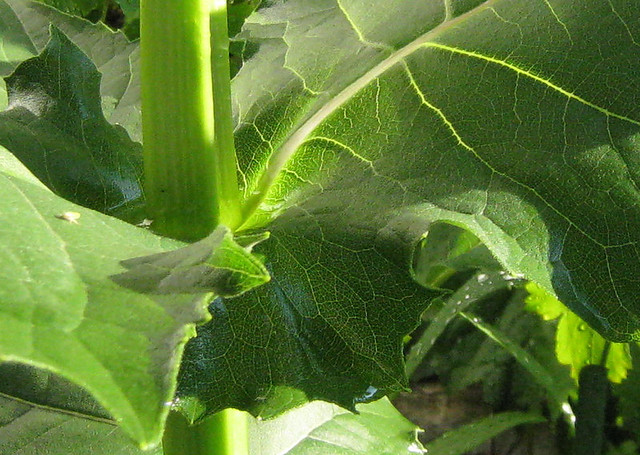
Cup plant is a true garden personality. I do sometimes see chickadees and other birds land on the large leaf and dip into the “cup” for a drink. Perhaps they also capture insects in the water. The leaf is pointed, with a jagged edge and rough as sand paper. The stem is thick, smooth, straight, and square, giving it another common name, “Carpenter’s Weed” (Kurz, Ozark Wildflowers, 121). If you were to design a garden plant that breaks all the rules of garden plant developers and hybridizers, you’d come up with Cup Plant. There’s nothing dainty about it. Now you know why I like it!

Cup Plant leaves in June AMcC

By early August, many of my plants are 8 feet tall. Plants that don’t receive as much light and water are smaller. Towering plants with large leaves filled with rainwater sometimes tip over during a storm. If you have a good spot for Cup Plants, plan on staking them up in early summer, and use a really stout stake.

Cup plant blooms are always in demand with bees of all sorts, especially bumblebees. It’s worth remembering that native bees such as bumble bees are much less likely to sting than honeybees, but if you’re concerned, don’t plant it near the door or walkway. I welcome bees and other pollinators, but I found out my mail carrier didn’t. This perennial does spread from the root, so I could afford to thin the herd. Once I removed a plant or two and staked the others up away from the box, he started delivering my junk mail again.

Leaves form a cup as they enclose the stem. AMcC
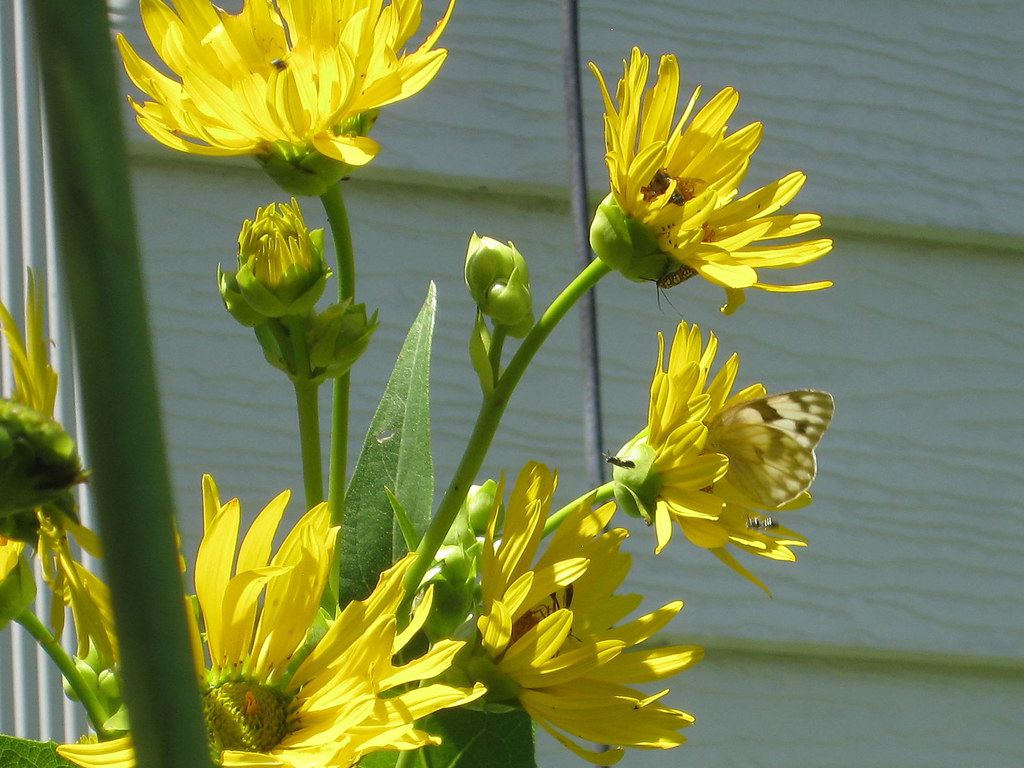
The blooms of Cup Plant are a bit more than 3 inches across. Like other members of the Aster family, they provide the perfect landing platform for butterflies. When they’re in bloom, I frequently see 4 different butterfly species in the yard at a time. Today’s Cup Plant list: Monarch, Painted Lady, Fiery Skipper, and Checkered White butterfly. Bumblebees, carpenter bees (known as “long-tongued” bees) and butterflies are the most important pollinators for Cup Plant. When it goes to seed, American Goldfinches, House Finches, and (on rare occasions) Pine Siskins will visit.

Butterflies and Moths of Missouri, by J Richard and Joan E. Heizman (1987) mentions that the caterpillar of a moth, Eucosma giganteana (no common name), bores into the root of Silphium. With its wings closed, E. giganteana looks a lot like a small bird dropping—a great strategy for avoiding hungry birds. With a little research, I kicked up this story by P. J. Johnson: In South Dakota, Cup plant is being studied as a possible source of renewable energy! It’s possible that Cup Plant will be used to produce biodiesel fuel or plastics. If it is to be grown as a biomass crop however, scientists need to know about the possible impact of E. giganteana on the crop, especially since Cup Plant is its one and only host or larval food plant. Their studies found the larva in the flower heads, leaves and stems, but not in the root. I did find a caterpillar on one of my plants, but it looked nothing like the larva pictured in Johnson’s article. Apparently, E. giganteana is very uncommon, but I’m still going to examine bird droppings a little more closely.

Thursday, August 5, 2010

Of Cabbages and Checkered Whites

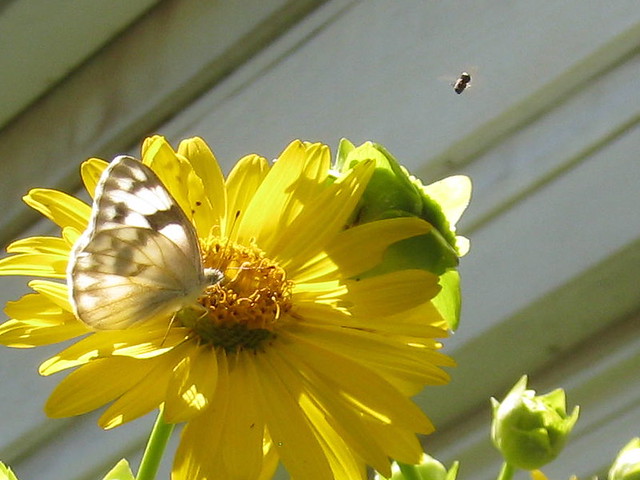
Female Checkered White butterfly on cup plant
as a native bee takes aim! AMcC

August is an exciting time in a wildlife garden. My yellow composites are beginning to bloom—cup plant, prairie dock, golden glow, woodland sunflower, and brown-eyed Susan. Goldfinches add to the yellow garden as they harvest purple coneflower seeds for their nestlings. The males sing almost as much and as loudly as robins in May. Pollinators of every kind are busy all day long. All these species are on schedule, and then a surprise: a Checkered White butterfly! Checkered Whites are not rare, but they are new to my “yard list.”

You might not think a member of the family of “Whites” or Pierids would be eye-catching, but I think the female’s pattern is really appealing. I was thrilled with the new species, but I didn’t realize how uncommon this sighting was till I talked to my friend, Yvonne Homeyer. Yvonne writes the butterfly report for our local chapter of North American Butterfly Association and serves on NABA’s board of Directors. She pointed out that this year Checkered Whites have been seen in just a few gardens and not reported at all in natural areas.

I did a bit of checking on the abundance of Checkered Whites. In Brock & Kaufman’s Butterflies of North America, the map indicates that they are uncommon in my area (St. Louis County, MO). Glassberg’s Butterflies through Binoculars; The East says, “Abundance of this species greatly fluctuates.” Wagner, in Caterpillars of Eastern North America, says, “This species has declined precipitously over the east in my lifetime.”

Why this should be is unknown. Checkered White caterpillars can eat just about anything in the mustard/cabbage family (Brassicaceae), which includes plenty of native and non-native weeds as well as garden vegetables. I didn’t think I had any of the host plants in my yard, till I checked Denison’s Missouri Wildflowers. I have a small area of toothwort (Carmdamine), which I didn’t realize was in the mustard family. A plant they seem to use quite heavily is pepper grass, which is abundant in the nearby city property and college campus. Every yard seems to have another brassica, the invasive, non-native hairy bittercress.

I spent about 3 days trying to get photos. Monday, I saw a male Checkered White, but it had disappeared by the time I got my camera. Tuesday was a scorcher, 100° with high humidity. I ran out of the air-conditioned house with the camera as soon as I spotted it through the window. This butterfly was a very cooperative female, but the condensation on my lens made the images useless. Amazingly, I saw another female Checkered White on Wednesday and was able to get some decent shots, in spite of the fact that it didn’t linger long at a blossom. It’s really nice to study the photos later and see native bees and an Ailanthus Webworm moth in the frame.

I recognize the female butterfly by the checkered markings, especially on the hind wing. But if I were a  Checkered White butterfly, according to the University of Florida’s Institute of Food and Agricultural Sciences, I’d look for a different “UV reflectivity.” I guess that would be pretty attractive too.

Seeing such a beautiful, pale butterfly kind of makes up for the wounds of reading that its preferred habitat includes “dry weedy areas” (Milleman, Mizzel, Jones on “Web Only Display of Miscellaneous Local Insects”) and—even worse—“disturbed open areas…(and) abandoned railway tracks” (Glassberg, 52). I don’t like to think of my front yard as “disturbed,” but it is interesting that I have only seen it in the front among cup plants and a number of species adapted to dry glades. So far, it has ignored my backyard of tall phlox, butterfly bush, and swamp milkweed.
Female Checkered White Butterfly shares Cup Plant
with native bees and Ailanthus Webworm moth AMcC
“The time has come,” the Walrus said,
“To talk of many things:
 Of shoes—and ships—and sealing wax—
 Of cabbages—and kings.”

Tuesday, July 27, 2010

Way down yonder in the Pawpaw patch

Zebra Swallowtail nectars on Dogbane, photo by Joby Joseph

The only place I seen Zebra Swallowtails in numbers is at Shaw Nature Reserve in Gray Summit, Missouri, where they were doing exactly what Glassberg describes in Butterflies through Binoculars. The group flew close to the ground, and they made quite an impression with better than 3-inch wingspan and “tails” up to an inch long. In my own yard however, I usually see a single Zebra flying near the top of my pawpaw tree.

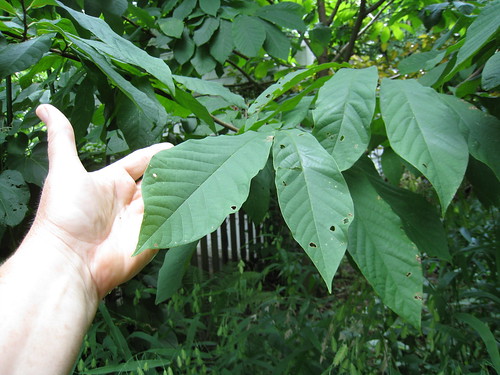
Pawpaw leaves are large and tropical looking AMcC
I got my pawpaw at the spring native plant at Shaw Nature Reserve. It took some teamwork to get it in the car. My friend Pat and her sister helped pack the tree, all the trays of plants, and me into the back seat. We rode back home with the tip of the tree peeking out the window of the car. My motivation for planting it a shady corner of the yard was Native Landscaping for Wildlife and People. Author Dave Tylka writes that pawpaw is the “only Midwest larval food for zebra swallowtail.” Like Pipevine Swallowtail and Monarch caterpillars, Zebra Swallowtail larvae chow down on a plant that other plant predators can’t abide. In an article on Beetles in the Bush, Ted MacRae mentions the alkaloids that protect the plant’s bark and seed from insects.

Besides Zebra Swallowtail caterpillars, I would dearly love to see some fruit on the tree. At the camp where I worked many summers, a grove of pawpaws grew at the base of the hill we called Sunnytop. Remembering the song—“pickin’ up pawpaws, put ’em in your pocket”—I looked for the fruit every summer. No luck. Knowing that he had grown up in rural Jefferson/Ste. Genevieve Counties near camp, I asked the property manager, Jim LaPlant, about the fruit. Jim laughed and told me that as a boy, others had called him “a Pawpaw-eatin’ Frenchman.” Exactly what that meant I don’t know. Reportedly pawpaws are messy to eat. Is that what these mean kids were talking about? Or was it because supposedly only unpopular people would eat them? Or was it just another in the long and regrettable tradition of insulting a person by referring to his ethnic food? Well, lots of folks do like pawpaws. By golly, Pawpaws have their own Flickr group. What’s more, on September 17-19 this year, Lake Snowden, Ohio, holds its 12th Annual Pawpaw Festival. They have an atalatal-throwing contest there too and you just don’t see that every day!

Photo by Beautiful Rust

To grow fruit, a tree needs a pollinator. In the case of the pawpaw, it’s not butterflies, though it is a type of fly. Being an understory tree, pawpaw blooms early, before the canopy of trees block most of the light. It’s strange maroon/brown blossoms hang off the bare limbs. The scent has been described a rotting meat or, as Don Kurz describes it in Trees of Missouri, like fermenting grapes. I’ve never noticed any scent myself, but if I did, I don’t think I’d be confused between rotting meat and rotting fruit.

Kurz also explains a bit about the scientific name, Asimina triloba. “Triloba” refers to the 3-lobed shape of the flower. “Asimina” is a Latinized version of the French rendition of an American Indian name for the tree. I didn’t find any explanation of what that American Indian word was or what it mean. I didn’t find any satisfactory explanation of the word “pawpaw” either, except that it is  also applied to papaya, a unrelated fruit tree.

Pawpaw Sphinx moth,
photo by Seabrooke Leckle

Whether or not my tree ever bears fruit, it will one day host larvae of either the Zebra Swallowtail or the Pawpaw sphinx moth, Dolba hyloeous. Seabrooke Leckle writes about this gorgeous moth and other large moths in a 2009 post in her blog, the Marvelous in Nature.

The scent is not the only confusion. California Rare Fruit Growers state that it is pollinated by  “unenthusiastic” flies & carrion beetles. James Trager mentions that the flowers a probably pollinated by fungus gnats, a type of fly that feeds on decaying plant material. Either way, the flowers are self-incompatible—that is, they need to be pollinated from an unrelated tree if the fruit is to form. I actually found an “unrelated” pawpaw about a thousand feet from my tree. I wonder how far a 1/8th of an inch-long fungus gnat can fly?


Special thanks to my Flickr friends (credited in the caption under the photos) who were kind enough to license their photos through Creative Commons.

Sunday, July 25, 2010

Pipe Dream

Pipe vine casts deep shade. AMcC


I first read about pipevines—the plants—and its relationship to Pipevines—the butterflies—from an article in American Butterflies, Summer 2001, written by Jeffrey Glassberg. American Butterflies is the quarterly journal of the North American Butterfly Association (NABA). NABA launched its “Pipe-dream Project” that year. The North American Bluebird Society (NABS) promotes nestboxes and habitat suited to bluebirds, and along with other organizations, has successfully expanded the range, increased populations and public awareness of Eastern, Western, and Mountain Bluebirds. NABA hoped to do the same for the Pipevine Swallowtail and its southern cousin, the Polydamas Swallowtail. Glassberg recommended growing the host plant, pipevine, either Dutchman’s Pipe, Aristolochia macrophylla, or a pipevine species native to your area. I had never had a Pipevine Swallowtail in my yard so I couldn’t wait to try it. Dutchman’s Pipe is native to the Eastern US, and I would have preferred to plant Missouri’s species, Wooly Dutchman’s Pipe, A. tomentosa, but I was unable to find a source at the time. I planted two Dutchman’s pipe vines on a metal arch, set in concrete. I had intended that arch for climbing roses, but that another story.

The species name, macrophylla, means “large leaf.” Many of the leaves are 6 inches wide and more than 7 inches long. They arrange themselves like shingles on a roof, casting a deep shade. When people sat outdoors to cool off in summer, folks planted it to cover the porch. Now that most of us enjoy air-conditioning in the heat, the plant is rare in suburbs and towns.

The first season the vines looked acceptable, but weak. By late summer, I had seen a few Pipevine Swallowtail adults, but no eggs or caterpillars. The next summer, I had more adults, but still no “cats.” Just before the plants’ third season, I met a woman who had grown the plant for years. She advised me to prune it to around one or two feet in the spring. I was horrified. Perhaps you’ve heard the old garden wisdom about vines, “First they sleep, then they creep, then they leap!” That summer, mine leapt. The vine covered the arch, headed down the fence, and made a grab for the gutters. I do prune my pipe vines in late winter now, and trim during the growing season if they misbehave. The plant laughs at pruners, and the butterflies seem to prefer to lay their eggs on the fresh growth.

Dutchman's Pipe bloom. Photo by Margy Terpstra ©

My plants bloom well in spring, though the flowers are small. They’re not showy, but their strange shape (like a meerschaum pipe) has an even more bizarre function. According to the Plant Diversity Website, the flower is perfumed like road kill. Fear not, gentle gardener! I have never detected this odor. A hungry fly enters the bloom and finds itself trapped in the convoluted shape. There the fly stays till it is covered with pollen and the flower matures, releasing it to play London Bridge once more.

This summer, Pipevines been particularly abundant. I can see them all day long. It took a long time for me to find the cats. Last summer I had several “hatch outs” and I learned what to look for. If you see a leaf with damage, try looking underneath it. Sometimes a dark shadow turns out to be a group of larva. For more about the caterpillars, see “Botanical Arsenic and Old Lace.” For more about the adult, see “Leaping Lepidopterists, Batman!” 
Dutchman's pipe grows on an arch. AMcC

Friday, July 23, 2010

Botanical Arsenic and Old Lace


Take a few minutes to watch this amazing time-lapse video by JCMegabyte. It covers the entire life cycle of the Pipevine Swallowtail butterfly. Video footage is courtesy of JCM Digital Imaging.

Plants have a fascinating variety of strategies to defend themselves against herbivores, including ourselves. If a species is to survive in the wild it needs thorns or spines, or armor, such as thick bark or nutshells. One of the most intriguing is the use are the poisons plants manufacture and concentrate in their leaves or seeds. Sort of like a botanical Arsenic and Old Lace. 

Of course, Aunts Martha and Abby used elderberry wine with cyanide, while Pipevine (Aristolochia macrophylla) leaves contain a toxin called aristolochic acid. If you were to eat enough of it, it could be fatal. This is the plant that Pipevine Swallowtails require in their larval stage. How can a small caterpillar thrive on a plant that could kill great big humans? Co-evolution my friends—eons of it. The caterpillars are able ingest the toxin without any ill effects, making both the larva and adult taste terrible. Birds and other predators learn to avoid them.
Aunt Martha: One of our gentlemen found time to say, “How delicious!”


The larvae are black, with hornlike protuberances of orange or red. They also like to hang out in gangs, which is actually pretty intimidating to see if you don’t know what they are. The bright orange spots set off by blue on the adult are warning colors too. Kenn Kaufman and Jim Brock’s book, Butterflies of North America, lists 6 other black butterflies of the Midwest that gain protection by mimicking the Pipevine Swallowtail’s coloration. The colors are effective for me too. I’ve never been tempted to eat a Pipevine Swallowtail.
Late instar of Pipevine Swallowtail caterpillar, on pipevine of course!

Wednesday, July 21, 2010

Leaping Lepidopterists, Batman!

Pipevine Swallowtail on Liatris, Yvonne Homeyer ©
Pipevine Swallowtail is one of the most exciting butterflies anyone can have in their garden. Pipevine Swallowtails are large, with a wingspan of 3-5 inches or so. Their hind wings are iridescent turquoise blue, which is fabulous, but hard to see because they “batter” their wings so rapidly. I just can’t stop chasing them around the yard, as they dart over, under, tilting, and disappearing. This is probably the butterfly that prompted the stereotype of the leaping lepidopterist.

I saw my first Pipevine Swallowtail of the year here in Missouri on June 18. Her black wings were just a blurs as she fluttered along my pipevine. Pipevine is the only plant that Pipevine Swallowtails use as a host. The only other member of its genus in the US is the Polydamas Swallowtail, which also uses pipevines. It’s interesting that the world’s largest butterfly, the Queen Alexandra Birdwing of eastern Papua New Guinea also lays her eggs on a pipevine relative.

Linnaeus, who gave our Pipevine Swallowtail its scientific name, Battus philenor, could have seen a relative of the butterfly in Europe. At first I thought that Battus might refer to its flight pattern, which actually is kind of bat-like. However, the Latin word for bat is “vespertilio,” so that can’t be right. “Battus” or “Battuti” refers to a 14th Century group of folks who paraded through town whipping themselves. Possibly the color of the butterfly is related to the costumes of the Battuti? No, reportedly, the Battuti did not wear shirts at all. Hmm. Could the rapid wing beat of Pipevine Swallowtail suggest the French “battus,” that is, “beaten”?

My own theory is that Linnaeus named the genus after Battus of Cyrene, who was worshipped after his death as Aristaeus. Aristaeus is described as a one of the Greek’s minor gods, who taught humans to raise bees and make cheese. “Aristaeus” also means “the best”—well deserved if he’s responsible for cheese—and a word that seems suspiciously like Aristolochia, the genus name of the plant that Pipevine larvae eat. Still with me? Thus, it could be that Battus is the synonym for the genus name, Aristolochia, which the insect requires. More about that plant in later posts.

Philenor, the specific name, comes from the Greek for “loving one’s husband.” Linnaeus didn’t explain that one either.

A warm thank you to Yvonne Homeyer who sent me a photo above from our fieldtrip with St. Louis Chapter of North American Butterfly Association. It shows a Pipevine Swallowtail on Liatris. What a sight Jeff Pippin saw at this “puddle party” of Pipevines! Apparently, these guys are sipping minerals from the damp sand—sort of like meeting at Starkbucks.
Puddle Party of Pipevine Swallowtails, Buncombe Co., NC by Jeff Pippin

Saturday, July 17, 2010

Ever Eat a Pine Tree?

Naturalist Ellen Rathbone wrote a wonderful post for Adirondack Almanack this week on a topic dear to my heart, cattails. She brought back some memories that gave me a laugh. If you’ve ever been in a cattail fight, it’s a plant you’ll always love. For those of you that haven’t had the pleasure—and you pretty much need to be under 16 for this—take a dry, mature, fluffy cattail seedhead. Now wallop your friend with it. Hilarious.

Growing up a nature nut in the 60s, of course I read Stalking the Wild Asparagus by Euell Gibbons. Euell was the butt of many a joke on late-night TV, but I’m sure he laughed all the way to the bank. I loved him. I tried a few of his recipes, persimmon bread, grape vine salad, sassafras leaves, and sassafras tea. The cattail recipes were intriguing, and I was fortunate enough to have a small area of cattails near my home. It was spring, so I gathered some of the young, hard green “tails”—Rathbone explains that these are the male flowers of the plant—and boiled them. With a little butter and salt, they were like corn on the cob as promised, though they tasted more like zucchini.

Later that day my hands and feet began to swell. It hurt to walk or hold a pen. The next morning it was worse, so Mom got me an appointment with the pediatrician. It’s tough for a teenager to go to a pediatrician’s office for any reason of course, but it got worse. The first thing the doc asked me was, “Have you eaten anything unusual recently?” Now I was really humiliated. I lamely explained about Euell and the cattails. As you botany folks have already guessed, male flowers of the cattail are 100% pollen and I was having an allergic reaction. My family has never quit laughing.

I still had a few chapters of Stalking the Wild Asparagus to cook through, but it seems I’d run out of goodwill in the kitchen. I had to make due with Grape-Nuts. They taste like “wild hickory nuts” you know.

Thanks to my Flickr friend Ken Spencer for his great photo of cattails!

Thursday, July 8, 2010

Reincarnated Cowboys

Photo by Richard Skoonberg
If binoculars are basic equipment in your garden, you’ve gotta have purple coneflowers! Being native to this area (Midwestern USA), they don’t demand much—just sunlight and an occasional rain. No need for fertilizer or insecticides. Echinacea purpurea is native to Missouri, but so are pale purple coneflower (E. pallida), whose petals droop even more than the “regular” purple, and yellow coneflower (E. paradoxa).

Hybridized garden varieties are shorter than the species—that is, less than 4 feet tall. Nurseries have developed purple coneflowers that are orange, red, or deep purple. If you like to play with scale, try ‘Little Annie,’ a new variety. It’s miniaturized—less than 10 inches, with many small flowers. I have one in a container one the front porch. Modern garden varieties hold their petals closer to horizontal, but I prefer the charming droop of the unimproved native plant.

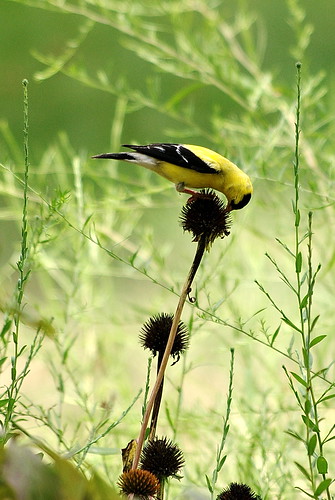
Of course the main reason to have loads of purple coneflowers is goldfinches. Cornell doesn’t mention it in their fantastic bird website, but rodeo-riders—and perhaps the clowns too—are reincarnated as goldfinches. When the blooms are finished and most gardeners would get out the shears, that’s the time little yellow birds hop onto that bloomed-out conehead and ride, Sally, ride! My Flickr friend Richard Skoonberg captured this photo as a male goldfinch tweezes the seeds out, then flies off to feed his nestlings. American Goldfinches are one of the few species of birds that feed seeds to their young, not insects. In the process, they drop a few seeds in new areas, allowing the plant to spread. Purple coneflowers are indispensable in a wildlife garden!