Showing posts with label wildlife. Show all posts

Sunday, March 2, 2014

Weldon Spring MO Christmas Bird Count 2014

Eastern Phoebe, photo by John Benson, from Wikipedia

Thanks to all who helped with the Weldon Spring Christmas Bird Count, Jan. 4, 2014! We had 18 participants, 63 species, 8774 birds, and some really decent weather for the season. The Weldon Spring Count (also known as the "Busch count," officially labeled by National Audubon Society as "MOWS") has been held every year since 1952, sponsored by Webster Groves Nature Study Society. The count, like all Christmas Counts, is held between Dec. 14, 2013, and Jan. 4, 2014, and covers a 15-mile-diameter circle. In our case, the circle is centered on the town of Weldon Spring in St. Charles County, Missouri. It includes some of the best land-birding in the greater St. Louis area: Busch Memorial Conservation Area and, bordering the Missouri River,  Weldon Spring Conservation Area.

Only one species had an unusually high count this year: Red-shouldered Hawks totaled 22, topping the previous high of 18 in 2008. Out of 62 counts, Red-shouldered Hawk has occurred only 28 times.

Several species were unusually low. Only 2 Red-headed Woodpeckers were reported. The previous low was 1 in 1964, occurring 51 out of the 62 counts. Red-headed Woodpecker is a "species of concern;" one of 117 species on the "yellow list" in the 2007 WatchList. Only 1 Ruby-crown Kinglet was reported—previous low of 1 in 2012. Only 2 Cedar Waxwings and 2 Purple Finches were seen. The low for Purple Finch was a single bird in 2012. The House Sparrow count was also low—only 6. (Most of us feel that’s a good thing.) The all-time low for House Sparrow on our count was 5 in 2007.

A highlights for me were Hermit Thrush and Fox Sparrow, found along a seldom-used road in the north-east section of Busch. Another Hermit Thrush was found in Babler State Park. Hermit Thrushes are listed as "rare" in winter, and although the Fox Sparrow is considered "uncommon," but not rare, I've missed it a number of times on the count.

Our rock star was an Eastern Phoebe, found independently in the Weldon Spring area by two different groups. This is only the third occurrence out of 62 counts—one in 1986, one in 2005. Birds of the St. Louis Area: Where and When to Find Them describes the Eastern Phoebe as "hardiest of the flycatchers" on our area. The complete report is available to download at the bottom of the Birding page of the Webster Groves Nature Study Society's website. Happy birding in 2014!

Sunday, November 14, 2010

Fragrant Sumac in the Winner's Circle


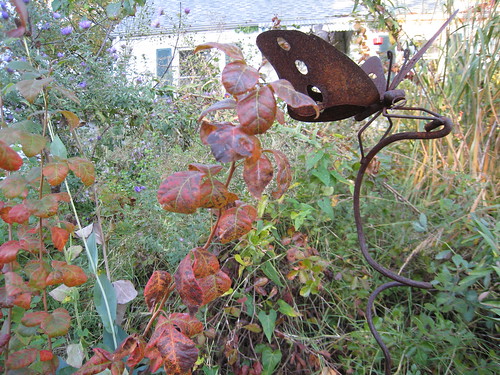
Fragrant Sumac shows great fall color AMcC
If there were a triathlon of Midwestern native plants, Fragrant Sumac (Rhus aromatica) would be in the winner’s circle.

In the first leg of the triathlon, Wildlife Use, sumac’s performance is outstanding. Fragrant Sumac is one of the earliest blooming plants in our area (Midwestern US). Small yellow flowers appear in March, which, according to the US Forest Service, are pollinated by native bees. The red, hairy little red fruits are gobbled up by mockingbirds and others, since it is one of the first fruits available in summer. Caterpillars of the Red-banded Hairstreak eat fallen, decomposing sumac leaves (Brock and Kaufman, Butterflies of North America). I have seen this butterfly in my yard, but have never observed the caterpillar among the leaf litter.

Sumacs are host plants for two spectacular moths, both with outlandish caterpillars. The Showy Emerald Moth (Dichorda iridaria) caterpillar mimics a crumpled, dead sumac leaf. I haven’t seen this caterpillar yet, and I was unable to find a photo of one online, but nature-lovers should get a copy of David Wagner’s Caterpillars of Eastern North America just to see it. The adult Showy Emerald moth is beautiful. According to ButterfliesandMoths.org (hosted at Montana State University), its range centers on Missouri.

Hickory Horned Devil, photo by Tom Woodward
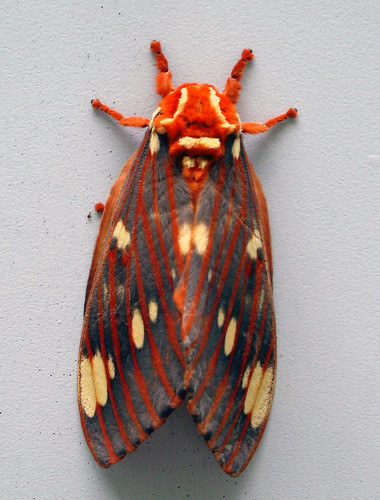
The startling Hickory Horned Devil can be almost 5 inches long! ButterfliesandMoths.org lists its food plant is “sumac.” It’s the larva of the Royal Walnut Moth, also known as Regal Moth. I haven’t seen these on my plants yet, but I’ve seen the adult moth nearby.

Fragrant sumac is a contender in the Garden Use leg of the competition. It’s a small shrub, drought-tolerant, native to glades and prairies. Dave Tylka recommends it as a good shrub for the understory of your wildlife garden (Native Landscaping for Wildlife and People). More than 10 years ago I purchased several plants of the variety named Gro-Low, named a Plant of Merit by Missouri Botanical Garden. It has formed a thick groundcover, just like I’d hoped it would. However, my plants have never borne fruit. Even though the Garden shows it with fruit, I think it is a sterile hybrid. Recently I bought three unimproved plants from a native plant nursery. They bloomed well their first spring and immediately bore fruit. In addition, I decided to experiment with a variety named ‘Konza Prairie,’ selected from the wild by the Kansas Forest Service for “its superior fruit production.” I think the natives have better fall color too, which leads me to the final leg of our triathlon.

Royal Walnut moth, photo by Cherie Priest
We’ve had a good fall for leaf color this year, though not perfect. According to Missouri Environment and Garden, Oct. 2010, (newsletter of the University of Missouri’s Plant Protection Programs) the best fall color occurs when days are warm and nights are cool. We’ve had too many warm nights in October and November this year for optimal color, but it’s still been great. The first picture above is one of my “unimproved” fragrant sumacs and its purple leaves show that the anthocyanins have done their job. In the interest of full disclosure though, there is one plant that may outrun my little Rhus aromatica
—its cousin, Smooth Sumac (Rhus glabra). This small tree has tropical-looking leaves that are dazzling red in fall. I may have to add it to my collection.

A big shout out to my Flickr friends Tom Woodward and Cherie Priest for the use of their Creative Commons photos!

Smooth Sumac's autumn show is hard to beat. AMcC