 |
| Huge ice crystals mark the sand in Dardenne Creek AMcC |
We began our Christmas Bird Count by looking for the Red-headed Woodpecker, near what’s labeled as “Shorebird Area.” This low spot below the dam for Busch Conservation Area’s largest lake, Lake 33, is reliable for Red-headeds, a species that has declined 4.6% per year since 1980, according to National Audubon Society. They gave us quite a show, sparring with Blue Jays, and chattering to each other on a snag that looked like Swiss cheese.
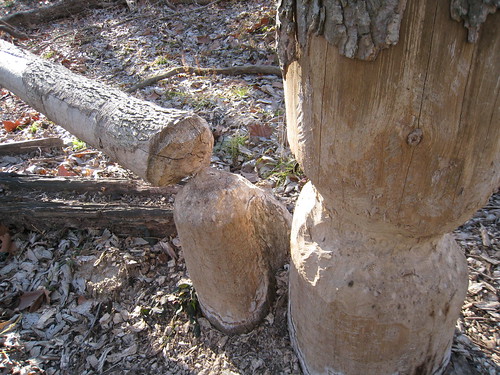 |
| beaver cuts along Dardenne Creek AMcC |
There was no open water at “Shorebird,” so after a lap around fields that sparkled with frost, we headed down to Dardenne Creek. The sand bars were puddled with white ice, the kind that we liked to smash when we were kids. Ripples and huge crystals of ice marked the sand. A small flock of Swamp Sparrows and White-throats hopped away.
On the high bank of Dardenne we saw the work of an ambitious beaver. The beaver cuts looked old, but it’s interesting that Red-headed Woodpeckers are associated with beaver. The woodpeckers claim the trees killed when flooded by beaver ponds, and exploit the edge habitat created as beavers fell trees.
After lunch, we headed down a disused service road, toward a corner of large white pines. White pine is not native to our area; possibly this stand was planted for lumber. My friend Connie was determined we’d find a Red-breasted Nuthatch in the pines. White-breasted Nuthatches are expectable year-round residents at Busch, but Birds of the St. Louis Area: Where and When to Find Them lists Red-breasted as uncommon to casual (that is, beyond rare) in January. In the pine grove, she produced her iPhone, with not one, but three different apps for bird songs, and played a recording of the Red-breasted Nuthatch. Then we paused—silence. At least 30 seconds ticked by, then, an answer! There must have been some pretty bad grammar in that recording, because this Red-breasted Nuthatch was outraged! He scolded us till we fled, not wanting to stress the little guy beyond endurance.
We crossed the road and entered the trailless area that will now be known as “The Enchanted Forest.” Within a few minutes, we found ourselves surrounded by birds: three calling Yellow-rumped (Myrtle) Warblers, a Northern Flicker, and another Red-breasted Nuthatch—all in the same tree! Now a Brown Creeper joined the group, tugging itself up a tree trunk, where Blue Jays screeched. Not far beyond, a Pileated Woodpecker answered the jays. In the same tree, a Hairy Woodpecker minded his own business. The sun peeked briefly from behind the clouds, and a male Golden-crowned Kinglet snatched those rays to light his golden-orange crest. Chickadees and a dozen American Robins called all around us. As we moved through the flock, stumbling over an old wire fence as we looked skyward, they vanished. Not even a White-throat chirped as we walked back to the car.
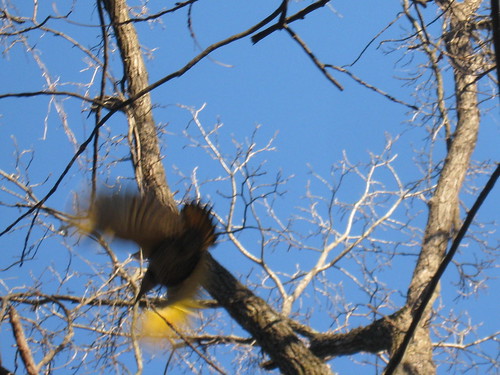 |
| Northern Flicker in the mixed species flock AMcC |