Showing posts with label predator. Show all posts

Sunday, April 10, 2011

A Walk on the Wild Side

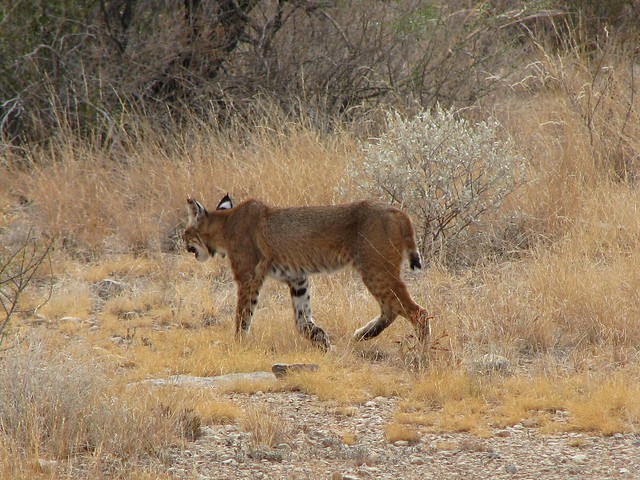
Texas bobcat, photo by Matthew High
And the winner is…
Patricia Lichen's cat! Patricia commented on my previous post about sounds in the night that she wasn't sure what made the strange call

but her cat seemed to!

Her cat was justifiably upset because the call we heard before dawn in the woods of Bentsen State Park was a bobcat (Lynx rufus texensis). Reportedly, bobcats are fairly common in this part of southeastern Texas, near the Rio Grande. According to Wild Mammals of Missouri, Schwartz and Schwartz, 2001, March is the peak of the breeding season in Missouri. This was March 16 in Texas, so it's possible that the Pauraque wasn't the only amorous singer on the prowl.

Bobcats have the widest range of all the wild cats of the Americas; from southern Canada—where they may compete with the larger Canada lynx (Lynx canadensis), down to central Mexico. That bobbed tail usually helps distinguish a bobcat from a feral domestic cat, but a bobcat is also about twice the size of a pet cat: 17-23 inches tall and between 11 and 30 pounds. According to Wikipedia's article, it is absent from most of Missouri, but Wild Mammals of Missouri, other sources and experience disagrees. I saw my first bobcat in Jefferson County, Missouri, crossing a country road at night. Friends in Dent Country tell me they see them on occasion. We didn't get to see this one, but I'm glad we heard him.

Thanks to Matthew High for his great photo of a bobcat seen in west Texas in September.

Sunday, February 13, 2011

Charismatic Megafauna

Black Bear photo by Ed Coyle Photography
Since the confirmed sighting of a mountain lion in St. Louis County, I've been thinking a lot about charismatic megafauna—or big, scary carnivores—depending on how close the animal is. Mike, from Slugyard, commented that he had never seen a mountain lion, then added that unsettling thought that he was sure that a mountain lion had seen him. He reminded me of something that I experienced. I've seen wolves and grizzly bears in Yellowstone, always from a vehicle. It's a different experience when you're on foot.
  
One summer my brother and I visited one of the most beautiful places on earth, Yosemite National Park. We couldn't stay long, and he wanted to sleep in, so that morning I decided to head down a trail by myself. I was anxious to see the giant trees, so I picked up my pace. As a jogged up the path, I stopped. About 50 feet ahead of me was a bear. The wind must have been blowing toward me, because he was unaware of my presence. He—or she—stood, grasping the trunk of a huge tree, tucking his head down. I should have been frightened, but something about the bear's posture was reassuring. He didn't seem like a vicious beast, waiting to pounce. He seemed to be hiding from something much more frightening than a bear.

Just then, three women appeared, walking side by side down the trail toward the bear and me. They were happily chatting and laughing as they passed the tree that concealed the bear. They walked on past me without a moment's lull in the conversation. The bear was still unaware that I was watching him, just as the women never suspected that they were watched. As they disappeared down the hill, the bear broke from his hiding place and loped away without a backward glance.

Black bears are quite variable in size in color. The bear I saw seemed to be an adult, but not a large one. According to Wikipedia, bears on the Pacific side of the US are smaller on average than those in the East. Like 91% of bears in Yosemite, his coat was cinnamon, just a bit lighter than the one in the above photo by Ed Coyle Photography, taken one June in Yosemite. Check out this pool of Flickr photos, The Yosemite Bear Project.

Wednesday, February 9, 2011

The Macaulay Library of Animal Sounds

Sapsucker Woods, Cornell University          photo by eflon
We were just settling in for the night. We had already tested the hammocks to see how far you could swing someone before she'd land with a thump. Our scout leaders were tucked into a cabin, farther down the hill. We were on our own. Suddenly, we heard the most hair-raising sounds! We had no idea what creature it was, but there would be no sleep that night.

I've wondered about those shrieks for a few short decades, and I think now I can identify the shrieker. After searching the Macaulay Library of Animal Sounds from Cornell University, I can say that we probably were hearing two wrangling raccoons, although there was more screaming than you hear in this recording. The Macaulay Library is, "The world's largest natural sound and video archive of animal behavior."

There are other sounds on my Website Wednesday featured site that are not conducive to sleep, like this Western Diamondback Rattlesnake, recorded in--of all places--Sapsucker Woods, Ithaca, New York. Another animal sound that scared the living daylights out of me was the snort of a white-tailed deer. Call me a wimpy kid if you must, but that snort can be spine-chilling!

You can select broad categories like arthropods, or fish, or search by common or scientific name. Notes are available giving details of the equipment used and sometimes the recordist or videographer. One recording I found is an 87 minute interview about amphibians held in Buenos Aires Wildlife Refuge, a really fascinating place in southern Arizona. Frogs caterwaul in the background.

There's lots of video too, including this one of a beautiful mountain lion. The video was shot by Tim Barksdale, former St. Louisan and Webster Groves Nature Study Society member. Video and audio from this site is copyrighted, so I can't post it, but hopefully you'll use these links and enjoy them.

I was able to embed the mountain lion audio from the Missouri Dept. Conservation's article about the confirmed cougar sighting in Chesterfield (St. Louis County, MO), that I wrote about a few days ago. Click the play button below. If we had heard anything like this, we would never have camped again!


Courtesy of Missouri Dept. of Conservation.

Sunday, February 6, 2011

Mountain Lion in Suburban St. Louis

At 2:30 AM, January 12, deep in the heart of the suburbs, a camera clicked. Triggered by heat and motion, the infrared flash fired taking 2 digital photos per second. Seeing the images must have been a shock. Here in St. Louis County, the most populated county in Missouri, a mountain lion had stepped within 10 feet of  the camera, leaving several glamour shots to tell the tale. 
Courtesy of Missouri Dept. of Conservation
This is the third confirmed report in the state since November 2010! The other two were in rural counties on the western edge of the state. Both border on the Missouri River. Garrett Jensen's camera trap is only about 2 miles from the Missouri R., but 200 miles or so east of the other sightings. The last confirmed sighting of a cougar in St. Louis County was in 1994. As I recall, that sighting was about 15 miles south and a bit west of this one, in an area much less developed. This sighting is in the high rent district: lovely homes, treated lawns, and fragments of good habitat here and there. 

Mountain lions, sometimes called cougars, prefer areas that offer plenty of deer and few humans. St. Louis County certainly has deer--too many for some homeowners. Hunting deer by humans with firearms is not a good idea in the suburbs, so deer populations are quite dense in some neighborhoods. According to The Wild Mammals of Missouri, by Charles and Elizabeth Schwartz, an adult cougar requires about 35 deer per year. In spite of the abundance of deer, the suburbs have too many hazards and too little cover for a large carnivore. The Missouri Department of Conservation's Jeff Beringer states, "To date, we have no evidence to suggest that a breeding population of mountain lions exists in Missouri." They believe that these animals are young males, dispersing from self-sustained populations in the Rocky Mountains--northern Nebraska and South Dakota being the closest.

Wild Mammals of Missouri, 2nd rev. ed., 2001, shows a map of the distribution of mountain lions that includes most of the southern half of Texas, almost all of Louisiana, and most of Arkansas, touching the Missouri border at Taney and Ozark counties. Comparing with other sources, this map seems outdated or overly optimistic. Mammals of North America, by Bowers, Bowers, and Kaufman, 2004, shows a very different range, including only the states of the far west, the Rio Grand Valley in Texas, and a tiny area of south Florida. The Florida panther, as that subspecies is called, has suffered from genetic problems brought on by its isolation from other populations. The Cougar Network, an organization interested in the sightings of mountain lions in their former range, has a detailed map showing established populations and confirmed sightings. Their map is similar to the one in the Kaufman guide.


I remember reading that Big Bend National Park in south Texas had no bears when the land was first made a national park. Later, bears dispersing from Mexico repopulated the park. Could the same thing happen with mountain lions following corridors of habitat outward from the Rocky Mountains? Do we value these beautiful animals enough to tolerate their presence?