Showing posts with label hawk. Show all posts

Sunday, October 16, 2011

We Love Squirrels

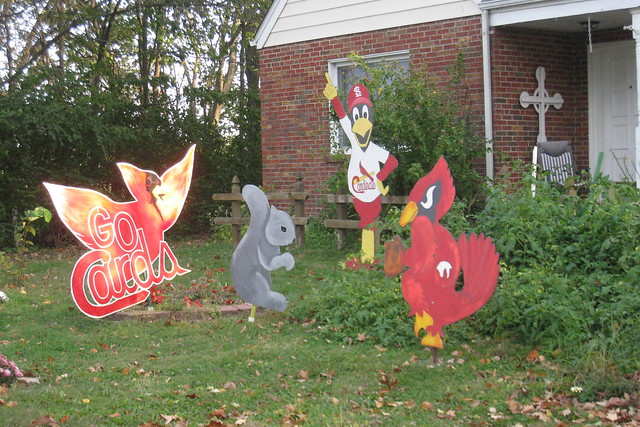
I knew that all St. Louisans were bird watchers--specifically, Redbird watchers, but who knew they were squirrel watchers too? The yard art pictured above was created by one of my neighbors. It features "The Rally Squirrel" warming up before the big game. For those of you who are not from 'round here, or for those Americans who live under a rock, I have embedded video of the Rally Squirrel's moment of fame (posted by Andrewbeginning, Oct. 6, 2011).

Moaning about the economy has been replaced with chatter about the Rally Squirrel in my hometown. Of course, I had to have a St. Louis Cardinal's Rally Squirrel t-shirt. I found one at the grocery store. I've gotten so many compliments on it, I'm going to buy all my clothes at there from now on. It's so convenient--right next to the produce section.

Some years ago, I attended a lecture at the Missouri Botanical Garden, presented by Roger Swain. Swain was the science editor at Horticulture magazine, author of books about gardening, as well as a very entertaining host of the public broadcasting show, The Victory Garden, for 15 or so years. Swain discussed growing fruit in the home garden as well as nuts. That prompted a question from the audience about squirrels. Really, until recent sporting events, I thought everyone, particularly gardeners and bird watchers, hated squirrels. Swain answered with a story about a neighbor who--how can I put this politely--culled squirrels to protect her backyard nut crop. Another hand popped up immediately. "I'm an animal control officer in St. Louis, and I have successfully prosecuted a man who shot the squirrels in his yard for animal cruelty." Roger regarded the man through his spectacles for a beat, then announced, "If anyone in this audience is arrested for killing a squirrel, I will go your bail!" The audience exploded in laughter. (If you'd like to verify this anecdote, it's repeated in Bill Adler, jr.'s Outwitting Squirrels: 101 Cunning Stratagems to Reduce Dramatically the Egregious Misappropriation of Seed from Your Birdfeeder by Squirrels, 1996.)

The squirrel in the video was reportedly trapped, along with his buddies, at the stadium, then released in Castlewood State Park. A man who spotted my t-shirt told me that they trapped all the squirrels, but then let one go in the stadium again--just for luck. This is the kind of urban legend I love.

Perhaps it's a good thing they choose a large area like Castlewood's 1818 acres. Yesterday while walking the dog at a nearby college campus, I spotted a Red-tailed Hawk, sitting on the ground. As I approached, he took off, and I could just see a bushy, gray tail dragging behind. It seems from the Cardinal's performance against the Brewers (as I post this), the Rally Squirrel was spared once again.
.

Wednesday, January 26, 2011

Cooper's Hawk in the Library

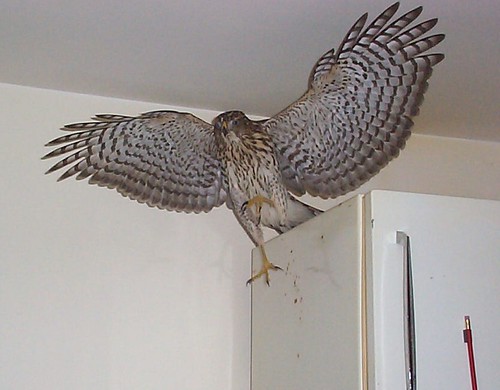
This young Cooper's Hawk is jarringly out of place. Photo by m_barje
After hearing the news stories that a juvenile Cooper's Hawk somehow got trapped in the main reading room of the Library of Congress, my mom and I had this conversation:
Mom:   Did you hear about the Cooper's Hawk that's in the Library of Congress?
Me:      Yes, I did. I hope they get it out soon. It can't last long in there.
Mom:   Of course you're happy about that--you don't like Cooper's Hawks.
Me:      Yes, I do actually.
Mom:   They eat little birds don't they?
Me:      Well, a hawk's gotta eat something.
Mom:   Anne, I'm surprised at you. I thought you liked little birds!
Me:      I do.
Mom:   Well, can't he learn to eat something else?
Me:      I don't think so.
Mom:   He learned enough to go to the library.
Me:      Yes, he did.
Mom:   And he picked a good library.
Me:      Yes he did.
Mom:   I tell you, there's a children's book in it if he lives.
Me:      Hmmm…at least a blog post.

Searching through Flickr, I found the above photo of another juvenile Cooper's that blundered into a building. Fortunately, this one eventually followed the cat out the same door it entered. I noticed that well-known blogger Birdchick left a comment on the Library Congress's first blog post about the hawk. She mentions that when she worked with a raptor center, she once rescued a Cooper's from a batting cage.
I'm not a bird rehabber, but I had a similar experience. I was just out for a walk with my best buddy, Rosie, in the campus of a nearby college. We took the path past the track and ball field, when I saw a Cooper's Hawk frantically trying to get out of the nylon-net batting cage. I hurried home and put Rosie inside, then headed back.
More than once I'd freed Mourning Doves from these batting cages, and I figured I could help the hawk, though his size would make it more of a challenge. I lifted the netting as high as I could, but it was surprisingly heavy and hard to lift over my head for very long. The panicked hawk would come nowhere near the opening with me there. There was a woman running the track at the time, so I trotted over to ask for her help. Two of us could hold up the net from the corners, leaving a wide open space, I explained. She was afraid of birds, she said, and left immediately.
Finally I found two chairs left by baseball fans and used them to prop the net up creating a low but wide opening. The hawk was frantically trying to get out of the top of the net so I withdrew. When I checked an hour later, the hawk was gone.
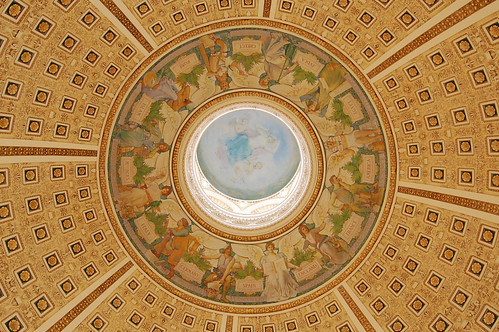
Dome of the Main Reading Room of the Library of
Congress, where the hawk is trapped. Photo by Photo Phiend


As I post this, the Cooper's Hawk has now been in the LOC for almost 7 days, hanging out just below the "Mural of Human Understanding," seen on the left in a photo by Photo Phiend. We bloggers have had some fun with this story, but the bird's situation is serious. She-- they determined that she's a female--managed to steal some food from the trap set by the Virginia Raptor Conservancy team, but didn't spring the mechanism. Check the latest tweets about the LOC's hawk here.

Sunday, December 19, 2010

Critical Mass of Starlings


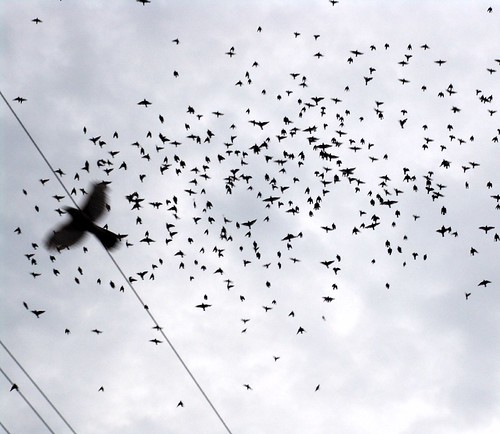
Birding while driving is never a good idea, but while flocks of starlings wheel and twist over the highway, I give them a quick glance. When the flock is behaving this way, I suspect there’s a hawk nearby. Here it is, a red-tail, high and outside. As I leave the highway, I see another flock gathering, preparing to roost in the neighborhood. Blocks away, I arrive at my destination, still hearing the cacophony of chatters and whistles.
At one point, some called European Starlings the most abundant bird in North America. It wasn’t always so. The Acclimatization Society of New York, NY, is responsible for turning them loose on this continent in 1890. Their stated goal was to introduce to North America all the birds mentioned by Shakespeare. Henry IV, Part I is play responsible. The character Hotspur, furious at the King over his refusal to ransom Hotspur’s brother-in-law Mortimer, raves that he’ll train a starling to say “Mortimer” and give it to the King as a gift. It’s a good idea. Starlings are great mimics, as befits a member of the myna family, as this video shows.
Cooper's Hawk with flock of European Starlings
photo by zen Sutherland
European Starlings are aggressive, noisy cavity nesters. In winter, they like to roost with about 999 of their closest pals. This has not endeared them to human communities. If you have to endure these gatherings, Cornell has some advice for you, and best of luck.
In 1960, Eastern Airlines flight 375 took off from Boston and struck a flock of starlings. The crash killed 62 people, the worst accident caused by bird strike on an aircraft. We blamed them too for the decline of bluebirds. Starlings have become of the most despised of all winged creatures—right up there with mosquitoes. Recent studies, however, have failed to turn up evidence that starlings have had any negative effect on any North American species, except the sapsucker.
Our relationship with the starling may be an uneasy one, but that doesn’t diminish our fascination with those amazing flocks. An article in Wired Science, June 2010 explains their behavior as “synchronized orientation…in a critical system,” meaning that members of the flock can communicate so well that if a single bird turns, the flock of thousands can follow. The behavior dazzles humans, as well as avian predators.

Monday, October 25, 2010

Whooo's awake? Me tooo!

Red-tailed Hawk launches from the antenna on the water tower. AMcC

Occasionally people ask me, “What is that thing?” or, “Looks like a spaceship—hope it doesn’t land!” Living under the city water tower has its ups and downs. It’s easy for people to find my house. It’s provided many would-be comedians with a topic. And though the tower and surrounding fence could best be described as—well—unattractive, it’s not like living under a roller coaster.

Last week, construction equipment rattled on to my block, preparing to build a new water tower and tear down the old one. That’s prompted me to review some stories about my quiet, green neighbor over the last 25 year. When I first moved in an American Kestrel claimed the structure. As long as he was around, pigeons stayed away. A persistent Mockingbird owned it for awhile. For many summers, joints of the steel girders were home to a colony of Common Grackles. With 30 or so noisy grackles, pretty much everything stayed away. One spring morning I stepped outside to hear the crows screaming as they dived onto the top of the tower. Finally I saw what they were screaming about. A Turkey Vulture had landed on the dome to warm its six-foot wingspan in the morning sun.

Red-tail overlooks construction AMcC
In the summer of 2009, a pair of Red-tailed Hawks nested nearby in the remnants of woods. Every day one or both of the parents would guard the territory, perched on the plastic cover over cell phone antennas mounted on the catwalk. It occurred to me that for them, the tower is a cliff; the antenna, a tall pine balanced on the edge. An artificial cliff is less scenic to humans, but for birds, it functions like the real thing.

A few years back, I dragged my neighbor out of bed to see two Great Horned Owls perched on the railing of the water tower. As we watched, sharing a pair of binoculars—yes, you can see some things through binoculars at night—one of the owls turned his back to us, pitched up his tail, and yelled into the side of the tank, “WHOOO’s awake? Me TOOOO!” The hoots boomed and echoed—the structure amplified his call as if it were a canyon! Hopping from girder to strut and back, he launched into an extended concert that certainly impressed us. I hope his lady friend felt the same.

Since that night, many Great Horned Owls have made their presence known, usually in fall or January. This year though, I’ve seen a Great Horned perched on the antenna almost every night since early May. Usually she is silent—the female’s voice is a bit higher and I suspect my horned neighbor is a female. Every night the dogs and I step out with the binoculars and check the antennas. If the moon isn’t too bright, she’ll be there. Sometimes she’ll flash her bright white under throat at us.

The removal of the tower will be good for my garden, allowing more southern light. The new tower will be just far enough west to cast its disk-shaped shadow on someone else’s yard. I don’t know what effect the construction/destruction of water towers will have on local wildlife. I’m hoping against hope they won’t remove the only trees on the property—3 mature white pines, beloved by grackles, goldfinches, and owls alike. 

Wednesday, July 14, 2010

Why do people think that bird watchers are nerds?


There I was, minding my own business, binoculars around my neck, three dogs in tow, and a plastic bag filled with the products of our walk. Why should I feel self-conscious? Just because I was blocking the sidewalk, my binoculars straight up, unaware that a small group of 10-year-olds were gathering. 

Overhead, not much higher than the treetops, circled two Mississippi Kites. Long, narrow grey wings, white secondaries (the trailing, inner portion of the wings), and a graphite grey tail, appeared and disappeared as they swung silently among the trees. “What are they?” one boy asked. I knew the answer would be confusing. “They call them kites. Aren’t they cool?” “Yeah,” they agreed, watching, half-on, half-off their bikes. Maybe bird watching isn’t so geeky.

We think of birds of prey eating rabbits, or elephants, in the case of the mythical Roc. Kites are smaller and lighter than the hawks we’re used to. Two of the five North American species eat mostly insects, including the Mississippi Kite. It’s described in National Geographic’s Complete Birds of North America and The Sibley Guide to Birds as having a “buoyant” flight. I could not imagine what that meant till I saw one floating, almost motionless over a field.

I’m lucky enough to see Mississippi Kite several times a week here in the St. Louis, MO area. Today I saw one that I swear did a loop-de-loop like a stunt plane at the VP Fair. A little further on in my walk, I saw two circling over a lawn, perhaps looking for their favorite snack, dragonflies. One later sailed over carrying a twig in its talons. It disappeared then, returned without the stick. Why it would be carrying nesting material in mid-July is a mystery to me. This is a good spot to say thanks to my Flickr friend Ned Harris for his terrific photo, above. Check out his awesome photos of birds and insects.

Last summer I spotted one as I drove by the Kirkwood Farmers market. I followed, and suddenly it stalled, then spun away after a bat. All this in broad daylight! The bat swooped down and under into the thick foliage of a catalpa tree and the bird followed. The end of the story—whether happy or sad for the bat—is unknown.