Showing posts with label fruit. Show all posts

Tuesday, July 12, 2011

Fruits of Summer


Indian Cherry, Rhamnus caroliniana, is a shrub or small tree of dry, rocky glades, but it's also found near streams. It has a patchy distribution, show in the US Geological Survey map below. In Missouri, it's found south of the Missouri River, mostly in the Ozarks.
Range of Indian Cherry, USGS

The photo above was taken just a week ago. Now some of the fruit is beginning to turn red. The "Indian" part of it's name may be related to it medicinal use by Native Americans. According to Don Kurz in Trees of Missouri, they used it to induce vomiting. It's surprising how many plants were used as emetics in traditional medicine. I really don't get that.

Indian Cherry is also known as Carolina Buckthorn, even though it has no thorns. Wikipedia says its fruit ripens in summer, Dave Tylka, in Native Landscaping for Wildlife and People, says fall. This is the first time my little tree has fruit, so I'll let you know.


Pipevine fruit

Here's a mysterious fruit! My pipevine, Dutchman’s Pipe, Aristolochia macrophylla, is 5 or 6 years old and it's also bearing fruit for the first time. I haven't been able to find anything about the fruit, except that like the rest of the plant, the fruit is poisonous. Pipevine blossoms are pollinated by tiny flies that get temporarily trapped in the weird little flower, so who knows? Perhaps some of the flies that pollinated my pawpaw tree performed the same service for the pipevine. Of course, I grow pipevine for the butterflies it attracts, not the poisonous products. I've written about the vine and the fascinating butterfly in earlier posts.

But wait! there's more! Not only have my Pawpaw (see previous post), Indian Cherry, and Dutchman's Pipevine borne fruit for the first time this year, my Golden Currant, Ribes odoratum, has joined in! There are four members of the Ribes genus native to Missouri, two gooseberries and two currants, but unlike its cousins, this shrub has no thorns. I wrote about Golden Currant's pollinators and fragrance this spring. It's fruit is ripe right now.
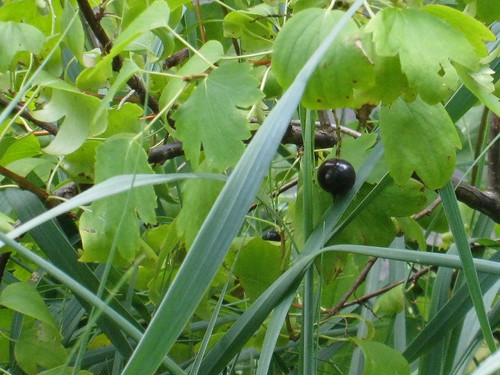
Golden Currant

Productivity in my small native plant landscape is pretty gratifying—a bit like my blog, which is now 1 year old! 


Monday, December 6, 2010

Waxwing Party at the Pond

White lines on the back and red "wax" AMcC
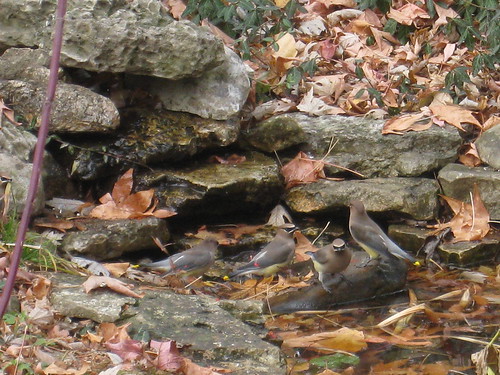
The Cedar Waxwing is a lovely bird with silky smooth feathers, a jaunty crest. and a mask that makes him look like Zorro the Avenger. They are expectable in winter, but unpredictable and easy to miss when you’re out birding in my area. So when a flock of Cedar Waxwings dropped by my yard some days ago to visit my little swimmin’ hole, I grabbed my point-and-shoot camera a got a few shots.

I never really noticed the striking white lines on the back that show in this photo, but then I don’t often have a view looking down on Cedar Waxwings. The white edge is formed by wing feathers close to the body (the tertials). Usually I see them high in the sky, calling to each other in the flock with a high-pitched “Seeeee!”

Joined by a few Dark-eyed Juncos and a small group of Pine Siskins, the waxwings bathed the way they do everything; enthusiastically, and with friends. The Birder’s Handbook; A Field Guide to the Natural History of North American Birds, by Ehrlich, Dobkin, and Wheye, describes the exact behavior we see in this photo. They use their wings to splash water up onto the back, while holding the tail up and head back to “form a cup” (Birder’s Handbook, 1988, 429).

This waxwing uses his wings and tail to form a cup. AMcC 
Cedar waxwings are very fond of the blue “berries” of Eastern Red Cedar (Juniperus virginiana). Although they are round and appear as berries, they are really the female cones of this evergreen tree. According to Dave Tylka, in Native Landscaping for Wildlife and People, the cones are low-fat and low-sugar, which means that birds will ignore them until late winter when all the high-fat dogwood, sassafras, and black gum berries have disappeared into the crops of fall-migrating birds. Cedar berries are a reliable reserve food--sort of like oatmeal. If you can’t get a Belgian waffle, you take what you can get.

Waxwings have been found to digest cedar berries in 12 minutes flat! Research shows that seeds that take the short outing through a waxwing’s digestive tract triple their chances of germination. Of course, within 12 minutes the bird may travel, depositing the seed many yards away from the shade of the parent plant.

The fondness for cedar berries accounts for the first part of the English name, but what about that strange surname? Waxwings are named for the waxy material on tips of the secondary wing feathers of adults (The Sibley Guide to Bird Life and Behavior, Elphick, Dunning, and Sibley, ed. 2001, 484). Only adult birds have this, and it’s very hard to spot, in spite of the fact that the Wikipedia article on Cedar Waxwing calls it “the bird’s most prominent feature.” Birds were named during the era when devotees of birds carried shotguns, not binoculars. Those early “birders” named birds for features that stood out as unique while holding the bird in hand, not for field marks as we think of them today. Sibley says that this material feels “more like plastic,” so I’m guessing he’s handled a few waxwings in hand too. This red “wax” is visible in my first photo.

Cedars provide wildlife with food and shelter. AMcC
Cedars are an important wildlife plant in my area. Tylka calls the cedar the number-one winter roost for birds. Besides providing winter dining for fruit-eating birds, the cones/berries are used to flavor gin, of all things. Wikipedia records that the oldest red cedar was found in Missouri. It was 795 years old.

Cedars are a “pioneer” species, meaning that they thrive in open, disturbed areas. They have invaded the open glade habitats found on west and south-facing slopes throughout the Ozarks, shading out rare glade plants. In the past, wildfire would have controlled the advance of cedars. Between habitat loss to roads and parking lots and the suppression of fire, glade species have declined while cedars increased.

The Wikipedia article on cedar also mentions their use as Christmas trees in the Ozarks, a fact confirmed by my brother-in-law. He grew up in Rolla, Missouri, in the heart of the Ozarks. They would cut a cedar on Grandma’s farm, then cut the top out. The lower portion of the tree is too scraggly to use a decoration. The house would fill with scent of the fresh cut cedar heartwood.

Sunday, November 14, 2010

Fragrant Sumac in the Winner's Circle


Fragrant Sumac shows great fall color AMcC
If there were a triathlon of Midwestern native plants, Fragrant Sumac (Rhus aromatica) would be in the winner’s circle.

In the first leg of the triathlon, Wildlife Use, sumac’s performance is outstanding. Fragrant Sumac is one of the earliest blooming plants in our area (Midwestern US). Small yellow flowers appear in March, which, according to the US Forest Service, are pollinated by native bees. The red, hairy little red fruits are gobbled up by mockingbirds and others, since it is one of the first fruits available in summer. Caterpillars of the Red-banded Hairstreak eat fallen, decomposing sumac leaves (Brock and Kaufman, Butterflies of North America). I have seen this butterfly in my yard, but have never observed the caterpillar among the leaf litter.

Sumacs are host plants for two spectacular moths, both with outlandish caterpillars. The Showy Emerald Moth (Dichorda iridaria) caterpillar mimics a crumpled, dead sumac leaf. I haven’t seen this caterpillar yet, and I was unable to find a photo of one online, but nature-lovers should get a copy of David Wagner’s Caterpillars of Eastern North America just to see it. The adult Showy Emerald moth is beautiful. According to ButterfliesandMoths.org (hosted at Montana State University), its range centers on Missouri.

Hickory Horned Devil, photo by Tom Woodward
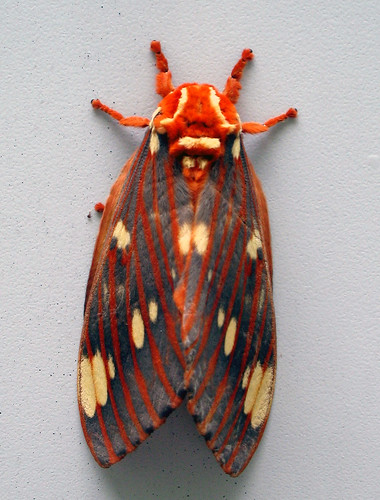
The startling Hickory Horned Devil can be almost 5 inches long! ButterfliesandMoths.org lists its food plant is “sumac.” It’s the larva of the Royal Walnut Moth, also known as Regal Moth. I haven’t seen these on my plants yet, but I’ve seen the adult moth nearby.

Fragrant sumac is a contender in the Garden Use leg of the competition. It’s a small shrub, drought-tolerant, native to glades and prairies. Dave Tylka recommends it as a good shrub for the understory of your wildlife garden (Native Landscaping for Wildlife and People). More than 10 years ago I purchased several plants of the variety named Gro-Low, named a Plant of Merit by Missouri Botanical Garden. It has formed a thick groundcover, just like I’d hoped it would. However, my plants have never borne fruit. Even though the Garden shows it with fruit, I think it is a sterile hybrid. Recently I bought three unimproved plants from a native plant nursery. They bloomed well their first spring and immediately bore fruit. In addition, I decided to experiment with a variety named ‘Konza Prairie,’ selected from the wild by the Kansas Forest Service for “its superior fruit production.” I think the natives have better fall color too, which leads me to the final leg of our triathlon.

Royal Walnut moth, photo by Cherie Priest
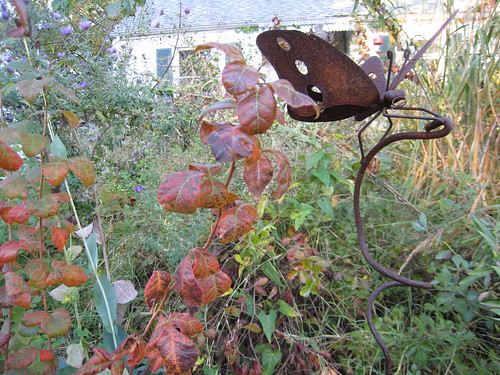
We’ve had a good fall for leaf color this year, though not perfect. According to Missouri Environment and Garden, Oct. 2010, (newsletter of the University of Missouri’s Plant Protection Programs) the best fall color occurs when days are warm and nights are cool. We’ve had too many warm nights in October and November this year for optimal color, but it’s still been great. The first picture above is one of my “unimproved” fragrant sumacs and its purple leaves show that the anthocyanins have done their job. In the interest of full disclosure though, there is one plant that may outrun my little Rhus aromatica
—its cousin, Smooth Sumac (Rhus glabra). This small tree has tropical-looking leaves that are dazzling red in fall. I may have to add it to my collection.

A big shout out to my Flickr friends Tom Woodward and Cherie Priest for the use of their Creative Commons photos!

Smooth Sumac's autumn show is hard to beat. AMcC