Showing posts with label books. Show all posts

Wednesday, July 18, 2012

How to report a butterfly

male Funereal Duskywing, photo by Bill Bouton
 
It's hard to imagine a more dramatic name than the Funereal Duskywing's (Erynnis funeralis). The name conjures up an image of a dreary black butterfly, possibly one whose preferred habitat is a graveyard. 
 
But let's be fair. This little guy is certainly not as dark as, say, a black swallowtail or pipevine swallowtail. 

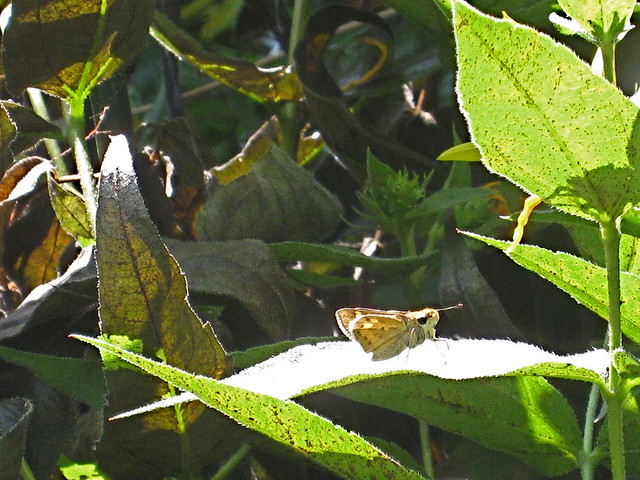
Identifying the funereal is not as hard as identifying most Duskywing butterflies. It's hind wing shows a white fringe that's absolutely cheerful. No other butterfly in my area has this characteristic. I managed to get a photo that was good enough for identification, though not as gorgeous as the above photo by Bill Bouton, who shared his through Creative Commons.

I had a Funereal in the backyard a few years ago, before I knew that it was a rare species for my area. In the world of birders and butterfliers, "rare" means excitement. My mood was anything but mournful when I spotted it this time. The range map in Jeffrey Glassberg's Butterflies through Binoculars: The East shows the nearest population in central Kansas--500 miles or so west of my yard in Saint Louis Missouri. In Butterflies of North America, Kenn Kaufman and Jim Brock show it as uncommon as close as Rolla, MO--less than 100 miles from me.

I looked it up on Butterflies and Moths of North America. They include a map of reports, which showed a sighting as far north as the Illinois Wisconsin border. I decided to submit my report also. Their process is a little more rigorous and some citizen science websites. I'll go through the steps.

Step 1: In the menu of the website, click on "get involved." 
Step 2: Get a free account with Butterflies and Moths of North America (BAMONA for short). 
Step 3: Fill out the submission form online. You'll need to submit a photo of your butterfly or moth, and the photo needs to be cropped so that the insect fills the frame.  Stay with me here. This photo editing could be an obstacle but it doesn't need to be. I used to edit my photos on the photo-sharing website Flickr, with a free website/tool called Picnik. Picnik is no longer partnered with Flickr. They moved to Google+. Editing is still available on Flickr however, in a new tool called Aviary. Just use the action menu on the Flickr photo you want to edit. Of course you can also crop your photos with iPhoto or Google's Picasa--which looks a lot like Picnik. But wait! There's more. BAMONA also would like you to add your user name as a "watermark" to your photo. That's a lot easier than it sounds. Just use the text tool in the editing program you're using. Mine looked like this when I finished editing.
To complete the report you'll need to indicate on the map where the butterfly was seen. Just enter the address in the address box then check to see that the point on the map goes just where you want it. Finish by adding the state and county where you saw the butterfly or moth. 
Step 4: Wait anxiously for a reply from an expert in your region. The expert hopefully will confirm your report. My region's expert turned out to be a friend of mine, the chair of the entomology group of Webster Groves Nature Study Society.
Optional step 5: Send an email offering to let them use your photo on the website. The full instructions are on BAMONA.
 
 My thanks to you for staying with my blog. Now that I've cleared up the spam that led to my site being listed as "suspicious," I thought I'd better get cracking and write a post!
You might also like:
Emma Peel as a Butterfly

Of Cabbages & Checkered Whites

Tuesday, August 9, 2011

A Rabble of Ruby-throats?


I love my hummingbird plants, but when I read that hummers may need up to 1,000 blooms a day, I knew I was going to need feeders! A little more investigation into hummingbird calorie requirements at Hummingbirds.net is really instructive—and a bit overwhelming for a gardener.

I recently came across the blog of Susan and Richard Day, Daybreak Blog. Susan is one of the authors of a favorite book, The Wildlife Gardener's Guide to Hummingbirds and Songbirds From the Tropics (Collins, 2003) and Richard is a photographer and leader of photo workshops. A few years ago, I had a chance to tour their property in central Illinois with the St. Louis Chapter of the North American Butterfly Association (NABA). We were really inspired by their work to create and improve wildlife habitat on their farm. I asked Susan many questions about her hummingbird and butterfly gardens and I was glad to see her recent post about "Hummingbird Wars."

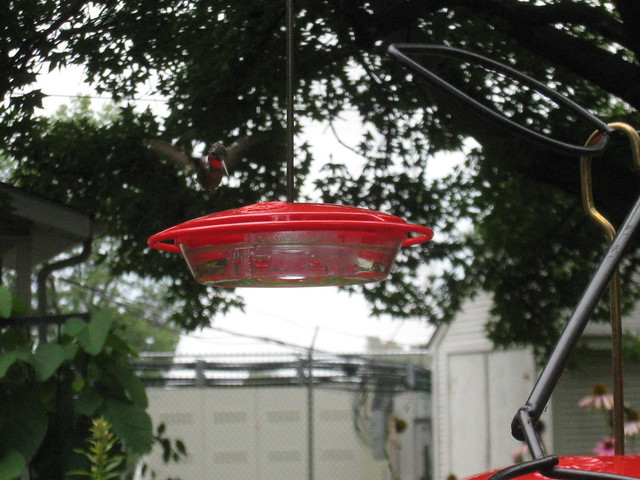
I was surprised to though that she was talking not about flowers, but feeders. I have lots of hummingbird-attracting plants—also known as "humplants"—and two feeders, one in the front and one on the kitchen window. As I mentioned in a recent post, Susan Day interviewed Bob Sargent, well-known hummingbird bander and the found of the Hummer/Bird Study Group. His suggestion to those who would like to attract more hummingbirds and solve the problem of one bird guarding a feeder or driving other hummers away from your Cardinal Flower patch is simple: Add more feeders! Susan add 10 more.

I added 5. Naturally, I expected a rambunctious rabble of Ruby-throats the next morning.


Actually, I'm slightly more patient than that. I've had the extra feeders up for two days. So far I think that my feeder collection has made it more fun to watch the hummers because they're so easy to find. I've seen as many as 3 at a time—not unusual in my yard at this time of year even before adding feeders. When I see more than birds sharing a feeder at the nectar station, I'll feel that my experiment has succeeded. More hummingbird posts to come!

Rootin' Tootin' Rufous                

You might also enjoy these posts:
                    
Hole in One!
Golden Currant & Friends

Wednesday, June 15, 2011

Songs of Summer and Scarlet

On June 11 and 12 I did more breeding bird surveys at Busch Memorial Conservation Area in St. Charles Co., Missouri, with my friend Kevin Renick. We didn't see the numbers of butterflies I mentioned in my previous post, but we saw and heard some great birds, including two not commonly seen: a Blue Grosbeak along the dam at Lake 37, and a brief view of a Blue-winged Warbler at the same spot.

Kevin is a singer-songwriter as well as a whiz at birding; his musical abilities extend into his nature hobby. What impressed me most this weekend was Kevin's ability to consistently tell the difference between the songs of the Scarlet Tanager and the Summer Tanager. Both birds nest here in oak-hickory forests of Missouri, and although their calls are very different, their songs are very much alike. I asked him to summarize the differences between the two songs. I'm accompanying Kevin's summary with video from the incomparable recordist of nature sounds, Lang Elliot.


Kevin's hints: "The Scarlet Tanager's song has sometimes been described as being like a 'robin with a sore throat.' It's a melodic warble, but it has a prominent screechy or raspy sound on one or two notes of its phrasing. The Summer Tanager on the other hand, is not raspy at all. It's a clear, sweet warble, a bit gentler than the Scarlet."


If you hear the bird's call—as opposed to its song—you've got it made. The Summer's call begins this video: "Picky-tucky-tuck." The Scarlet Tanager call, heard in the middle of his video, is "Chick-burrr. Chick-burrrr." David Sibley, author of The Sibley Guide to Birds, says that the Summer's song includes, "brief but distinct pauses between phrases." The Scarlet's by contrast is made up of a "fairly rapid, continuous series."

Thanks to Kevin Renick for his song analysis and to Lang Elliot for making his videos available.

Friday, April 22, 2011

Happy Earth Day, Horace!

I was glad that Lisa, over at A Walk in our Garden, invited me to participate in the Earth Day Reading Project this week. Sponsored by Sage Butterfly's blog, the idea is to talk about 3 books that have inspired you to "live green." There are lots of books about nature that I love and I'll stretch the meaning of "living green" to include them, since for me a love of nature and taking steps to protect it go hand in hand. The first book I will mention is one I read in 8th grade, Camping and Woodcraft: A Handbook for Vacation Campers and for Travelers in the Wilderness, by Horace Kephart (available free from Google books). Kephart was born in 1862; this title was published in 1917. I found it in my local public library.

I was fascinated by his illustrations of various types of shelter, each with a romantic name like "Hudson Bay tent," and "tomahawk shelter." I couldn't wait to follow his instructions for assembling a bed roll for my next camping trip. He quotes a "southern Indian's" advice on building a fire that won't waste wood (Vol. 1, page 232); something I applied each time we camped. There are many things that distinguish Kephart's book from other camping books--his abundant opinions, his instructions for lost arts, his obvious love for the land and the people who lived their lives immersed in it.

Camping and Woodcraft is an 800+ page, two-volume work. Why would a 12-year-old choose this ancient tome? Honestly, there were few other camping books available to me in the mid-1960s. (Today, the St. Louis County Library system lists 164 books on the subject--still low for a system that holds about 1.4 million books.) Unfortunately, Kephart's books are no longer part of the collection. I'm pretty sure I skipped over the chapter titled "Trophies--Pelts and Rawhide," but I checked the book out several times and eventually read everything else. 

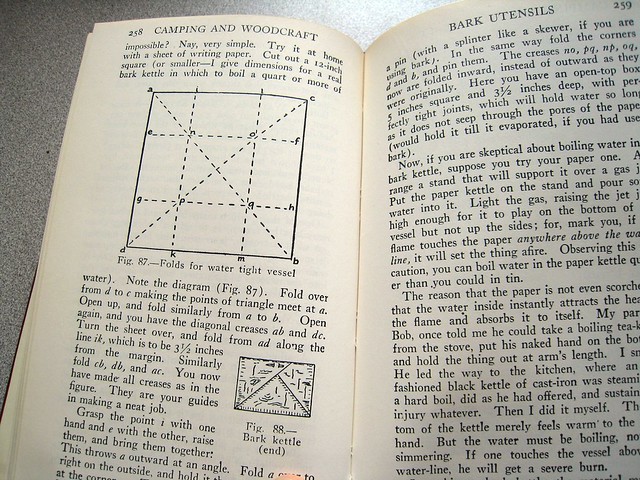
The best material is in Vol. II, Woodcraft: splitting a log, building a "masked camp," bee-hunting, "How to Walk," and cabin building. I tried his instructions--pictured above--for "Boiling water in a bark kettle" (Vol. 2, p. 257). Not having access to birch bark in my area, I constructed it from paper. It actually worked! Not only is the paper kettle watertight, and you cook with it and the paper doesn't burn (usually). I tried some recipes too, including "ash cake," but that wasn't exactly a hit with my scout troop. I'd stay away from the sassafras tea too.

I had to wait till the age of Wikipedia to find out more about the author. Most of Kephart's writing is about Appalachia, including the area that later became Great Smokey Mountain National Park, so I assumed he had always lived in that area. Episode 4 of Ken Burns' National Parks covers his contribution to the park and the Appalachian Trail. I was surprised to learn that he had a local connection: he directed the St. Louis Mercantile Library for 13 years. The Mercantile is a private library, established in 1846. I was a member of the library when it was located downtown. Now on the campus of University of Missouri-St. Louis, it's the oldest library still active in the US.

I puzzled over his dedication for a long time: “To the shade of Nessmuk in the Happy Hunting Ground.” Nessmuk (George Sears) and Kephart both wrote for Field and Stream and both were obsessed with wilderness. Born in 1821, Nessmuk is another throw-back who regarded progress as a very mixed blessing. It took a lot longer to run down Nessmuk's writings (now also available free from Gutenberg.org).

Some of Kephart's projects would no longer be considered "green," such as marking a trail with a hatchet and building a bed with fresh pine boughs nightly, but his enthusiasm for living simply, surrounded by forests, rocks, and sky make it worth reading even in the 21st Century. 

Happy Earth Day, Horace! Maybe some other folks out there in the blogosphere would like to participate in this 3-book tribute. Check out the description of the meme! The rest of my book list will have to wait for a later post.

Sunday, February 27, 2011

The Phantom Forest

The name is intriguing: The Phantom Forest Conservation Area. Is it a wooded area troubled with ghosts? Does it seem to be a forest, but when visited, it vanishes into thin air? I've been wanting to check it out since I first spotted the sign last spring, but road construction made it impossible to access, then school started, etc. Today I was nearby, and the temperature reached the low 60s.

I've been wanting to apply the techniques I've learned from Forest Forensics: A Field Guide to Reading the Forested Landscape, by Tom Wessels (2010). The title of the book is well chosen, because Wessels's expertise is deducing the the history of the land using evidence of human use (or lack thereof).  The book is organized as a dichotomous key.
1A. Is the land smooth and even? Go to 2A.
1B. Is the land not smooth and even? Go to 2B.
I'm just a beginner at these techniques, but here's a few things I found in the Phantom Forest Conservation Area:
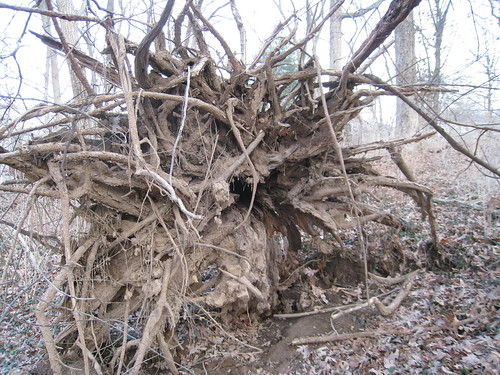
The ground is not smooth and even. When live trees are blown down in storms, the base is pulled from the ground roots and all. As in the photo above, as cavity or "cradle" is left where the tree once stood. As the roots and trunk decay and the dirt falls away, a mound or "pillow" is left. This area is too uneven to have ever been plowed crop land, but neither is the forest old growth. The windblown trees are not decayed and there is no evidence of old, eroded pillows and cradles.
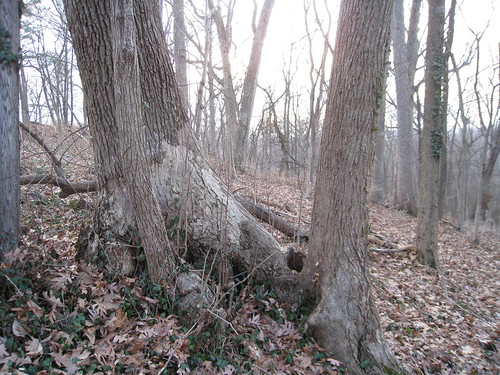
There are many double and multiple-trunked trees, which can be evidence of past logging. The main trunk was harvested, and sprouts—now mature trees—grew from the roots. Like almost every inch of Missouri, this site was probably logged in the first half of the 20th Century.

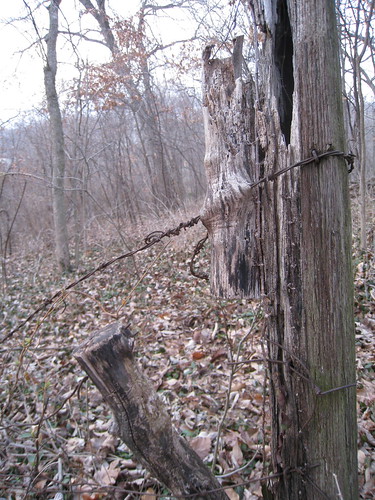
Barbed wire suggests that after logging, at least the downhill portion of this site was once a cow pasture. I don't know how to age the barbed wire, but the fence has been long abandoned.
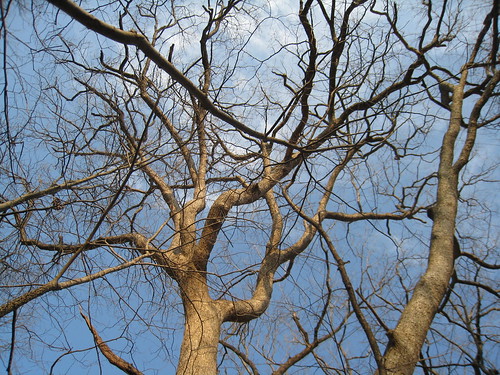
The spreading limbs of the mature oaks also show that the tree grew in an open field, not shaded in a thick forest.
Next to an old, cement foundation, an abandoned tub is overrun by non-native winter creeper. Other non native plants such as yucca and white pine grow near the old home site. 
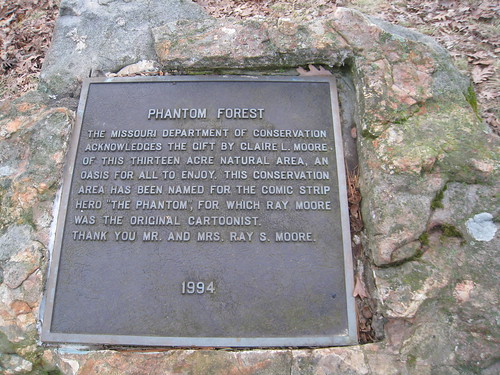
Above the old home, I came upon this plaque. I didn't expect to find the answer to the riddle of the name of the conservation area so easily. The mysterious Ray Moore was a Missourian. The Phantom strikes again!
Image courtesy of Wikimedia Commons


Sunday, February 20, 2011

The Crossley ID Guide

Cape May Warbler in The Crossley ID Guide, p. 411 alongside Birds of America, plate 95
I got my copy of The Crossley ID Guide: Eastern Birds this week. Lots of well-known bloggers and experts have reviewed it as well, which I have linked to below. I'm not qualified to debate whether a the photo for the 1st-winter Glaucous-winged Gull is adequately differentiates it from the 1st-winter Thayer's Gull. However, if the target audience for this book is the average birder who gets out into the field when the demands of work and family allow; an average birder who'd like to improve her birding skills, then I'm eminently qualified. A better question might be, given that there are already a half-dozen excellent field guides to birds of the US, is this new book useful to me? I answer, enthusiastically, yes!

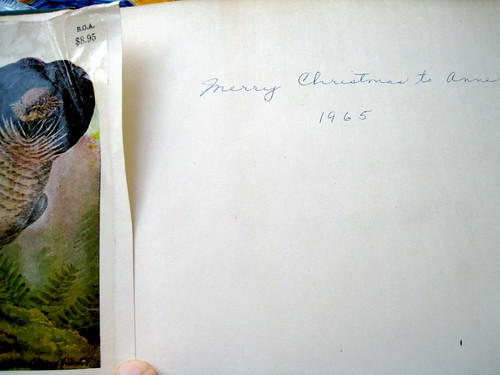
You're not gonna get this book into the pocket of your birding vest—it's bigger than The Joy of Cooking. I own only one bird book that larger and heavier than The Crossley ID Guide: the reprint of the 1917 Birds of America I got for Christmas in 1965. Edited by T. Gilbert Pearson, with color plates by Louis Agassiz Fuertes, its dust jacket proclaims in all caps, "This is the perfect, permanent bird book for all ages." Did the publisher mean it was perfect for a 14-year old as well as a 41-year old? Stone Age as well as Bronze Age? Industrial as well as Digital?

Like Fuertes' published paintings in Birds of America, Richard Crossley's plates are large, showing the species shown in its typical habitat. Crossley is not a painter however, his color plates are composite photos. Numerous photos of the bird are set against a background of the typical habitat. In the foreground of the of the composition appear a few close-up photos of the bird, each in a different plumage. In many plates, the middle ground displays several images of the bird in flight. In the distance are proportionally small images of the same species. Crossely's purpose is to pack as much identification information about the species into one scene as he can; how it may appear in flight, at rest from the side, viewed from the front when feeding, in the distance where streaks seem to blend into a wash of color.

At first I found these scenes a bit like a backlot studio shot in an old movie—I was distracted by the background. The more I looked at the page however, the more the images appeared 3-dimensional. Crossley is not trying to depict field marks. He asks the reader to look over the complete image, focusing first on this bird, then that, putting those photos of variable plumages and postures into context. In Japanese films, the director often gives the audience a wider shot than we're used to with Hollywood movies; the viewer, not the director, decides what to look at within the frame. Crossley's approach is more Kurosawa than Corman.

It will take me a long time to go through this book, but I'll use one plate as an example of the role this book can play in your birding toolbox. When I first moved to Kirkwood in the 80s, I occasionally saw what I called "the mystery bird." Its wings were swept back like a gull, but the tail wasn't the right shape for a gull. Sometimes I'd see a distant bird with a leading edge so straight that it appeared to be headless. It's flight was so effortless and acrobatic, I thought it might be a falcon. All of these are shown in the tiny distance shots on page 239. 

Ruffed Grouse peers in from the dust jacket
to read the 1965 version of an interactive comment.

The fact that I can point you toward that page whether you own the book or not is another feature of this birding guide that Peterson and Pearson never dreamed of; it's interactive! I can try to soak it all the images on the printed page, but if I need more information, I can find it with a click on the website. The web version has labels, comments, and questions not included in the book. Of course, you can "like" it, make comments, or leave questions for the author on Facebook too. Adjusted for inflation, at $8.95, Birds of America was roughly 3 times the Amazon price of The Crossley ID Guide!


If you wrote about this book on the web and I haven't listed you below, I'd love it if you'd comment and give us the link!
10,000 Birds
The Bird Chaser and second post
Audubon Magazine
Birdzilla.com
Monarch's Nature Blog
The Bird Booker Report
Sapsucker Woods (gift shop of Cornell U)
What Bird Forum


Wednesday, January 5, 2011

Website Wednesday: The Owls of Harry Potter

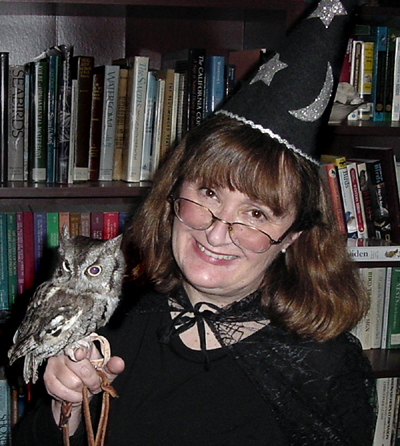
Laura Erickson and Archimedes share their love of birds
and Harry Potter with children. 

Laura Erickson, seen here as “Professor McGonagowl,” is a well-known author of The Bird Watching Answer Book: Everything You Need to Know to Enjoy Birds in Your Backyard and Beyond, 2009, Sharing the Wonder of Birds with Kids, 2002, and For the Birds, An Uncommon Guide, 1993. Her web page, The Owls of Harry Potter, packs a lot of information into a small space. Designed to appeal to young fans of J. K. Rowling’s books, “The Owls of Harry Potter” introduces each owl that’s a character in the novels, then provides a photo and its proper name. She discusses the natural—as well as magical—range of each owl.

The owl people most often associate with the Harry Potter movies and books is Harry’s own messenger owl and pet, Hedwig. Hedwig is a Snowy Owl, a bird of the Arctic tundra. Hedwig is of course female, but Erickson points out that she is played by a male bird—actually, 7 of them—in the films. Female snowies have black barring on the crown, back, and chest. Young males are barred, but usually not as much as females. As they mature, the plumage grows white. Presumably the director felt that a pure white bird would look “snowier.” They are magical birds, especially when the French horns and celesta of John Williams’ “Hedwig’s Theme” play in the background.

Whether Snowy, Great Grey, or Scops, an owl is a wizard’s letter carrier of choice, but we notice there is no junk mail in the wizard world. Muggles like ourselves are annoyed by it and, more to the point, millions of trees are destroyed so that our mailboxes can be filled with useless, unread messages. As you would expect from the author of 101 Ways to Help Birds (2006), Erickson includes ways to help owls by precycling, that is reducing the stream of junk mail and excessive packaging. She even includes a link to a publisher that uses 100% recycled paper in the printing of Harry Potter!

Really—which one is cuter, Laura or Archimedes? I contacted her to ask for permission to use this photo and inquire after her Screech Owl. She replied, “Archimedes is my own licensed education owl—I’ve had him since 2000. He was unreleasable after an illness as a nestling, and the rehab center had to find a safe place to transfer him right when my license had been approved but I didn’t yet have an owl. He’s still doing well.” Erickson maintains 2 blogs worth visiting too: Twin Beaks, and Laura’s Birding Blog.

Sunday, August 15, 2010

Photos & Friends, Skippers & Moths

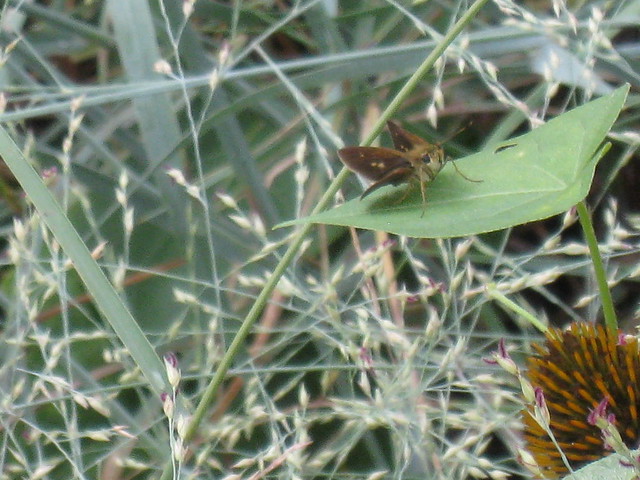
Northern Broken-Dash Skipper? AMcC

I had planned to do a third post on Silphiums, but there are too many butterflies in the garden for that! It’s all the more exciting since this summer has not been the best for butterflies. I don’t know if it’s been the weather, my garden, or the truck that sprayed mosquitoes (and every other living thing) on my street in late June. Whatever the problem, butterfly numbers seem to be recovering. Skippers are everywhere.

Skippers are small, fast-flying butterflies. Compared to the wings, the head is large—kind of cute if you get to see it well. Most are golden-brown or brown and frustrating to identify. It’s been said that skippers are the Empidonax of the butterfly world. (That last sentence actually means something to birders.) If you’re going to have any chance at all identifying skippers, you’ll need a good butterfly book with range maps and a close focusing set of binoculars. See my list of “Favorite Nature and Gardening Books” below. Having a digital camera and an expert friend to study the photo are probably required for some skippers.

I’ve had a new species in the yard this week that I tentatively identified as Northern Broken-Dash Skipper. I sent a photo to my friend Yvonne to see what she thinks. Northern Broken-Dash and Little Glassywing are very similar and my yard is within the range of both. The larvae of both eat grass. According to Glassberg’s Butterflies through Binoculars: The East, Little Glassywing’s caterpillars eat purpletop grass. I don’t have any purpletop in my yard, but it is common and probably can be found 1/2 mile from my house. Northern Broken-Dash caterpillars prefer switch grass. I have switch grass; in fact, it’s growing all around the skipper in the picture. The plant is Panicum virgatum ‘Prairie Sky.’ Maybe you have an opinion about the skipper in the photo you’d like to leave as a comment!

Female Fiery Skipper AMcC

My most common little guy is the Fiery Skipper. The one in this photo is a female, and she really confused me for a while. I seem to see mostly males.

Early this morning I saw a new species visiting my cup plant. It looked like a moth, but was behaving very much like a butterfly. I looked through Butterflies and Moths of Missouri, but couldn’t find it. I sent a shot of it to one of my favorite Flickr groups, ID Please. Members view the shared photos and give their opinion through the comments below the photo. To use this tool, you first need to join Flickr (it’s free), upload your photo, join the group, and then share it. I also sent the photo to What’s that Bug?, a website that features pages of insect photos and discussion. If you have an insect you’d like to identify, look for the “Ask What’s that Bug” page. Two more great sites to exploe are The Bug Guide and the North American Moth Photographers Group.

Corn Earworm Moth AMcC

While waiting for a response from these websites, I tidied up my desk. That when I accidentally came across a photo in Kaufman’s Field Guide to Insects of North America. I’d forgotten that 35 pages of moths are included in that book. So I’ve identified my mystery moth as one of the Owlet Moths, the Corn Earworm moth. I’ve mentioned two good books for butterfly identification but books devoted to moths, with photos or drawings of living critter are not so easy to find. I’m looking forward to the spring 2012 publication of Moths of Northeastern North America by David Beadle and Seabrooke Leckie. While you’re waiting, you might want to check out Seabrooke’s blog, “the Marvelous in Nature,” “North American Moths,” or the “blog carnival” dedicated to moths, “The Moth and Me,” most recently hosted at “The Skeptical Moth.”


Wordle


Sunday, August 8, 2010

Bees, Butterflies, and Biodiesel

Monarch Butterfly on Cup Plant bloom AMcC

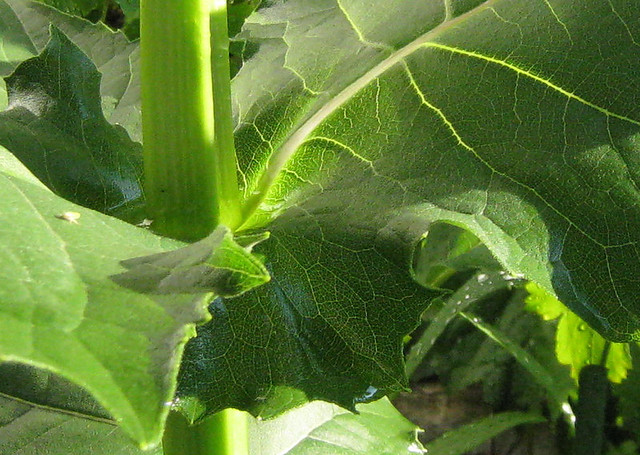
One of my favorite native plants is Cup Plant, Silphium perfoliatum. My first experience with it was in Hidden Meadow at Girl Scout Camp Cedarledge. My friend Sandy, whose position was “Nature Specialist,” showed me how the large opposite leaves wrap the square stem to form a cup. It had been hot and dry, but when she tipped the tall stalk, water dripped out. Pretty cool! Much later, I read about a couple who got rid of their bird feeders and planted a wildlife garden. I wish I could remember the title of the book, but I do remember that next to their windows, they planted cup plant so that they could enjoy watching the birds use the “natural birdbath.” I resolved to do the same when I got my own home.

Cup plant is a true garden personality. I do sometimes see chickadees and other birds land on the large leaf and dip into the “cup” for a drink. Perhaps they also capture insects in the water. The leaf is pointed, with a jagged edge and rough as sand paper. The stem is thick, smooth, straight, and square, giving it another common name, “Carpenter’s Weed” (Kurz, Ozark Wildflowers, 121). If you were to design a garden plant that breaks all the rules of garden plant developers and hybridizers, you’d come up with Cup Plant. There’s nothing dainty about it. Now you know why I like it!

Cup Plant leaves in June AMcC

By early August, many of my plants are 8 feet tall. Plants that don’t receive as much light and water are smaller. Towering plants with large leaves filled with rainwater sometimes tip over during a storm. If you have a good spot for Cup Plants, plan on staking them up in early summer, and use a really stout stake.

Cup plant blooms are always in demand with bees of all sorts, especially bumblebees. It’s worth remembering that native bees such as bumble bees are much less likely to sting than honeybees, but if you’re concerned, don’t plant it near the door or walkway. I welcome bees and other pollinators, but I found out my mail carrier didn’t. This perennial does spread from the root, so I could afford to thin the herd. Once I removed a plant or two and staked the others up away from the box, he started delivering my junk mail again.

Leaves form a cup as they enclose the stem. AMcC
The blooms of Cup Plant are a bit more than 3 inches across. Like other members of the Aster family, they provide the perfect landing platform for butterflies. When they’re in bloom, I frequently see 4 different butterfly species in the yard at a time. Today’s Cup Plant list: Monarch, Painted Lady, Fiery Skipper, and Checkered White butterfly. Bumblebees, carpenter bees (known as “long-tongued” bees) and butterflies are the most important pollinators for Cup Plant. When it goes to seed, American Goldfinches, House Finches, and (on rare occasions) Pine Siskins will visit.

Butterflies and Moths of Missouri, by J Richard and Joan E. Heizman (1987) mentions that the caterpillar of a moth, Eucosma giganteana (no common name), bores into the root of Silphium. With its wings closed, E. giganteana looks a lot like a small bird dropping—a great strategy for avoiding hungry birds. With a little research, I kicked up this story by P. J. Johnson: In South Dakota, Cup plant is being studied as a possible source of renewable energy! It’s possible that Cup Plant will be used to produce biodiesel fuel or plastics. If it is to be grown as a biomass crop however, scientists need to know about the possible impact of E. giganteana on the crop, especially since Cup Plant is its one and only host or larval food plant. Their studies found the larva in the flower heads, leaves and stems, but not in the root. I did find a caterpillar on one of my plants, but it looked nothing like the larva pictured in Johnson’s article. Apparently, E. giganteana is very uncommon, but I’m still going to examine bird droppings a little more closely.

Tuesday, July 13, 2010

Are they edible?


Those pesky stinkhorns sure are conversation-starters! I’ve had several people ask if they are edible, and the answer seems to be “Yes,” and “No.” Tom Volk’s  “Fungus of the Month” article says that they are, with certain cooking techniques. Another source, “Wildman” Steve Brill found them to be revolting, even when cooked in broth. The totally amazing 2006 BBC series Planet Earth had a time lapse video of a Netted Stinkhorn’s growth. I’d love to embed the video, but the embedding is disabled. Click this link, or better yet, watch Planet Earth. I came across a discussion on this topic at GardenWeb. I was glad to see at least one gardener recognized that they are harmless, interesting mushrooms. Just think of them as “fun-guy!” Thanks for all the comments and photos!