On June 11 and 12 I did more breeding bird surveys at Busch Memorial Conservation Area in St. Charles Co., Missouri, with my friend Kevin Renick. We didn't see the numbers of butterflies I mentioned in my previous post, but we saw and heard some great birds, including two not commonly seen: a Blue Grosbeak along the dam at Lake 37, and a brief view of a Blue-winged Warbler at the same spot.
Kevin is a singer-songwriter as well as a whiz at birding; his musical abilities extend into his nature hobby. What impressed me most this weekend was Kevin's ability to consistently tell the difference between the songs of the Scarlet Tanager and the Summer Tanager. Both birds nest here in oak-hickory forests of Missouri, and although their calls are very different, their songs are very much alike. I asked him to summarize the differences between the two songs. I'm accompanying Kevin's summary with video from the incomparable recordist of nature sounds, Lang Elliot.
Kevin's hints: "The Scarlet Tanager's song has sometimes been described as being like a 'robin with a sore throat.' It's a melodic warble, but it has a prominent screechy or raspy sound on one or two notes of its phrasing. The Summer Tanager on the other hand, is not raspy at all. It's a clear, sweet warble, a bit gentler than the Scarlet."
If you hear the bird's call—as opposed to its song—you've got it made. The Summer's call begins this video: "Picky-tucky-tuck." The Scarlet Tanager call, heard in the middle of his video, is "Chick-burrr. Chick-burrrr." David Sibley, author of The Sibley Guide to Birds, says that the Summer's song includes, "brief but distinct pauses between phrases." The Scarlet's by contrast is made up of a "fairly rapid, continuous series."
Thanks to Kevin Renick for his song analysis and to Lang Elliot for making his videos available.
Showing posts with label hummingbird garden. Show all posts
Showing posts with label hummingbird garden. Show all posts
Wednesday, June 15, 2011


Tuesday, April 19, 2011
Red Hot Sally Rides Again!

I always get a few quart or two-quart sized containers of red salvia because hummingbirds love them and there's not much else in bloom for early birds. Lanny Chambers at Hummingbirds.net recommends surveyor's tape fluttering from your feeders to bring in the hummers (see my review of his site). I prefer 'Sally.'
Back to nature. Josey and I were out in the back, protecting the Salvias, as I said, when I spotted a large insect in flight. The twilight and impending storm made it impossible to see much detail and for once, I hadn't brought my binoculars with me. Yet it seemed too early for an insect this large to be flying through the yard. Then I saw its silhouette pitch up, in a very non-insect-like flight, and drop onto a twig. My first hummingbird of 2011!
Thanks to *~Dawn~* for licensing her fascinating photo with Creative Commons!
Sunday, February 20, 2011
The Crossley ID Guide
 |
| Cape May Warbler in The Crossley ID Guide, p. 411 alongside Birds of America, plate 95 |
You're not gonna get this book into the pocket of your birding vest—it's bigger than The Joy of Cooking. I own only one bird book that larger and heavier than The Crossley ID Guide: the reprint of the 1917 Birds of America I got for Christmas in 1965. Edited by T. Gilbert Pearson, with color plates by Louis Agassiz Fuertes, its dust jacket proclaims in all caps, "This is the perfect, permanent bird book for all ages." Did the publisher mean it was perfect for a 14-year old as well as a 41-year old? Stone Age as well as Bronze Age? Industrial as well as Digital?
Like Fuertes' published paintings in Birds of America, Richard Crossley's plates are large, showing the species shown in its typical habitat. Crossley is not a painter however, his color plates are composite photos. Numerous photos of the bird are set against a background of the typical habitat. In the foreground of the of the composition appear a few close-up photos of the bird, each in a different plumage. In many plates, the middle ground displays several images of the bird in flight. In the distance are proportionally small images of the same species. Crossely's purpose is to pack as much identification information about the species into one scene as he can; how it may appear in flight, at rest from the side, viewed from the front when feeding, in the distance where streaks seem to blend into a wash of color.
At first I found these scenes a bit like a backlot studio shot in an old movie—I was distracted by the background. The more I looked at the page however, the more the images appeared 3-dimensional. Crossley is not trying to depict field marks. He asks the reader to look over the complete image, focusing first on this bird, then that, putting those photos of variable plumages and postures into context. In Japanese films, the director often gives the audience a wider shot than we're used to with Hollywood movies; the viewer, not the director, decides what to look at within the frame. Crossley's approach is more Kurosawa than Corman.
It will take me a long time to go through this book, but I'll use one plate as an example of the role this book can play in your birding toolbox. When I first moved to Kirkwood in the 80s, I occasionally saw what I called "the mystery bird." Its wings were swept back like a gull, but the tail wasn't the right shape for a gull. Sometimes I'd see a distant bird with a leading edge so straight that it appeared to be headless. It's flight was so effortless and acrobatic, I thought it might be a falcon. All of these are shown in the tiny distance shots on page 239.
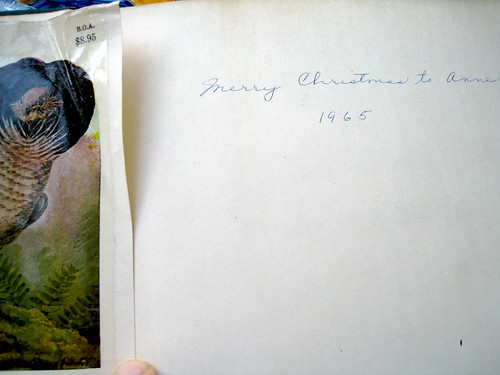 |
| Ruffed Grouse peers in from the dust jacket to read the 1965 version of an interactive comment. |
The fact that I can point you toward that page whether you own the book or not is another feature of this birding guide that Peterson and Pearson never dreamed of; it's interactive! I can try to soak it all the images on the printed page, but if I need more information, I can find it with a click on the website. The web version has labels, comments, and questions not included in the book. Of course, you can "like" it, make comments, or leave questions for the author on Facebook too. Adjusted for inflation, at $8.95, Birds of America was roughly 3 times the Amazon price of The Crossley ID Guide!
If you wrote about this book on the web and I haven't listed you below, I'd love it if you'd comment and give us the link!
10,000 Birds
The Bird Chaser and second post
Audubon Magazine
Birdzilla.com
Monarch's Nature Blog
The Bird Booker Report
Sapsucker Woods (gift shop of Cornell U)
What Bird Forum
Monday, October 4, 2010
Mexican Sage is A Hummer Magnet
 |
| Adult male Allen's Hummingbird on Salvia leucantha. Photo by tdlucas5000 |
I lied. I had to. I told work I’d be late because of a doctor’s appointment. I wanted be there early, but at 7:45 AM I was already part of the crowd. No, I’m not talking about Black Friday at Wal-Mart, but the St. Louis Community College-Meramec Horticulture Club Spring Plant Sale! Wandering through the packed tables that bright spring day in ’99, I spotted a scrawny, Charlie-Brown-Christmas-tree sort of a plant. It was labeled “Salvia leucantha, Mexican Sage”—no other information given.
I’d been thinking about devoting a section of my garden to hummingbirds, especially after the visit of a western wanderer, a Selasphorus hummingbird the previous November. (My stray hummer was probably a Rufous Hummingbird, but it could have been an Allen's—they're both in the genus Selasphorus.) Any Salvia is worth trying, especially if it claims to come from Mexico. I bought two of the puny things; $3 each.
Guessing that the plants would not be hardy, I put them in containers. During the long, hot summer that followed the plants grew—and grew. By July they were almost 5 feet tall and 3 feet wide, narrow-leaved and wild looking. The stems were covered with white, powdery down, but nary a bloom had bloomed. By late August I considered pitching them into the compost. Six bucks down the drain.
Then in September—buds! Hummers fought over the still-closed, deep blue buds. By the time the Broad-winged Hawks were migrating, each denim-colored calyx had a white tube projecting from it. The hummers showed their delight by beating up on each other constantly.
In early October another Selasphorus hummingbird arrived and chased away the Ruby-throats. Around Halloween I had to cover the plants to protect them from frost, but the temperatures recovered and they bloomed till almost December.
 |
| Mexican bush sage blooms when days get short. AMcC |
Such a fabulous plant—why had I never heard of it before? And why was Meramec the only place in town that carried it? Since then I’ve spied it here and there. Salvia leucantha showed up twice on PBS’s The Victory Garden. When that best-of-garden-TV shows visited Cape Town, South Africa, Adrian Bloom commented on a bed of them. The gardener replied, “Oh, yes. That’s one of the old Salvias.” (An old-fashioned flower? An old planting in his garden? I don’t know.) In another episode, the camera lingered over a terrace filled with them in Provence, France. A photo of Mexican sage graced the cover of Fine Gardening, in October, 2002. I spotted it in the Canon color printer commercial, with the pair of Anna’s Hummingbirds. The plant even appeared on the Clairol Herbal Essences Conditioner bottle—the one for “Normal to Oily Hair.”
It’s easier to find Salvia leucantha in local garden centers now, but I usually find it in the herb section with the kitchen sage. I don’t know of any culinary use. I suspect they just don’t know where else to put it.
The culture is not difficult. Mexican sage—also known as Mexican bush sage—can tolerate drought and poor soil. It’s great in containers, but grows larger in the ground. Presumably it’s adapted to sharp drainage in its Mexican home. It’s built for scorching sun, judging by the narrow leaves and reflective coating on the stems. I have had plants do very well in part-sun however.
It doesn’t bloom till the days are short. Does the plant do so to minimize exposure to the sun? Is it related late summer rains in the Sonoran desert? Or is it trying to match its blooming period with the southward migration of its preferred pollinator, hummingbirds?
My plants in loose garden soil did better than the ones in compacted clay, but they all survived—till the temperatures dipped below 29°. Poor little plants. Never saw it coming. While native plants formed seeds and went dormant, they bloomed and put on fresh, tender growth till the frost hammered them to the ground. Mexican sage’s hardiness is rated at Zone 7. We’re two zones north of that in Zone 5. The stems are brittle and can be easily snapped when planting. The pieces root just as easily however, and that’s the best way to save some for next season.
Some gardeners have told me they wouldn’t devote space to a plant that won’t bloom till gardening season is over. Few plants can give this punch of color for so many weeks though, attracting feisty little birds, sometimes rare ones. I’ve grown it every year since ’99. Mexican bush sage sure beats the heck out of fall mums. Give it a try!
Thanks to my Flickr friend tdlucas5000 for the terrific photo of the Allen's Hummingbird guarding his patch of Mexican bush sage.
Sunday, September 26, 2010
They'd Rather Fight than Switch!
 |
| Hummingbird throwdown! Photo by Amyn Kassam |
Here’s what we love about hummingbirds: They have that vertical posture, they make eye contact, they love sweets, and of course, they fight. They’re so human!
Watching hummingbirds is not like watching other wildlife. Hummers get up close and personal. Laura Erickson, in her 2006 book, 101 Ways to Help Birds, tells us about hummers that tap on her window when they want her attention. I watched a hummingbird pirouette around a friend wearing a coral-colored shirt, even though he was surrounded by a crowd partying on a small deck. Hummers have come within inches of my face to catch the spray as I water my plants.
My neighbor recently told me about two hummers that clashed and then crashed, knocking each other to the ground right in front of his basset hound. Both recovered and flew off before the dog could get over her surprise and devour them. Last summer, a skirmishing hummer clobbered my brother-in-law in the head!
The level of aggression in hummingbirds is a mystery to me. Isn’t fighting over resources a waste of valuable foraging and feeding time? In her 2000 book, Attracting and Feeding Hummingbirds, Sheri Williamson points out that plants must be frugal with the nectar they produce. Nectar is of no use to the plant directly. It’s sole purpose is to pull in pollinators, so once a blossom has been pollinated, it ceases to produce nectar. Since plants are so stingy, hummers adopt a strategy of claiming a territory and protecting their resource ferociously. According to Williamson, “Territories are smaller where flowers are abundant, larger where they are scarce (14).” I can see the evolutionary advantage of resource guarding, but I’m not sure why it seems so much stronger in hummers than—say—woodpeckers.
Like grizzly bears and bull elephants, hummingbirds use “mock charges” to panic their rival into flight, while minimizing the risk of injury to themselves. Adult males can flash their color throat feathers (the gorget) to intimidate from a distance. Females and juvenile bird display the white tips of the outer tail feathers for the same purpose, as you see in the photo above by my Flickr friend, Amyn Kassam. Hummingbirds can scold predators and interlopers with chirping sounds, and some can startle with buzzing sounds produced by tail or wing feathers. There are times however when, like Taryton smokers, hummingbirds would rather fight than switch.
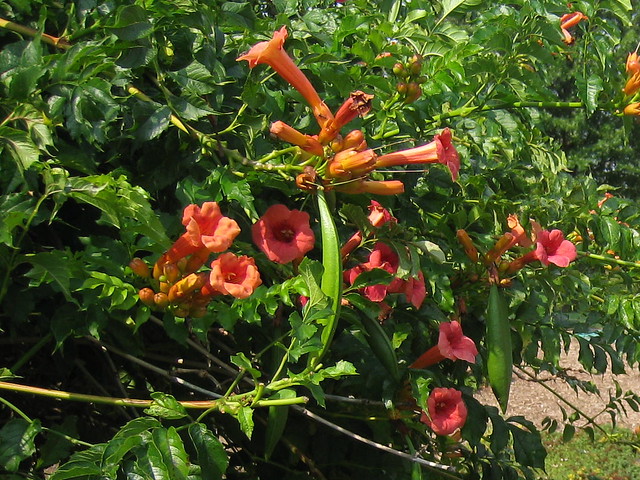
Some of my readers know that I worked at a youth camp in the Ozarks for many summers. Trumpet creepers (Campsis radicans) brought in birds by the dozen. Like Snoopy and the Red Baron, hummers battled around the camp office from sun up till sundown. Once, a staff member was actually injured in a hummingbird fight. As she crossed the parking lot, two hummers collided in front of her and a dislodged feather hit her in the eye!
 |
| Trumpet Creeper is a hummingbird magnet! Photo by AMcCormack |
Trumpet creeper is a hummingbird magnet for a reason. In a 2003 article in LOS News, the newsletter of the Louisiana Ornithological Society, Dennis Demcheck wrote about the “Sugar Content of Hummingbird Plants in Louisiana Gardens.” Demcheck used a refractometer to measure the concentration of sugar in the nectar of blossoms in his garden—the same equipment used by wine makers. He found that, among wild/native plants, the trumpet creeper had the highest concentration of sugar at 34.3%, with each bloom producing a large volume of nectar. To reach that nectar, the bird must actually climb inside the 3-inch long bloom. It’s quite a risk for a bird to limit its vision like that, but obviously worth it.
If you’re thinking about adding trumpet creeper to your home garden, linger on this blog a little longer. Trumpet creeper is a big plant; every bit as aggressive as the hummers that love it. The main stem can be wider than your hand and all those branches in summer are heavy as they lie on the roof of your garage or branches of your prized specimen tree. Maybe you can persuade your neighbor to grow it.
Tuesday, July 13, 2010
Are they edible?

Those pesky stinkhorns sure are conversation-starters! I’ve had several people ask if they are edible, and the answer seems to be “Yes,” and “No.” Tom Volk’s “Fungus of the Month” article says that they are, with certain cooking techniques. Another source, “Wildman” Steve Brill found them to be revolting, even when cooked in broth. The totally amazing 2006 BBC series Planet Earth had a time lapse video of a Netted Stinkhorn’s growth. I’d love to embed the video, but the embedding is disabled. Click this link, or better yet, watch Planet Earth. I came across a discussion on this topic at GardenWeb. I was glad to see at least one gardener recognized that they are harmless, interesting mushrooms. Just think of them as “fun-guy!” Thanks for all the comments and photos!
Subscribe to:
Posts (Atom)