Showing posts with label silphium. Show all posts

Wednesday, August 3, 2011

What is she doing?


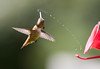
As my garden renovation proceeds, I removed a Sweet Autumn Clematis (Clematis terniflora) from one of my witch hazel trees. Nasty work in this heat, but I'm finally getting serious about removing the invasive alien plants in my yard. Sweet Autumn Clematis has just about engulfed the Sugar Creek area of Kirkwood, Missouri, but I think I'll make that the subject of a later post. Just as I stretched out atop the ladder to remove that last bit of vine shading my puny little witch hazel, I had a moment of panic. A hummingbird—a female-plumaged Ruby-throated Hummingbird—frantically bounced around the tip of a top branch. Had I accidently destroyed her nest?

I've never had a hummingbird nest in my yard, in spite of the fact that I've done as much as I can to attract them to my garden, including mounting Dan True's "Hummingbird House." Also, it's pretty late in summer for a hummingbird to have an active nest. I searched, but found no evidence of a nest among the piles of vines below. So what was she doing?

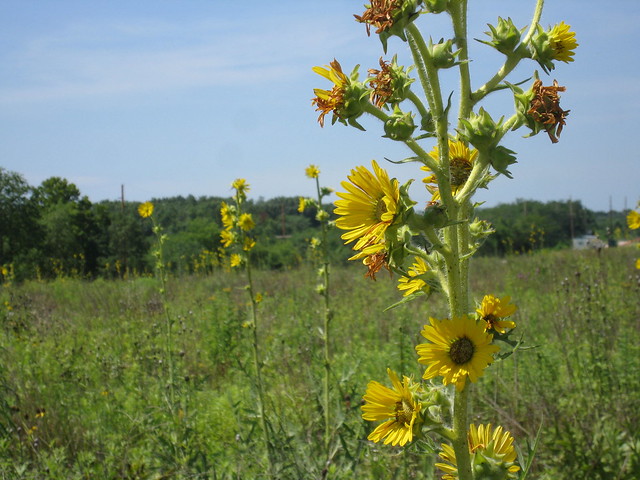
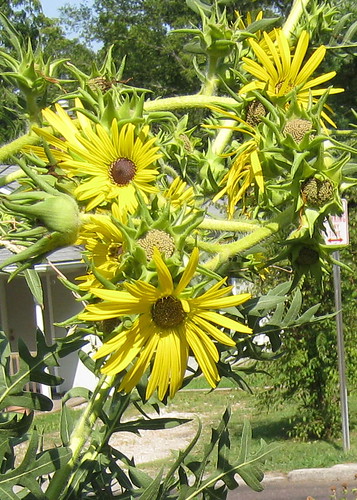
I took these photo on July 17, just as my Cup Plants (Silphium perfoliatum) were beginning to bloom. Is this female Ruby-throat getting nectar from the bloom, as butterflies do? 
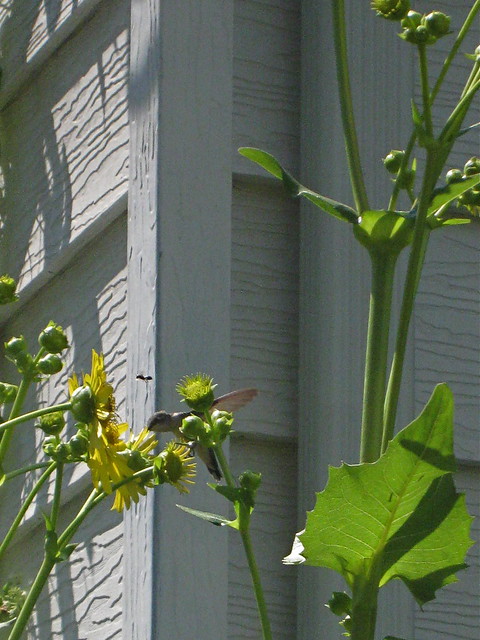

She certainly seems to be. Daisy-like composite blooms aren't described as hummingbird flowers in the books. Like the Pipevine Swallowtail butterflies that visit my Royal Catchfly, hummingbirds don't read the books.

Or are there some insects within the bloom that she's lapping up? I remember reading Bob Sargent's quote on Hummingbirds.net: "Hummers need nectar to power the bug-eating machine that they are." Bob Sargent is a well-known hummingbird bander and author. He was interviewed on Richard and Susan Day's Daybreak Blog.

Since I spotted the hummer  at my witch hazel, I've seen others busy at things that make no sense to me. I noticed one bobbing up and down on the tips of a cedar tree (Juniperus virginiana) where I don't think there can be any nectar.

Hummingbirds use a display flight to attract a mate or drive out an intruder, but these displays typically cover more than ten feet of vertical air space. The movement I described covered only a few inches.

I assume hummingbirds don't have energy to waste, so their activity must have some purpose. I wonder what it was…
You might also enjoy:
Royal Catchfly 
Hole in One
Golden Currant
  

Thursday, June 23, 2011

Pa-RUM-pa-pum-pum

Through May and early June I occasionally heard a rapid, metallic drumming—almost a trill. "I'll bet a woodpecker is drumming on someone's aluminum siding," I thought, but I could never find the bird. On Memorial Day weekend however, I heard the sound again—very close, but where?
  
Caught in the act! See the little drummer bird, just beneath the metal cap on my chimney? It is believed that woodpeckers use drumming as a substitute for song. Woodpeckers don't have a song for claiming territory or attracting a mate like a robin or cardinal would employ. They don't need one. All a woodpecker has to do if find some resonant material—a hollow snag, or your aluminum gutter—and drill, baby, drill! David Sibley's website has a great article about drumming, complete with sonagrams and recordings of Downy and the similar-looking and similar-sounding Hairy Woodpecker.

Sibley notes some intriguing findings in the research: both male and female Downy Woodpeckers drum and at all times a year. We assume the male is trying to attract a mate with his drumming/song. Is the female doing the same? And if we hear drumming in January, is that drummer defending a territory even though it's not nesting season? My grainy photo doesn't show the red nape patch, but this was a male playing his drum for me, and the neighborhood. What is he trying to say with his 15 beats per second?

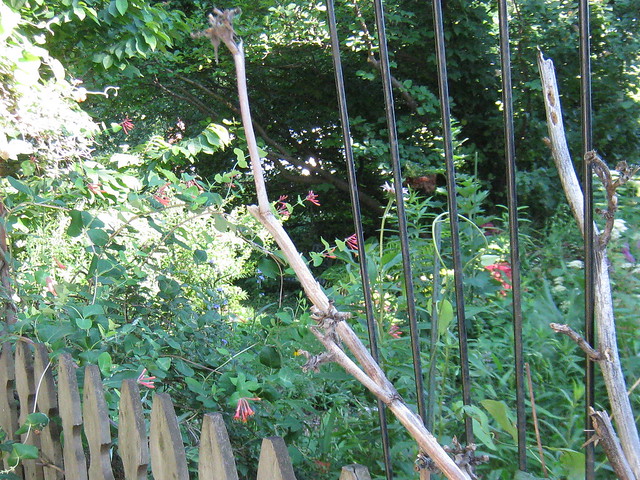
When I visited southeastern Arizona in the summer of 2000, I fascinated to see that birders decorated their yards with dried agave stalks. The stalks seemed to advertise to hummingbirds that dinner time had arrived. Fiesty little Rufous and Black-chinned hummers would perch on the stalk, survey the feeders, and dive in. I was dying to carry off one of these stalks for my own yard, but alas, it would not fit into my baggage. I cast around for a substitute, and saw the potential in a year-old Compass Plant stalk.

I wrote about Compass Plant (Silphium laciniatum) last August. It's one of my favorites. This spring I tied several Compass Plant stalks to my fence. Investigating the stalk this morning, I saw not a hummingbird, but a young female Downy Woodpecker. 

She drilled into the stems and pulled out something that was black. You can see tiny drill holes near the top of the right stalk. Even tinier ones are barely visible in the left stalk, just below the center of the photos. According to John Hilty's website, Illinois Wildflowers, inside the dried stem could have been the larva of the Tumbling Flower Beetle. What a great name! Check out MOBugs' post on this insect, with great photos.

Sunday, December 12, 2010

Pokey Hat

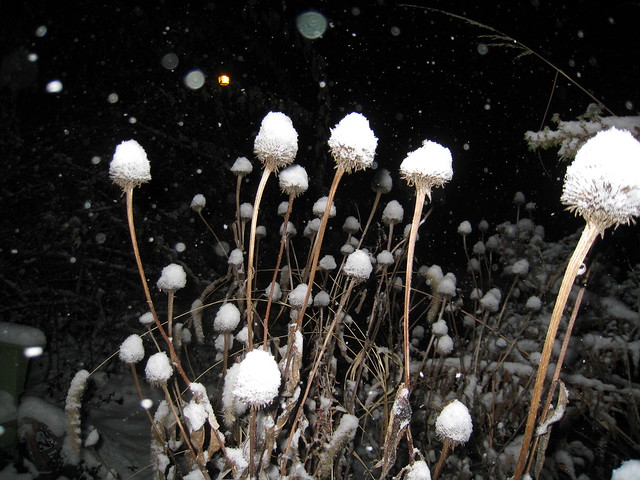
Pokey hats, early on a snowy Sunday. AMcC

Some years ago I had the opportunity to visit a state park with a friend from Scotland. Montauk State Park is a beautiful spot on the banks of the upper Current River. After a long day of watching people fish for trout, we visited the lodge. My friend stepped up to the snack bar and in a heavy Glaswegian accent ordered a “pokey hat.” It took some effort to discover that she meant an ice cream cone. Hilarious!

Cup Plant hangs on to the snow too,
almost as well as it does rain water. AMcC
Hold on now, Scottish readers! I got my comeuppance when that same friend and I dropped into a Glasgow curry shop and I ordered “nan bread.” In my Saint Louis accent, “naan” rhymes with Anne. The clerk could hardly take my order he was laughing so hard. He called the cooks to come out and begged me say it again!


I saw a pokey hat in my front yard early this morning. The prickly seedhead of Purple coneflower (Echinacea purpurea) is especially good at showing off the beautiful snow. It’s afternoon now and gusts of 40 mile-per-hour winds haven’t yet knocked the hat off.


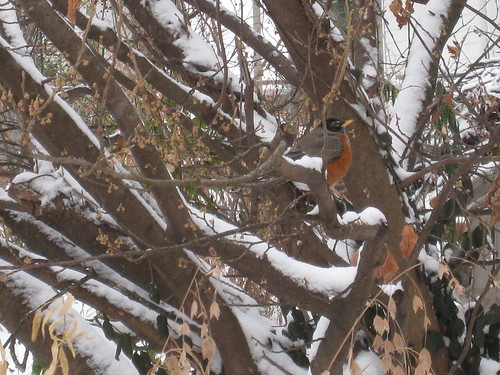
Male American Robin rides the storm out in the witch hazel tree. AMcC
About 3 months from now, a meteorologist on local TV will proudly display a photo documenting the arrival of the first robin of the year. Actually, American Robins are present in our area all year long, but they aren’t quite as conspicuous to non-birders as they are in spring.

Am. Goldfinches hard at work on
the seeds of Prairie Dock. AMcC


In spite of a temperature of 19° F (wind chill of 2°), Slate-colored Junco, Carolina Chickadee, Downy Woodpecker, and White-throated Sparrow are busy in the back yard. In the front, American Goldfinches tease the last seeds out of Prairie Dock seedheads (Silphium terebinthinaceum). 

All this activity is missing from gardens where the owner tidies up in fall. That’s one less chore for those who garden with binoculars.

Wednesday, August 11, 2010

A Compass on the Lone Prairie

Compass Plant blooms at Howell Prairie, St. Charles Co., MO AMcC

My first reason for wanting to find Compass plant for my yard is the tale that it can be used as a compass. Now that my plants are large, I can say that the tale is true—mostly. Compass plant (Silphium laciniatum) is a plant of tall grass prairies and glades and everything about it shows is adaptated to dry conditions with blazing sun. Leaves and stem are hispid, as the botanists say; or covered with “little tiny hairs,” as Jonathan Winters would say. The stiff white hairs reflect light, effectively protecting the plant’s tissues against the sun.

Presumably, they also discourage deer and antelope from snacking on it as they play on the range. Instead of large, light-gathering leaves on a tropical philodendron, Compass plant’s leaves are large but deeply cut, reducing the surface area. Merv Wallace at Missouri Wildflowers Nursery says they look like “green flames.” The plant’s best trick is to move those leaves around during the day so that they face east and west, presenting only a narrow edge to the scorching south. Now the leaf points north, hence, the name. Of course, if the plant is shaded by something, the leaves may face any direction, so navigators beware!

Leaves point north AMcC
I wonder what the first Europeans thought of Compass plant when they first explored the tall grass prairies of the Midwest. It towers up to 8 feet, with a tough, thick stem, topped with 2 to 3 inch sunny flowers. Many sources mention that the Indians used the resin in the top part of the stem for chewing gum. The Pawnee used the dried root as a medicine, given in tea. I don’t envy the job the Pawnee women had, trying to dig the huge taproot in dry soil, using only a sharpened stick.

In Ozark Wildflowers, Kurz tells us that the Omaha and Ponca believed the plant attracted lightning and would not camp near it. It makes sense if you image mile after mile of treeless, tall grass prairie. Compass plant could very well be the tallest structure out there. Tall things can be at a premium for birds on the prairie. Meadowlarks and sparrows need to make their presence known so they can defend territory and find a mate, and Compass plant stalks are just the ticket. On a birding trip to southeast Arizona, I noticed that some of the Arizona birders tied Agave stalks to their fences, providing an attractive perch for hummers. I couldn’t get an Agave stalk into my carry-on, so I use last season’s Compass plant stalk for my hummers.

If you grow Compass plant, remember that it takes a few years for it to bloom, growing from seed. Once your plant sends up its tall stalk from the leaves at the base, stake it at least by June, with a heavy stake, driven in deeply. Out on the prairie it wouldn’t matter if a few stalks fell over in a storm, there would still be many of them blooming. But we gardeners don’t have that kind of space. Horizontal blooms don’t really impress in the garden.

Compass Plant blooming in August AMcC
Several insects depend soley or partly on Compass plant: the Silphium beetle, Rynchites sp. and the prairie cicada, Okanagana balli, which the Illinois Dept of Natural Resources calls, “the rarest large insect in Illinois.” Studies on this insect in Kansas found that although it occurs on remnant native prairies, it has never been found on a restored prairie. I was unable to find out if the prairie cicada occurs in my home state, Missouri.

Cattle and horses do eat Compass plant, according to the USDA Natural Resources Conservation Service. I like to look out at my plants and imagine buffalo grazing on Compass plant. The buffalo wouldn’t stay long in my yard—I only have two plants. I bet the plants would grow back though. Dr. John Hilty’s website says that Compass plant can live for 100 years!

Sunday, August 8, 2010

Bees, Butterflies, and Biodiesel

Monarch Butterfly on Cup Plant bloom AMcC

One of my favorite native plants is Cup Plant, Silphium perfoliatum. My first experience with it was in Hidden Meadow at Girl Scout Camp Cedarledge. My friend Sandy, whose position was “Nature Specialist,” showed me how the large opposite leaves wrap the square stem to form a cup. It had been hot and dry, but when she tipped the tall stalk, water dripped out. Pretty cool! Much later, I read about a couple who got rid of their bird feeders and planted a wildlife garden. I wish I could remember the title of the book, but I do remember that next to their windows, they planted cup plant so that they could enjoy watching the birds use the “natural birdbath.” I resolved to do the same when I got my own home.

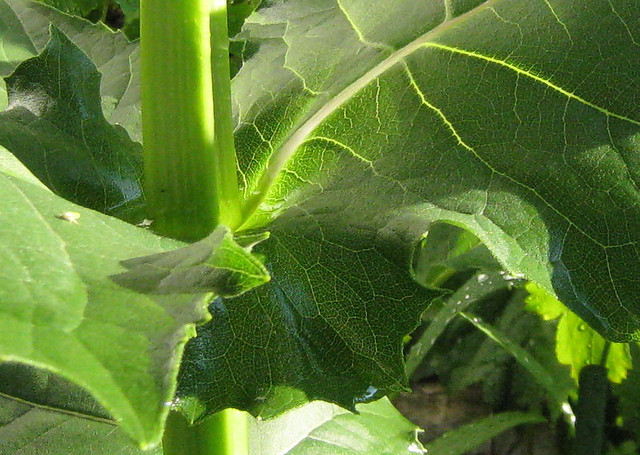
Cup plant is a true garden personality. I do sometimes see chickadees and other birds land on the large leaf and dip into the “cup” for a drink. Perhaps they also capture insects in the water. The leaf is pointed, with a jagged edge and rough as sand paper. The stem is thick, smooth, straight, and square, giving it another common name, “Carpenter’s Weed” (Kurz, Ozark Wildflowers, 121). If you were to design a garden plant that breaks all the rules of garden plant developers and hybridizers, you’d come up with Cup Plant. There’s nothing dainty about it. Now you know why I like it!

Cup Plant leaves in June AMcC

By early August, many of my plants are 8 feet tall. Plants that don’t receive as much light and water are smaller. Towering plants with large leaves filled with rainwater sometimes tip over during a storm. If you have a good spot for Cup Plants, plan on staking them up in early summer, and use a really stout stake.

Cup plant blooms are always in demand with bees of all sorts, especially bumblebees. It’s worth remembering that native bees such as bumble bees are much less likely to sting than honeybees, but if you’re concerned, don’t plant it near the door or walkway. I welcome bees and other pollinators, but I found out my mail carrier didn’t. This perennial does spread from the root, so I could afford to thin the herd. Once I removed a plant or two and staked the others up away from the box, he started delivering my junk mail again.

Leaves form a cup as they enclose the stem. AMcC
The blooms of Cup Plant are a bit more than 3 inches across. Like other members of the Aster family, they provide the perfect landing platform for butterflies. When they’re in bloom, I frequently see 4 different butterfly species in the yard at a time. Today’s Cup Plant list: Monarch, Painted Lady, Fiery Skipper, and Checkered White butterfly. Bumblebees, carpenter bees (known as “long-tongued” bees) and butterflies are the most important pollinators for Cup Plant. When it goes to seed, American Goldfinches, House Finches, and (on rare occasions) Pine Siskins will visit.

Butterflies and Moths of Missouri, by J Richard and Joan E. Heizman (1987) mentions that the caterpillar of a moth, Eucosma giganteana (no common name), bores into the root of Silphium. With its wings closed, E. giganteana looks a lot like a small bird dropping—a great strategy for avoiding hungry birds. With a little research, I kicked up this story by P. J. Johnson: In South Dakota, Cup plant is being studied as a possible source of renewable energy! It’s possible that Cup Plant will be used to produce biodiesel fuel or plastics. If it is to be grown as a biomass crop however, scientists need to know about the possible impact of E. giganteana on the crop, especially since Cup Plant is its one and only host or larval food plant. Their studies found the larva in the flower heads, leaves and stems, but not in the root. I did find a caterpillar on one of my plants, but it looked nothing like the larva pictured in Johnson’s article. Apparently, E. giganteana is very uncommon, but I’m still going to examine bird droppings a little more closely.

Thursday, August 5, 2010

Of Cabbages and Checkered Whites

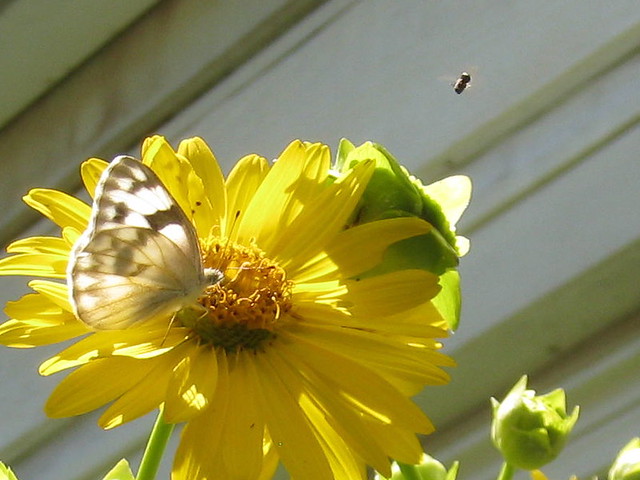
Female Checkered White butterfly on cup plant
as a native bee takes aim! AMcC

August is an exciting time in a wildlife garden. My yellow composites are beginning to bloom—cup plant, prairie dock, golden glow, woodland sunflower, and brown-eyed Susan. Goldfinches add to the yellow garden as they harvest purple coneflower seeds for their nestlings. The males sing almost as much and as loudly as robins in May. Pollinators of every kind are busy all day long. All these species are on schedule, and then a surprise: a Checkered White butterfly! Checkered Whites are not rare, but they are new to my “yard list.”

You might not think a member of the family of “Whites” or Pierids would be eye-catching, but I think the female’s pattern is really appealing. I was thrilled with the new species, but I didn’t realize how uncommon this sighting was till I talked to my friend, Yvonne Homeyer. Yvonne writes the butterfly report for our local chapter of North American Butterfly Association and serves on NABA’s board of Directors. She pointed out that this year Checkered Whites have been seen in just a few gardens and not reported at all in natural areas.

I did a bit of checking on the abundance of Checkered Whites. In Brock & Kaufman’s Butterflies of North America, the map indicates that they are uncommon in my area (St. Louis County, MO). Glassberg’s Butterflies through Binoculars; The East says, “Abundance of this species greatly fluctuates.” Wagner, in Caterpillars of Eastern North America, says, “This species has declined precipitously over the east in my lifetime.”

Why this should be is unknown. Checkered White caterpillars can eat just about anything in the mustard/cabbage family (Brassicaceae), which includes plenty of native and non-native weeds as well as garden vegetables. I didn’t think I had any of the host plants in my yard, till I checked Denison’s Missouri Wildflowers. I have a small area of toothwort (Carmdamine), which I didn’t realize was in the mustard family. A plant they seem to use quite heavily is pepper grass, which is abundant in the nearby city property and college campus. Every yard seems to have another brassica, the invasive, non-native hairy bittercress.

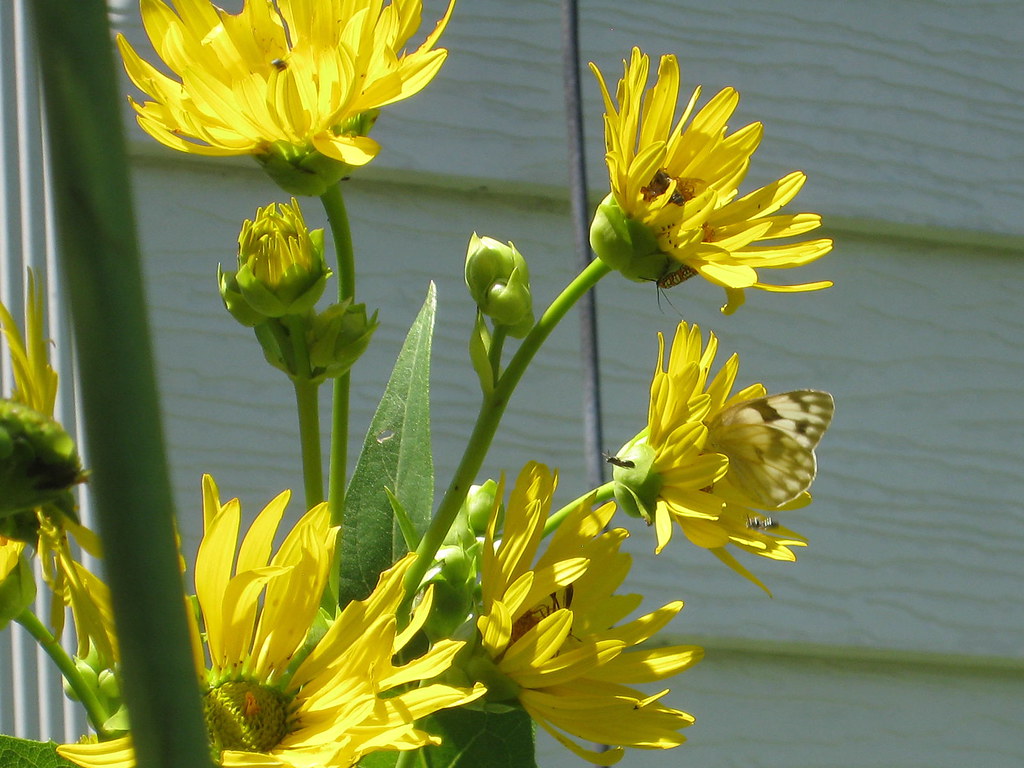
I spent about 3 days trying to get photos. Monday, I saw a male Checkered White, but it had disappeared by the time I got my camera. Tuesday was a scorcher, 100° with high humidity. I ran out of the air-conditioned house with the camera as soon as I spotted it through the window. This butterfly was a very cooperative female, but the condensation on my lens made the images useless. Amazingly, I saw another female Checkered White on Wednesday and was able to get some decent shots, in spite of the fact that it didn’t linger long at a blossom. It’s really nice to study the photos later and see native bees and an Ailanthus Webworm moth in the frame.

I recognize the female butterfly by the checkered markings, especially on the hind wing. But if I were a  Checkered White butterfly, according to the University of Florida’s Institute of Food and Agricultural Sciences, I’d look for a different “UV reflectivity.” I guess that would be pretty attractive too.

Seeing such a beautiful, pale butterfly kind of makes up for the wounds of reading that its preferred habitat includes “dry weedy areas” (Milleman, Mizzel, Jones on “Web Only Display of Miscellaneous Local Insects”) and—even worse—“disturbed open areas…(and) abandoned railway tracks” (Glassberg, 52). I don’t like to think of my front yard as “disturbed,” but it is interesting that I have only seen it in the front among cup plants and a number of species adapted to dry glades. So far, it has ignored my backyard of tall phlox, butterfly bush, and swamp milkweed.
Female Checkered White Butterfly shares Cup Plant
with native bees and Ailanthus Webworm moth AMcC
“The time has come,” the Walrus said,
“To talk of many things:
 Of shoes—and ships—and sealing wax—
 Of cabbages—and kings.”