Showing posts with label milkweed. Show all posts

Monday, June 13, 2011

Hits and Misses on the Breeding Bird Survey

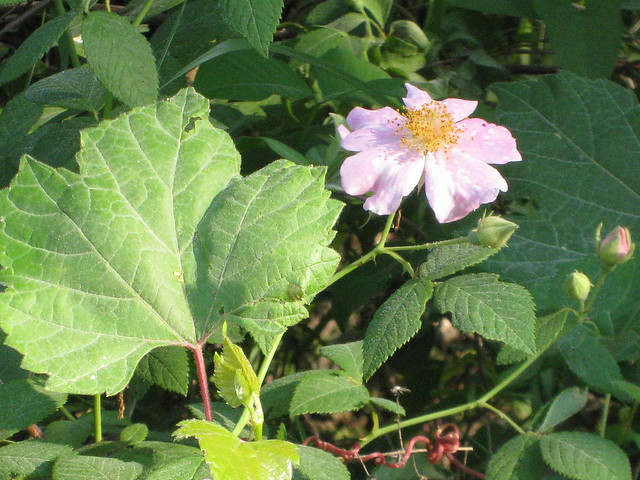
Wild Rose
I got a chance to do a bird surveys this week at one of my favorite places, Busch Memorial Conservation Area, in St. Charles County, Missouri. Busch is a mixed use area, with many artificial lakes, stocked with fish, and some fields rented to farmers. It's also the area of a long-running Christmas Count. On Thursday, July 9, I birded with my cousin, Ginny. We started birding together back before the Beatles appeared in Ed Sullivan. Back in the day, we shared field glasses, the Zim guide, and recorded our list on a Big Chief notebook. As we walked through the neighborhood and nearby cemetery, our list looked like this:

cardinal
starling
English sparrow
robin
blue jay

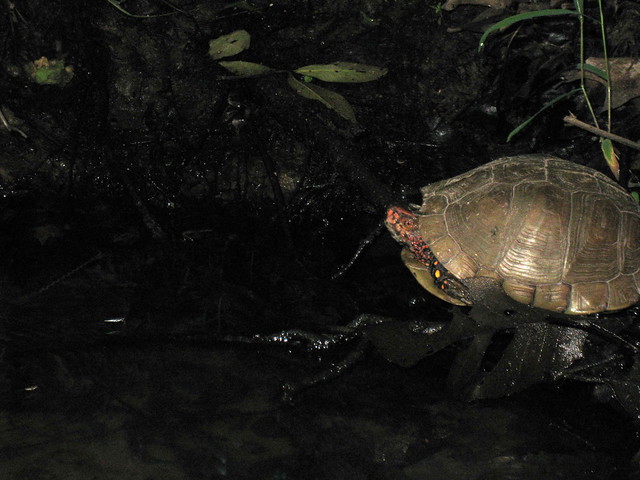
Our list was a bit longer this year, but it was hazy, hot, and humid even at 6:30 AM. The heat kept many of the birds from singing, and if you're going to bird when the leaves are full-sized, you need those birds to sing. We started at Lake 22. This small lake has been part of my territory for 8 years. Some dead trees stood in the lake and Tree Swallows nested there. Each year the snags decayed, and this year, none were left. Not a swallow was seen. A deeply eroded road leads down to a beautiful creek where I've recorded Kentucky Warbler and Black-and-White Warblers, but the area was fenced off, presumably because of an erosion control project. A half-dead elm near the parking area hosted an Orchard Oriole nest, but the tree had been removed and the orioles were missing. We did find this Three-Toed Box Turtle in a wet area on the far side of the lake. His red eye and face markings show that he's a male.

The bird of the day was the Acadian Flycatcher. It's a common bird in the woodlands in our area, one of a complex of similar-looking small flycatchers in the genus Empidonax. You hear 10 for every one you see. Near Lake 23, one perched on a thin branch over the road, allowing us a good long look as he surveyed his domain. Another surprise was a female Wood Duck. Not an uncommon bird, but it can be difficult to find. I don't think I've ever recorded one on the summer bird survey before.

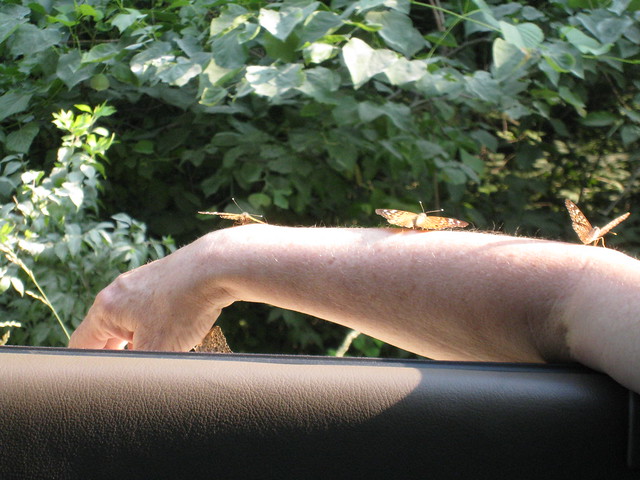
If the birds were a bit shy, the butterflies were not. Thousands upon thousands of fresh-looking Hackberry Emperor butterflies (Asterocampa celtis) dotted the gravel roads for several miles. Hackberries are known for the fondness for landing on humans, lapping up the salt in sweat. They seemed to enjoy Ginny's arm:

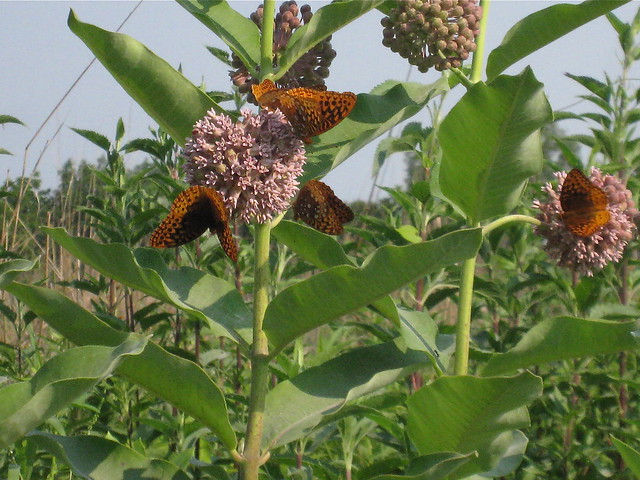
Great Spangled Fritallaries (Speyeria cybele) were out in numbers too. We saw them everywhere we found Common Milkweed (Asclepias syriaca) or Purple Milkweed (A. purpurascens).
Sunday, July 11, 2010

Those Ever-Lovin' Vines!


Pop used to call them “Those ever-lovin’ vines!” and it was clear he was not in love with them. I don’t know any gardeners that are. I’m talking about those vines that spring from nowhere just to deface your Japanese maple. Edgar Denison calls it Angle-Pod, others use the common names Climbing Milkweed, Bluevine, Honeyvine, or Sandvine. Or Everlovinvine.
This plant is a stalker—literally. The stem twines slyly around the stalk of your treasured perennial. You won’t even notice it till it starts to bloom. By then it’s tied a dozen plants into an impenetrable tangle, snapping stems under the weight of the hitchhiker and the next rain. Its blooms are insignificant and white, but put out strong perfume, calling bees and flies to pollinator duty. The fragrance is sweet to humans too, but for my money, it’s too sweet.
Removing Cynanchum laeve requires delicacy and restraint. The vine twines with a counter-clockwise motion, so to remove, you must carefully twist it in a clockwise direction. The temptation to pull is usually too much for me, and that yanks off the flowers I’m trying to save. A better strategy is to use scissors to clip the vine every few inches, then pick off each piece. The root is deep. It looks like long, thin, white carrot. If you choose to leave the root, the vine will sprout right back. You understand, of course, that removing the root will pretty much destroy that section of your garden. The best plan is to let the vine grow long enough so that you can safely hit it with herbicide, leaving the rest of the garden untouched. Good luck with that.
When all else fails, comfort yourself with the knowledge that Monarch butterflies and their caterpillars love this plant. I’ve seen caterpillars on it a number of times. Sometimes I just hook it with the side-view mirror as I back out of my driveway and drive around town with a vine and black-eyed Susan dangling from my passenger side. Works for me!