Showing posts with label Christmas Bird Count. Show all posts

Sunday, March 2, 2014

Weldon Spring MO Christmas Bird Count 2014

Eastern Phoebe, photo by John Benson, from Wikipedia

Thanks to all who helped with the Weldon Spring Christmas Bird Count, Jan. 4, 2014! We had 18 participants, 63 species, 8774 birds, and some really decent weather for the season. The Weldon Spring Count (also known as the "Busch count," officially labeled by National Audubon Society as "MOWS") has been held every year since 1952, sponsored by Webster Groves Nature Study Society. The count, like all Christmas Counts, is held between Dec. 14, 2013, and Jan. 4, 2014, and covers a 15-mile-diameter circle. In our case, the circle is centered on the town of Weldon Spring in St. Charles County, Missouri. It includes some of the best land-birding in the greater St. Louis area: Busch Memorial Conservation Area and, bordering the Missouri River,  Weldon Spring Conservation Area.

Only one species had an unusually high count this year: Red-shouldered Hawks totaled 22, topping the previous high of 18 in 2008. Out of 62 counts, Red-shouldered Hawk has occurred only 28 times.

Several species were unusually low. Only 2 Red-headed Woodpeckers were reported. The previous low was 1 in 1964, occurring 51 out of the 62 counts. Red-headed Woodpecker is a "species of concern;" one of 117 species on the "yellow list" in the 2007 WatchList. Only 1 Ruby-crown Kinglet was reported—previous low of 1 in 2012. Only 2 Cedar Waxwings and 2 Purple Finches were seen. The low for Purple Finch was a single bird in 2012. The House Sparrow count was also low—only 6. (Most of us feel that’s a good thing.) The all-time low for House Sparrow on our count was 5 in 2007.

A highlights for me were Hermit Thrush and Fox Sparrow, found along a seldom-used road in the north-east section of Busch. Another Hermit Thrush was found in Babler State Park. Hermit Thrushes are listed as "rare" in winter, and although the Fox Sparrow is considered "uncommon," but not rare, I've missed it a number of times on the count.

Our rock star was an Eastern Phoebe, found independently in the Weldon Spring area by two different groups. This is only the third occurrence out of 62 counts—one in 1986, one in 2005. Birds of the St. Louis Area: Where and When to Find Them describes the Eastern Phoebe as "hardiest of the flycatchers" on our area. The complete report is available to download at the bottom of the Birding page of the Webster Groves Nature Study Society's website. Happy birding in 2014!

Thursday, December 20, 2012

There's an app for that! The FieldSurvey App


I love birding, but I hate checklists. It just takes too long to find the bird in the list. Does anyone else feel that studying field marks is way more interesting than memorizing taxonomic order? 

Ahh, but now there’s an app for that-- the FieldSurvey app. Imagine doing your Breeding Bird Survey, then submitting the data on your iPhone or iPad before you head home. Just such an app has been developed by birder David Rabenau of Stray Dog Software. It’s available in the App Store for iPhone, iPad, and iPod Touch for $1.99.

FieldSurvey allows you to quickly enter each species and the number of individuals seen. Global positioning records the location where you enter the data. When you're finished, it's easy to email the list or export it to bird listing sites.

The design is simple and elegant. Begin by creating the name of your survey. You can add notes including hours in the field, weather conditions, etc. The GPS function puts a pin in the map at the point where you click to add a species to your list. Each time you click, another pin is added so that when the survey is completed, you'll see accurate representation on a map. It’s interesting to see clusters of birds and lone birds on your route. 

Now, enter the birds seen. You can type in the name of each species you see, or if you prefer, you can use the standard four-letter abbreviation for each. The flexibility to create your own list means that this app can be used for any kind of inventory. It’s easy to create your own list as you go, but recent updates offer preloaded lists of North American birds, dragonflies, and butterflies—in-app purchase, $0.99. FieldSurvey can be used for sruveys of insect or plants, bio-blitzes and, of course, Christmas Bird Counts!

I’ve tested this out around my neighborhood, but last weekend I wanted to try out my newly purchased bird list, so I headed for one of the best areas for land birds around here, Busch Wildlife area, in St. Charles County, Missouri.

When you touch the number next to the name of the bird, the phone vibrates, letting you know that you successfully counted one of the selected bird. This simple feature is actually a big help, because you've got a lot to handle when you're walking through the holding phone, binoculars, and a leash with a young and rambunctious dog on the other end. If you come upon a flock of thousands of Snow Geese, just tap to pop up a box to and enter the number in the count field.

The list of birds of North America, of course, is huge. I thought this might a bit too much like a checklist. However, the Field Survey list is in alphabetical order—and I already learned my alphabet. On the right of the screen letters appear. It was easy to tap “C,” and swipe through to “Caroline Wren.”

Having a gadget to list the birds is nice, but if you had to then transfer it to some other form for record keeping—well, you might as use a checklist. When I finished my list, I tapped the “send” icon at the bottom, and selected “Export & Email” in the eBird Record format. Once I signed in to my eBird account, I chose “import,” and uploaded my file. There was no need to convert or adjust—my whole list, including locations, was completed in less time than it took to log in. You can also choose to your list to export to Eremaea, or as a CSV file (can be opened with MS Excel), as a .kml file (used by Google Earth) or .gpx, or email it to yourself. 

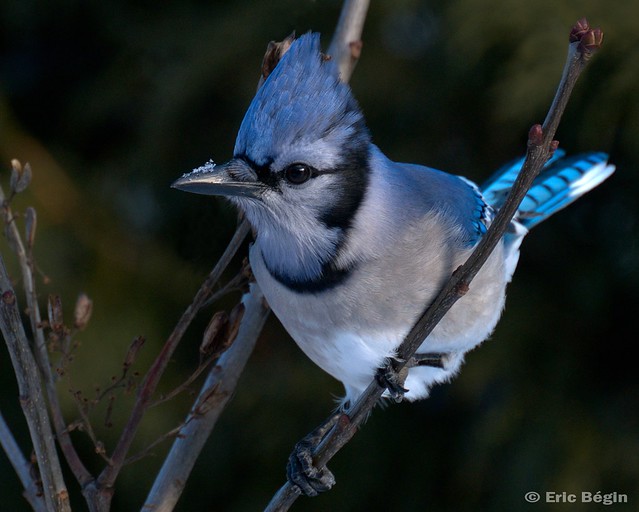
Thanks to Eric Bégin for his outstanding photo of a handsome Blue Jay, licensed with Creative Commons.

Saturday, February 11, 2012

The Not-So-Common Common Ground Dove of Weldon Spring CBC


Truman was President, Muddy Waters sang "Rollin' Stone," Lefty Frizzell sang "If You've Got the Money," "Sunset Boulevard" took the Golden Globe, and the Webster Groves Nature Study Society  counted birds in the cold December winds at Busch Wildlife Conservation Area near Weldon Spring, Missouri, Dec. 29, 1950.

Every year since then, Webster Groves Nature Study Society, better known as WGNSS--pronounced, "Wig-ness"--has participated in the National Audubon Society's Christmas Bird Count (officially,  MOWS, "Missouri-Weldon Spring") by surveying the area we call "Busch." There are about 11 square miles to survey, including 3,000 acres of forest, 32 artificial lakes, and 100 bunkers once used for storing TNT during WW2. Throw in plenty of gravel roads, a thousand acres of grassland plus 200 acres of restored prairie and the same amount of old fields, and you've got a diverse and accessible birding area--all within 50 minutes' drive from the St. Louis Arch.The plan in a survey such as this is to count each species of bird seen, as well the number of individuals. We divide into territories, and take precautions not to count an individual more than once. For example, I might spot 3 Blue Jays in the tall oak by the creek. Some time later I drive past the same spot and see 5 Blue Jays. I record an additional 2 birds, not 5. On the way to my territory, I see a Bald Eagle overhead. I don't record that bird, but I do notify the count compiler in case the team in that area missed it. If so, Bald Eagle will be added.

This year we had 11 participants who counted 2,441 birds of 49 species, including one that has never been recorded on the Weldon Spring count, the Common Ground-Dove. For that matter, it's likely the only individual of its species ever to have been recorded on a Christmas Count in Missouri. It's a bird that's normally found in the extreme southeast and southwestern US and coastal Mexico. Records show that the species has never been recorded in St. Charles County. Thanks to Josh Uffman for making this information available online.

Our little dove--smallest in the US; half the length of the abundant Mourning Dove--was very kind to us, considering all the factors. It had been dallying in the fields of Busch for weeks, putting up with hunters and as well as unruly birders. It was our target bird, but rabbit hunters with their noisy beagles caused it to lie low. Fortunately, some of the group were very patient, including Bob Nieman who snapped this picture just as the sun set. Bob was visiting the area for the holidays--thanks for your help in making this a memorable count!

On my route, I was delighted to witness a  behavior I'd never seen before. I paused along the road where fields gave way to forest. American Robins and Cedar Waxwings crossed back and forth, feeding on and the waxy blue berries (really cones) of Eastern Red Cedar and the abundant red berries of invasive bush honeysuckle. Amidst the busy, noisy robins, two sleek waxwings rested on a branch. One passed a berry to the other's beak, who then passed it back. They did this for several minutes. Male and female Cedar Waxwings look identical, but the two were probably a pair engaged in courtship behavior (A Guide to Bird Behavior, Vol. II, by Don and Lillian Stokes, 1983).

Wednesday, December 21, 2011

Christmas Bird Counts on TV

I had a chance to talk about Christmas Bird Counts on local TV today. Dan Zarlenga, of Missouri Department of Conservation, set up the interview with John Fuller of KPLR-TV Channel 11 in Saint Louis MO. I had a blast! The broadcasters and staff could not have been nicer. I hope it will motivate a few more people to volunteer their time with Christmas Bird Counts.

 
More posts about Christmas Bird Counts:
 
CBC Chartbuster

Register Online for CBC
Weldon Spring CBC
  
Bird Encounters

Saturday, January 8, 2011

Bird Encounters of the Christmas Count Kind


Huge ice crystals mark the sand in Dardenne Creek AMcC
We began our Christmas Bird Count by looking for the Red-headed Woodpecker, near what’s labeled as “Shorebird Area.” This low spot below the dam for Busch Conservation Area’s largest lake, Lake 33, is reliable for Red-headeds, a species that has declined 4.6% per year since 1980, according to National Audubon Society. They gave us quite a show, sparring with Blue Jays, and chattering to each other on a snag that looked like Swiss cheese.
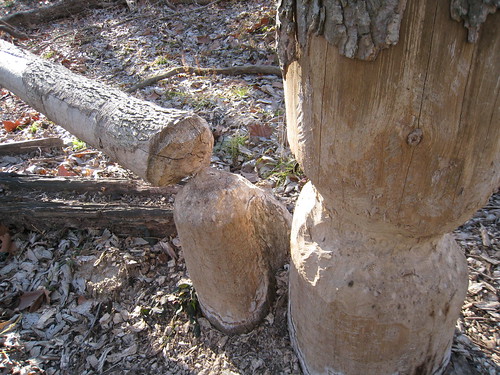
beaver cuts along Dardenne Creek AMcC
There was no open water at “Shorebird,” so after a lap around fields that sparkled with frost, we headed down to Dardenne Creek. The sand bars were puddled with white ice, the kind that we liked to smash when we were kids. Ripples and huge crystals of ice marked the sand. A small flock of Swamp Sparrows and White-throats hopped away.
On the high bank of Dardenne we saw the work of an ambitious beaver. The beaver cuts looked old, but it’s interesting that Red-headed Woodpeckers are associated with beaver. The woodpeckers claim the trees killed when flooded by beaver ponds, and exploit the edge habitat created as beavers fell trees.
After lunch, we headed down a disused service road, toward a corner of large white pines. White pine is not native to our area; possibly this stand was planted for lumber. My friend Connie was determined we’d find a Red-breasted Nuthatch in the pines. White-breasted Nuthatches are expectable year-round residents at Busch, but Birds of the St. Louis Area: Where and When to Find Them lists Red-breasted as uncommon to casual (that is, beyond rare) in January. In the pine grove, she produced her iPhone, with not one, but three different apps for bird songs, and played a recording of the Red-breasted Nuthatch. Then we paused—silence. At least 30 seconds ticked by, then, an answer! There must have been some pretty bad grammar in that recording, because this Red-breasted Nuthatch was outraged! He scolded us till we fled, not wanting to stress the little guy beyond endurance.
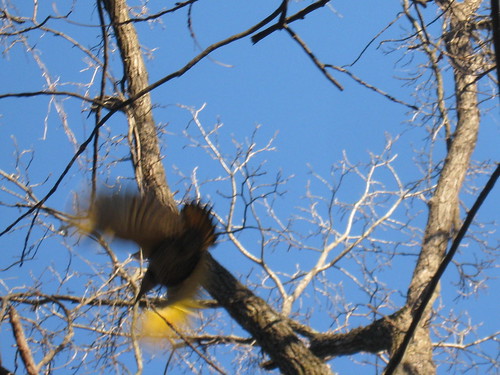
Northern Flicker in the mixed species flock AMcC
We crossed the road and entered the trailless area that will now be known as “The Enchanted Forest.” Within a few minutes, we found ourselves surrounded by birds: three calling Yellow-rumped (Myrtle) Warblers, a Northern Flicker, and another Red-breasted Nuthatch—all in the same tree! Now a Brown Creeper joined the group, tugging itself up a tree trunk, where Blue Jays screeched. Not far beyond, a Pileated Woodpecker answered the jays. In the same tree, a Hairy Woodpecker minded his own business. The sun peeked briefly from behind the clouds, and a male Golden-crowned Kinglet snatched those rays to light his golden-orange crest. Chickadees and a dozen American Robins called all around us. As we moved through the flock, stumbling over an old wire fence as we looked skyward, they vanished. Not even a White-throat chirped as we walked back to the car.

Friday, December 31, 2010

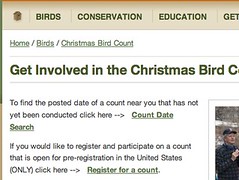
How to register for a Christmas Bird Count Online

Registering online for a Christmas Bird count is easy!
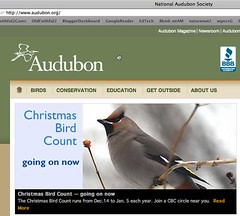
Go to National Audubon Society's page. Click "Christmas Bird count."

Click on "Register for a count.
Use your existing account, or get a free one.
You will need to know the code for the count. For example, the Weldon Spring Count in Missouri is "MOWS." The Confluence Count in Missouri is "MOCF." You can find one near you here.
Click "Sign up here."

Step 5: Add your information and pay the $5 fee with a credit card. Click "submit." It's just that easy!