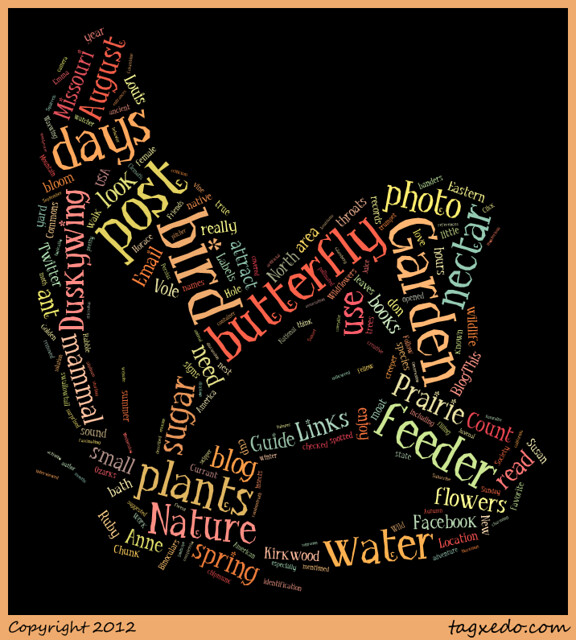
Unfortunately this graphic doesn't show up when I use Safari on my laptop, although it does on my desktop machine. Here's a static image of it you're seeing blank space above. For more information about Wordle and Tagxedo, check my other blog, Ed Tech Training Wheels.
Adventures in a wildlife garden, and the native plants, birds, butterflies, and bugs we love!
Nature stories from the border of the Missouri Ozarks.
Showing posts with label blogs. Show all posts
Tuesday, March 13, 2012
Word Clouds with Tagxedo
Unfortunately this graphic doesn't show up when I use Safari on my laptop, although it does on my desktop machine. Here's a static image of it you're seeing blank space above. For more information about Wordle and Tagxedo, check my other blog, Ed Tech Training Wheels.
Friday, September 30, 2011
Back to the Blogosphere
It's been almost 4 weeks since my last post, so a few words of explanation might be in order. It's been perfect storm of obstacles to getting online: minor accidents that befell a family member (everyone's OK now), a snafu that left me without phone or internet service for a week, deadlines at work, a reunion, and living with amazingly energetic puppy. Blogging is sort of like taking an online course, with the topics chosen by me. I missed reading blogs, conversing with bloggers and other readers, and writing. Hopefully, things are returning to the usual pace and I'll have a chance to post regularly. Thanks for staying with me!
Wednesday, January 5, 2011
Website Wednesday: The Owls of Harry Potter
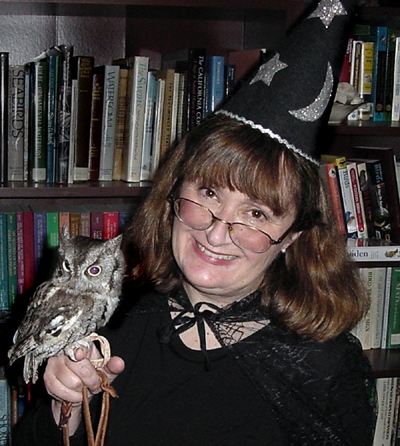
| Laura Erickson and Archimedes share their love of birds and Harry Potter with children. |
Laura Erickson, seen here as “Professor McGonagowl,” is a well-known author of The Bird Watching Answer Book: Everything You Need to Know to Enjoy Birds in Your Backyard and Beyond, 2009, Sharing the Wonder of Birds with Kids, 2002, and For the Birds, An Uncommon Guide, 1993. Her web page, The Owls of Harry Potter, packs a lot of information into a small space. Designed to appeal to young fans of J. K. Rowling’s books, “The Owls of Harry Potter” introduces each owl that’s a character in the novels, then provides a photo and its proper name. She discusses the natural—as well as magical—range of each owl.
The owl people most often associate with the Harry Potter movies and books is Harry’s own messenger owl and pet, Hedwig. Hedwig is a Snowy Owl, a bird of the Arctic tundra. Hedwig is of course female, but Erickson points out that she is played by a male bird—actually, 7 of them—in the films. Female snowies have black barring on the crown, back, and chest. Young males are barred, but usually not as much as females. As they mature, the plumage grows white. Presumably the director felt that a pure white bird would look “snowier.” They are magical birds, especially when the French horns and celesta of John Williams’ “Hedwig’s Theme” play in the background.
Whether Snowy, Great Grey, or Scops, an owl is a wizard’s letter carrier of choice, but we notice there is no junk mail in the wizard world. Muggles like ourselves are annoyed by it and, more to the point, millions of trees are destroyed so that our mailboxes can be filled with useless, unread messages. As you would expect from the author of 101 Ways to Help Birds (2006), Erickson includes ways to help owls by precycling, that is reducing the stream of junk mail and excessive packaging. She even includes a link to a publisher that uses 100% recycled paper in the printing of Harry Potter!
Really—which one is cuter, Laura or Archimedes? I contacted her to ask for permission to use this photo and inquire after her Screech Owl. She replied, “Archimedes is my own licensed education owl—I’ve had him since 2000. He was unreleasable after an illness as a nestling, and the rehab center had to find a safe place to transfer him right when my license had been approved but I didn’t yet have an owl. He’s still doing well.” Erickson maintains 2 blogs worth visiting too: Twin Beaks, and Laura’s Birding Blog.
Wednesday, December 29, 2010
Website Wednesday: Views of the Ock
View Otters 2010 in a larger map
40 years ago, Arthur C. Clarke predicted that data transfer would “bring the accumulated knowledge of the world to your fingertips.” Substantially, Clarke was correct, if only it could all be found. A year and a half ago it was estimated that there were something close to 110 million websites, and that’s just in the surface layer of the web that search engines survey. I throw my hat into the Internet search arena with “Website Wednesday!” Each Wednesday, I will try to find a site for the nature-lover that is useful, surprising, entertaining or just plain gorgeous. Let’s go to Views of the Ock for a start.
I enjoy reading blogs about travel to exotic places, about people who compete for the longest list of birds, but there’s a lot to be said for appreciating and adding to the understanding of your own back yard. Richard is a “back yard blogger” in Britain. The Ock is a tributary of the River Thames, which flows through the Richard’s neighborhood.
Just because the territory is limited doesn’t mean the subject is narrow. He covers a great variety of topics, all accompanied by beautiful, or sometimes interesting photos. Did you know there is a special word that means “otter poo”? Neither did I! You gotta love a guy who creates a Google map of otter spraint (seen above). He shares photos of tracks and signs he finds in monthly otter surveys of the Ock, as well as water vole surveys. There are lovely photos of the countryside as well as the town of Abington in snow. He explores an ancient beech forest, full of trees in fantastic shapes, rare insects and even a rare fungus. He studies cuckoo bumble bees, mushrooms, damselflies and moths.
I first became aware of Views of the Ock when Richard left a comment on my post about European Starlings and their behavior in flocks. Unbeknownst to me, he had written about Starling flocks some weeks earlier. My vocabulary expanded again, when I found there is a special word for startling flock: “murmuration.” And I have to say, I was thrilled when he included my post in his list of “favourite blog posts over the last 12 months.” Be sure to check out Views of the Ock as well as the other blogs he links to in his “Blog Roll Review of the Year.”
Location:
Kirkwood, MO, USA
Sunday, August 15, 2010
Photos & Friends, Skippers & Moths
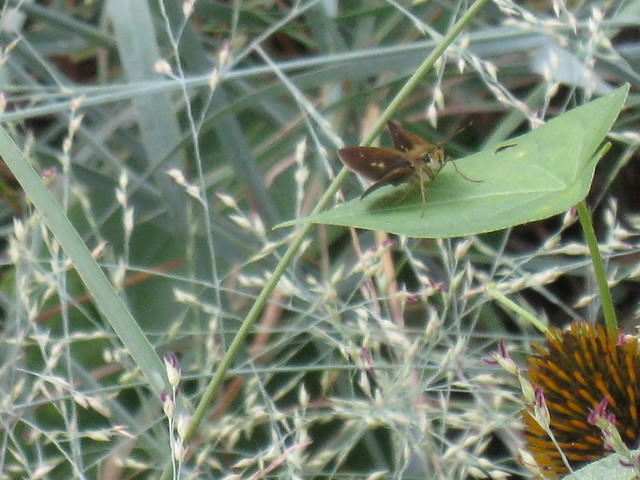
| Northern Broken-Dash Skipper? AMcC |
I had planned to do a third post on Silphiums, but there are too many butterflies in the garden for that! It’s all the more exciting since this summer has not been the best for butterflies. I don’t know if it’s been the weather, my garden, or the truck that sprayed mosquitoes (and every other living thing) on my street in late June. Whatever the problem, butterfly numbers seem to be recovering. Skippers are everywhere.
Skippers are small, fast-flying butterflies. Compared to the wings, the head is large—kind of cute if you get to see it well. Most are golden-brown or brown and frustrating to identify. It’s been said that skippers are the Empidonax of the butterfly world. (That last sentence actually means something to birders.) If you’re going to have any chance at all identifying skippers, you’ll need a good butterfly book with range maps and a close focusing set of binoculars. See my list of “Favorite Nature and Gardening Books” below. Having a digital camera and an expert friend to study the photo are probably required for some skippers.
I’ve had a new species in the yard this week that I tentatively identified as Northern Broken-Dash Skipper. I sent a photo to my friend Yvonne to see what she thinks. Northern Broken-Dash and Little Glassywing are very similar and my yard is within the range of both. The larvae of both eat grass. According to Glassberg’s Butterflies through Binoculars: The East, Little Glassywing’s caterpillars eat purpletop grass. I don’t have any purpletop in my yard, but it is common and probably can be found 1/2 mile from my house. Northern Broken-Dash caterpillars prefer switch grass. I have switch grass; in fact, it’s growing all around the skipper in the picture. The plant is Panicum virgatum ‘Prairie Sky.’ Maybe you have an opinion about the skipper in the photo you’d like to leave as a comment!
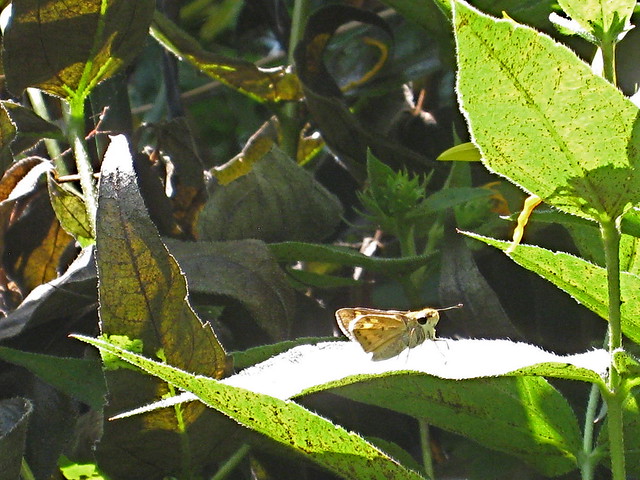
| Female Fiery Skipper AMcC |
My most common little guy is the Fiery Skipper. The one in this photo is a female, and she really confused me for a while. I seem to see mostly males.
Early this morning I saw a new species visiting my cup plant. It looked like a moth, but was behaving very much like a butterfly. I looked through Butterflies and Moths of Missouri, but couldn’t find it. I sent a shot of it to one of my favorite Flickr groups, ID Please. Members view the shared photos and give their opinion through the comments below the photo. To use this tool, you first need to join Flickr (it’s free), upload your photo, join the group, and then share it. I also sent the photo to What’s that Bug?, a website that features pages of insect photos and discussion. If you have an insect you’d like to identify, look for the “Ask What’s that Bug” page. Two more great sites to exploe are The Bug Guide and the North American Moth Photographers Group.
| Corn Earworm Moth AMcC |
While waiting for a response from these websites, I tidied up my desk. That when I accidentally came across a photo in Kaufman’s Field Guide to Insects of North America. I’d forgotten that 35 pages of moths are included in that book. So I’ve identified my mystery moth as one of the Owlet Moths, the Corn Earworm moth. I’ve mentioned two good books for butterfly identification but books devoted to moths, with photos or drawings of living critter are not so easy to find. I’m looking forward to the spring 2012 publication of Moths of Northeastern North America by David Beadle and Seabrooke Leckie. While you’re waiting, you might want to check out Seabrooke’s blog, “the Marvelous in Nature,” “North American Moths,” or the “blog carnival” dedicated to moths, “The Moth and Me,” most recently hosted at “The Skeptical Moth.”
| Wordle |
Location:
Kirkwood, MO, USA
Thursday, July 15, 2010
Things you didn’t know you didn’t know
One of the great things about learning about nature is meeting really interesting people. I knew the name Ted MacRae from our nature study group and found his blog, Beetles in the Bush. It challenged me to learn about creatures I had never even noticed before, especially those beautiful tiger beetles! It’s always great to learn things you didn’t know that you didn’t know. Later I met Ted in person and found that he was not only a great entomologist and writer, but also a friend. His invitation to write a post on Beetles in the Bush was intriguing. I enjoyed writing “Dogbane for Dinner” so much, I started “Gardening with Binoculars.” Thanks, Ted!
Labels:
beetle,
blogs,
dogbane,
dogbane beetle,
guest post,
pollinator
Location:
Kirkwood, MO, USA
Subscribe to:
Posts (Atom)