Showing posts with label bird. Show all posts

Sunday, March 2, 2014

Weldon Spring MO Christmas Bird Count 2014

Eastern Phoebe, photo by John Benson, from Wikipedia

Thanks to all who helped with the Weldon Spring Christmas Bird Count, Jan. 4, 2014! We had 18 participants, 63 species, 8774 birds, and some really decent weather for the season. The Weldon Spring Count (also known as the "Busch count," officially labeled by National Audubon Society as "MOWS") has been held every year since 1952, sponsored by Webster Groves Nature Study Society. The count, like all Christmas Counts, is held between Dec. 14, 2013, and Jan. 4, 2014, and covers a 15-mile-diameter circle. In our case, the circle is centered on the town of Weldon Spring in St. Charles County, Missouri. It includes some of the best land-birding in the greater St. Louis area: Busch Memorial Conservation Area and, bordering the Missouri River,  Weldon Spring Conservation Area.

Only one species had an unusually high count this year: Red-shouldered Hawks totaled 22, topping the previous high of 18 in 2008. Out of 62 counts, Red-shouldered Hawk has occurred only 28 times.

Several species were unusually low. Only 2 Red-headed Woodpeckers were reported. The previous low was 1 in 1964, occurring 51 out of the 62 counts. Red-headed Woodpecker is a "species of concern;" one of 117 species on the "yellow list" in the 2007 WatchList. Only 1 Ruby-crown Kinglet was reported—previous low of 1 in 2012. Only 2 Cedar Waxwings and 2 Purple Finches were seen. The low for Purple Finch was a single bird in 2012. The House Sparrow count was also low—only 6. (Most of us feel that’s a good thing.) The all-time low for House Sparrow on our count was 5 in 2007.

A highlights for me were Hermit Thrush and Fox Sparrow, found along a seldom-used road in the north-east section of Busch. Another Hermit Thrush was found in Babler State Park. Hermit Thrushes are listed as "rare" in winter, and although the Fox Sparrow is considered "uncommon," but not rare, I've missed it a number of times on the count.

Our rock star was an Eastern Phoebe, found independently in the Weldon Spring area by two different groups. This is only the third occurrence out of 62 counts—one in 1986, one in 2005. Birds of the St. Louis Area: Where and When to Find Them describes the Eastern Phoebe as "hardiest of the flycatchers" on our area. The complete report is available to download at the bottom of the Birding page of the Webster Groves Nature Study Society's website. Happy birding in 2014!

Tuesday, July 2, 2013

Birding Legend, Bill Rudden

Bill Rudden at Riverlands Migratory Bird Sanctuary  Photo by Al Smith, used with permission

"Bird watcher"--even today, for many people, the image of Miss Jane Hathaway leaps to mind. When Bill's hobby shifted from hunting to bird watching, stereotypes tumbled. Bill was a firefighter for the city of St. Louis, Missouri (retired as a captain), and an athlete. As recently as 2007, he competed in IronMan triathlons. I was shocked and saddened when I heard of his death on June 30, 2013, by way of a comment on this blog.

Bill is a legend in the St. Louis birding community for his role in finding what Birds of the St. Louis Area calls, "the most famous bird to visit St. Louis" in 1984. Bill was birding along the Mississippi River near the Alton Dam on a miserably cold December day and spotted a large gull with a dark mantle. He alerted other birders, including birding experts Phoebe Snetsinger and Ron Goetz, and together they identified it as a Slaty-backed Gull--according to  Birds of the St. Louis Area, "the first known occurrence of this Siberian/Alaskan species in the lower 48 United States (113)."

Bill gets a nod in Olivia Gentile's biography of Phoebe Snetsinger, Life List: A Woman's Quest for the World's Most Amazing Birds (89-90). A long-time member of Webster Groves Nature Study Society (WGNSS), he often birded with Phoebe. According to Life List, in 1978, Snetsinger decided to try to break the record for the greatest number of bird species seen in a year in the St. Louis area. She enlisted Bill's help, and succeeded in listing more than 274 for the year.

Bill led the WGNSS field trips on Saturdays for a number of years in the 1980s and was well-known in the St. Louis birding community. His sense of fun was as legendary as his mad birding skills. The first time I met Bill was about 1991. That year, the WGNSS annual banquet was held at one of St. Louis' premier birding spots, Tower Grove Park. A few of us gathered before the event to enjoy some spring birding in the northwest section of the park. Big Day was only two days away, so when we ran into Bill,  members of the group peppered him with questions about his latest sightings.  (Big Day: birding jargon for a competition for the greatest number of bird species seen within a single day.) Referring to his own Big Day plans, he told us, "Oh yeah, my team's parachuting in at midnight."

As a birder, you've got to know your birds, and it helps to know your birders too. I recall a trip to Riverlands, hearing someone say, "Wait--isn't that Rudden over there? What's he lookin' at?" The whole bunch folded their scopes and scurried over to hear what Bill had to say. He was always generous with his news, ID tips, and wisecracks. He was active on the MoBirds listserve, sharing photos as well as reports. His last post on the list reads, "5-30-13 Horseshoe Lake SP Madison county IL. Mostly cormorants were loafing on a snag.  Main lake off old dredge point."

I hope more folks will share their tales about Bill and other birders. If you're unfamiliar with blogs, just click the word "comments" below to read other's comments and leave your own. There's no need to sign in.

How to comment on a blog


Wednesday, December 21, 2011

Christmas Bird Counts on TV

I had a chance to talk about Christmas Bird Counts on local TV today. Dan Zarlenga, of Missouri Department of Conservation, set up the interview with John Fuller of KPLR-TV Channel 11 in Saint Louis MO. I had a blast! The broadcasters and staff could not have been nicer. I hope it will motivate a few more people to volunteer their time with Christmas Bird Counts.
 
More posts about Christmas Bird Counts:
 
CBC Chartbuster

Register Online for CBC
Weldon Spring CBC
  
Bird Encounters

Sunday, November 20, 2011

The Very Very Late Ruby-throat

I
I strolled around the turrets of Hogwarts Castle, enjoying the sweeping views of tropical foliage. From the ravine below, a hummingbird came into view. It was large--something along the lines of a Violet Sabrewing. I reached out and held the bird. It seemed to be in some kind of transitional plumage: purple, mixed with buff and green. Then I was startled by sounds of an uproar coming from Hogwarts. A group of boys rode some kind of magical escalator, screaming with laughter. The bird vanished. Beautiful singing of pygmies (or Solomon Islanders) woke me. That's because my alarm plays CDs; this morning, it's Deep Forest's controversial 1993 album, Deep Forest.


Wondering what I had eaten the night before to produce such a vivid dream, I finished up my morning chores and headed to work without a moment to spare. As I headed for the gate Tuesday, Nov.15, an unmistakable silhouette  popped up into the sweet gum tree--a hummingbird! I ran back to the house for my binoculars. Like my dream bird, the hummer had vanished and I headed for work.


I posted my report of the hummingbird on MObirds, the listserve of the Audubon Society of Missouri. I also contacted my friends Lanny Chambers and Margy Terpstra. Margy lives nearby. She and her husband are wild bird photographers. They have a wealth of subjects in their beautiful, wildlife-friendly yard. Lanny is a hummingbird bander who has visited my yard many times chasing fall hummers. He also holds the record for the only Allen's Hummingbird in the state--banded in his own yard!

I didn't return up till after dark on Tuesday. Wednesday morning the temperature on my back porch was 33 ° F. The bird bath had a skin of ice, but I caught a brief view of a dark bird at the nectar feeder. Surely this is some rare stray! Wed. evening that I saw the bird again, and was shocked to see that it looked exactly like a male Ruby-throated Hummingbird! Ruby-throats are the only hummer normally present in our area, but they should be gone by October 10 or so. Males migrate earlier than females and juveniles. I don't remember ever seeing one after mid-September.

I didn't get to study the bird long before the light was gone. That's when I checked my email to find Margy's wonderful photos of Lanny examining the bird in hand. It was indeed a male Ruby-throat. It may not be the latest Ruby-throat ever, but it's likely to be the latest confirmed record. As you can see in the photos, he is a worn individual. His weight was good however, and Lanny saw no reason that the bird would have trouble migrating to his winter home in southern Mexico or even Panama.


I spotted the bird again Thursday and Friday mornings and evenings, still visiting the last of my Big blue sage (Salvia guaranitica) and Mexican bush sage (S. leucantha). The sages and the bird had weathered near-freezing temperatures for 3 nights. Saturday we warmed up to 60°, but I didn't see the bird. Let's hope that soon he'll be rubbing shoulders with Violet Sabrewings. Thanks to Margy Terpstra for the use of her photos and to Lanny Chambers for enabling us to play a role in the study of hummingbird migration.

You might also like these posts:

Mexican Sage is a Hummer Magnet
 
Hole in One!
Rootin' Tootin' Rufous

Sunday, October 2, 2011

Nighthawks

We could call it a "kettle," if they were hawks--a pretty good description of a flock where the individuals seems to boil from the top to the bottom over and over again. In that sense, I watched a kettle of Common Nighthawks over the dog park on September 20. I estimated at least 60 in the flock, but it could easily have been twice that. The kettle gradually moved west, the birds whirling and flashing like flakes in a snow globe. The birds never dropped as low as the tree tops, while below, a flock of migrating Green Darner dragonflies roiled in their own version of a kettle, 6 to 15 feet above ground. The Crossley ID Guide (Richard Crossley, 2011) mentions that they are often found along wooded streams, and the dog park is within sight of the Meramec River.

Nighthawks are not even close to being hawks, but they hunt on the wing, that is, they "hawk" for insects, and are most active in twilight. My dad used to call them "bullbats." If you use the word "bull" to mean "large or strong," they certainly would be large, strong bats, if they were bats. He told me they liked to hang around the lights at the ballpark and sometimes along the street. I used to see them in those places too as a kid, but I see fewer and fewer of them now flying erratically over towns. The Sibley Guide to Bird Life and Behavior, by David Sibley (2001), notes that Common Nighthawk populations have declined throughout their breeding range (p. 352). The breeding range covers most of the Canada and the US (excluding south and central California, Alaska, and areas near or north of the arctic circle), and the western portion of Mexico (excluding Baja California). Factors contributing to the decline include the use of insecticides, and the loss of open areas that they need for hunting and mating displays (Sibley).

Nighthawks don't build nests, laying their eggs on the ground in open, rocky areas. They have adapted to using flat roofs covered with gravel, but as these become less common and roofs insulated with smooth PVC coatings become the norm, nighthawks have lost an important resource. In her book 101 Ways to Help Birds, Laura Erickson (2006) discusses ways to accommodate nighthawk nesting sites (p. 169) by providing pads with gravel in shaded areas of flat roofs.

Besides their beautiful, haphazard flight, male nighthawks have an intriguing display. I heard it "in the wild" only once. I was sitting on the front stoop of a shop, enjoying a traditional St. Louis treat, a "concrete," when I heard it. Nighthawks had been flying overheard, calling with nasal, off-key notes, "beans...beans..." when I heard a sound that shouldn't have come from a bird. Greg Budney, audio curator of the Macaulay Library at Cornell, describes it as similar to "a truck roaring by, that suddenly disappears." Somewhere along the city street, a male nighthawk dove between the buidlings, creating that roar as wind passed through the long flight feathers. Perhaps he planned his display to take advantage of the echoes in the urban "canyon."

At the end of the recording below, you hear this mechanical sound. If you have 2 minutes, check out the video from Cornell's Lab of Ornithology which I embedded below it. Thanks to Bill Bouton for his great photo of a Common Nighthawk above, taken in northern California, and to Don Jones who recorded the species in New Jersey, and the Cornell Lab, all of whom licensed their work with Creative Commons.


You might also like:
Crossley ID Guide   
Macaulay Library of Animal Sounds
Mysterious Sounds of the Night

Sunday, September 4, 2011

Last Kite of the Season

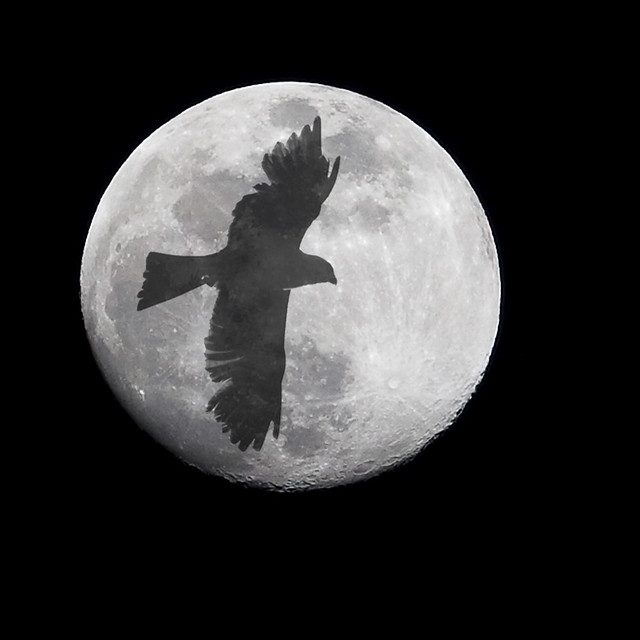
Mississippi Kite's keystone-shaped tail shows in this silhouette composite photo by George Thomas
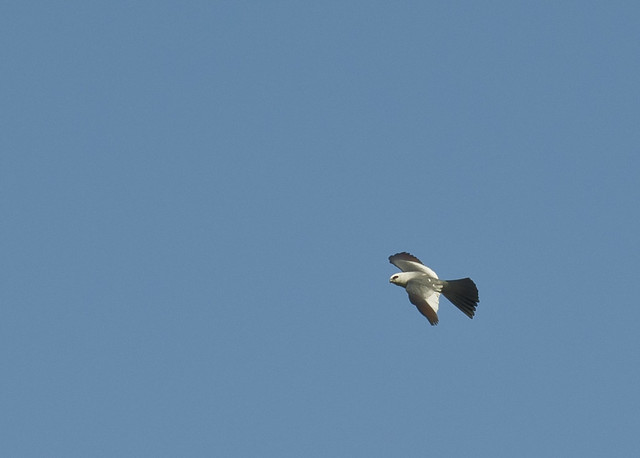
I may have seen my last Mississippi Kite of the year yesterday. My puppy Chunk and I visited Emmenegger Nature Park, climbing the trail along the bluffs above the Meramec River and paused at one of the glades. Chunk investigated the scents along and under the limestone rocks. I scanned the wide valley below with my binoculars. The landscape is urban, with remnants of oak-hickory woods on the hills. Floating over the former site of the Chrysler plant, a beautiful male Mississippi Kite sailed on the warm, still air. The open glade afforded me a rare view of the kite from above. Contrasting with the dark grey body, I could see the white head and secondaries—the flight feathers close to the body along the trailing edge of the wing. The creative image above is by George Thomas, and the beautiful one below is by MRHSfan. Thanks for licensing your photos with Creative Commons, George and MRHSfan!

adult male Mississippi Kite, photo by MRHSfan
I see Mississippi Kites almost daily in my area, starting in early May. They can be hard to spot early in the season. They tend to be silent and avoid being conspicuous as soon as they begin nesting. A friend who has a nest nearby said she often sees them flying low—under the radar, so to speak—as they approach the nest.

By August, the young are in flight and I occasionally hear them call. It's a strange sound—imagine a flycatcher impersonating a Broad-winged Hawk's two-note whistle. Click the play button to hear the recording below, also Creative Commons. Kites show up predictably at favorite perches around the neighborhood; always on dead snags atop mature trees. About 3 weeks ago I saw a group of 6 kites, including at least 2 juveniles, in a half-dead oak. Not far away, I could hear a 7th bird calling. Sometimes 2 or 3 will circle overhead. Are these local birds or the first migrants? I wish I knew.

When I first started birding seriously, in the early 90s, I saw my life Mississippi Kites in Webster Groves. Birders at that time said Webster was about as far north as they were found in summer, but now they breed up into Iowa.

They are predominantly insect eaters, so they must head south in fall. Conventional wisdom says that all the kites will be gone from Missouri by the end of the first week of September, but curiously, the first are record of Mississippi Kite was in autumn, on September 22, 1956 (Birds of the St. Louis Area; Where and When to Find Them, Webster Groves Nature Study Society, 1995). They migrate through Texas, along the east coast of Mexico, through Central and northwestern South America. Their non-breeding range is Bolivia, western Brazil, Paraguay, and northern Argentina. See this range map on the Cornell U website. Check out this spectacular video of a flock of kites migrating through Soberanía National Park in Panama, taken by Dave Jackson in April, 2007.

You might also enjoy:
Why do People Think Bird Watchers Are Nerds?
Fragrant Sumac in the Winner's Circle
Urban Birding, Texas Style

Sunday, August 21, 2011

A Bird Bath for Hummingbirds

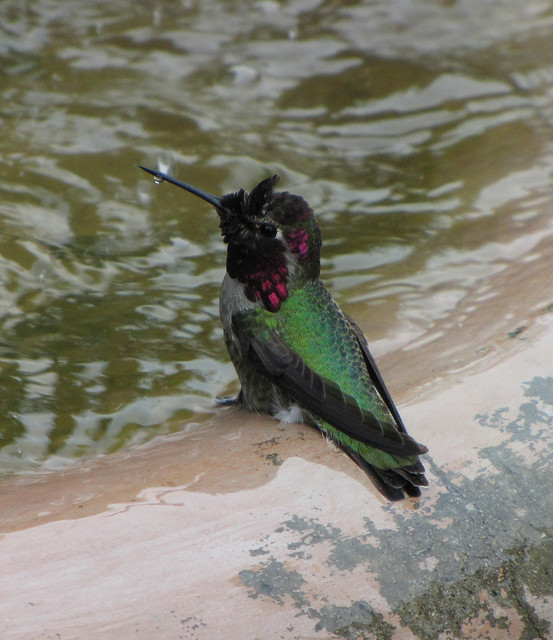
Anna's Hummingbird photo by randomtruth
On a particularly anxious day some years ago, I glanced out the kitchen window, looking at the viburnum leaves, covered with with rain drops. Movement caught my eye—a hummingbird, diving chest first into the droplets, flailing her wings and splashing around in the microliters of water on the leaf. Because I'm a human and humans always look for meaning—especially when they're really stressed—I read a message in this brief, extraordinary scene: "Things will work out fine." And they did.

Hummers get plenty of liquid as they lap up nectar from a trumpet creeper bloom or from your feeder, so they don't need to drink from a bird bath as a Mourning Dove or Cedar Waxwing might. However hummingbird banders tell me that the feathers are often sticky with nectar, both natural and artificial, so they do need to bathe to keep their feathers in top condition. Hummers can bathe in a rain shower, or you can try to attract them with water by…
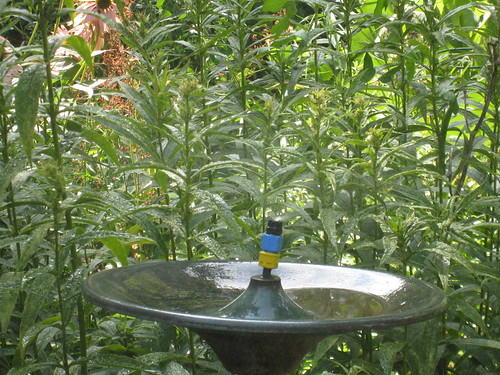
Providing a mist fountain. I use a connector with shut-off valves so I can have two hose lines. 
After I finish watering the container plants, I completely shut off the water. Then I open the valve on the line that leads to the mister. 
This little device will run a long time on the residual water pressure within the hose. 

An easier method is to hose down some large leaves. 

I hope you have a chance to see a hummer take a "leaf bath." If you do, and I'd love to see your photo!

For those of you keeping track, here in the Midwest, Anna's Hummingbird, seen in the photo above, is not one of our normal birds. In fact, there are only 5 records for the state of Missouri, most recently in 1997—the only record in my area. Thanks, Josh Uffman, for compiling, organizing, and sharing the state records. 

The charming photo of an adult male Anna's is by randomtruth, and I'd like to thank him for sharing his photo with a Creative Commons license. Be sure to check out his blog, The Nature of a Man. He wrote a terrific post about Anna's Hummingbird: California Christmas Ornaments.

Wednesday, August 3, 2011

What is she doing?


As my garden renovation proceeds, I removed a Sweet Autumn Clematis (Clematis terniflora) from one of my witch hazel trees. Nasty work in this heat, but I'm finally getting serious about removing the invasive alien plants in my yard. Sweet Autumn Clematis has just about engulfed the Sugar Creek area of Kirkwood, Missouri, but I think I'll make that the subject of a later post. Just as I stretched out atop the ladder to remove that last bit of vine shading my puny little witch hazel, I had a moment of panic. A hummingbird—a female-plumaged Ruby-throated Hummingbird—frantically bounced around the tip of a top branch. Had I accidently destroyed her nest?

I've never had a hummingbird nest in my yard, in spite of the fact that I've done as much as I can to attract them to my garden, including mounting Dan True's "Hummingbird House." Also, it's pretty late in summer for a hummingbird to have an active nest. I searched, but found no evidence of a nest among the piles of vines below. So what was she doing?

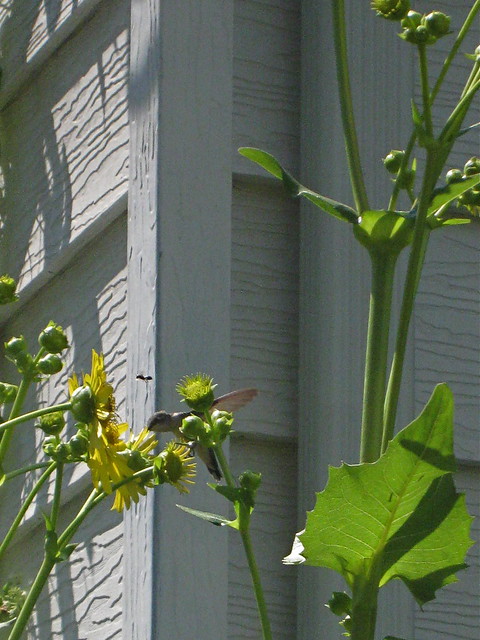
I took these photo on July 17, just as my Cup Plants (Silphium perfoliatum) were beginning to bloom. Is this female Ruby-throat getting nectar from the bloom, as butterflies do? 


She certainly seems to be. Daisy-like composite blooms aren't described as hummingbird flowers in the books. Like the Pipevine Swallowtail butterflies that visit my Royal Catchfly, hummingbirds don't read the books.

Or are there some insects within the bloom that she's lapping up? I remember reading Bob Sargent's quote on Hummingbirds.net: "Hummers need nectar to power the bug-eating machine that they are." Bob Sargent is a well-known hummingbird bander and author. He was interviewed on Richard and Susan Day's Daybreak Blog.

Since I spotted the hummer  at my witch hazel, I've seen others busy at things that make no sense to me. I noticed one bobbing up and down on the tips of a cedar tree (Juniperus virginiana) where I don't think there can be any nectar.

Hummingbirds use a display flight to attract a mate or drive out an intruder, but these displays typically cover more than ten feet of vertical air space. The movement I described covered only a few inches.

I assume hummingbirds don't have energy to waste, so their activity must have some purpose. I wonder what it was…
You might also enjoy:
Royal Catchfly 
Hole in One
Golden Currant
  

Wednesday, June 15, 2011

Songs of Summer and Scarlet

On June 11 and 12 I did more breeding bird surveys at Busch Memorial Conservation Area in St. Charles Co., Missouri, with my friend Kevin Renick. We didn't see the numbers of butterflies I mentioned in my previous post, but we saw and heard some great birds, including two not commonly seen: a Blue Grosbeak along the dam at Lake 37, and a brief view of a Blue-winged Warbler at the same spot.

Kevin is a singer-songwriter as well as a whiz at birding; his musical abilities extend into his nature hobby. What impressed me most this weekend was Kevin's ability to consistently tell the difference between the songs of the Scarlet Tanager and the Summer Tanager. Both birds nest here in oak-hickory forests of Missouri, and although their calls are very different, their songs are very much alike. I asked him to summarize the differences between the two songs. I'm accompanying Kevin's summary with video from the incomparable recordist of nature sounds, Lang Elliot.


Kevin's hints: "The Scarlet Tanager's song has sometimes been described as being like a 'robin with a sore throat.' It's a melodic warble, but it has a prominent screechy or raspy sound on one or two notes of its phrasing. The Summer Tanager on the other hand, is not raspy at all. It's a clear, sweet warble, a bit gentler than the Scarlet."


If you hear the bird's call—as opposed to its song—you've got it made. The Summer's call begins this video: "Picky-tucky-tuck." The Scarlet Tanager call, heard in the middle of his video, is "Chick-burrr. Chick-burrrr." David Sibley, author of The Sibley Guide to Birds, says that the Summer's song includes, "brief but distinct pauses between phrases." The Scarlet's by contrast is made up of a "fairly rapid, continuous series."

Thanks to Kevin Renick for his song analysis and to Lang Elliot for making his videos available.

Monday, June 13, 2011

Hits and Misses on the Breeding Bird Survey

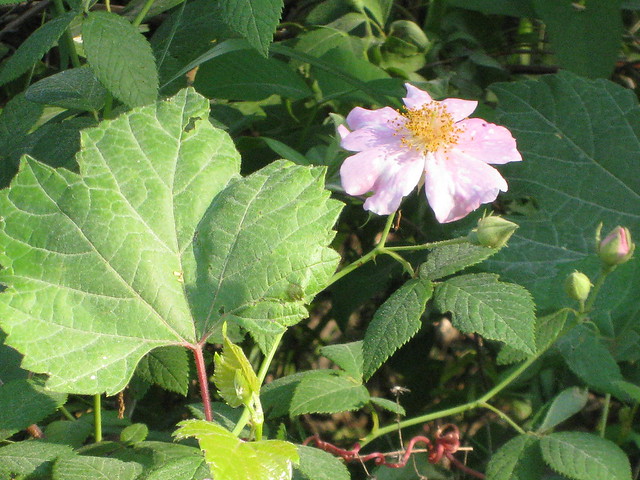
Wild Rose
I got a chance to do a bird surveys this week at one of my favorite places, Busch Memorial Conservation Area, in St. Charles County, Missouri. Busch is a mixed use area, with many artificial lakes, stocked with fish, and some fields rented to farmers. It's also the area of a long-running Christmas Count. On Thursday, July 9, I birded with my cousin, Ginny. We started birding together back before the Beatles appeared in Ed Sullivan. Back in the day, we shared field glasses, the Zim guide, and recorded our list on a Big Chief notebook. As we walked through the neighborhood and nearby cemetery, our list looked like this:

cardinal
starling
English sparrow
robin
blue jay

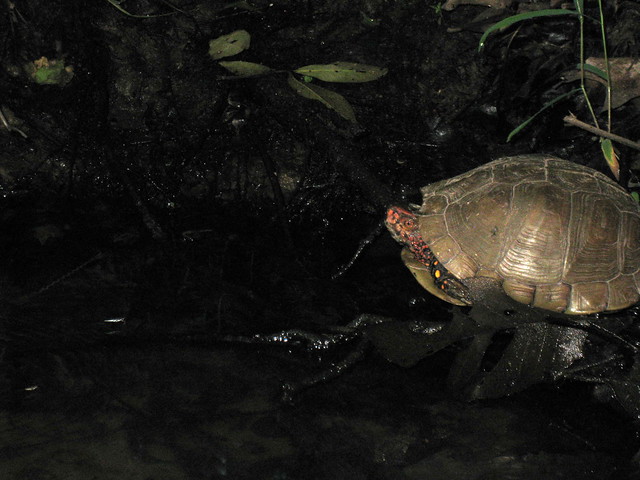
Our list was a bit longer this year, but it was hazy, hot, and humid even at 6:30 AM. The heat kept many of the birds from singing, and if you're going to bird when the leaves are full-sized, you need those birds to sing. We started at Lake 22. This small lake has been part of my territory for 8 years. Some dead trees stood in the lake and Tree Swallows nested there. Each year the snags decayed, and this year, none were left. Not a swallow was seen. A deeply eroded road leads down to a beautiful creek where I've recorded Kentucky Warbler and Black-and-White Warblers, but the area was fenced off, presumably because of an erosion control project. A half-dead elm near the parking area hosted an Orchard Oriole nest, but the tree had been removed and the orioles were missing. We did find this Three-Toed Box Turtle in a wet area on the far side of the lake. His red eye and face markings show that he's a male.


The bird of the day was the Acadian Flycatcher. It's a common bird in the woodlands in our area, one of a complex of similar-looking small flycatchers in the genus Empidonax. You hear 10 for every one you see. Near Lake 23, one perched on a thin branch over the road, allowing us a good long look as he surveyed his domain. Another surprise was a female Wood Duck. Not an uncommon bird, but it can be difficult to find. I don't think I've ever recorded one on the summer bird survey before.

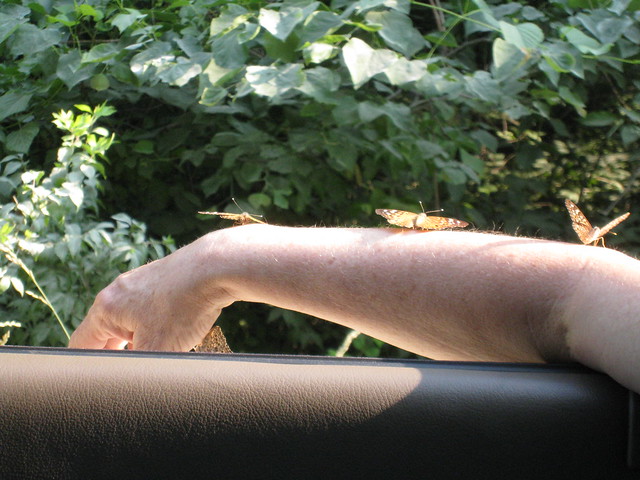
If the birds were a bit shy, the butterflies were not. Thousands upon thousands of fresh-looking Hackberry Emperor butterflies (Asterocampa celtis) dotted the gravel roads for several miles. Hackberries are known for the fondness for landing on humans, lapping up the salt in sweat. They seemed to enjoy Ginny's arm:


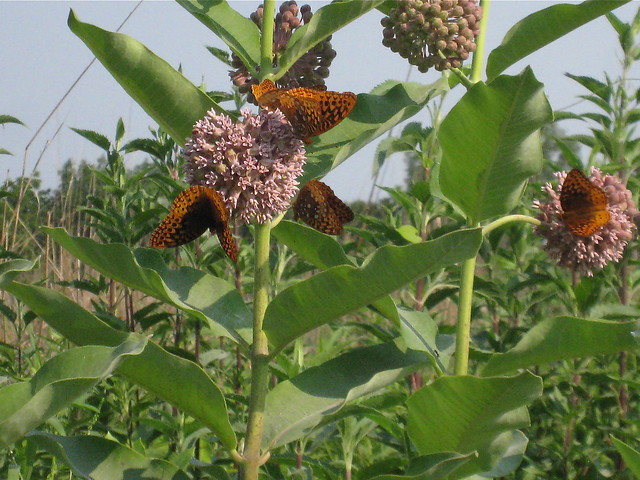
Great Spangled Fritallaries (Speyeria cybele) were out in numbers too. We saw them everywhere we found Common Milkweed (Asclepias syriaca) or Purple Milkweed (A. purpurascens).

Tuesday, April 5, 2011

Mysterious Sounds of the Night…

Common Pauraque in Estero Llano Grande State Park, Hidalgo Co. Texas. Photo by David Marjamaa. Used by permission. 


Before dawn on March 16, we arrived at Bentsen-Rio Grande Valley State Park, outside of Mission, Texas. Our trip leader, Bill Rowe, had arranged for us to meet biologist and blogger Mary Gustafson at Bentsen to find the Common Pauraque. David Marjamaa, who took this great photo above, was part of the group too, along with me and five others. 
  
Nightjars are fascinating creatures, loaded with folklore, cryptic coloring, and evocative names. I presume that the name of the family, "Nightjar," comes from the fact that the typical calls of some species "jar the night," in the sense that the voice heard in the night is startling or has a disagreeable effect on the human listener. Of course, that "jar" is in the ear of the listener. I'm most familiar with one of Missouri's nightjars, the Whip-poor-will. Here's a beautiful recording by Lang Elliott. Its song is one of the most beautiful and haunting sounds in nature. A Whip-poor-will can belt out his clear, "whip poor WILL! whip poor WILL!" up to 400 times without a break

One breezy night in June, deep in the Ozark hills, a Whip-poor-will, perched on the ridge pole of our tent, came dangerously close to breaking that record. Tent-mate and guest blogger, J Bowen suggested solving the problem with a shotgun. I pretty much think that would be jarring in the night too, J! 

But I digress. We are talking about a different nightjar, the Common Pauraque. We walked down the road in the dark, hearing the "Quawk!" of Black-crowned Night-Herons amid the sounds of unfamiliar frogs and insects to me. First we strained to hear a distant Pauraque, then a bird answered, then many more. Mary used her industrial-strength flashlight to find the birds. We saw several near the road, making strange hops and short flights like long-tailed moths. Their eyes reflected the light of the beacon like torches.

No wonder these strange birds of the night have acquired so many tales, superstitions, and names. Their call sounds nothing like the English pronunciation of the name, "pah-RAH-kee." I surmised that it had originated from the Spanish, "¿Para que?"—"What for?" But it really doesn't sound like that either. Arthur Grosset pointed me toward an article from the Auk, 1948, that explains that the Mexican name for this bird in nearby Tamualipas is "Parruaca," pronounced "pahrrr-WAH-cuh," which more closely resembles the call. Evidently the word "Pauraque" is an incorrect English transcription. Pauraque's range just barely makes it into south Texas. It's found along both coasts of Central America, on in to northern South America, south to the northern edge of Argentina. In Central America, it's known as "Caballero de la Noche ("Gentleman of the Night") ; apparently, "el Caballero" is believed to be the Don Juan of birds. Nightjars are members of the family known as Goatsuckers, based on the ancient belief that the birds drank milk from goats. A pretty bizarre myth, but I guess those goats kicked up insects that the birds found tasty, and goat herders, frightened by dark, flying shapes in the night, assumed the worst. The scientific name for the family, Caprimulgidae, means the same thing in Latin. Of course, Spanish for Goatsucker would be Chupacabra, but that's another story. 
 
We heard another sound; one we couldn't identify at the time. Imagine some kind of hoarse, nasal baritone saying, ―Wowwwww! oo Wowww! It sounded a lot like the sound file below. What do you think it is? 

Tuesday, March 29, 2011

Urban Birding, Texas Style

Like puppies, wild parrots seem to make everyone smile. On a recent trip to south Texas, our trip leader, Bill, headed toward a couple of addresses in McAllen that offered some great urban birding. The first was in a residential neighborhood. A lady on her front porch began yelling to us as soon as our big van pulled up. I can certainly understand why homeowners would feel uncomfortable when strangers with binoculars pull up to your house. We yelled back, "We're just looking at birds!" but we weren't listening—she was saying, "Come on into my driveway!" When we finally heard her welcome, we stepped on over and got a great view of 5 Red-crowned Parrots screeching in a palm tree.

The welcoming attitude was more surprising to me than the parrots. Most birders are used to wariness if not hostility from residents. I've had people call the police on me during Christmas Counts. Birding is big business in Texas—I knew that, but I just didn't know how supportive the average person is in south Texas. Impressive!

Our next stop was a strip mall on 10th Street. Around sunset, we waited by the huge fountain in front of Lowe's. The parking lot was full of cars with plates from Iowa, Wisconsin, Ontario—everyone waiting for the Green Parakeets. Most didn't have binoculars, but as I say, everyone loves wild parrots, not just birders. Suddenly with great fanfare and squeaky chattering, a flock of 500 Green Parakeets jostled for position on the overhead wires. After checking the scene, they flew over to the fountain and began to bathe. A few moments later, a Cooper's Hawk streaked in, chasing the parakeets first low, then high over the roofs. Cooper's Hawks really love wild parrots! Most of the non-birders left, but it didn't take long for the flock to regroup and circle back to the fountain. Urban birding at its best!

Saturday, March 12, 2011

Spring Migration in St. Louis' Forest Park


For 20 years, my friend Randy Korotev kept extensive notes on birds in Forest Park on the west edge of Saint Louis MO. His article, "Counting Warblers; A Timetable for the Spring Songbird Migration Through Saint Louis," with original data is available online or as a PDF. Click on "Bird and Birding Information," then "Timetable for Spring Migration."

I decided to illustrate his data using TimeToast, arbitrarily choosing the year 2009. Just hover the mouse over the balloons to display them. Click once to see text, links, photo, and photo credit. To extend the timeline and see the dates farther apart, slide the control on the bottom in toward the center. In my other set of pajamas, I teach computer at an elementary school. I made a tutorial video for TimeToast if you're interested. Please feel free to use my "Peak Migration TimeToast" for non-commercial purposes.

In addition to this amazing feat of record-keeping and persistence, Randy is a true Renaissance man. I interviewed him about moon rocks last summer and returned to the moon rock story last December. Visit him at his lunar meteorite website!

Below is the list of generous photographers who licensed their photo with Creative Commons so we all could enjoy them.
Fox Sparrow, and Golden-crowned Kinglet, Yellow-throated Warbler by Seabrooke Leckie (See her blog, The Marvelous in Nature)
Winter Wren, and Field Sparrow by Kelly Colgan Azar
Louisiana Waterthrush, by Bill Majoros
Hermit Thrush, by Jamie Chavez
Ruby-crowned Kinglet, Worm-eating Warbler by Jerry Oldenettel
Pine Warbler and Brown Thrasher, by Vicki DeLoach
Prairie Warbler, by Dominic Sherony
Yellow-rumped Warbler by pheanix
Orange-crowned Warbler by Andrew Reding
Prothonotary Warbler by naathas

Sunday, March 6, 2011

Slepen all the Nyght with Open Eye

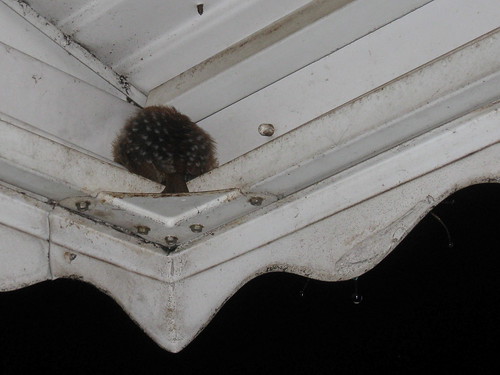
My 16-year-old dachshund needs help with the steps when it's time to go outside. I am usually focused on carrying her and avoiding a fall, but Sunday night I was startled with I noticed what looked like a dark ball tucked into the corner of my awning. Was it a mouse? A chipmunk? A tangled mass of sweet gum balls? Some horrible growth of fungus?

Because of the dire predictions of storms crawling across the bottom of the TV screen all day, I had my flashlight ready. With the added light, I recognized the color. It was not a rodent or ball of goo, it was a Carolina Wren!

In spite of my closeness, the wren didn't budge. She even tolerated the flash of my camera. Was she sound asleep, or just riding the storm out? We had straight-line winds that night—March 4—and nearby Illinois had numerous tornadoes.

Tolerant as she was, it's unlikely that the bird was unaware of my presence. Mike O’Connor, in his 2007 book Why Don't Woodpeckers Get Headaches? And Other Answers to Bird Questions You Know You Want to Ask  (p. 188), tells us that birds sleep lightly, ready to fly if danger threatens. He explains that a bird often sleeps by turning its head towards its back and settling its beak onto its shoulder. I can't say if my little feathered friend is using this method in the photo above, but I can at least see that her feathers are fluffed to help trap warmth. I'm sure she appreciated the awning that night, since in addition to the high winds and rain, the temperature was in the high 30s F. By the way, O’Connor is a lively and entertaining writer. I really get a kick out of this book!

Birds need to take advantage of every opportunity for shelter left to them in the suburbs. Tom over at Mon@rch's Nature Blog, wrote about an American Goldfinch that he spotted as it turned in for the night in the gap between his foundation and a snow bank. The "Father of English Literature" also wrote about napping birds in the "Prologue":

And smale foweles maken melodye,
That slepen al the nyght with open eye

Back in the day, Geoffrey Chaucer and his pilgrim friends would have pronounced that last word as "ee," so it really did rhyme with "melodye." Old Geoff was more accurate than we thought. Former St. Louisan and Big Day birding teammate of mine, Niels Rattenborg, demonstratted in his research that birds can put one half of the brain to bed, while leaving the other half—and the eye that it controls—alert to danger. Using this unihemispheric form of sleep even allows some birds to fly while they sleep!

Wednesday, January 26, 2011

Cooper's Hawk in the Library

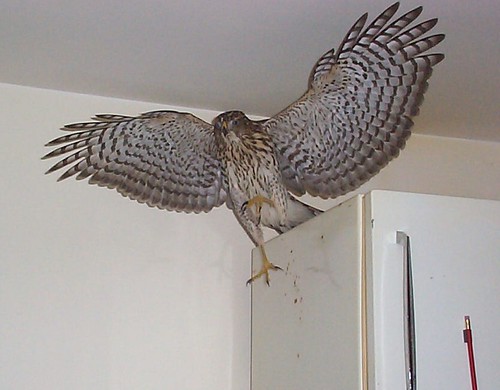
This young Cooper's Hawk is jarringly out of place. Photo by m_barje
After hearing the news stories that a juvenile Cooper's Hawk somehow got trapped in the main reading room of the Library of Congress, my mom and I had this conversation:
Mom:   Did you hear about the Cooper's Hawk that's in the Library of Congress?
Me:      Yes, I did. I hope they get it out soon. It can't last long in there.
Mom:   Of course you're happy about that--you don't like Cooper's Hawks.
Me:      Yes, I do actually.
Mom:   They eat little birds don't they?
Me:      Well, a hawk's gotta eat something.
Mom:   Anne, I'm surprised at you. I thought you liked little birds!
Me:      I do.
Mom:   Well, can't he learn to eat something else?
Me:      I don't think so.
Mom:   He learned enough to go to the library.
Me:      Yes, he did.
Mom:   And he picked a good library.
Me:      Yes he did.
Mom:   I tell you, there's a children's book in it if he lives.
Me:      Hmmm…at least a blog post.

Searching through Flickr, I found the above photo of another juvenile Cooper's that blundered into a building. Fortunately, this one eventually followed the cat out the same door it entered. I noticed that well-known blogger Birdchick left a comment on the Library Congress's first blog post about the hawk. She mentions that when she worked with a raptor center, she once rescued a Cooper's from a batting cage.
I'm not a bird rehabber, but I had a similar experience. I was just out for a walk with my best buddy, Rosie, in the campus of a nearby college. We took the path past the track and ball field, when I saw a Cooper's Hawk frantically trying to get out of the nylon-net batting cage. I hurried home and put Rosie inside, then headed back.
More than once I'd freed Mourning Doves from these batting cages, and I figured I could help the hawk, though his size would make it more of a challenge. I lifted the netting as high as I could, but it was surprisingly heavy and hard to lift over my head for very long. The panicked hawk would come nowhere near the opening with me there. There was a woman running the track at the time, so I trotted over to ask for her help. Two of us could hold up the net from the corners, leaving a wide open space, I explained. She was afraid of birds, she said, and left immediately.
Finally I found two chairs left by baseball fans and used them to prop the net up creating a low but wide opening. The hawk was frantically trying to get out of the top of the net so I withdrew. When I checked an hour later, the hawk was gone.
Dome of the Main Reading Room of the Library of
Congress, where the hawk is trapped. Photo by Photo Phiend


As I post this, the Cooper's Hawk has now been in the LOC for almost 7 days, hanging out just below the "Mural of Human Understanding," seen on the left in a photo by Photo Phiend. We bloggers have had some fun with this story, but the bird's situation is serious. She-- they determined that she's a female--managed to steal some food from the trap set by the Virginia Raptor Conservancy team, but didn't spring the mechanism. Check the latest tweets about the LOC's hawk here.

Saturday, January 8, 2011

Bird Encounters of the Christmas Count Kind


Huge ice crystals mark the sand in Dardenne Creek AMcC
We began our Christmas Bird Count by looking for the Red-headed Woodpecker, near what’s labeled as “Shorebird Area.” This low spot below the dam for Busch Conservation Area’s largest lake, Lake 33, is reliable for Red-headeds, a species that has declined 4.6% per year since 1980, according to National Audubon Society. They gave us quite a show, sparring with Blue Jays, and chattering to each other on a snag that looked like Swiss cheese.
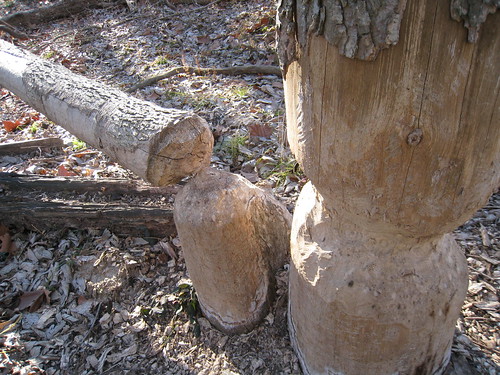
beaver cuts along Dardenne Creek AMcC
There was no open water at “Shorebird,” so after a lap around fields that sparkled with frost, we headed down to Dardenne Creek. The sand bars were puddled with white ice, the kind that we liked to smash when we were kids. Ripples and huge crystals of ice marked the sand. A small flock of Swamp Sparrows and White-throats hopped away.
On the high bank of Dardenne we saw the work of an ambitious beaver. The beaver cuts looked old, but it’s interesting that Red-headed Woodpeckers are associated with beaver. The woodpeckers claim the trees killed when flooded by beaver ponds, and exploit the edge habitat created as beavers fell trees.
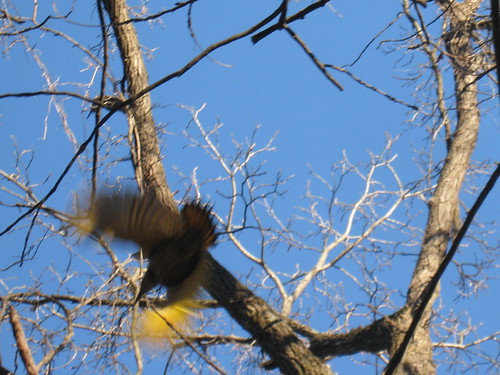
After lunch, we headed down a disused service road, toward a corner of large white pines. White pine is not native to our area; possibly this stand was planted for lumber. My friend Connie was determined we’d find a Red-breasted Nuthatch in the pines. White-breasted Nuthatches are expectable year-round residents at Busch, but Birds of the St. Louis Area: Where and When to Find Them lists Red-breasted as uncommon to casual (that is, beyond rare) in January. In the pine grove, she produced her iPhone, with not one, but three different apps for bird songs, and played a recording of the Red-breasted Nuthatch. Then we paused—silence. At least 30 seconds ticked by, then, an answer! There must have been some pretty bad grammar in that recording, because this Red-breasted Nuthatch was outraged! He scolded us till we fled, not wanting to stress the little guy beyond endurance.
Northern Flicker in the mixed species flock AMcC
We crossed the road and entered the trailless area that will now be known as “The Enchanted Forest. Within a few minutes, we found ourselves surrounded by birds: three calling Yellow-rumped (Myrtle) Warblers, a Northern Flicker, and another Red-breasted Nuthatch—all in the same tree! Now a Brown Creeper joined the group, tugging itself up a tree trunk, where Blue Jays screeched. Not far beyond, a Pileated Woodpecker answered the jays. In the same tree, a Hairy Woodpecker minded his own business. The sun peeked briefly from behind the clouds, and a male Golden-crowned Kinglet snatched those rays to light his golden-orange crest. Chickadees and a dozen American Robins called all around us. As we moved through the flock, stumbling over an old wire fence as we looked skyward, they vanished. Not even a White-throat chirped as we walked back to the car.