On June 11 and 12 I did more breeding bird surveys at Busch Memorial Conservation Area in St. Charles Co., Missouri, with my friend Kevin Renick. We didn't see the numbers of butterflies I mentioned in my previous post, but we saw and heard some great birds, including two not commonly seen: a Blue Grosbeak along the dam at Lake 37, and a brief view of a Blue-winged Warbler at the same spot.
Kevin is a singer-songwriter as well as a whiz at birding; his musical abilities extend into his nature hobby. What impressed me most this weekend was Kevin's ability to consistently tell the difference between the songs of the Scarlet Tanager and the Summer Tanager. Both birds nest here in oak-hickory forests of Missouri, and although their calls are very different, their songs are very much alike. I asked him to summarize the differences between the two songs. I'm accompanying Kevin's summary with video from the incomparable recordist of nature sounds, Lang Elliot.
Kevin's hints: "The Scarlet Tanager's song has sometimes been described as being like a 'robin with a sore throat.' It's a melodic warble, but it has a prominent screechy or raspy sound on one or two notes of its phrasing. The Summer Tanager on the other hand, is not raspy at all. It's a clear, sweet warble, a bit gentler than the Scarlet."
If you hear the bird's call—as opposed to its song—you've got it made. The Summer's call begins this video: "Picky-tucky-tuck." The Scarlet Tanager call, heard in the middle of his video, is "Chick-burrr. Chick-burrrr." David Sibley, author of The Sibley Guide to Birds, says that the Summer's song includes, "brief but distinct pauses between phrases." The Scarlet's by contrast is made up of a "fairly rapid, continuous series."
Thanks to Kevin Renick for his song analysis and to Lang Elliot for making his videos available.
Showing posts with label bumblebee. Show all posts
Showing posts with label bumblebee. Show all posts
Wednesday, June 15, 2011


Monday, September 20, 2010
Forgotten Pollinators
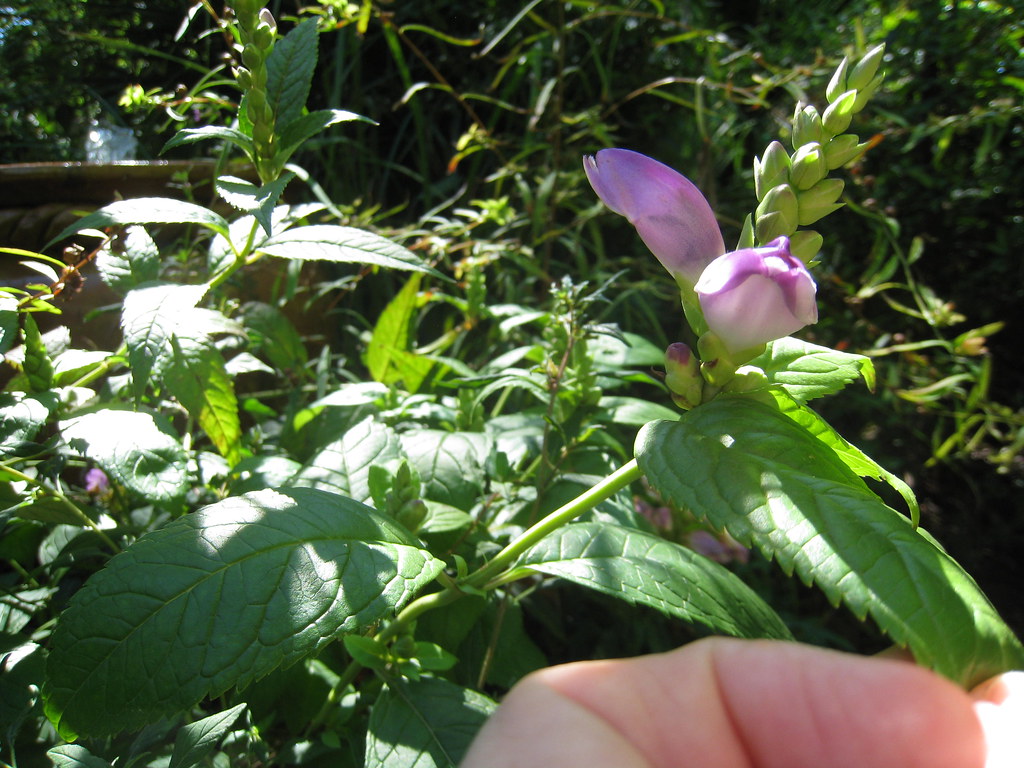 |
| Bumblebee inside translucent blossom of Rose Turtlehead AMcCormack |
First, the Turtlehead forces the bee to struggle through a tight, tubular opening. Then, the plant positions its nectar reward far at the back of its one-and-a-half-inch blossom. Once the bee reaches the nectar, she finds that the pollen she was counting on to feed the kids is stuck on the anthers. Determined, she vibrates her body violently to shake the pollen from the anthers. Now she must somehow work her way out of the bloom, and fly off with her load to another delectable Rose Turtlehead. The process is called buzz pollination, and it's not just Turtleheads that require it of their pollinators. Tomatoes, blueberries, and many wildflowers such as wild indigo (Basptisia australis) produce more and larger fruits if they are successfully buzz pollinated.
 |
| Bumblebee struggles to break free of the blossom AMcC |
Not every pollinator is up to the task. Honeybees and smaller native bees are too tiny. Only the Sumo wrestlers of the bee world, the bumblebees, can really deliver that buzz. What is the evolutionary brass ring that Turtlehead is reaching for? By withholding its reward from pollinators other than it's favored one, the plant encourages that selected pollen-carrier to visit another bloom of the same species--"pollinator constancy." Evidently, once the bumblebee finds something she likes, she sticks with it.
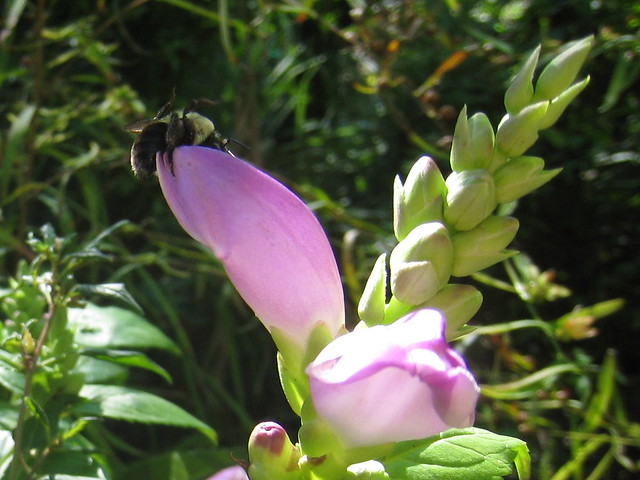
I had really hoped that my photos would help me identify the species of bumblebee, but I just didn't get enough of the insect in the frame. I'll keep trying though. There are several web pages that help with bee identification. My favorite is the identification key to bumblebees from Discover Life. The Xerces Society has a page devoted to the topography of the bumblebee. Bumblebee.org has a great color chart for identifying bumblebees as well as information about their life cycle and how to attract them.
The media has given quite a bit of attention to colony collapse disorder, which has caused the European honeybee to vanish from many places where it was once abundant. We can't afford to lose our native bees as well. The Xerces Society provides information about bumblebee conservation, as well as information about my region, Missouri.
Aerodynamically, the bumblebee shouldn't be able to fly, but the bumblebee doesn't know it, so it goes on flying anyway.
Mary Kay Ash
Not really true, aerodynamically, but isn't it a great quotation?
Sunday, August 8, 2010
Bees, Butterflies, and Biodiesel
 |
| Monarch Butterfly on Cup Plant bloom AMcC |
One of my favorite native plants is Cup Plant, Silphium perfoliatum. My first experience with it was in Hidden Meadow at Girl Scout Camp Cedarledge. My friend Sandy, whose position was “Nature Specialist,” showed me how the large opposite leaves wrap the square stem to form a cup. It had been hot and dry, but when she tipped the tall stalk, water dripped out. Pretty cool! Much later, I read about a couple who got rid of their bird feeders and planted a wildlife garden. I wish I could remember the title of the book, but I do remember that next to their windows, they planted cup plant so that they could enjoy watching the birds use the “natural birdbath.” I resolved to do the same when I got my own home.
Cup plant is a true garden personality. I do sometimes see chickadees and other birds land on the large leaf and dip into the “cup” for a drink. Perhaps they also capture insects in the water. The leaf is pointed, with a jagged edge and rough as sand paper. The stem is thick, smooth, straight, and square, giving it another common name, “Carpenter’s Weed” (Kurz, Ozark Wildflowers, 121). If you were to design a garden plant that breaks all the rules of garden plant developers and hybridizers, you’d come up with Cup Plant. There’s nothing dainty about it. Now you know why I like it!
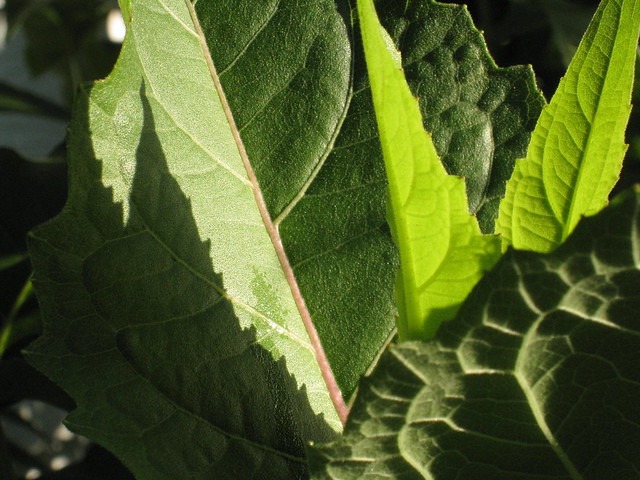 |
| Cup Plant leaves in June AMcC |
By early August, many of my plants are 8 feet tall. Plants that don’t receive as much light and water are smaller. Towering plants with large leaves filled with rainwater sometimes tip over during a storm. If you have a good spot for Cup Plants, plan on staking them up in early summer, and use a really stout stake.
Cup plant blooms are always in demand with bees of all sorts, especially bumblebees. It’s worth remembering that native bees such as bumble bees are much less likely to sting than honeybees, but if you’re concerned, don’t plant it near the door or walkway. I welcome bees and other pollinators, but I found out my mail carrier didn’t. This perennial does spread from the root, so I could afford to thin the herd. Once I removed a plant or two and staked the others up away from the box, he started delivering my junk mail again.
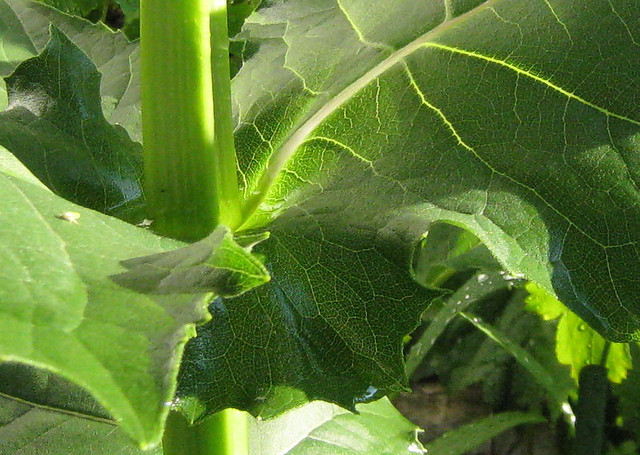 |
| Leaves form a cup as they enclose the stem. AMcC |
The blooms of Cup Plant are a bit more than 3 inches across. Like other members of the Aster family, they provide the perfect landing platform for butterflies. When they’re in bloom, I frequently see 4 different butterfly species in the yard at a time. Today’s Cup Plant list: Monarch, Painted Lady, Fiery Skipper, and Checkered White butterfly. Bumblebees, carpenter bees (known as “long-tongued” bees) and butterflies are the most important pollinators for Cup Plant. When it goes to seed, American Goldfinches, House Finches, and (on rare occasions) Pine Siskins will visit.
Butterflies and Moths of Missouri, by J Richard and Joan E. Heizman (1987) mentions that the caterpillar of a moth, Eucosma giganteana (no common name), bores into the root of Silphium. With its wings closed, E. giganteana looks a lot like a small bird dropping—a great strategy for avoiding hungry birds. With a little research, I kicked up this story by P. J. Johnson: In South Dakota, Cup plant is being studied as a possible source of renewable energy! It’s possible that Cup Plant will be used to produce biodiesel fuel or plastics. If it is to be grown as a biomass crop however, scientists need to know about the possible impact of E. giganteana on the crop, especially since Cup Plant is its one and only host or larval food plant. Their studies found the larva in the flower heads, leaves and stems, but not in the root. I did find a caterpillar on one of my plants, but it looked nothing like the larva pictured in Johnson’s article. Apparently, E. giganteana is very uncommon, but I’m still going to examine bird droppings a little more closely.
Tuesday, July 13, 2010
Are they edible?

Those pesky stinkhorns sure are conversation-starters! I’ve had several people ask if they are edible, and the answer seems to be “Yes,” and “No.” Tom Volk’s “Fungus of the Month” article says that they are, with certain cooking techniques. Another source, “Wildman” Steve Brill found them to be revolting, even when cooked in broth. The totally amazing 2006 BBC series Planet Earth had a time lapse video of a Netted Stinkhorn’s growth. I’d love to embed the video, but the embedding is disabled. Click this link, or better yet, watch Planet Earth. I came across a discussion on this topic at GardenWeb. I was glad to see at least one gardener recognized that they are harmless, interesting mushrooms. Just think of them as “fun-guy!” Thanks for all the comments and photos!
Subscribe to:
Posts (Atom)