Showing posts with label birding. Show all posts

Tuesday, July 2, 2013

Birding Legend, Bill Rudden

Bill Rudden at Riverlands Migratory Bird Sanctuary  Photo by Al Smith, used with permission

"Bird watcher"--even today, for many people, the image of Miss Jane Hathaway leaps to mind. When Bill's hobby shifted from hunting to bird watching, stereotypes tumbled. Bill was a firefighter for the city of St. Louis, Missouri (retired as a captain), and an athlete. As recently as 2007, he competed in IronMan triathlons. I was shocked and saddened when I heard of his death on June 30, 2013, by way of a comment on this blog.

Bill is a legend in the St. Louis birding community for his role in finding what Birds of the St. Louis Area calls, "the most famous bird to visit St. Louis" in 1984. Bill was birding along the Mississippi River near the Alton Dam on a miserably cold December day and spotted a large gull with a dark mantle. He alerted other birders, including birding experts Phoebe Snetsinger and Ron Goetz, and together they identified it as a Slaty-backed Gull--according to  Birds of the St. Louis Area, "the first known occurrence of this Siberian/Alaskan species in the lower 48 United States (113)."

Bill gets a nod in Olivia Gentile's biography of Phoebe Snetsinger, Life List: A Woman's Quest for the World's Most Amazing Birds (89-90). A long-time member of Webster Groves Nature Study Society (WGNSS), he often birded with Phoebe. According to Life List, in 1978, Snetsinger decided to try to break the record for the greatest number of bird species seen in a year in the St. Louis area. She enlisted Bill's help, and succeeded in listing more than 274 for the year.

Bill led the WGNSS field trips on Saturdays for a number of years in the 1980s and was well-known in the St. Louis birding community. His sense of fun was as legendary as his mad birding skills. The first time I met Bill was about 1991. That year, the WGNSS annual banquet was held at one of St. Louis' premier birding spots, Tower Grove Park. A few of us gathered before the event to enjoy some spring birding in the northwest section of the park. Big Day was only two days away, so when we ran into Bill,  members of the group peppered him with questions about his latest sightings.  (Big Day: birding jargon for a competition for the greatest number of bird species seen within a single day.) Referring to his own Big Day plans, he told us, "Oh yeah, my team's parachuting in at midnight."

As a birder, you've got to know your birds, and it helps to know your birders too. I recall a trip to Riverlands, hearing someone say, "Wait--isn't that Rudden over there? What's he lookin' at?" The whole bunch folded their scopes and scurried over to hear what Bill had to say. He was always generous with his news, ID tips, and wisecracks. He was active on the MoBirds listserve, sharing photos as well as reports. His last post on the list reads, "5-30-13 Horseshoe Lake SP Madison county IL. Mostly cormorants were loafing on a snag.  Main lake off old dredge point."

I hope more folks will share their tales about Bill and other birders. If you're unfamiliar with blogs, just click the word "comments" below to read other's comments and leave your own. There's no need to sign in.

How to comment on a blog


Thursday, December 20, 2012

There's an app for that! The FieldSurvey App


I love birding, but I hate checklists. It just takes too long to find the bird in the list. Does anyone else feel that studying field marks is way more interesting than memorizing taxonomic order? 

Ahh, but now there’s an app for that-- the FieldSurvey app. Imagine doing your Breeding Bird Survey, then submitting the data on your iPhone or iPad before you head home. Just such an app has been developed by birder David Rabenau of Stray Dog Software. It’s available in the App Store for iPhone, iPad, and iPod Touch for $1.99.

FieldSurvey allows you to quickly enter each species and the number of individuals seen. Global positioning records the location where you enter the data. When you're finished, it's easy to email the list or export it to bird listing sites.

The design is simple and elegant. Begin by creating the name of your survey. You can add notes including hours in the field, weather conditions, etc. The GPS function puts a pin in the map at the point where you click to add a species to your list. Each time you click, another pin is added so that when the survey is completed, you'll see accurate representation on a map. It’s interesting to see clusters of birds and lone birds on your route. 

Now, enter the birds seen. You can type in the name of each species you see, or if you prefer, you can use the standard four-letter abbreviation for each. The flexibility to create your own list means that this app can be used for any kind of inventory. It’s easy to create your own list as you go, but recent updates offer preloaded lists of North American birds, dragonflies, and butterflies—in-app purchase, $0.99. FieldSurvey can be used for sruveys of insect or plants, bio-blitzes and, of course, Christmas Bird Counts!

I’ve tested this out around my neighborhood, but last weekend I wanted to try out my newly purchased bird list, so I headed for one of the best areas for land birds around here, Busch Wildlife area, in St. Charles County, Missouri.

When you touch the number next to the name of the bird, the phone vibrates, letting you know that you successfully counted one of the selected bird. This simple feature is actually a big help, because you've got a lot to handle when you're walking through the holding phone, binoculars, and a leash with a young and rambunctious dog on the other end. If you come upon a flock of thousands of Snow Geese, just tap to pop up a box to and enter the number in the count field.

The list of birds of North America, of course, is huge. I thought this might a bit too much like a checklist. However, the Field Survey list is in alphabetical order—and I already learned my alphabet. On the right of the screen letters appear. It was easy to tap “C,” and swipe through to “Caroline Wren.”

Having a gadget to list the birds is nice, but if you had to then transfer it to some other form for record keeping—well, you might as use a checklist. When I finished my list, I tapped the “send” icon at the bottom, and selected “Export & Email” in the eBird Record format. Once I signed in to my eBird account, I chose “import,” and uploaded my file. There was no need to convert or adjust—my whole list, including locations, was completed in less time than it took to log in. You can also choose to your list to export to Eremaea, or as a CSV file (can be opened with MS Excel), as a .kml file (used by Google Earth) or .gpx, or email it to yourself. 

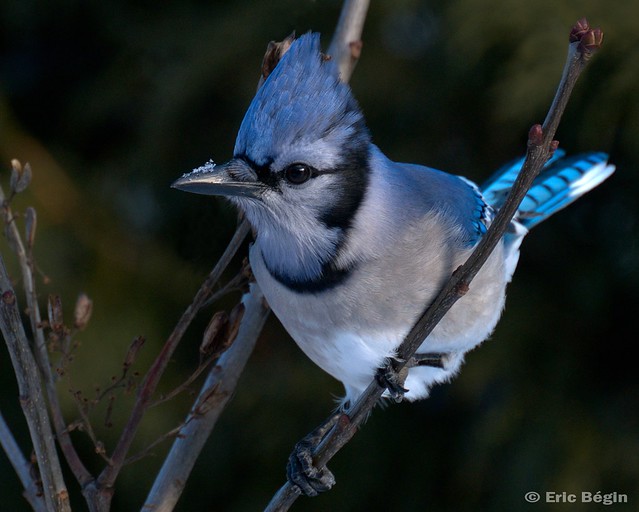
Thanks to Eric Bégin for his outstanding photo of a handsome Blue Jay, licensed with Creative Commons.

Saturday, February 11, 2012

The Not-So-Common Common Ground Dove of Weldon Spring CBC


Truman was President, Muddy Waters sang "Rollin' Stone," Lefty Frizzell sang "If You've Got the Money," "Sunset Boulevard" took the Golden Globe, and the Webster Groves Nature Study Society  counted birds in the cold December winds at Busch Wildlife Conservation Area near Weldon Spring, Missouri, Dec. 29, 1950.

Every year since then, Webster Groves Nature Study Society, better known as WGNSS--pronounced, "Wig-ness"--has participated in the National Audubon Society's Christmas Bird Count (officially,  MOWS, "Missouri-Weldon Spring") by surveying the area we call "Busch." There are about 11 square miles to survey, including 3,000 acres of forest, 32 artificial lakes, and 100 bunkers once used for storing TNT during WW2. Throw in plenty of gravel roads, a thousand acres of grassland plus 200 acres of restored prairie and the same amount of old fields, and you've got a diverse and accessible birding area--all within 50 minutes' drive from the St. Louis Arch.The plan in a survey such as this is to count each species of bird seen, as well the number of individuals. We divide into territories, and take precautions not to count an individual more than once. For example, I might spot 3 Blue Jays in the tall oak by the creek. Some time later I drive past the same spot and see 5 Blue Jays. I record an additional 2 birds, not 5. On the way to my territory, I see a Bald Eagle overhead. I don't record that bird, but I do notify the count compiler in case the team in that area missed it. If so, Bald Eagle will be added.

This year we had 11 participants who counted 2,441 birds of 49 species, including one that has never been recorded on the Weldon Spring count, the Common Ground-Dove. For that matter, it's likely the only individual of its species ever to have been recorded on a Christmas Count in Missouri. It's a bird that's normally found in the extreme southeast and southwestern US and coastal Mexico. Records show that the species has never been recorded in St. Charles County. Thanks to Josh Uffman for making this information available online.

Our little dove--smallest in the US; half the length of the abundant Mourning Dove--was very kind to us, considering all the factors. It had been dallying in the fields of Busch for weeks, putting up with hunters and as well as unruly birders. It was our target bird, but rabbit hunters with their noisy beagles caused it to lie low. Fortunately, some of the group were very patient, including Bob Nieman who snapped this picture just as the sun set. Bob was visiting the area for the holidays--thanks for your help in making this a memorable count!

On my route, I was delighted to witness a  behavior I'd never seen before. I paused along the road where fields gave way to forest. American Robins and Cedar Waxwings crossed back and forth, feeding on and the waxy blue berries (really cones) of Eastern Red Cedar and the abundant red berries of invasive bush honeysuckle. Amidst the busy, noisy robins, two sleek waxwings rested on a branch. One passed a berry to the other's beak, who then passed it back. They did this for several minutes. Male and female Cedar Waxwings look identical, but the two were probably a pair engaged in courtship behavior (A Guide to Bird Behavior, Vol. II, by Don and Lillian Stokes, 1983).

Wednesday, December 21, 2011

Christmas Bird Counts on TV

I had a chance to talk about Christmas Bird Counts on local TV today. Dan Zarlenga, of Missouri Department of Conservation, set up the interview with John Fuller of KPLR-TV Channel 11 in Saint Louis MO. I had a blast! The broadcasters and staff could not have been nicer. I hope it will motivate a few more people to volunteer their time with Christmas Bird Counts.

 
More posts about Christmas Bird Counts:
 
CBC Chartbuster

Register Online for CBC
Weldon Spring CBC
  
Bird Encounters

Tuesday, March 29, 2011

Urban Birding, Texas Style

Like puppies, wild parrots seem to make everyone smile. On a recent trip to south Texas, our trip leader, Bill, headed toward a couple of addresses in McAllen that offered some great urban birding. The first was in a residential neighborhood. A lady on her front porch began yelling to us as soon as our big van pulled up. I can certainly understand why homeowners would feel uncomfortable when strangers with binoculars pull up to your house. We yelled back, "We're just looking at birds!" but we weren't listening—she was saying, "Come on into my driveway!" When we finally heard her welcome, we stepped on over and got a great view of 5 Red-crowned Parrots screeching in a palm tree.

The welcoming attitude was more surprising to me than the parrots. Most birders are used to wariness if not hostility from residents. I've had people call the police on me during Christmas Counts. Birding is big business in Texas—I knew that, but I just didn't know how supportive the average person is in south Texas. Impressive!

Our next stop was a strip mall on 10th Street. Around sunset, we waited by the huge fountain in front of Lowe's. The parking lot was full of cars with plates from Iowa, Wisconsin, Ontario—everyone waiting for the Green Parakeets. Most didn't have binoculars, but as I say, everyone loves wild parrots, not just birders. Suddenly with great fanfare and squeaky chattering, a flock of 500 Green Parakeets jostled for position on the overhead wires. After checking the scene, they flew over to the fountain and began to bathe. A few moments later, a Cooper's Hawk streaked in, chasing the parakeets first low, then high over the roofs. Cooper's Hawks really love wild parrots! Most of the non-birders left, but it didn't take long for the flock to regroup and circle back to the fountain. Urban birding at its best!

Sunday, February 20, 2011

The Crossley ID Guide

Cape May Warbler in The Crossley ID Guide, p. 411 alongside Birds of America, plate 95
I got my copy of The Crossley ID Guide: Eastern Birds this week. Lots of well-known bloggers and experts have reviewed it as well, which I have linked to below. I'm not qualified to debate whether a the photo for the 1st-winter Glaucous-winged Gull is adequately differentiates it from the 1st-winter Thayer's Gull. However, if the target audience for this book is the average birder who gets out into the field when the demands of work and family allow; an average birder who'd like to improve her birding skills, then I'm eminently qualified. A better question might be, given that there are already a half-dozen excellent field guides to birds of the US, is this new book useful to me? I answer, enthusiastically, yes!

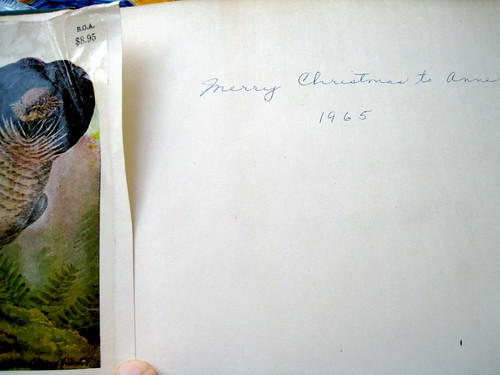
You're not gonna get this book into the pocket of your birding vest—it's bigger than The Joy of Cooking. I own only one bird book that larger and heavier than The Crossley ID Guide: the reprint of the 1917 Birds of America I got for Christmas in 1965. Edited by T. Gilbert Pearson, with color plates by Louis Agassiz Fuertes, its dust jacket proclaims in all caps, "This is the perfect, permanent bird book for all ages." Did the publisher mean it was perfect for a 14-year old as well as a 41-year old? Stone Age as well as Bronze Age? Industrial as well as Digital?

Like Fuertes' published paintings in Birds of America, Richard Crossley's plates are large, showing the species shown in its typical habitat. Crossley is not a painter however, his color plates are composite photos. Numerous photos of the bird are set against a background of the typical habitat. In the foreground of the of the composition appear a few close-up photos of the bird, each in a different plumage. In many plates, the middle ground displays several images of the bird in flight. In the distance are proportionally small images of the same species. Crossely's purpose is to pack as much identification information about the species into one scene as he can; how it may appear in flight, at rest from the side, viewed from the front when feeding, in the distance where streaks seem to blend into a wash of color.

At first I found these scenes a bit like a backlot studio shot in an old movie—I was distracted by the background. The more I looked at the page however, the more the images appeared 3-dimensional. Crossley is not trying to depict field marks. He asks the reader to look over the complete image, focusing first on this bird, then that, putting those photos of variable plumages and postures into context. In Japanese films, the director often gives the audience a wider shot than we're used to with Hollywood movies; the viewer, not the director, decides what to look at within the frame. Crossley's approach is more Kurosawa than Corman.

It will take me a long time to go through this book, but I'll use one plate as an example of the role this book can play in your birding toolbox. When I first moved to Kirkwood in the 80s, I occasionally saw what I called "the mystery bird." Its wings were swept back like a gull, but the tail wasn't the right shape for a gull. Sometimes I'd see a distant bird with a leading edge so straight that it appeared to be headless. It's flight was so effortless and acrobatic, I thought it might be a falcon. All of these are shown in the tiny distance shots on page 239. 

Ruffed Grouse peers in from the dust jacket
to read the 1965 version of an interactive comment.

The fact that I can point you toward that page whether you own the book or not is another feature of this birding guide that Peterson and Pearson never dreamed of; it's interactive! I can try to soak it all the images on the printed page, but if I need more information, I can find it with a click on the website. The web version has labels, comments, and questions not included in the book. Of course, you can "like" it, make comments, or leave questions for the author on Facebook too. Adjusted for inflation, at $8.95, Birds of America was roughly 3 times the Amazon price of The Crossley ID Guide!


If you wrote about this book on the web and I haven't listed you below, I'd love it if you'd comment and give us the link!
10,000 Birds
The Bird Chaser and second post
Audubon Magazine
Birdzilla.com
Monarch's Nature Blog
The Bird Booker Report
Sapsucker Woods (gift shop of Cornell U)
What Bird Forum


Friday, December 31, 2010

How to register for a Christmas Bird Count Online

Registering online for a Christmas Bird count is easy!
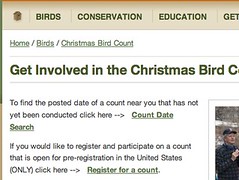
Go to National Audubon Society's page. Click "Christmas Bird count."

Click on "Register for a count.
Use your existing account, or get a free one.
You will need to know the code for the count. For example, the Weldon Spring Count in Missouri is "MOWS." The Confluence Count in Missouri is "MOCF." You can find one near you here.
Click "Sign up here."

Step 5: Add your information and pay the $5 fee with a credit card. Click "submit." It's just that easy!

Wednesday, August 4, 2010

21st Century Birding Skills

"Seeing the Past" photo by Charles Kaiser

Nate, over at The Drinking Bird, wrote a fascinating blog post about the Orange-billed Nightingale-thrush. This Central American bird showed up South Dakota, of all places. Not only is the bird well out of its normal summer range in Tamaulipas, Mexico and 1,435 miles north of it’s previous Texas record, it is not even a migratory species. Perhaps even more remarkable is that someone found it in Spearfish Canyon. Well, by now, possibly thousands of people have found it. This is a little less surprising, given that, as Nate has pointed out, the intrepid discoverer, Eric Ripma, is also a blogger!

Way back in the Twentieth Century, word of such a finding was spread by telephone. Our nature group, the Webster Groves Nature Study Society, maintained a “hotline” for many years for this purpose. A birder who discovered an uncommon or rare species called the person at the beginning of the chain, who called the next, and so on. As long as people were home (no cell phones), twenty or so people were informed within 6-24 hours of the sighting. If the first person in the chain doubted the claim, his or her dialing finger remained idle. Assuming that the hotline was activated, the first group of 6 or 12 arrived, relying on binoculars for the most part. Only one field guide—Peterson—was easily available, and it didn’t list rare visitors from other climes. By 1983, National Geographic published its more comprehensive field guide. The average income of birders began to climb, the price of spotting scopes began to fall, and optics improved by leaps and bounds.

Enter the digital age! List serves have replaced hotlines, informing vastly more birders in less time. Excited birders on the scene of a rare sighting send up a Tweet from cell phone without leaving the bird! When a text message isn’t enough, why not upload your digiscoped photo? Of course, it’s not just the sending, it’s the receiving too. Subscribers get a ring tone wherever they are—at work, or in rush hour traffic. I don’t subscribe to national rare birding hotlines, but I found out about the Orange-billed Nightingale Thrush through a photo posted by Christopher Taylor (a friend I’ve never met) on Facebook.

Do we still admire birding records of the past as 21st Century birding skills sweep them away? Is the ability to spot and identify a bird becoming less important? Maybe all I need to do is follow a Google Map posted by a birder, and wait for the experts to point out the bird. I ask you, fellow birders, is the famed picnic table of Patagonia now good for nothing but picnics?

I asked my nephew Sean for an analogy from sports. No sport seems more obsessed with record keeping than baseball, and Sean is the Sultan of Stats—a walking Wikipedia! He pointed me toward the “Dead Ball Era.” Just to give you an idea of how baseball was played at the time (1900-1919), Frank “Home Run” Baker earned his nickname by hitting 2 home runs in the world series of 1911. That’s right—both in the same series. When Frank tore the cover off the ball in 1911, the ball was worn, weak, dented, brown, and flat before he smashed it. Now baseballs are lively and replaced ever few minutes so that they remain a nice, visible white. In every type of sporting equipment, quality has taken a quantum leap since the days of the Gas House Gang.

Actually, I’m confident that birding skill is alive and well in the 21st Century. After all, it was Ripma’s skill that allowed him to find the bird. Just as every player from Stan the Man to Hammerin’ Hank would have used modern equipment if it had been available, I have no doubt that Ted Parker and Phoebe Snetsinger would have Twitter followers if they were still birding today.