Showing posts with label vine. Show all posts

Tuesday, July 12, 2011

Fruits of Summer


Indian Cherry, Rhamnus caroliniana, is a shrub or small tree of dry, rocky glades, but it's also found near streams. It has a patchy distribution, show in the US Geological Survey map below. In Missouri, it's found south of the Missouri River, mostly in the Ozarks.
Range of Indian Cherry, USGS

The photo above was taken just a week ago. Now some of the fruit is beginning to turn red. The "Indian" part of it's name may be related to it medicinal use by Native Americans. According to Don Kurz in Trees of Missouri, they used it to induce vomiting. It's surprising how many plants were used as emetics in traditional medicine. I really don't get that.

Indian Cherry is also known as Carolina Buckthorn, even though it has no thorns. Wikipedia says its fruit ripens in summer, Dave Tylka, in Native Landscaping for Wildlife and People, says fall. This is the first time my little tree has fruit, so I'll let you know.


Pipevine fruit

Here's a mysterious fruit! My pipevine, Dutchman’s Pipe, Aristolochia macrophylla, is 5 or 6 years old and it's also bearing fruit for the first time. I haven't been able to find anything about the fruit, except that like the rest of the plant, the fruit is poisonous. Pipevine blossoms are pollinated by tiny flies that get temporarily trapped in the weird little flower, so who knows? Perhaps some of the flies that pollinated my pawpaw tree performed the same service for the pipevine. Of course, I grow pipevine for the butterflies it attracts, not the poisonous products. I've written about the vine and the fascinating butterfly in earlier posts.

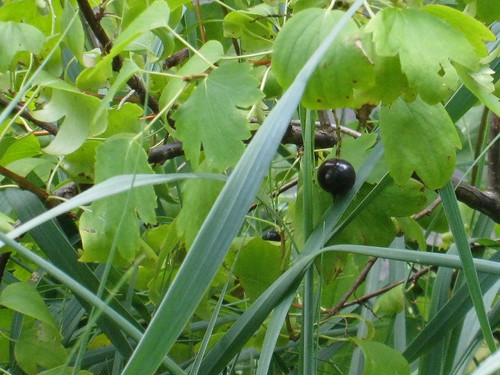
But wait! there's more! Not only have my Pawpaw (see previous post), Indian Cherry, and Dutchman's Pipevine borne fruit for the first time this year, my Golden Currant, Ribes odoratum, has joined in! There are four members of the Ribes genus native to Missouri, two gooseberries and two currants, but unlike its cousins, this shrub has no thorns. I wrote about Golden Currant's pollinators and fragrance this spring. It's fruit is ripe right now.
Golden Currant

Productivity in my small native plant landscape is pretty gratifying—a bit like my blog, which is now 1 year old! 


Wednesday, November 24, 2010

Bittersweet


American Bittersweet AMcC
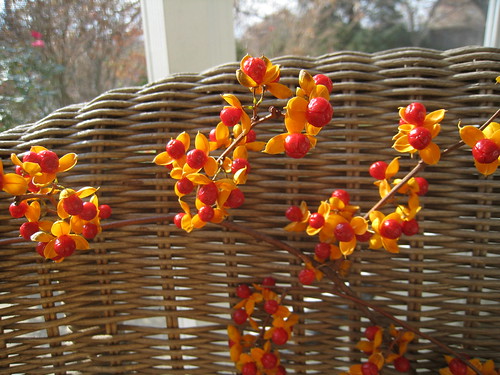
Spring is a time of easy metaphors for renewal, hope, life. Autumn, well, not so much. Lovely fall colors are cheery, but brief. Just as Goldengrove is unleaving, a magnificent vine is revealed, covered with clusters of small, shiny red fruits, surrounded by open capsules of orange. We call it American Bittersweet, Celastrus scandens. Kurz notes in Shrubs and Woody Vines of Missouri that Celastrus is a Greek name for a tree and scandens means climbing. But how did it get its melancholy English name? Perhaps its autumnal display associates it with the demise of summer, the season of loss.

We humans like to ascribe meaning to natural phenomena. The albatross symbolizes guilt; the raven, death; the lark, “blithe spirit;” bittersweet, remembrance.

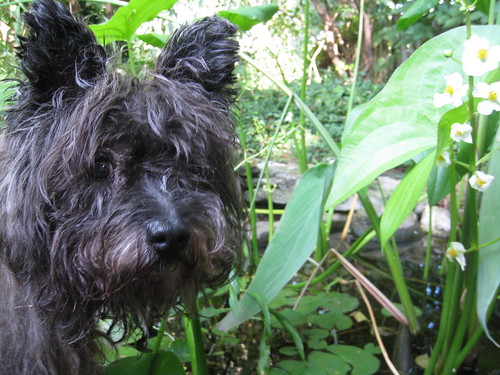
The contradictory name has been on my mind, since the furry friend you see in my profile picture died this week. For those who have experienced the death of a dear pet, I don’t need to explain my feelings. For those who have not, I don’t think I can adequately describe it. Instead, I’ll focus on the sweet memories.

Rosie and I went everywhere together for more than 16 years. She accompanied me on many birding trips, though she really preferred chipmunks, moles, and other mammals. She camped with us in the Rocky Mountains one June, and I was surprised to see her barking at two Gray Jays. She didn’t usually pay attention to birds. Then I saw one dart in and snatch a bit of her fur while the other stole a kibble from her bowl.

Rosie the Fishin' Dog AMcC
My brother-in-law called her “the fishin’ dog.” Her favorite spot was the tiny pond in my back yard. I keep a few goldfish there to eat mosquito larvae, and once she spotted them, she wanted them. She tried to catch a fish every day of her life and never succeeded. Far from being discouraged, she came back to the job fresh every time. She spent so much time in the water that one summer I had to take her to the vet for swimmer’s ear.

Like a true a terrier, she was independent. She seldom asked to sit in my lap as I watched TV, but she did like a good nature show now and then, especially if there were bears to bark at. When she was a puppy, she sat up on the bed while I watched Turner and Hooch; starring the tidy detective Tom Hanks and the untidy Dogue de Bordeaux named Hooch. She barked and jumped and generally went nuts every time Hooch came on the screen. That video was like a Jane Fonda exercise tape for Rosie.

If you grow bittersweet in your woodlot or on an arbor, be sure you get the native variety, not Celastrus orbiculatus, Round-leaved or Asiatic bittersweet. The fruits of Round-leaved bittersweet are less showy, and the plant is aggressive. As the name suggests, the easiest way to determine if the vine is native to the US or an invasive invader is the shape of the leaves. American bittersweet’s leaf is not round, but an elongated oval with a pointed tip. Sweet as they are to look at, the fruits are poisonous.

Sunday, October 17, 2010

Creatures of the Night


Fragrant moonflowers open at night, but stay open till the next morning. Photo by Karen Dorsett

A few weeks ago, my sister Kim called to tell me about a startling experience with a bat or bird fluttering around their moonvine. I haven’t grown moonvine or moonflower (Ipomoea alba) since the shade shelter over my patio collapsed, so I was delighted to hear about one of my favorite plants.

I saw moonflowers for the first time in the pages of Peter Loewer’s Bringing the Outdoors In: How to Do Wonders with Vines, Wildflowers, Ferns, Mosses, Bulbs, Cacti, and Dozens of Other Plants Most People Overlook (Contemporary Books, 1974). Loewer did the illustrations too and they are wonderful. Inspired, I planted moonflowers (or moonvines) in my garden. The vines climbed the shade shelter, growing larger and larger leaves. They seemed to enjoy the hot summer, but alas, they produced no blooms. Concluding that I had planted too late in spring, I tried again the next season. Again, huge healthy vines shot up, providing shade but no blooms. 

Daytime camouflage of
Pink-spotted Hawkmoth. Photo by cwphobia
Then one fall night I happened to walk out in the backyard and behold! A huge white bloom, every bit of 6 inches in diameter (15.24 cm)! I noted the fragrance too, and realized that it was familiar. My vines must have bloomed the previous season, but at the top of the shade shelter where I couldn’t see the flowers. About then something fluttered past my ear—then another! I was about to beat a rapid retreat into the house, but there was just enough light for me to see that the winged monsters were moths. Almost as big as the flower, the moths (possibly Pink-spotted Hawkmoth) appeared to blunder into the delicate white bloom and then bounce away. 


Kim got this shot with her phone on Oct. 14
Kim told me that when she transplanted the vine into her garden last spring, she thought, “Well, I’ll never see you again.” But the tiny vine plunged through the lush growth and found itself in moonvine heaven. It leaped over the roses and laughed at the trellis, but it refused to set buds till September. Reassured that bats were not invading the patio, the spectacle of opening buds began to attract the attention of human neighbors too. Kim told me that when the weather is warm, “The buds pop open like a firecracker.” It it’s cooler, they unfurl more slowly. In very cool weather, the buds wither away without opening. Kim and Steve have hosted friends for moonflower-gazing parties almost nightly. Sounds very Zen, doesn’t it? Except I think they served wine, not tea. On October 10, following daytime temperatures in the mid-80s, 23 blooms opened! That night, the thermometer dipped to 42°F, and the next night, in spite of another unseasonably warm day, only 7 opened. This just in: 3 are open tonight.

I’ve read discussions on when to plant, whether or not to fertilize, and lots of other tips to encourage moonflowers to bloom earlier. Here in St. Louis, Missouri, our average date of first frost is between Oct. 11-20, so a tender vine that doesn’t get going till mid-September may not merit space in the garden. Like another favorite of mine, Mexican sage, the blooms depend on day length, not on any factor that gardeners can control. In its native South and Central America, apparently it doesn’t pay to bloom when days are long. For gardeners though, what could be better than a plant that blooms when nights are long?

Sunday, July 11, 2010

Those Ever-Lovin' Vines!


Pop used to call them “Those ever-lovin’ vines!” and it was clear he was not in love with them. I don’t know any gardeners that are. I’m talking about those vines that spring from nowhere just to deface your Japanese maple. Edgar Denison calls it Angle-Pod, others use the common names Climbing Milkweed, Bluevine, Honeyvine, or Sandvine. Or Everlovinvine.
This plant is a stalker—literally. The stem twines slyly around the stalk of your treasured perennial. You won’t even notice it till it starts to bloom. By then it’s tied a dozen plants into an impenetrable tangle, snapping stems under the weight of the hitchhiker and the next rain. Its blooms are insignificant and white, but put out strong perfume, calling bees and flies to pollinator duty. The fragrance is sweet to humans too, but for my money, it’s too sweet.
Removing Cynanchum laeve requires delicacy and restraint. The vine twines with a counter-clockwise motion, so to remove, you must carefully twist it in a clockwise direction. The temptation to pull is usually too much for me, and that yanks off the flowers I’m trying to save. A better strategy is to use scissors to clip the vine every few inches, then pick off each piece. The root is deep. It looks like long, thin, white carrot. If you choose to leave the root, the vine will sprout right back. You understand, of course, that removing the root will pretty much destroy that section of your garden. The best plan is to let the vine grow long enough so that you can safely hit it with herbicide, leaving the rest of the garden untouched. Good luck with that.
When all else fails, comfort yourself with the knowledge that Monarch butterflies and their caterpillars love this plant. I’ve seen caterpillars on it a number of times. Sometimes I just hook it with the side-view mirror as I back out of my driveway and drive around town with a vine and black-eyed Susan dangling from my passenger side. Works for me!