Showing posts with label glades. Show all posts

Wednesday, May 25, 2011

Shaw Nature Reserve


If I were going to film The Lord of the Rings, I'd start at Shaw Nature Reserve, in Gray Summit, Missouri. For Lothlórien, the enchanted forest where forest elves live in fantastic tree houses, we'd take cameras down the Wildflower Trail. Oaks and hickories give way to pawpaws and ancient sycamores as the trail drops to the Meramec River. Prothonotary Warbler sings in the background. Whole hillsides are covered with dwarf crested iris (Iris cristata). Picture Orlando Bloom running through this scene, bow in hand. Are ya feelin' it?

The St. Louis Chapter of the North American Butterfly Association (NABA) held a butterfly count here on May 22. I arrived about an hour early to do a little birding. (Birders get up earlier than butterfliers.) Along the border of the woods, a Wood Thrush sang its haunting song. In the meadows I heard several Prairie Warblers, while Barn Swallows and Tree Swallows glided over the lake.

Juniper Hairstreak, photo by Jeannie Moe (used with permission)
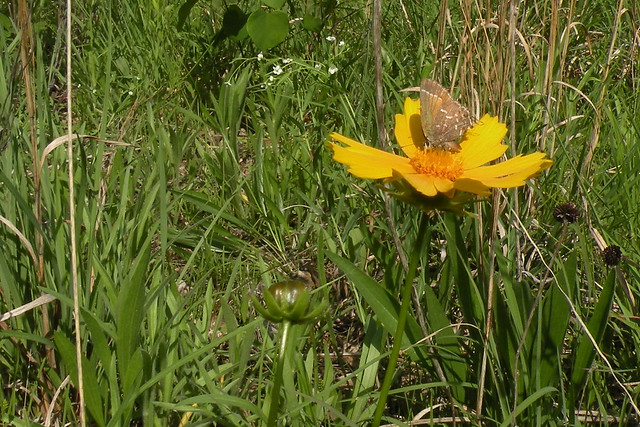
We began our count on the well-named Bluff Overlook Trail, with great views of the landscape and a the opportunity to occasionally look birds in the eye as they hunt for caterpillars in the treetops. We passed dolomite glades where coneflowers were just beginning to bloom. On a coreopsis (Coreopsis lanceolata), Jeannie found our best butterfly of the day: Juniper Hairstreak.

Yvonne and her group spotted an amazing sight: a Polyphemus Moth was just emerging from its cocoon. Its body and legs appear swollen as it pumps fluid into its wings to expand them. This creature is as fantastic as any in Middle Earth.

Polyphemus Moth, photo by Yvonne Homeyer (used with permission)

Monday, May 9, 2011

Fire Pink

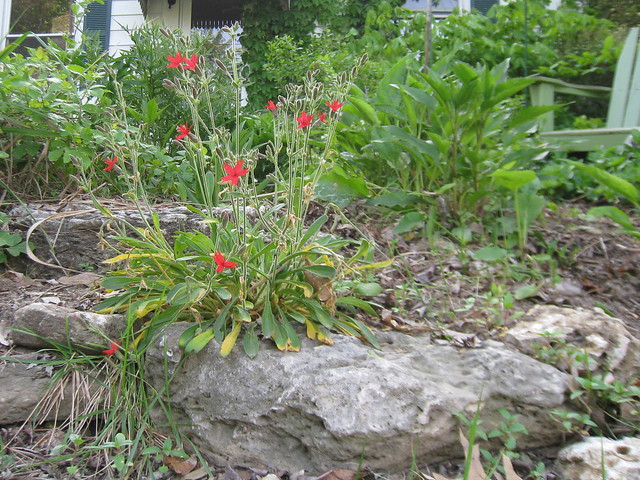
Besides having a stunning red flower, Fire Pink (Silene virginica) attracts hummingbirds, and I'm all about that! So I made a number of clumsy attempts to grow it in my garden and always failed, until last year. That's when I decided to get serious about imitating the habitat where I first found it: on a dry, rocky, west-facing hillside in Jefferson County, Missouri.

A glade garden may seem an odd choice in an east-facing, suburban front yard, but that's where I have a slope and the greatest hours of sunlight. I started by removing the Bermuda grass, and some of the dry, clay soil. I replaced it with crushed limestone, and topped that with the rocks. I had to purchase rocks that I could lift, so I looked for ones that could fit together to give the impression of a rock shelf. Then I tamped and pounded till they seemed stable. Once you install an artificial limestone/dolomite ledge, you're pretty well committed, so I really needed a success.

I had a moment of panic when I reread Kurz' description of the typical habitat in Ozark Wildflowers: "wooded slopes in sandstone, chert, or igneous soils." That suggested acid soil, not clay and limestone. As they say though, the plants don't read the books, and the Silene gods smiled on me. My Fire Pink bloomed well last year and returned for an even stronger show this year. Dan Tenaglia's website, MissouriPlants.com, has really great photos of this plant in the wild, and the rocks in his photo look suspiciously like limestone/dolomite.

The stem and calyx of Fire Pink or Catchfly are sticky. John Hilty's website, Illinois Wildflowers (which I talked about in January 2011), says that the purpose of that sticky substance is to discourage ants from "stealing" the nectar. An animal "steals" nectar when it takes nectar without pollinating the flower. Hilty says however that little is known about Fire Pink's pollinators, although is is presumed to be hummingbirds. Even though I've only seen a hummer at the blooms once, I don't have any doubt Silene is a hummingbird plant.


Sunday, May 1, 2011

Victoria Glades

If I had to pick a favorite habitat, it would be glades. Open sky, tough plants, rocks that invite you to sit and look, that's what I'm talkin' about! To officially qualify as a glade, the area must have all or most of these characteristics:

  • thin, rocky soils
  • exposed bedrock
  • steep slope
  • facing south, west, or southwest
  • dry, fast draining soils
  • fire adapted plants
  • scarcity of trees

Spring is busy for gardeners with binoculars, but I decided to make time for "Missouri's Glades," a continuing education class at St. Louis Community College, sponsored by Missouri Native Plant Society (MONPS), and taught by their past-president, Rex Hill. Our first field trip was to a dolomite glade less than an hour from me,  Victoria Glades in Jefferson County. One portion of the glades is managed by The Nature Conservancy, the other by Missouri Dept. of Conservation.

Let's get right to the amazing plants and animals: I have never seen so much Indian Paintbrush (Castilleja coccinea)! The whole hillside had a reddish cast. Alongside the paintbrush, Fremont's Leather Flower (Clematis fremontii) bloomed. This is a non-climbing clematis, rare and protected in Missouri. I have never seen it in  bloom before.

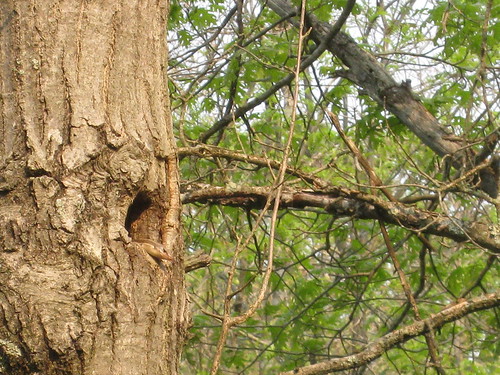
A female broad-headed skink warms in the sun from a tree cavity on the edge of the glade.
Down by the creek, the Louisiana Waterthrush sang his beautiful, slurred complex song. Up in the glades, Prairie Warblers sang from thickets of fragrant sumac (Rhus aromatica). Eventually, one danced to the edge and gave us great views. Blue-winged warbler, another species that likes open or shrubby habitat, popped up to the top of a tree, threw back his little yellow head, wheezing his sleepy, "Beee-buzzzzz."

In spite of strong breezes, we saw butterflies too.We watched a very faded, transparent Monarch nectaring on leather flower. There were Eastern Tailed Blues on False Toadflax, and we saw several Pearl Crescents.  I just managed to get a poor photo of a dark butterfly, which I think was a lifer for me, a Dusted Skipper!

One of the group found a Wild Turkey egg in the dry grass. A good part of the egg was missing, and as we look inside, we could see a large beetle that apparently was eating what was left of the yolk, or possibly, was eating whatever was eating the yolk. After following Beetles in the Bush and taking my first tentative steps toward appreciating insects, I was excited that I identified it as a carrion beetle, Necrophila americana.

John managed to find us a striped bark scorpion, a Western Slimy Salamander,  and this little dandy, an Eastern Hog-nosed Snake. Non-venomous hog-nosed snakes are the entertainers of the reptile world. A hog-nose can play possum, rolling over belly-up leaving its tongue out. When being "dead" doesn't seem the best defense, it will try to bluff its way out of the jam. It can pull its head and front portion upright, spreading its neck in a thoroughly convincing imitation of a cobra; when I happened to come upon one of these tricksters, it made my hair stand on end! Pat, who volunteers at a St. Louis County conservation area, told me that they had reports of 3 cobras just that week!

I took about 100 photos--seriously. I shared a few of them here.


Sunday, April 17, 2011

Golden Currant and Friends

Gardeners with small yards have to prioritize, especially if, like myself, you're a plant collector masquerading as a gardener. Here are some of the questions I ask about a plant before squeezing it in:

Is this plant…
  • native to my state?
  • enticing to hummingbirds?
  • inviting to fruit-eating birds?
  • attractive to bees and other pollinators?
  • found on Missouri glades?
  • fragrant?
  • easy to cultivate?
  • not so tall that it will obscure the view of the garden?
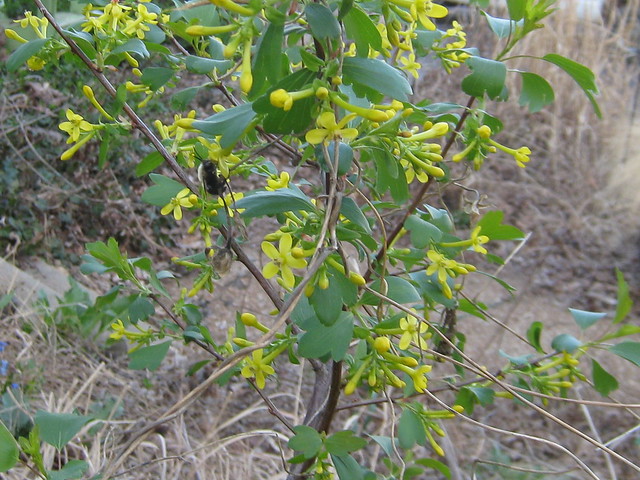
It's pretty tough to meet all of these criteria in a single plant, but I think I may have found it: Golden Currant, Ribes odoratum, also known as clove currant, Missouri currant, and buffalo currant. My bushes are about 5 years old and bloomed profusely for the first time this year. 

The blooms have the tubular shape typical of hummingbird-pollinated flowers. Stokes Hummingbird Book (Don & Lillian Stokes, 1989) has a concise summary of the characteristics of the plants in this "exclusive club":

  • tube or trumpet-shaped blooms that produce nectar at the base of the tube
  • flowers are usually red
  • blooms point downward
  • flowers have small petals, without a "landing platform" for insects
  • flowers produce no fragrance

Let's see… Golden Currant has a tube-shaped bloom, which—in the interest of bringing you the facts—I munched. It was a little sweet, but then, it's a little flower. The flowers are deep yellow, though as the bloom matures, the tips of the corolla show rusty red.  On my bushes, the most of the flowers point upward. The petals are tiny. The blooms are wonderfully fragrant. Color me confused. Which pollinator is the plant trying to attract?

Hummingbird Gardens: Attracting Nature's Jewels to Your Backyard (Newfield and Nielsen, 1996) recommends several species of Ribes, including R. odoratum as hummingbird plants, in the chapters on western gardens. I even found this photo of an Anna's Hummingbird visiting currant blooms in California.

I have not seen a hummer at my currant bushes, but I don't usually see them this early in the season. I have seen lots of bees though. I grabbed my close-focus binoculars—the ones I use for butterfly watching—and had a chance to observe the bees closely. Because they have shiny black abdomens, I judged them to be Eastern Carpenter Bees. Some were males with yellow mouth parts that give them a comic, bucktoothed expression. I couldn't really tell what they were doing inside the flower, but carpenter bees are long-tongued, and should be capable of reaching the base of the bloom to lap up the nectar. 

Golden Currant's natural range in my state, according to Shrubs and Woody Vines of Missouri (Kurz, 1997), includes only 4 counties: Shannon, Barry, Stone, and Taney. All of these are deep in the Ozarks, and feature dolomite or limestone glades and bluffs. Some sources call it Ribes aureum var. villosum, but list Ribes odoratum as a western species. Searching for R. odoratum often redirects to R. aureum, so I don't know if there is a difference in distribution across the continent, or just name confusion because of a change in botanical classification.

The USDA's site says that the Kiowa used the plant (whether leaves, fruit, or bark is not given) as a remedy for snake bite. The Kiowa believed this remedy was so effective that snakes were afraid of the currant bush. I haven't seen any rattlers near my bushes either! Many tribes used the fruit in the Native American version of the energy bar, pemmican. I'm hoping my bushes produce fruit this year—you'll need 2 to produce fruit—which I'll be glad to see the birds gobble up.

Monday, December 6, 2010

Waxwing Party at the Pond

White lines on the back and red "wax" AMcC
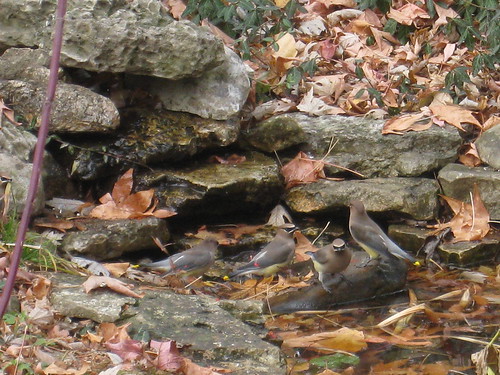
The Cedar Waxwing is a lovely bird with silky smooth feathers, a jaunty crest. and a mask that makes him look like Zorro the Avenger. They are expectable in winter, but unpredictable and easy to miss when you’re out birding in my area. So when a flock of Cedar Waxwings dropped by my yard some days ago to visit my little swimmin’ hole, I grabbed my point-and-shoot camera a got a few shots.

I never really noticed the striking white lines on the back that show in this photo, but then I don’t often have a view looking down on Cedar Waxwings. The white edge is formed by wing feathers close to the body (the tertials). Usually I see them high in the sky, calling to each other in the flock with a high-pitched “Seeeee!”

Joined by a few Dark-eyed Juncos and a small group of Pine Siskins, the waxwings bathed the way they do everything; enthusiastically, and with friends. The Birder’s Handbook; A Field Guide to the Natural History of North American Birds, by Ehrlich, Dobkin, and Wheye, describes the exact behavior we see in this photo. They use their wings to splash water up onto the back, while holding the tail up and head back to “form a cup” (Birder’s Handbook, 1988, 429).

This waxwing uses his wings and tail to form a cup. AMcC 
Cedar waxwings are very fond of the blue “berries” of Eastern Red Cedar (Juniperus virginiana). Although they are round and appear as berries, they are really the female cones of this evergreen tree. According to Dave Tylka, in Native Landscaping for Wildlife and People, the cones are low-fat and low-sugar, which means that birds will ignore them until late winter when all the high-fat dogwood, sassafras, and black gum berries have disappeared into the crops of fall-migrating birds. Cedar berries are a reliable reserve food--sort of like oatmeal. If you can’t get a Belgian waffle, you take what you can get.

Waxwings have been found to digest cedar berries in 12 minutes flat! Research shows that seeds that take the short outing through a waxwing’s digestive tract triple their chances of germination. Of course, within 12 minutes the bird may travel, depositing the seed many yards away from the shade of the parent plant.

The fondness for cedar berries accounts for the first part of the English name, but what about that strange surname? Waxwings are named for the waxy material on tips of the secondary wing feathers of adults (The Sibley Guide to Bird Life and Behavior, Elphick, Dunning, and Sibley, ed. 2001, 484). Only adult birds have this, and it’s very hard to spot, in spite of the fact that the Wikipedia article on Cedar Waxwing calls it “the bird’s most prominent feature.” Birds were named during the era when devotees of birds carried shotguns, not binoculars. Those early “birders” named birds for features that stood out as unique while holding the bird in hand, not for field marks as we think of them today. Sibley says that this material feels “more like plastic,” so I’m guessing he’s handled a few waxwings in hand too. This red “wax” is visible in my first photo.

Cedars provide wildlife with food and shelter. AMcC
Cedars are an important wildlife plant in my area. Tylka calls the cedar the number-one winter roost for birds. Besides providing winter dining for fruit-eating birds, the cones/berries are used to flavor gin, of all things. Wikipedia records that the oldest red cedar was found in Missouri. It was 795 years old.

Cedars are a “pioneer” species, meaning that they thrive in open, disturbed areas. They have invaded the open glade habitats found on west and south-facing slopes throughout the Ozarks, shading out rare glade plants. In the past, wildfire would have controlled the advance of cedars. Between habitat loss to roads and parking lots and the suppression of fire, glade species have declined while cedars increased.

The Wikipedia article on cedar also mentions their use as Christmas trees in the Ozarks, a fact confirmed by my brother-in-law. He grew up in Rolla, Missouri, in the heart of the Ozarks. They would cut a cedar on Grandma’s farm, then cut the top out. The lower portion of the tree is too scraggly to use a decoration. The house would fill with scent of the fresh cut cedar heartwood.

Thursday, November 18, 2010

How I Learned to Stop Worrying & Love a Scorpion

Striped Bark Scorpion, photo by Ted MacRae
Earlier this month, one of my favorite blogs, Beetles in the Bush, had a popular post about scorpions. Seeing Ted’s scorpion photos—which he generously loaned to me—reminded me of my own limited experiences with these arachnids. The difference is I didn’t stick around to take photos. I skedaddled. Except once…

I worked for more than 20 summers at youth camps, most of that time at the same camp in Missouri. The camp is situated in the foothills of the Ozarks, four valleys surrounded by seven hills. West and south-facing slopes have comparatively sparse vegetation; cedar trees (Juniperus virginiana), post oaks (Quercus stellata), and fragrant sumac (Rhus aromatica), and an occasional patch of prickly pear cactus. In between are enormous limestone ledges, some like small cliffs, sparse grass, and butterfly weed. When I took a field zoology class from Dave Tylka I saw what was underneath those slabs of limestone. Until that first field trip, I never dreamed of turning over a rock to see if a black widow waited in ambush underneath.

So much for the ecological background.

This particular summer, I worked in the camp office. Along with 3 others, I stayed in a split-level cabin. On the upper level were 2 small bedrooms, an ancient bath and shower, and a phone that never stopped ringing. The lower level was a meeting area/kitchen, furnished with a couch and chairs made of a clunky log framework and a vinyl-covered cushions, fiesta orange. The walls and ceilings were stained lumber. Some described the style as “Early Adirondack.” Others noted its resemblance to a coffin.

We had a bigger problem than orange furniture in our cabin—roaches. They were everywhere, and I’m talking about big roaches. Flying roaches! My horror knew no bounds. The assistant director was a young woman from south Texas, who went by “Tex.” She was a fun-loving person, but not one to suffer a fool lightly. And I was being very foolish.

“Well my goodness, it’s nothin’ but a li’l billy ole roach!” she’d say with disdain. “Such a fuss over a li’l billy ole roach, cain’t even hurt nobody. Now if it was a stangin’ scorpion I could understand it, but this is jus’ a li’l billy ole roach!”

The next morning, I pulled a clean T-shirt out of the chest. If you’ve ever spent time at camp, you know the tremendous value of a clean shirt. Out of that shirt leaped a roach! They heard me screaming on the next hillside. Tex was not impressed. “The way you carry on over a li’l billy ole roach, cain’t even hurt nobody. I could understand it if it was a stangin’ scorpion, but that’s nuthin’ but a li’l billy ole roach! Back home, we had stangin’ scorpions. Now if it was a stangin’ scorpion, that’d be different, but this is nuthin’ but a li’l billy ole roach, cain’t even hurt nobody.” We replayed this scene every day. Every day for 4 weeks. It was beginning to undermine my self-confidence.

One evening we had a meeting of camp counselors in the big room on the lower level. There was lots of laughter, some yawning, and a bit of arguing over the campfire plans. Just as the meeting was about to break up, I noticed something scuttling across the floor. The screen door no longer met the threshold and through that gap marched the biggest scorpion I ever hope to see. In a flash, weeks of humiliation overcame my cultural bias against invertebrates, and I called out cheerily, “Oh Tex! There’s someone here to see you!”

She bounded down the short steps into the room, and made eye contact with all eight eyes of our very own stangin’ scorpion. She screamed for days…

You don't find satisfaction like that every day. I grabbed a broom, encouraging “Little Stangie” to climb onto the bristles. Puzzled and amazed counselors watched as I gently carried it out to the dark rocky glade by the door. I didn’t want some insect-phobe trampling this misunderstood arachnid. I might need him again one day.

The only species of scorpion in Missouri is the striped bark scorpion (Centruroides vittatus). Along with other species of plants and animals of the glades, it’s a relic of Missouri’s ancient past as a desert. Missouri Department of Conservation says that our species averages between 1 and 1 and a half inches. No way! This big daddy was twice that! They also note that the sting is no more dangerous than that of a wasp. An article by Darryl Sanders on Missouri University Extension website states that they can be “up to 2.5 inches long.” MDC tell us its favorite meal might be spiders, beetles, or smaller scorpions. And li’l billy ole roaches.