 |
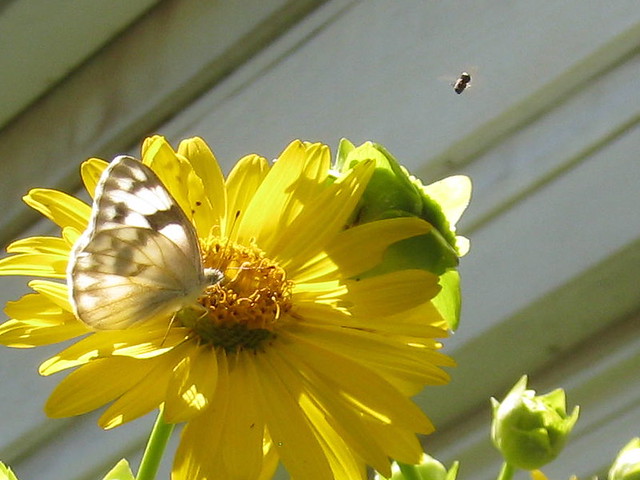
| Female Checkered White butterfly on cup plant as a native bee takes aim! AMcC |
August is an exciting time in a wildlife garden. My yellow composites are beginning to bloom—cup plant, prairie dock, golden glow, woodland sunflower, and brown-eyed Susan. Goldfinches add to the yellow garden as they harvest purple coneflower seeds for their nestlings. The males sing almost as much and as loudly as robins in May. Pollinators of every kind are busy all day long. All these species are on schedule, and then a surprise: a Checkered White butterfly! Checkered Whites are not rare, but they are new to my “yard list.”
You might not think a member of the family of “Whites” or Pierids would be eye-catching, but I think the female’s pattern is really appealing. I was thrilled with the new species, but I didn’t realize how uncommon this sighting was till I talked to my friend, Yvonne Homeyer. Yvonne writes the butterfly report for our local chapter of North American Butterfly Association and serves on NABA’s board of Directors. She pointed out that this year Checkered Whites have been seen in just a few gardens and not reported at all in natural areas.
I did a bit of checking on the abundance of Checkered Whites. In Brock & Kaufman’s Butterflies of North America, the map indicates that they are uncommon in my area (St. Louis County, MO). Glassberg’s Butterflies through Binoculars; The East says, “Abundance of this species greatly fluctuates.” Wagner, in Caterpillars of Eastern North America, says, “This species has declined precipitously over the east in my lifetime.”
Why this should be is unknown. Checkered White caterpillars can eat just about anything in the mustard/cabbage family (Brassicaceae), which includes plenty of native and non-native weeds as well as garden vegetables. I didn’t think I had any of the host plants in my yard, till I checked Denison’s Missouri Wildflowers. I have a small area of toothwort (Carmdamine), which I didn’t realize was in the mustard family. A plant they seem to use quite heavily is pepper grass, which is abundant in the nearby city property and college campus. Every yard seems to have another brassica, the invasive, non-native hairy bittercress.
I spent about 3 days trying to get photos. Monday, I saw a male Checkered White, but it had disappeared by the time I got my camera. Tuesday was a scorcher, 100° with high humidity. I ran out of the air-conditioned house with the camera as soon as I spotted it through the window. This butterfly was a very cooperative female, but the condensation on my lens made the images useless. Amazingly, I saw another female Checkered White on Wednesday and was able to get some decent shots, in spite of the fact that it didn’t linger long at a blossom. It’s really nice to study the photos later and see native bees and an Ailanthus Webworm moth in the frame.
I recognize the female butterfly by the checkered markings, especially on the hind wing. But if I were a Checkered White butterfly, according to the University of Florida’s Institute of Food and Agricultural Sciences, I’d look for a different “UV reflectivity.” I guess that would be pretty attractive too.
Seeing such a beautiful, pale butterfly kind of makes up for the wounds of reading that its preferred habitat includes “dry weedy areas” (Milleman, Mizzel, Jones on “Web Only Display of Miscellaneous Local Insects”) and—even worse—“disturbed open areas…(and) abandoned railway tracks” (Glassberg, 52). I don’t like to think of my front yard as “disturbed,” but it is interesting that I have only seen it in the front among cup plants and a number of species adapted to dry glades. So far, it has ignored my backyard of tall phlox, butterfly bush, and swamp milkweed.
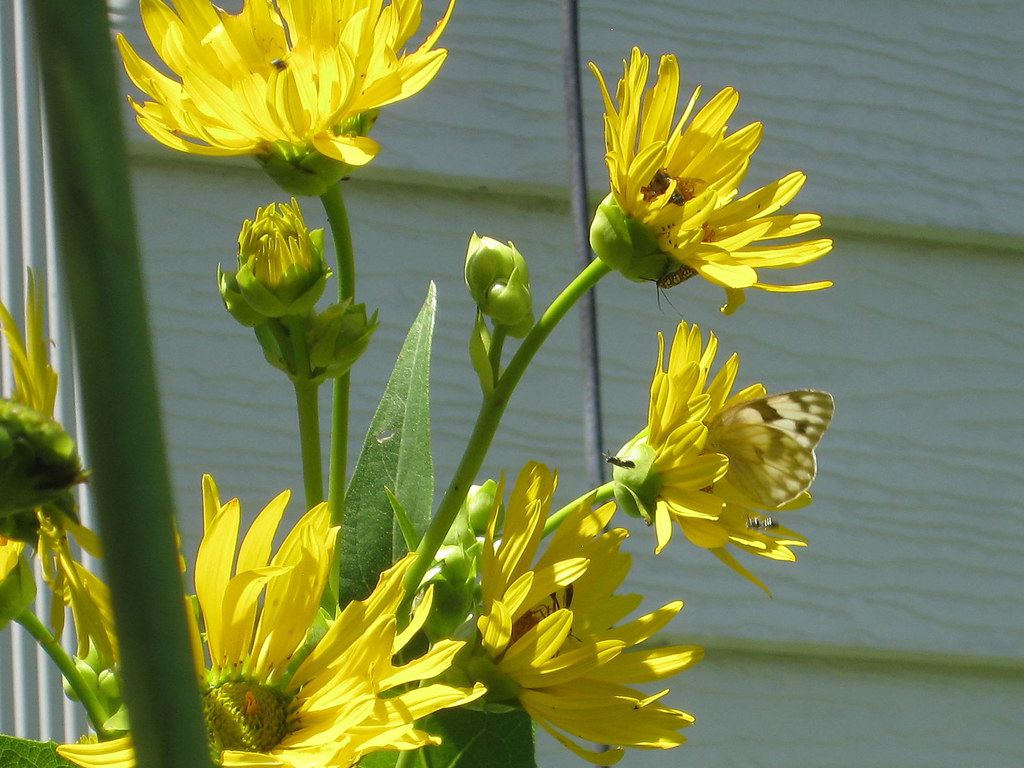 |
| Female Checkered White Butterfly shares Cup Plant with native bees and Ailanthus Webworm moth AMcC |
“The time has come,” the Walrus said,
“To talk of many things:
Of shoes—and ships—and sealing wax—
Of cabbages—and kings.”