Showing posts with label starling. Show all posts

Wednesday, December 29, 2010

Website Wednesday: Views of the Ock


View Otters 2010 in a larger map
40 years ago, Arthur C. Clarke predicted that data transfer would “bring the accumulated knowledge of the world to your fingertips.” Substantially, Clarke was correct, if only it could all be found. A year and a half ago it was estimated that there were something close to 110 million websites, and that’s just in the surface layer of the web that search engines survey. I throw my hat into the Internet search arena with “Website Wednesday!” Each Wednesday, I will try to find a site for the nature-lover that is useful, surprising, entertaining or just plain gorgeous. Let’s go to Views of the Ock for a start.
  
I enjoy reading blogs about travel to exotic places, about people who compete for the longest list of birds, but there’s a lot to be said for appreciating and adding to the understanding of your own back yard. Richard is a “back yard blogger” in Britain. The Ock is a tributary of the River Thames, which flows through the Richard’s neighborhood.
  
Just because the territory is limited doesn’t mean the subject is narrow. He covers a great variety of topics, all accompanied by beautiful, or sometimes interesting photos. Did you know there is a special word that means “otter poo”? Neither did I! You gotta love a guy who creates a Google map of otter spraint (seen above). He shares photos of tracks and signs he finds in monthly otter surveys of the Ock, as well as water vole surveys. There are lovely photos of the countryside as well as the town of Abington in snow. He explores an ancient beech forest, full of trees in fantastic shapes, rare insects and even a rare fungus. He studies cuckoo bumble bees, mushrooms, damselflies and moths.
  
I first became aware of Views of the Ock when Richard left a comment on my post about European Starlings and their behavior in flocks. Unbeknownst to me, he had written about Starling flocks some weeks earlier. My vocabulary expanded again, when I found there is a special word for startling flock: “murmuration.” And I have to say, I was thrilled when he included my post in his list of “favourite blog posts over the last 12 months.” Be sure to check out Views of the Ock as well as the other blogs he links to in his “Blog Roll Review of the Year.”

Sunday, December 19, 2010

Critical Mass of Starlings


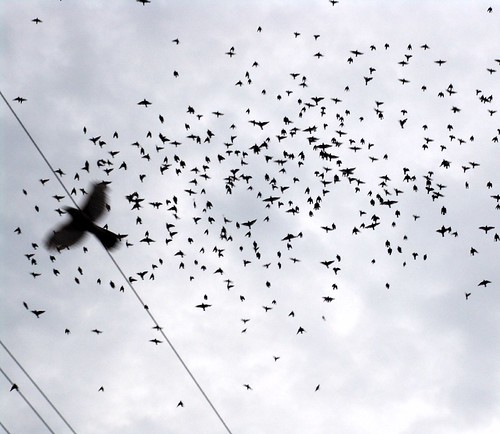
Birding while driving is never a good idea, but while flocks of starlings wheel and twist over the highway, I give them a quick glance. When the flock is behaving this way, I suspect there’s a hawk nearby. Here it is, a red-tail, high and outside. As I leave the highway, I see another flock gathering, preparing to roost in the neighborhood. Blocks away, I arrive at my destination, still hearing the cacophony of chatters and whistles.
At one point, some called European Starlings the most abundant bird in North America. It wasn’t always so. The Acclimatization Society of New York, NY, is responsible for turning them loose on this continent in 1890. Their stated goal was to introduce to North America all the birds mentioned by Shakespeare. Henry IV, Part I is play responsible. The character Hotspur, furious at the King over his refusal to ransom Hotspur’s brother-in-law Mortimer, raves that he’ll train a starling to say “Mortimer” and give it to the King as a gift. It’s a good idea. Starlings are great mimics, as befits a member of the myna family, as this video shows.
Cooper's Hawk with flock of European Starlings
photo by zen Sutherland
European Starlings are aggressive, noisy cavity nesters. In winter, they like to roost with about 999 of their closest pals. This has not endeared them to human communities. If you have to endure these gatherings, Cornell has some advice for you, and best of luck.
In 1960, Eastern Airlines flight 375 took off from Boston and struck a flock of starlings. The crash killed 62 people, the worst accident caused by bird strike on an aircraft. We blamed them too for the decline of bluebirds. Starlings have become of the most despised of all winged creatures—right up there with mosquitoes. Recent studies, however, have failed to turn up evidence that starlings have had any negative effect on any North American species, except the sapsucker.
Our relationship with the starling may be an uneasy one, but that doesn’t diminish our fascination with those amazing flocks. An article in Wired Science, June 2010 explains their behavior as “synchronized orientation…in a critical system,” meaning that members of the flock can communicate so well that if a single bird turns, the flock of thousands can follow. The behavior dazzles humans, as well as avian predators.