Showing posts with label texas. Show all posts

Sunday, April 10, 2011

A Walk on the Wild Side

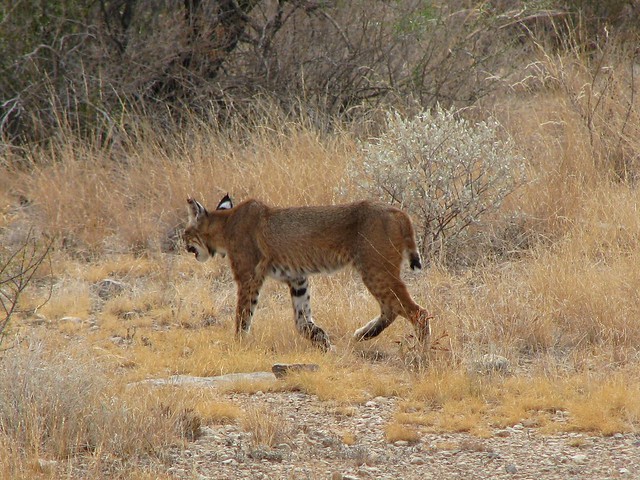
Texas bobcat, photo by Matthew High
And the winner is…
Patricia Lichen's cat! Patricia commented on my previous post about sounds in the night that she wasn't sure what made the strange call

but her cat seemed to!

Her cat was justifiably upset because the call we heard before dawn in the woods of Bentsen State Park was a bobcat (Lynx rufus texensis). Reportedly, bobcats are fairly common in this part of southeastern Texas, near the Rio Grande. According to Wild Mammals of Missouri, Schwartz and Schwartz, 2001, March is the peak of the breeding season in Missouri. This was March 16 in Texas, so it's possible that the Pauraque wasn't the only amorous singer on the prowl.

Bobcats have the widest range of all the wild cats of the Americas; from southern Canada—where they may compete with the larger Canada lynx (Lynx canadensis), down to central Mexico. That bobbed tail usually helps distinguish a bobcat from a feral domestic cat, but a bobcat is also about twice the size of a pet cat: 17-23 inches tall and between 11 and 30 pounds. According to Wikipedia's article, it is absent from most of Missouri, but Wild Mammals of Missouri, other sources and experience disagrees. I saw my first bobcat in Jefferson County, Missouri, crossing a country road at night. Friends in Dent Country tell me they see them on occasion. We didn't get to see this one, but I'm glad we heard him.

Thanks to Matthew High for his great photo of a bobcat seen in west Texas in September.

Tuesday, April 5, 2011

Mysterious Sounds of the Night…

Common Pauraque in Estero Llano Grande State Park, Hidalgo Co. Texas. Photo by David Marjamaa. Used by permission. 


Before dawn on March 16, we arrived at Bentsen-Rio Grande Valley State Park, outside of Mission, Texas. Our trip leader, Bill Rowe, had arranged for us to meet biologist and blogger Mary Gustafson at Bentsen to find the Common Pauraque. David Marjamaa, who took this great photo above, was part of the group too, along with me and five others. 
  
Nightjars are fascinating creatures, loaded with folklore, cryptic coloring, and evocative names. I presume that the name of the family, "Nightjar," comes from the fact that the typical calls of some species "jar the night," in the sense that the voice heard in the night is startling or has a disagreeable effect on the human listener. Of course, that "jar" is in the ear of the listener. I'm most familiar with one of Missouri's nightjars, the Whip-poor-will. Here's a beautiful recording by Lang Elliott. Its song is one of the most beautiful and haunting sounds in nature. A Whip-poor-will can belt out his clear, "whip poor WILL! whip poor WILL!" up to 400 times without a break. 

One breezy night in June, deep in the Ozark hills, a Whip-poor-will, perched on the ridge pole of our tent, came dangerously close to breaking that record. Tent-mate and guest blogger, J Bowen suggested solving the problem with a shotgun. I pretty much think that would be jarring in the night too, J! 

But I digress. We are talking about a different nightjar, the Common Pauraque. We walked down the road in the dark, hearing the "Quawk!" of Black-crowned Night-Herons amid the sounds of unfamiliar frogs and insects to me. First we strained to hear a distant Pauraque, then a bird answered, then many more. Mary used her industrial-strength flashlight to find the birds. We saw several near the road, making strange hops and short flights like long-tailed moths. Their eyes reflected the light of the beacon like torches.

No wonder these strange birds of the night have acquired so many tales, superstitions, and names. Their call sounds nothing like the English pronunciation of the name, "pah-RAH-kee." I surmised that it had originated from the Spanish, "¿Para que?"—"What for?" But it really doesn't sound like that either. Arthur Grosset pointed me toward an article from the Auk, 1948, that explains that the Mexican name for this bird in nearby Tamualipas is "Parruaca," pronounced "pahrrr-WAH-cuh," which more closely resembles the call. Evidently the word "Pauraque" is an incorrect English transcription. Pauraque's range just barely makes it into south Texas. It's found along both coasts of Central America, on in to northern South America, south to the northern edge of Argentina. In Central America, it's known as "Caballero de la Noche ("Gentleman of the Night") ; apparently, "el Caballero" is believed to be the Don Juan of birds. Nightjars are members of the family known as Goatsuckers, based on the ancient belief that the birds drank milk from goats. A pretty bizarre myth, but I guess those goats kicked up insects that the birds found tasty, and goat herders, frightened by dark, flying shapes in the night, assumed the worst. The scientific name for the family, Caprimulgidae, means the same thing in Latin. Of course, Spanish for Goatsucker would be Chupacabra, but that's another story. 
 
We heard another sound; one we couldn't identify at the time. Imagine some kind of hoarse, nasal baritone saying, ―Wowwwww! oo Wowww! It sounded a lot like the sound file below. What do you think it is? 

Tuesday, March 29, 2011

Urban Birding, Texas Style

Like puppies, wild parrots seem to make everyone smile. On a recent trip to south Texas, our trip leader, Bill, headed toward a couple of addresses in McAllen that offered some great urban birding. The first was in a residential neighborhood. A lady on her front porch began yelling to us as soon as our big van pulled up. I can certainly understand why homeowners would feel uncomfortable when strangers with binoculars pull up to your house. We yelled back, "We're just looking at birds!" but we weren't listening—she was saying, "Come on into my driveway!" When we finally heard her welcome, we stepped on over and got a great view of 5 Red-crowned Parrots screeching in a palm tree.

The welcoming attitude was more surprising to me than the parrots. Most birders are used to wariness if not hostility from residents. I've had people call the police on me during Christmas Counts. Birding is big business in Texas—I knew that, but I just didn't know how supportive the average person is in south Texas. Impressive!

Our next stop was a strip mall on 10th Street. Around sunset, we waited by the huge fountain in front of Lowe's. The parking lot was full of cars with plates from Iowa, Wisconsin, Ontario—everyone waiting for the Green Parakeets. Most didn't have binoculars, but as I say, everyone loves wild parrots, not just birders. Suddenly with great fanfare and squeaky chattering, a flock of 500 Green Parakeets jostled for position on the overhead wires. After checking the scene, they flew over to the fountain and began to bathe. A few moments later, a Cooper's Hawk streaked in, chasing the parakeets first low, then high over the roofs. Cooper's Hawks really love wild parrots! Most of the non-birders left, but it didn't take long for the flock to regroup and circle back to the fountain. Urban birding at its best!