Showing posts with label Busch. Show all posts

Sunday, March 2, 2014

Weldon Spring MO Christmas Bird Count 2014

Eastern Phoebe, photo by John Benson, from Wikipedia

Thanks to all who helped with the Weldon Spring Christmas Bird Count, Jan. 4, 2014! We had 18 participants, 63 species, 8774 birds, and some really decent weather for the season. The Weldon Spring Count (also known as the "Busch count," officially labeled by National Audubon Society as "MOWS") has been held every year since 1952, sponsored by Webster Groves Nature Study Society. The count, like all Christmas Counts, is held between Dec. 14, 2013, and Jan. 4, 2014, and covers a 15-mile-diameter circle. In our case, the circle is centered on the town of Weldon Spring in St. Charles County, Missouri. It includes some of the best land-birding in the greater St. Louis area: Busch Memorial Conservation Area and, bordering the Missouri River,  Weldon Spring Conservation Area.

Only one species had an unusually high count this year: Red-shouldered Hawks totaled 22, topping the previous high of 18 in 2008. Out of 62 counts, Red-shouldered Hawk has occurred only 28 times.

Several species were unusually low. Only 2 Red-headed Woodpeckers were reported. The previous low was 1 in 1964, occurring 51 out of the 62 counts. Red-headed Woodpecker is a "species of concern;" one of 117 species on the "yellow list" in the 2007 WatchList. Only 1 Ruby-crown Kinglet was reported—previous low of 1 in 2012. Only 2 Cedar Waxwings and 2 Purple Finches were seen. The low for Purple Finch was a single bird in 2012. The House Sparrow count was also low—only 6. (Most of us feel that’s a good thing.) The all-time low for House Sparrow on our count was 5 in 2007.

A highlights for me were Hermit Thrush and Fox Sparrow, found along a seldom-used road in the north-east section of Busch. Another Hermit Thrush was found in Babler State Park. Hermit Thrushes are listed as "rare" in winter, and although the Fox Sparrow is considered "uncommon," but not rare, I've missed it a number of times on the count.

Our rock star was an Eastern Phoebe, found independently in the Weldon Spring area by two different groups. This is only the third occurrence out of 62 counts—one in 1986, one in 2005. Birds of the St. Louis Area: Where and When to Find Them describes the Eastern Phoebe as "hardiest of the flycatchers" on our area. The complete report is available to download at the bottom of the Birding page of the Webster Groves Nature Study Society's website. Happy birding in 2014!

Saturday, February 11, 2012

The Not-So-Common Common Ground Dove of Weldon Spring CBC


Truman was President, Muddy Waters sang "Rollin' Stone," Lefty Frizzell sang "If You've Got the Money," "Sunset Boulevard" took the Golden Globe, and the Webster Groves Nature Study Society  counted birds in the cold December winds at Busch Wildlife Conservation Area near Weldon Spring, Missouri, Dec. 29, 1950.

Every year since then, Webster Groves Nature Study Society, better known as WGNSS--pronounced, "Wig-ness"--has participated in the National Audubon Society's Christmas Bird Count (officially,  MOWS, "Missouri-Weldon Spring") by surveying the area we call "Busch." There are about 11 square miles to survey, including 3,000 acres of forest, 32 artificial lakes, and 100 bunkers once used for storing TNT during WW2. Throw in plenty of gravel roads, a thousand acres of grassland plus 200 acres of restored prairie and the same amount of old fields, and you've got a diverse and accessible birding area--all within 50 minutes' drive from the St. Louis Arch.The plan in a survey such as this is to count each species of bird seen, as well the number of individuals. We divide into territories, and take precautions not to count an individual more than once. For example, I might spot 3 Blue Jays in the tall oak by the creek. Some time later I drive past the same spot and see 5 Blue Jays. I record an additional 2 birds, not 5. On the way to my territory, I see a Bald Eagle overhead. I don't record that bird, but I do notify the count compiler in case the team in that area missed it. If so, Bald Eagle will be added.

This year we had 11 participants who counted 2,441 birds of 49 species, including one that has never been recorded on the Weldon Spring count, the Common Ground-Dove. For that matter, it's likely the only individual of its species ever to have been recorded on a Christmas Count in Missouri. It's a bird that's normally found in the extreme southeast and southwestern US and coastal Mexico. Records show that the species has never been recorded in St. Charles County. Thanks to Josh Uffman for making this information available online.

Our little dove--smallest in the US; half the length of the abundant Mourning Dove--was very kind to us, considering all the factors. It had been dallying in the fields of Busch for weeks, putting up with hunters and as well as unruly birders. It was our target bird, but rabbit hunters with their noisy beagles caused it to lie low. Fortunately, some of the group were very patient, including Bob Nieman who snapped this picture just as the sun set. Bob was visiting the area for the holidays--thanks for your help in making this a memorable count!

On my route, I was delighted to witness a  behavior I'd never seen before. I paused along the road where fields gave way to forest. American Robins and Cedar Waxwings crossed back and forth, feeding on and the waxy blue berries (really cones) of Eastern Red Cedar and the abundant red berries of invasive bush honeysuckle. Amidst the busy, noisy robins, two sleek waxwings rested on a branch. One passed a berry to the other's beak, who then passed it back. They did this for several minutes. Male and female Cedar Waxwings look identical, but the two were probably a pair engaged in courtship behavior (A Guide to Bird Behavior, Vol. II, by Don and Lillian Stokes, 1983).

Wednesday, December 21, 2011

Christmas Bird Counts on TV

I had a chance to talk about Christmas Bird Counts on local TV today. Dan Zarlenga, of Missouri Department of Conservation, set up the interview with John Fuller of KPLR-TV Channel 11 in Saint Louis MO. I had a blast! The broadcasters and staff could not have been nicer. I hope it will motivate a few more people to volunteer their time with Christmas Bird Counts.

 
More posts about Christmas Bird Counts:
 
CBC Chartbuster

Register Online for CBC
Weldon Spring CBC
  
Bird Encounters

Saturday, June 18, 2011

Tick Protected and Trendy

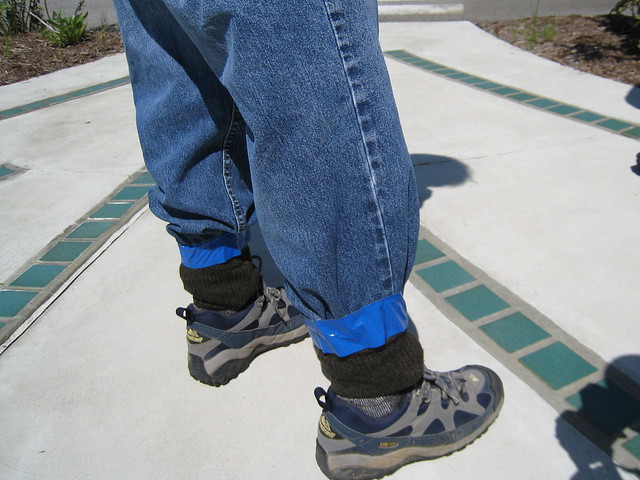
Modeling the latest in tick protection. Stylin', ain't I?
In June, 2008, my furry friend, Rosie, and I set out to do our breeding bird survey at Busch Memorial Conservation Area. It's the same territory I still visit and wrote about in my 2 most recent posts. Lake 22 always delivers. That day, an adult and juvenile Orchard Oriole showed off near their nest. I spotted a Hairy Woodpecker and no less than 4 Pileated Woodpeckers! We had some tough going as we headed east from the small lake toward the creek. The gullies had washed even deeper than the year before and the grass was already above my shoulders. Suddenly Rosie started fighting me for the leash. Usually she was more than eager to head down a trail, but perhaps this terrain was too for a 14-year-old Cairn terrier, so I picked her up. I carried her for a short distance, but the trail was getting deeper and more slippery, so we headed back to the car and on to the next lake.

Once we were in the car I noticed that she had several tick on her head and neck, some already attached. I knew we'd have a long session brushing, combing, and tweezing ticks from her thick fur when I got home. I had always been a bit casual about ticks. I was annoyed and disgusted with the itchy red welts left after a bite, but I never freaked out or stayed home to avoid them. Other birders wore long pants, but in the heat, the comfort of shorts was worth the risk of a bite. Sometimes I'd use bug spray.

I headed for the shower when I got home, which is when I discovered that we had gone through a huge swarm of ticks. There were dozens on me! Rosie must have had a hundred. I don't know how long I spent removing them from her, and in spite of being rewarded with treats for tolerating the process, she was not happy. I checked her again the next day and found more. Was this what she was trying to tell me back at Lake 22?

About week later I spiked a fever and called the doctor's office. The first thing they asked was, "Have you been exposed to ticks recently?" That gave me a pretty bad feeling. The doc gave me a prescription for an antibiotic and the fever soon disappeared. Unfortunately, the fever was only a small part of the illness. I was extremely tired. Each morning I'd get up after sleeping 11 hours or so, I'd drink a whole pot of coffee, and then I'd need to lie down to rest. I was taking 2 graduate credit classes at the time, so I'd drag myself over to the desk to work. By 5 PM, I'd be through for the day.

All my tests came back negative for 3 tick-borne diseases in my area of the Midwest: Rocky Mountain Spotted Tick Fever, Lyme disesase, and Ehrlichiosis. At the time, my doctor said that the tests were not too reliable, and he believed that I had one—or more! In spite of treatment, my extreme fatigue continued throughout the summer. The garden was overrun with weeds.

In September, 3 months after the tick bite, I was determined to go to my camp reunion. I told my friends that I had to be back about no later than 9 PM. I had a great time of course, and got home at 9:30 PM. Normally the last thing I do before bed is check that the doors are locked.

When I awoke the next morning, I found that not only had I not locked the door, I didn't even shut it. It was another 3 months before my sleep pattern returned to normal.

Later in 2009, Rosie's blood work showed that she had contracted Ehrlichiosis at some point. It was just 2 weeks ago though that I had some tests, and when my new doctor called with the results, she asked, "When did you have Ehrlichiosis?"

My bout with the disease was debilitating and not at all good for my garden, but I was lucky. Tragically, this week a healthy, middle-aged local woman died from a tick-borne illness. Another St. Louisan died in from Ehrlichiosis in June, 2009.

Tick-borne illnesses are scary, but I'm not going to quit enjoying the outdoors. Here are some tips for protecting yourself from tick exposure:

  • Pull your socks up onto the outside of your pant legs and wrap with duct tape. Ya gotta admit—it's a look!
  • Use bug spray with DEET on clothing and exposed skin. Don't forget to spray the dog!
  • Spray with permethrin on clothing. I spray permethrin on my jeans the night before a birding trip.
  • As soon as you return home from the woods and fields, put all clothing in the washer and dryer, check for ticks, and shower. Fortunately, it takes about 24 hours before an attached tick can transmit any pathogens.
  • Get rid of that invasive bush honeysuckle! Scientists from Washington University in St. Louis did experiments at the very same Busch Conservation Area, and found a connection between the abundance of bush honeysuckle, concentrated deer populations, and high density of disease-carrying ticks. Just another reason we should care about the environment!


Wednesday, June 15, 2011

Songs of Summer and Scarlet

On June 11 and 12 I did more breeding bird surveys at Busch Memorial Conservation Area in St. Charles Co., Missouri, with my friend Kevin Renick. We didn't see the numbers of butterflies I mentioned in my previous post, but we saw and heard some great birds, including two not commonly seen: a Blue Grosbeak along the dam at Lake 37, and a brief view of a Blue-winged Warbler at the same spot.

Kevin is a singer-songwriter as well as a whiz at birding; his musical abilities extend into his nature hobby. What impressed me most this weekend was Kevin's ability to consistently tell the difference between the songs of the Scarlet Tanager and the Summer Tanager. Both birds nest here in oak-hickory forests of Missouri, and although their calls are very different, their songs are very much alike. I asked him to summarize the differences between the two songs. I'm accompanying Kevin's summary with video from the incomparable recordist of nature sounds, Lang Elliot.


Kevin's hints: "The Scarlet Tanager's song has sometimes been described as being like a 'robin with a sore throat.' It's a melodic warble, but it has a prominent screechy or raspy sound on one or two notes of its phrasing. The Summer Tanager on the other hand, is not raspy at all. It's a clear, sweet warble, a bit gentler than the Scarlet."


If you hear the bird's call—as opposed to its song—you've got it made. The Summer's call begins this video: "Picky-tucky-tuck." The Scarlet Tanager call, heard in the middle of his video, is "Chick-burrr. Chick-burrrr." David Sibley, author of The Sibley Guide to Birds, says that the Summer's song includes, "brief but distinct pauses between phrases." The Scarlet's by contrast is made up of a "fairly rapid, continuous series."

Thanks to Kevin Renick for his song analysis and to Lang Elliot for making his videos available.

Monday, June 13, 2011

Hits and Misses on the Breeding Bird Survey

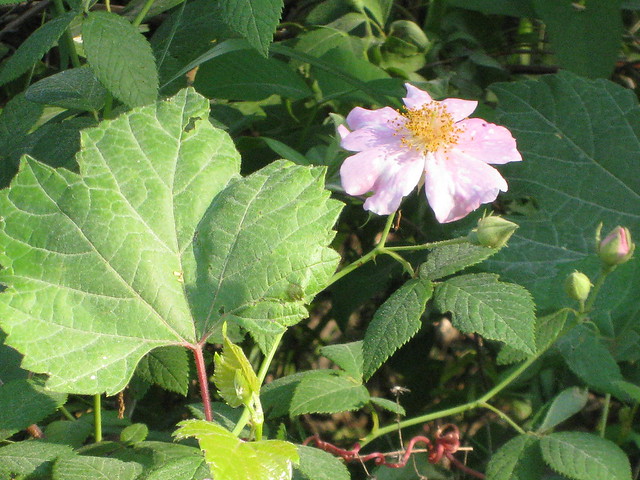
Wild Rose
I got a chance to do a bird surveys this week at one of my favorite places, Busch Memorial Conservation Area, in St. Charles County, Missouri. Busch is a mixed use area, with many artificial lakes, stocked with fish, and some fields rented to farmers. It's also the area of a long-running Christmas Count. On Thursday, July 9, I birded with my cousin, Ginny. We started birding together back before the Beatles appeared in Ed Sullivan. Back in the day, we shared field glasses, the Zim guide, and recorded our list on a Big Chief notebook. As we walked through the neighborhood and nearby cemetery, our list looked like this:

cardinal
starling
English sparrow
robin
blue jay

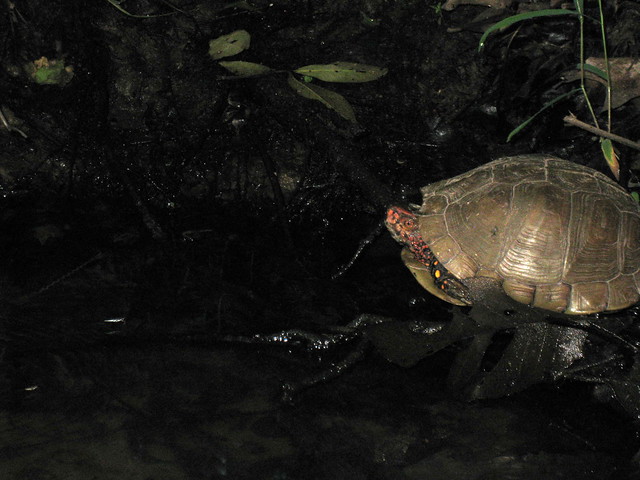
Our list was a bit longer this year, but it was hazy, hot, and humid even at 6:30 AM. The heat kept many of the birds from singing, and if you're going to bird when the leaves are full-sized, you need those birds to sing. We started at Lake 22. This small lake has been part of my territory for 8 years. Some dead trees stood in the lake and Tree Swallows nested there. Each year the snags decayed, and this year, none were left. Not a swallow was seen. A deeply eroded road leads down to a beautiful creek where I've recorded Kentucky Warbler and Black-and-White Warblers, but the area was fenced off, presumably because of an erosion control project. A half-dead elm near the parking area hosted an Orchard Oriole nest, but the tree had been removed and the orioles were missing. We did find this Three-Toed Box Turtle in a wet area on the far side of the lake. His red eye and face markings show that he's a male.


The bird of the day was the Acadian Flycatcher. It's a common bird in the woodlands in our area, one of a complex of similar-looking small flycatchers in the genus Empidonax. You hear 10 for every one you see. Near Lake 23, one perched on a thin branch over the road, allowing us a good long look as he surveyed his domain. Another surprise was a female Wood Duck. Not an uncommon bird, but it can be difficult to find. I don't think I've ever recorded one on the summer bird survey before.

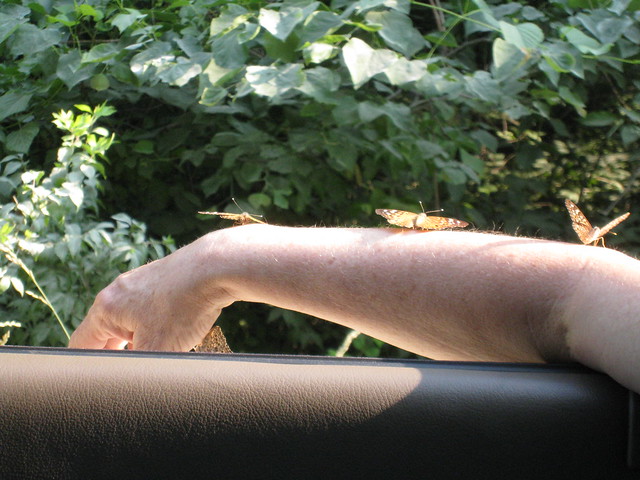
If the birds were a bit shy, the butterflies were not. Thousands upon thousands of fresh-looking Hackberry Emperor butterflies (Asterocampa celtis) dotted the gravel roads for several miles. Hackberries are known for the fondness for landing on humans, lapping up the salt in sweat. They seemed to enjoy Ginny's arm:


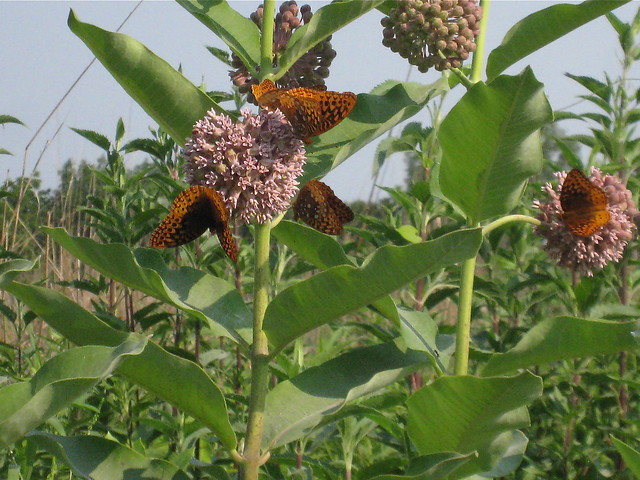
Great Spangled Fritallaries (Speyeria cybele) were out in numbers too. We saw them everywhere we found Common Milkweed (Asclepias syriaca) or Purple Milkweed (A. purpurascens).

Saturday, January 8, 2011

Bird Encounters of the Christmas Count Kind


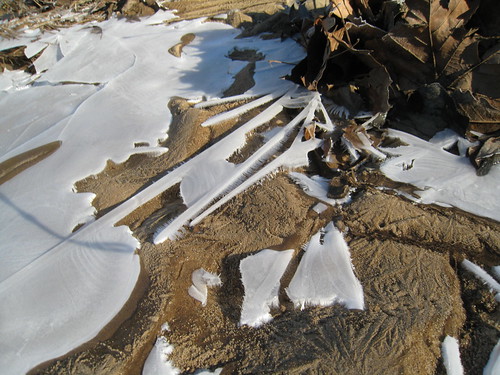
Huge ice crystals mark the sand in Dardenne Creek AMcC
We began our Christmas Bird Count by looking for the Red-headed Woodpecker, near what’s labeled as “Shorebird Area.” This low spot below the dam for Busch Conservation Area’s largest lake, Lake 33, is reliable for Red-headeds, a species that has declined 4.6% per year since 1980, according to National Audubon Society. They gave us quite a show, sparring with Blue Jays, and chattering to each other on a snag that looked like Swiss cheese.
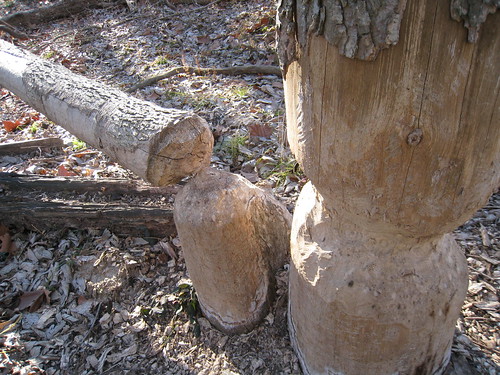
beaver cuts along Dardenne Creek AMcC
There was no open water at “Shorebird,” so after a lap around fields that sparkled with frost, we headed down to Dardenne Creek. The sand bars were puddled with white ice, the kind that we liked to smash when we were kids. Ripples and huge crystals of ice marked the sand. A small flock of Swamp Sparrows and White-throats hopped away.
On the high bank of Dardenne we saw the work of an ambitious beaver. The beaver cuts looked old, but it’s interesting that Red-headed Woodpeckers are associated with beaver. The woodpeckers claim the trees killed when flooded by beaver ponds, and exploit the edge habitat created as beavers fell trees.
After lunch, we headed down a disused service road, toward a corner of large white pines. White pine is not native to our area; possibly this stand was planted for lumber. My friend Connie was determined we’d find a Red-breasted Nuthatch in the pines. White-breasted Nuthatches are expectable year-round residents at Busch, but Birds of the St. Louis Area: Where and When to Find Them lists Red-breasted as uncommon to casual (that is, beyond rare) in January. In the pine grove, she produced her iPhone, with not one, but three different apps for bird songs, and played a recording of the Red-breasted Nuthatch. Then we paused—silence. At least 30 seconds ticked by, then, an answer! There must have been some pretty bad grammar in that recording, because this Red-breasted Nuthatch was outraged! He scolded us till we fled, not wanting to stress the little guy beyond endurance.
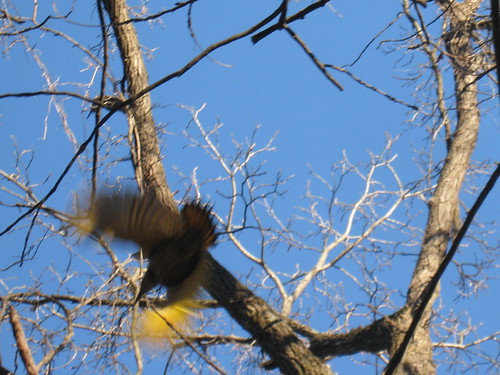
Northern Flicker in the mixed species flock AMcC
We crossed the road and entered the trailless area that will now be known as “The Enchanted Forest. Within a few minutes, we found ourselves surrounded by birds: three calling Yellow-rumped (Myrtle) Warblers, a Northern Flicker, and another Red-breasted Nuthatch—all in the same tree! Now a Brown Creeper joined the group, tugging itself up a tree trunk, where Blue Jays screeched. Not far beyond, a Pileated Woodpecker answered the jays. In the same tree, a Hairy Woodpecker minded his own business. The sun peeked briefly from behind the clouds, and a male Golden-crowned Kinglet snatched those rays to light his golden-orange crest. Chickadees and a dozen American Robins called all around us. As we moved through the flock, stumbling over an old wire fence as we looked skyward, they vanished. Not even a White-throat chirped as we walked back to the car.