Showing posts with label citizen science. Show all posts

Wednesday, July 18, 2012

How to report a butterfly

male Funereal Duskywing, photo by Bill Bouton
 
It's hard to imagine a more dramatic name than the Funereal Duskywing's (Erynnis funeralis). The name conjures up an image of a dreary black butterfly, possibly one whose preferred habitat is a graveyard. 
 
But let's be fair. This little guy is certainly not as dark as, say, a black swallowtail or pipevine swallowtail

Identifying the funereal is not as hard as identifying most Duskywing butterflies. It's hind wing shows a white fringe that's absolutely cheerful. No other butterfly in my area has this characteristic. I managed to get a photo that was good enough for identification, though not as gorgeous as the above photo by Bill Bouton, who shared his through Creative Commons.

I had a Funereal in the backyard a few years ago, before I knew that it was a rare species for my area. In the world of birders and butterfliers, "rare" means excitement. My mood was anything but mournful when I spotted it this time. The range map in Jeffrey Glassberg's Butterflies through Binoculars: The East shows the nearest population in central Kansas--500 miles or so west of my yard in Saint Louis Missouri. In Butterflies of North America, Kenn Kaufman and Jim Brock show it as uncommon as close as Rolla, MO--less than 100 miles from me.

I looked it up on Butterflies and Moths of North America. They include a map of reports, which showed a sighting as far north as the Illinois Wisconsin border. I decided to submit my report also. Their process is a little more rigorous and some citizen science websites. I'll go through the steps.

Step 1: In the menu of the website, click on "get involved." 
Step 2: Get a free account with Butterflies and Moths of North America (BAMONA for short). 
Step 3: Fill out the submission form online. You'll need to submit a photo of your butterfly or moth, and the photo needs to be cropped so that the insect fills the frame.  Stay with me here. This photo editing could be an obstacle but it doesn't need to be. I used to edit my photos on the photo-sharing website Flickr, with a free website/tool called Picnik. Picnik is no longer partnered with Flickr. They moved to Google+. Editing is still available on Flickr however, in a new tool called Aviary. Just use the action menu on the Flickr photo you want to edit. Of course you can also crop your photos with iPhoto or Google's Picasa--which looks a lot like Picnik. But wait! There's more. BAMONA also would like you to add your user name as a "watermark" to your photo. That's a lot easier than it sounds. Just use the text tool in the editing program you're using. Mine looked like this when I finished editing.
To complete the report you'll need to indicate on the map where the butterfly was seen. Just enter the address in the address box then check to see that the point on the map goes just where you want it. Finish by adding the state and county where you saw the butterfly or moth. 
Step 4: Wait anxiously for a reply from an expert in your region. The expert hopefully will confirm your report. My region's expert turned out to be a friend of mine, the chair of the entomology group of Webster Groves Nature Study Society.
Optional step 5: Send an email offering to let them use your photo on the website. The full instructions are on BAMONA.
 
 My thanks to you for staying with my blog. Now that I've cleared up the spam that led to my site being listed as "suspicious," I thought I'd better get cracking and write a post!
You might also like:
Emma Peel as a Butterfly

Of Cabbages & Checkered Whites

Saturday, February 11, 2012

The Not-So-Common Common Ground Dove of Weldon Spring CBC


Truman was President, Muddy Waters sang "Rollin' Stone," Lefty Frizzell sang "If You've Got the Money," "Sunset Boulevard" took the Golden Globe, and the Webster Groves Nature Study Society  counted birds in the cold December winds at Busch Wildlife Conservation Area near Weldon Spring, Missouri, Dec. 29, 1950.

Every year since then, Webster Groves Nature Study Society, better known as WGNSS--pronounced, "Wig-ness"--has participated in the National Audubon Society's Christmas Bird Count (officially,  MOWS, "Missouri-Weldon Spring") by surveying the area we call "Busch." There are about 11 square miles to survey, including 3,000 acres of forest, 32 artificial lakes, and 100 bunkers once used for storing TNT during WW2. Throw in plenty of gravel roads, a thousand acres of grassland plus 200 acres of restored prairie and the same amount of old fields, and you've got a diverse and accessible birding area--all within 50 minutes' drive from the St. Louis Arch.The plan in a survey such as this is to count each species of bird seen, as well the number of individuals. We divide into territories, and take precautions not to count an individual more than once. For example, I might spot 3 Blue Jays in the tall oak by the creek. Some time later I drive past the same spot and see 5 Blue Jays. I record an additional 2 birds, not 5. On the way to my territory, I see a Bald Eagle overhead. I don't record that bird, but I do notify the count compiler in case the team in that area missed it. If so, Bald Eagle will be added.

This year we had 11 participants who counted 2,441 birds of 49 species, including one that has never been recorded on the Weldon Spring count, the Common Ground-Dove. For that matter, it's likely the only individual of its species ever to have been recorded on a Christmas Count in Missouri. It's a bird that's normally found in the extreme southeast and southwestern US and coastal Mexico. Records show that the species has never been recorded in St. Charles County. Thanks to Josh Uffman for making this information available online.

Our little dove--smallest in the US; half the length of the abundant Mourning Dove--was very kind to us, considering all the factors. It had been dallying in the fields of Busch for weeks, putting up with hunters and as well as unruly birders. It was our target bird, but rabbit hunters with their noisy beagles caused it to lie low. Fortunately, some of the group were very patient, including Bob Nieman who snapped this picture just as the sun set. Bob was visiting the area for the holidays--thanks for your help in making this a memorable count!

On my route, I was delighted to witness a  behavior I'd never seen before. I paused along the road where fields gave way to forest. American Robins and Cedar Waxwings crossed back and forth, feeding on and the waxy blue berries (really cones) of Eastern Red Cedar and the abundant red berries of invasive bush honeysuckle. Amidst the busy, noisy robins, two sleek waxwings rested on a branch. One passed a berry to the other's beak, who then passed it back. They did this for several minutes. Male and female Cedar Waxwings look identical, but the two were probably a pair engaged in courtship behavior (A Guide to Bird Behavior, Vol. II, by Don and Lillian Stokes, 1983).

Wednesday, December 21, 2011

Christmas Bird Counts on TV

I had a chance to talk about Christmas Bird Counts on local TV today. Dan Zarlenga, of Missouri Department of Conservation, set up the interview with John Fuller of KPLR-TV Channel 11 in Saint Louis MO. I had a blast! The broadcasters and staff could not have been nicer. I hope it will motivate a few more people to volunteer their time with Christmas Bird Counts.

 
More posts about Christmas Bird Counts:
 
CBC Chartbuster

Register Online for CBC
Weldon Spring CBC
  
Bird Encounters

Friday, December 31, 2010

How to register for a Christmas Bird Count Online

Registering online for a Christmas Bird count is easy!
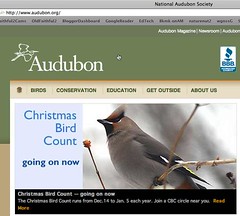
Go to National Audubon Society's page. Click "Christmas Bird count."

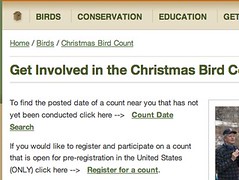
Click on "Register for a count.
Use your existing account, or get a free one.
You will need to know the code for the count. For example, the Weldon Spring Count in Missouri is "MOWS." The Confluence Count in Missouri is "MOCF." You can find one near you here.
Click "Sign up here."

Step 5: Add your information and pay the $5 fee with a credit card. Click "submit." It's just that easy!