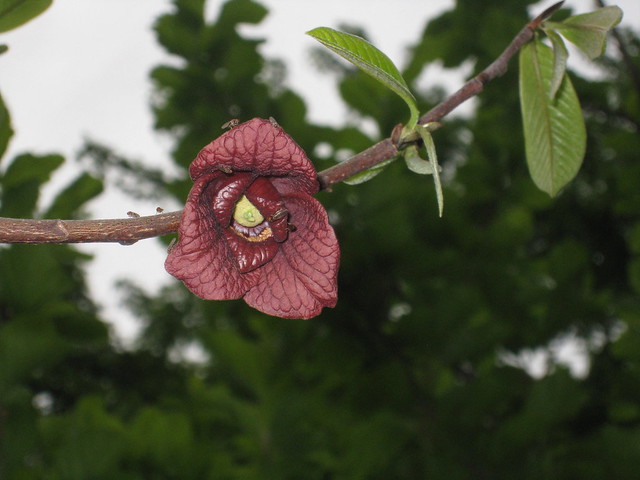
With large, tropical-looking leaves, and a dark, mysterious flower, the Pawpaw (Asimina triloba) is the kind of tree Tennessee Williams would have planted next to the magnolias, if he had been into gardening. The blooms look like a dark red bell hanging below the branch. The dark color makes them less than showy than a Flowering Dogwood, but attractive, especially when backlit by the afternoon sun. It’s the classic Missouri bottomland tree, but when I mention that it’s pollinated by flies because the bloom looks like roadkilll—well, it turns people off.
I wrote about Pawpaw’s relationships with butterflies and moths last July. Still, people imagine, as I did, a Pawpaw in bloom, swarming with big hairy flies and a putrid odor wafting on the wind. Nothing could be farther from the truth. I took the photo above on April 20, but when I downloaded it from the camera and the photo filled the screen, I saw the flies for the first time. The flower was about 2 inches across at its widest point. I would have had to wear my reading glasses to see the flies.
Pawpaws don’t make it easy on a pollinator. To bear fruit, the bloom needs pollen from an unrelated Pawpaw. What’s more, process depends on a pollinator that is believed to be inefficient, sloppy, and promiscuous—that is, it’s like to visit many things other than a bloom of a Pawpaw.
 |
| Gosh, the flower looks alarmingly fleshy in this extreme crop! Those flies look pretty scary too, but the red eyes in the photo are caused by the flash. |
Ted MacRae at Beetles in the Bush wrote about Pawpaws last May. In comments, James Trager, entomologist and restoration biologist at Shaw Nature Reserve, wrote that the tree is likely pollinated by fungus gnats. Fungus gnats are important pollinators, but the critters in my photo don’t have the comparatively long legs I associate with gnats.
I posted my photo on Bug Guide to ask for some ID help. One person suggested that they could be lesser dung flies. I estimated that the fly was 2 mm long or less—about the right size for dung fly family (Sphaeroceridae). The Wikipedia article states that dung fly larvae eat fungus or bacteria on rotting vegetation. Another user on Bug Guide suggested that because the blossoms are stinky, they must be some type of carrion fly. That brings us to the next question, what does a Pawpaw blossom smell like?
I headed out to the tree again and got up close and personal with the flower. It didn’t smell like roadkill, or dung—it had just the faintest odor of yeast. I could only detect the scent when my nose touched the bloom. Of course, yeast is a fungus, so fungus gnats and lots of other decomposers should find the fragrance attractive. But why be shy about the aroma if the plant really wants to be pollinated?
I have some ideas about that. First, just because the odor is hard for me to detect doesn’t mean that it’s hard for insects to find. Although I had been thinking that there was only one specialized organism that pollinated Pawpaws, I found this statement in a 2001 article in Ecology and Society by Carol Ann Kearns: "Many species of flies are generalists that visit multiple plant species." There are probably a number of different fly families that offer their pollination services to Pawpaw, though the flies don't seem to get any reward.
Second, it's possible Pawpaw is a bit conflicted about this whole fruiting process. According to California Rare Fruit Growers, because each bloom has more than one ovary, "a single flower can produce multiple fruits." Add to that this advice to growers resorting to hand pollination, from a 1990 article from


