Showing posts with label pipevine. Show all posts

Tuesday, July 12, 2011

Fruits of Summer


Indian Cherry, Rhamnus caroliniana, is a shrub or small tree of dry, rocky glades, but it's also found near streams. It has a patchy distribution, show in the US Geological Survey map below. In Missouri, it's found south of the Missouri River, mostly in the Ozarks.
Range of Indian Cherry, USGS

The photo above was taken just a week ago. Now some of the fruit is beginning to turn red. The "Indian" part of it's name may be related to it medicinal use by Native Americans. According to Don Kurz in Trees of Missouri, they used it to induce vomiting. It's surprising how many plants were used as emetics in traditional medicine. I really don't get that.

Indian Cherry is also known as Carolina Buckthorn, even though it has no thorns. Wikipedia says its fruit ripens in summer, Dave Tylka, in Native Landscaping for Wildlife and People, says fall. This is the first time my little tree has fruit, so I'll let you know.


Pipevine fruit

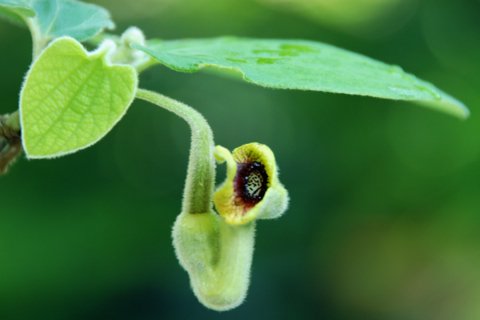
Here's a mysterious fruit! My pipevine, Dutchman’s Pipe, Aristolochia macrophylla, is 5 or 6 years old and it's also bearing fruit for the first time. I haven't been able to find anything about the fruit, except that like the rest of the plant, the fruit is poisonous. Pipevine blossoms are pollinated by tiny flies that get temporarily trapped in the weird little flower, so who knows? Perhaps some of the flies that pollinated my pawpaw tree performed the same service for the pipevine. Of course, I grow pipevine for the butterflies it attracts, not the poisonous products. I've written about the vine and the fascinating butterfly in earlier posts.

But wait! there's more! Not only have my Pawpaw (see previous post), Indian Cherry, and Dutchman's Pipevine borne fruit for the first time this year, my Golden Currant, Ribes odoratumhas joined in! There are four members of the Ribes genus native to Missouri, two gooseberries and two currants, but unlike its cousins, this shrub has no thorns. I wrote about Golden Currant's pollinators and fragrance this spring. It's fruit is ripe right now.
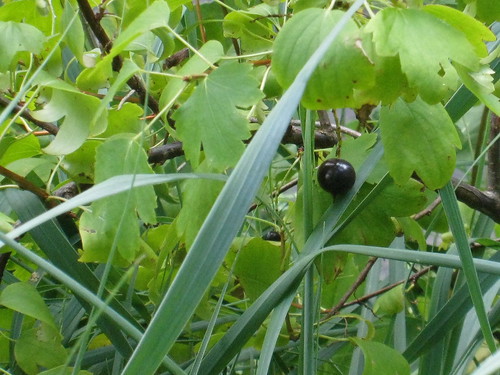
Golden Currant

Productivity in my small native plant landscape is pretty gratifying—a bit like my blog, which is now 1 year old! 


Sunday, July 25, 2010

Pipe Dream

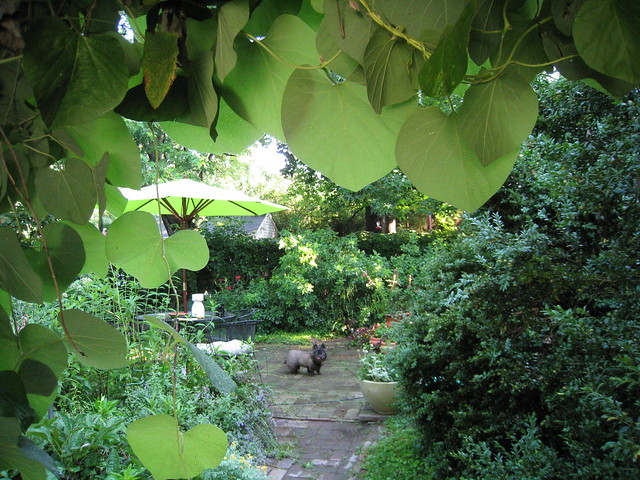
Pipe vine casts deep shade. AMcC


I first read about pipevines—the plants—and its relationship to Pipevines—the butterflies—from an article in American Butterflies, Summer 2001, written by Jeffrey Glassberg. American Butterflies is the quarterly journal of the North American Butterfly Association (NABA). NABA launched its “Pipe-dream Project” that year. The North American Bluebird Society (NABS) promotes nestboxes and habitat suited to bluebirds, and along with other organizations, has successfully expanded the range, increased populations and public awareness of Eastern, Western, and Mountain Bluebirds. NABA hoped to do the same for the Pipevine Swallowtail and its southern cousin, the Polydamas Swallowtail. Glassberg recommended growing the host plant, pipevine, either Dutchman’s Pipe, Aristolochia macrophylla, or a pipevine species native to your area. I had never had a Pipevine Swallowtail in my yard so I couldn’t wait to try it. Dutchman’s Pipe is native to the Eastern US, and I would have preferred to plant Missouri’s species, Wooly Dutchman’s Pipe, A. tomentosa, but I was unable to find a source at the time. I planted two Dutchman’s pipe vines on a metal arch, set in concrete. I had intended that arch for climbing roses, but that another story.

The species name, macrophylla, means “large leaf.” Many of the leaves are 6 inches wide and more than 7 inches long. They arrange themselves like shingles on a roof, casting a deep shade. When people sat outdoors to cool off in summer, folks planted it to cover the porch. Now that most of us enjoy air-conditioning in the heat, the plant is rare in suburbs and towns.

The first season the vines looked acceptable, but weak. By late summer, I had seen a few Pipevine Swallowtail adults, but no eggs or caterpillars. The next summer, I had more adults, but still no “cats.” Just before the plants’ third season, I met a woman who had grown the plant for years. She advised me to prune it to around one or two feet in the spring. I was horrified. Perhaps you’ve heard the old garden wisdom about vines, “First they sleep, then they creep, then they leap!” That summer, mine leapt. The vine covered the arch, headed down the fence, and made a grab for the gutters. I do prune my pipe vines in late winter now, and trim during the growing season if they misbehave. The plant laughs at pruners, and the butterflies seem to prefer to lay their eggs on the fresh growth.

Dutchman's Pipe bloom. Photo by Margy Terpstra ©

My plants bloom well in spring, though the flowers are small. They’re not showy, but their strange shape (like a meerschaum pipe) has an even more bizarre function. According to the Plant Diversity Website, the flower is perfumed like road kill. Fear not, gentle gardener! I have never detected this odor. A hungry fly enters the bloom and finds itself trapped in the convoluted shape. There the fly stays till it is covered with pollen and the flower matures, releasing it to play London Bridge once more.

This summer, Pipevines been particularly abundant. I can see them all day long. It took a long time for me to find the cats. Last summer I had several “hatch outs” and I learned what to look for. If you see a leaf with damage, try looking underneath it. Sometimes a dark shadow turns out to be a group of larva. For more about the caterpillars, see “Botanical Arsenic and Old Lace.” For more about the adult, see “Leaping Lepidopterists, Batman!” 
Dutchman's pipe grows on an arch. AMcC

Wednesday, July 21, 2010

Leaping Lepidopterists, Batman!

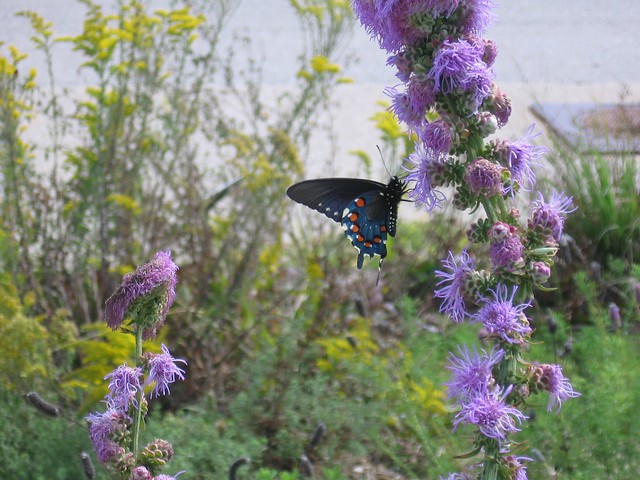
Pipevine Swallowtail on Liatris, Yvonne Homeyer ©
Pipevine Swallowtail is one of the most exciting butterflies anyone can have in their garden. Pipevine Swallowtails are large, with a wingspan of 3-5 inches or so. Their hind wings are iridescent turquoise blue, which is fabulous, but hard to see because they “batter” their wings so rapidly. I just can’t stop chasing them around the yard, as they dart over, under, tilting, and disappearing. This is probably the butterfly that prompted the stereotype of the leaping lepidopterist.

I saw my first Pipevine Swallowtail of the year here in Missouri on June 18. Her black wings were just a blurs as she fluttered along my pipevine. Pipevine is the only plant that Pipevine Swallowtails use as a host. The only other member of its genus in the US is the Polydamas Swallowtail, which also uses pipevines. It’s interesting that the world’s largest butterfly, the Queen Alexandra Birdwing of eastern Papua New Guinea also lays her eggs on a pipevine relative.

Linnaeus, who gave our Pipevine Swallowtail its scientific name, Battus philenor, could have seen a relative of the butterfly in Europe. At first I thought that Battus might refer to its flight pattern, which actually is kind of bat-like. However, the Latin word for bat is “vespertilio,” so that can’t be right. “Battus” or “Battuti” refers to a 14th Century group of folks who paraded through town whipping themselves. Possibly the color of the butterfly is related to the costumes of the Battuti? No, reportedly, the Battuti did not wear shirts at all. Hmm. Could the rapid wing beat of Pipevine Swallowtail suggest the French “battus,” that is, “beaten”?

My own theory is that Linnaeus named the genus after Battus of Cyrene, who was worshipped after his death as Aristaeus. Aristaeus is described as a one of the Greek’s minor gods, who taught humans to raise bees and make cheese. “Aristaeus” also means “the best”—well deserved if he’s responsible for cheese—and a word that seems suspiciously like Aristolochia, the genus name of the plant that Pipevine larvae eat. Still with me? Thus, it could be that Battus is the synonym for the genus name, Aristolochia, which the insect requires. More about that plant in later posts.

Philenor, the specific name, comes from the Greek for “loving one’s husband.” Linnaeus didn’t explain that one either.

A warm thank you to Yvonne Homeyer who sent me a photo above from our fieldtrip with St. Louis Chapter of North American Butterfly Association. It shows a Pipevine Swallowtail on Liatris. What a sight Jeff Pippin saw at this “puddle party” of Pipevines! Apparently, these guys are sipping minerals from the damp sand—sort of like meeting at Starkbucks.
Puddle Party of Pipevine Swallowtails, Buncombe Co., NC by Jeff Pippin