Showing posts with label aggression. Show all posts

Sunday, February 26, 2012

Those Terrible Pterosaurs


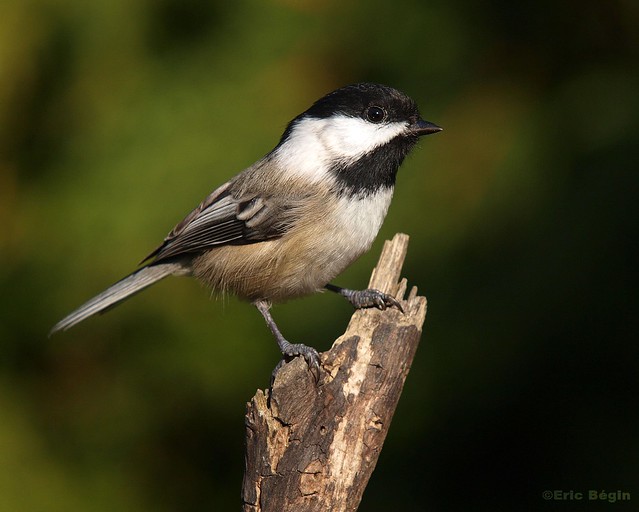
Notice the fearful claws & and the murderous look in his eye? Black-capped Chickadee photo by Eric Bégin

Yesterday, as I pulled out of the garage, something in the driver’s side view mirror caught my eye. A fuzzy ball of black and white—a bit larger than a prickly gumballs—came crashing down from the sweet gum tree. Then the ball broke apart into at least three Carolina Chickadees. They rolled on the ground, kicking, punching, and talking about each other’s mommas.

I recently attended a presentation by David Peters about the evolution of birds, sponsored by Webster Groves Nature Study Society, St. Louis Audubon and Eastern Missouri Society for Paleontology. The boundary of the Cretaceous and Jurassic is not my area, so most of what was said went right over my head. I apologize in advance for the mistakes I'm about to make. Peters’ theories about the taxonomy of pterosaurs is somewhat controversial; again, for reasons that are beyond me. His website is fascinating. He explained how the shoulder (coracoid bone) and fused clavicles (furcula, or wishbone) allowed the arm/front leg of a reptile to become the abducted, elongated wrist/claw/wing of a pterosaur.
Largest pterosaur, by Mark Witton

Now I hadn’t really thought of pterosaurs as the direct ancestors of birds. They looked like bats to me. I didn’t realize they had the modified scales we call feathers. Think of Quetzalcoatlus—the largest pterosaur, with a 40-foot wingspan, a spear-shaped head, and a ring finger that functioned as the wing. It looked even less like a bird when Peters analyzed the fossils of its tracks, demonstrating that it walked on its wings/knuckles like a reptile walks with its front limbs. 

When he showed Nemicolopterus crypticus, another pterosaur with a wingspan roughly the same as a chickadee’s, I began to see the family resemblance. The ruckus under the sweet gum makes more sense now that I no longer see them as charming chickadees, but tiny, terrible, pterosaurs.

Thanks to Eric Bégin and Mark Witton for licensing their photos with Creative Commons.


You might also enjoy:
For a Few Bags of Gumballs


When Butterflies Attack!

Sunday, September 26, 2010

They'd Rather Fight than Switch!

Hummingbird throwdown! Photo by Amyn Kassam

Here’s what we love about hummingbirds: They have that vertical posture, they make eye contact, they love sweets, and of course, they fight. They’re so human!


Watching hummingbirds is not like watching other wildlife. Hummers get up close and personal. Laura Erickson, in her 2006 book, 101 Ways to Help Birds, tells us about hummers that tap on her window when they want her attention. I watched a hummingbird pirouette around a friend wearing a coral-colored shirt, even though he was surrounded by a crowd partying on a small deck.  Hummers have come within inches of my face to catch the spray as I water my plants.


My neighbor recently told me about two hummers that clashed and then crashed, knocking each other to the ground right in front of his basset hound. Both recovered and flew off before the dog could get over her surprise and devour them. Last summer, a skirmishing hummer clobbered my brother-in-law in the head!


The level of aggression in hummingbirds is a mystery to me. Isn’t fighting over resources a waste of valuable foraging and feeding time? In her 2000 book, Attracting and Feeding Hummingbirds, Sheri Williamson points out that plants must be frugal with the nectar they produce. Nectar is of no use to the plant directly. It’s sole purpose is to pull in pollinators, so once a blossom has been pollinated, it ceases to produce nectar. Since plants are so stingy, hummers adopt a strategy of claiming a  territory and protecting their resource ferociously. According to Williamson, “Territories are smaller where flowers are abundant, larger where they are scarce (14).” I can see the evolutionary advantage of resource guarding, but I’m not sure why it seems so much stronger in hummers than—say—woodpeckers.


Like grizzly bears and bull elephants, hummingbirds use “mock charges” to panic their rival into flight, while minimizing the risk of injury to themselves. Adult males can flash their color throat feathers (the gorget) to intimidate from a distance. Females and juvenile bird display the white tips of the outer tail feathers for the same purpose, as you see in the photo above by my Flickr friend, Amyn Kassam. Hummingbirds can scold predators and interlopers with chirping sounds, and some can startle  with buzzing sounds produced by tail or wing feathers. There are times however when, like Taryton smokers, hummingbirds would rather fight than switch.


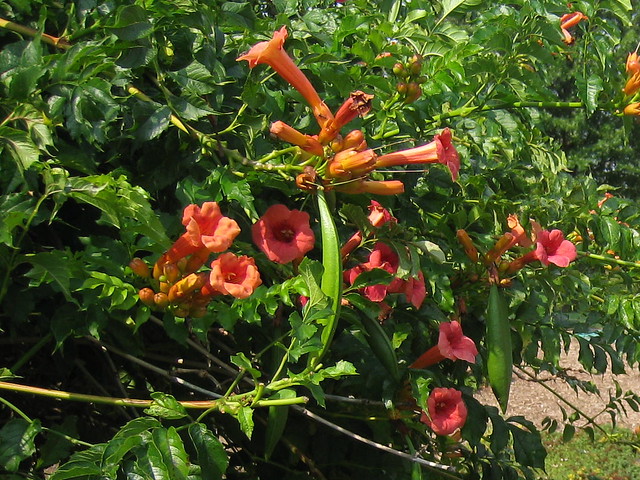
Some of my readers know that I worked at a youth camp in the Ozarks for many summers. Trumpet creepers (Campsis radicans) brought in birds by the dozen. Like Snoopy and the Red Baron, hummers battled around the camp office from sun up till sundown. Once, a staff member was actually injured in a hummingbird fight. As she crossed the parking lot, two hummers collided in front of her and a dislodged feather hit her in the eye!

Trumpet Creeper is a hummingbird magnet! Photo by AMcCormack

Trumpet creeper is a hummingbird magnet for a reason. In a 2003 article in LOS News, the newsletter of the Louisiana Ornithological Society, Dennis Demcheck wrote about the “Sugar Content of Hummingbird Plants in Louisiana Gardens.” Demcheck used a refractometer to measure the concentration of sugar in the nectar of blossoms in his garden—the same equipment used by wine makers. He found that, among wild/native plants, the trumpet creeper had the highest concentration of sugar at 34.3%, with each bloom producing a large volume of nectar. To reach that nectar, the bird must actually climb inside the 3-inch long bloom. It’s quite a risk for a bird to limit its vision like that, but obviously worth it.

If you’re thinking about adding trumpet creeper to your home garden, linger on this blog a little longer. Trumpet creeper is a big plant; every bit as aggressive as the hummers that love it. The main stem can be wider than your hand and all those branches in summer are heavy as they lie on the roof of your garage or branches of your prized specimen tree. Maybe you can persuade your neighbor to grow it.

Sunday, August 22, 2010

When Butterflies Attack!!!

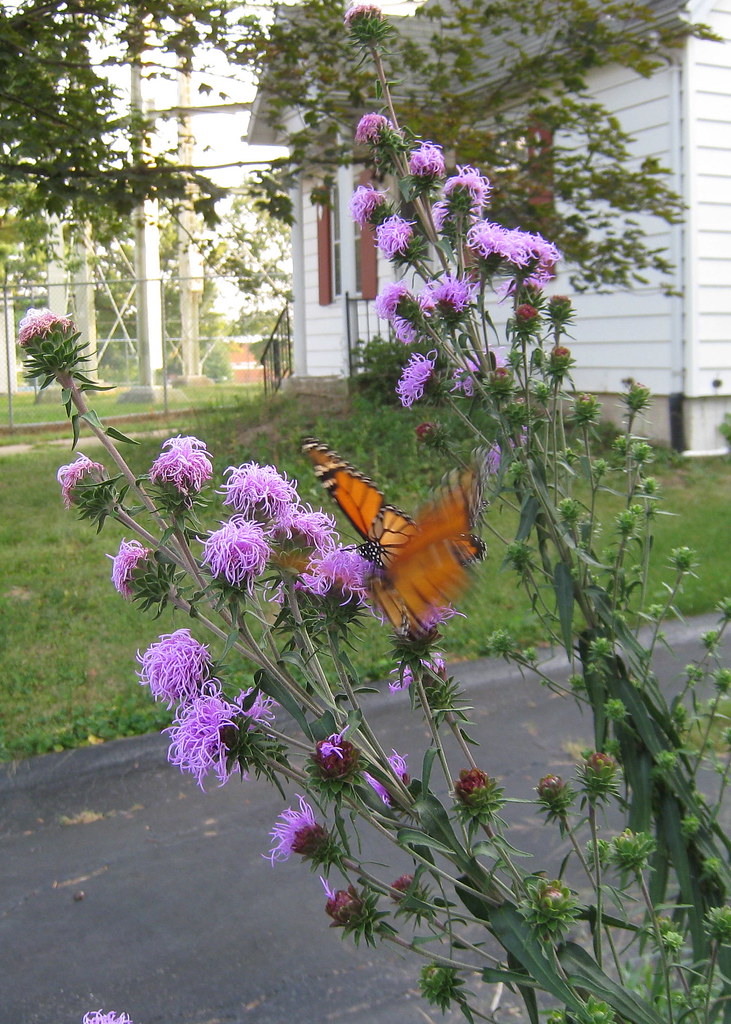
Monarch butterflies fighting AMcC

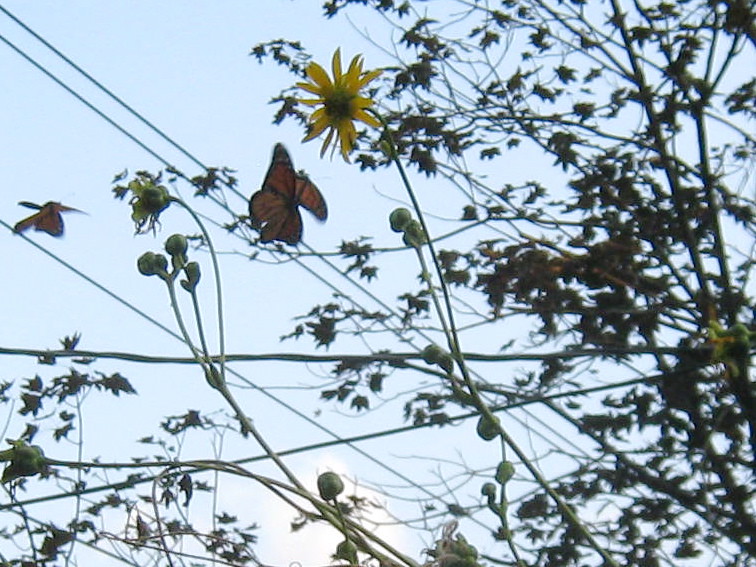
Seen through the rose-colored binoculars of the romantic nature-lover, butterflies are the very embodiment of harmony, as they flutter from one fragrant blossom to another. So how come I came home from work last week to find a brawl in my front yard? Three Monarch butterflies were duking it out, paying little attention to cars or photographers. These butterflies were not just circling each other in a “duel,” they were actually making contact!

Of course, butterflies have to struggle to survive and pass on their genes, the same as other wild creatures. Male Monarchs use a strategy for finding mates called “patrolling.” The male patrols an area, perhaps the top of a small hill were views are unobstructed, looking for females. I use the word look, because although moths are known to find mates through scent, butterflies rely primarily on sight (Boggs, Watt, Ehrlich, Butterflies: Ecology and Evolution Taking Flight, 75). Once the male detects a female, he gives pursuit and tries to mate. If however he encounters another male, he may attempt to drive off the interloper.

I remember spotting a male Monarch in my mom’s garden. When I pointed it out to her, she looked at me suspiciously. “How can you tell?” she asked.

“Well,” I said, still watching the butterfly in my binoculars, “you have to have a pretty good look.” (Bah-dum-bum.) She laughed hysterically. She didn’t even hear me explain that males have a small black scent patch on the hind wing, close to the rear of the abdomen.

I doubted whether I could get a photo of rock-’em-sock-’em Monarchs, but I headed out with my point-and-shoot camera anyway. I snapped off about 20 worthless shots of orange blurs above purple and yellow blurs. Finally, as I stepped up to a cooperative Monarch on my Rough Blazing star, another one dropped vertically into the frame, landing directly on to the first. I actually heard the collision! The first Monarch was definitely a male, but I can’t be positive about the attacker. However, of the three Monarchs I observed over the course of 2 hours, all the ones I saw well were male.

Monarch mayhem AMcC
I shared my photos with the Flickr group, “When Animals Attack!” Mine are the only butterfly photos in the pool.
3 Monarchs in a dogfight over Kirkwood AMcC