Sunday, February 26, 2012

Those Terrible Pterosaurs


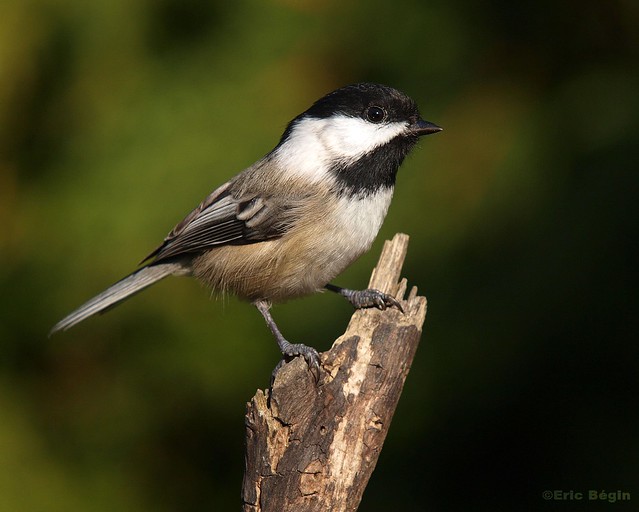
Notice the fearful claws & and the murderous look in his eye? Black-capped Chickadee photo by Eric Bégin. 

Yesterday, as I pulled out of the garage, something in the driver’s side view mirror caught my eye. A fuzzy ball of black and white—a bit larger than a prickly gumballs—came crashing down from the sweet gum tree. Then the ball broke apart into at least three Carolina Chickadees. They rolled on the ground, kicking, punching, and talking about each other’s mommas.

I recently attended a presentation by David Peters about the evolution of birds, sponsored by Webster Groves Nature Study Society, St. Louis Audubon and Eastern Missouri Society for Paleontology. The boundary of the Cretaceous and Jurassic is not my area, so most of what was said went right over my head. I apologize in advance for the mistakes I'm about to make. Peters’ theories about the taxonomy of pterosaurs is somewhat controversial; again, for reasons that are beyond me. His website is fascinating. He explained how the shoulder (coracoid bone) and fused clavicles (furcula, or wishbone) allowed the arm/front leg of a reptile to become the abducted, elongated wrist/claw/wing of a pterosaur.
Largest pterosaur, by Mark Witton

Now I hadn’t really thought of pterosaurs as the direct ancestors of birds. They looked like bats to me. I didn’t realize they had the modified scales we call feathers. Think of Quetzalcoatlus—the largest pterosaur, with a 40-foot wingspan, a spear-shaped head, and a ring finger that functioned as the wing. It looked even less like a bird when Peters analyzed the fossils of its tracks, demonstrating that it walked on its wings/knuckles like a reptile walks with its front limbs. 

When he showed Nemicolopterus crypticus, another pterosaur with a wingspan roughly the same as a chickadee’s, I began to see the family resemblance. The ruckus under the sweet gum makes more sense now that I no longer see them as charming chickadees, but tiny, terrible, pterosaurs.

Thanks to Eric Bégin and Mark Witton for licensing their photos with Creative Commons.


You might also enjoy:
For a Few Bags of Gumballs


When Butterflies Attack!

Saturday, February 11, 2012

The Not-So-Common Common Ground Dove of Weldon Spring CBC


Truman was President, Muddy Waters sang "Rollin' Stone," Lefty Frizzell sang "If You've Got the Money," "Sunset Boulevard" took the Golden Globe, and the Webster Groves Nature Study Society  counted birds in the cold December winds at Busch Wildlife Conservation Area near Weldon Spring, Missouri, Dec. 29, 1950.

Every year since then, Webster Groves Nature Study Society, better known as WGNSS--pronounced, "Wig-ness"--has participated in the National Audubon Society's Christmas Bird Count (officially,  MOWS, "Missouri-Weldon Spring") by surveying the area we call "Busch." There are about 11 square miles to survey, including 3,000 acres of forest, 32 artificial lakes, and 100 bunkers once used for storing TNT during WW2. Throw in plenty of gravel roads, a thousand acres of grassland plus 200 acres of restored prairie and the same amount of old fields, and you've got a diverse and accessible birding area--all within 50 minutes' drive from the St. Louis Arch.The plan in a survey such as this is to count each species of bird seen, as well the number of individuals. We divide into territories, and take precautions not to count an individual more than once. For example, I might spot 3 Blue Jays in the tall oak by the creek. Some time later I drive past the same spot and see 5 Blue Jays. I record an additional 2 birds, not 5. On the way to my territory, I see a Bald Eagle overhead. I don't record that bird, but I do notify the count compiler in case the team in that area missed it. If so, Bald Eagle will be added.

This year we had 11 participants who counted 2,441 birds of 49 species, including one that has never been recorded on the Weldon Spring count, the Common Ground-Dove. For that matter, it's likely the only individual of its species ever to have been recorded on a Christmas Count in Missouri. It's a bird that's normally found in the extreme southeast and southwestern US and coastal Mexico. Records show that the species has never been recorded in St. Charles County. Thanks to Josh Uffman for making this information available online.

Our little dove--smallest in the US; half the length of the abundant Mourning Dove--was very kind to us, considering all the factors. It had been dallying in the fields of Busch for weeks, putting up with hunters and as well as unruly birders. It was our target bird, but rabbit hunters with their noisy beagles caused it to lie low. Fortunately, some of the group were very patient, including Bob Nieman who snapped this picture just as the sun set. Bob was visiting the area for the holidays--thanks for your help in making this a memorable count!

On my route, I was delighted to witness a  behavior I'd never seen before. I paused along the road where fields gave way to forest. American Robins and Cedar Waxwings crossed back and forth, feeding on and the waxy blue berries (really cones) of Eastern Red Cedar and the abundant red berries of invasive bush honeysuckle. Amidst the busy, noisy robins, two sleek waxwings rested on a branch. One passed a berry to the other's beak, who then passed it back. They did this for several minutes. Male and female Cedar Waxwings look identical, but the two were probably a pair engaged in courtship behavior (A Guide to Bird Behavior, Vol. II, by Don and Lillian Stokes, 1983).

Sunday, December 25, 2011

Breakfast with Mrs. Claus

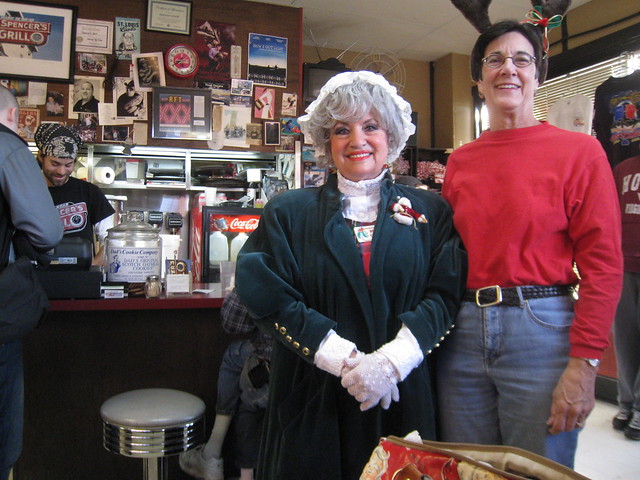
Everybody loves breakfast at a diner, so no one is surprised when Mrs. Claus drops in with a basket of candy canes to give away. It's Christmas Eve morning and the place is packed so my friend Debbie and I gladly share a booth with Mrs. Claus and her friend. She has an appointment to greet the passengers when the train arrives at the Kirkwood Station in an hour.

After eggs sunny-side-up with rye bread toast, we and I head down the block to the recycling center. Debbie does more about recycling than anyone I know. Her back seat was loaded with clean food and beverage cups. All these go into the styrofoam recycling container—the first available in St. Louis County. The next recycling bin accepts strings of Christmas lights. 

Kirkwood's recycling center is named after local leader and photographer Francis Scheidegger, an early proponent of lightening the load of trash on the planet. For half a century, Scheidegger's studio was just up the stairs from our breakfast stop.

Other posts about Kirkwood, Missouri:
  
Whooo's Awake? Me Too!
 
When Animals Attack--Plastic


Wednesday, December 21, 2011

Christmas Bird Counts on TV

I had a chance to talk about Christmas Bird Counts on local TV today. Dan Zarlenga, of Missouri Department of Conservation, set up the interview with John Fuller of KPLR-TV Channel 11 in Saint Louis MO. I had a blast! The broadcasters and staff could not have been nicer. I hope it will motivate a few more people to volunteer their time with Christmas Bird Counts.

 
More posts about Christmas Bird Counts:
 
CBC Chartbuster

Register Online for CBC
Weldon Spring CBC
  
Bird Encounters

Sunday, November 20, 2011

The Very Very Late Ruby-throat

I
I strolled around the turrets of Hogwarts Castle, enjoying the sweeping views of tropical foliage. From the ravine below, a hummingbird came into view. It was large--something along the lines of a Violet Sabrewing. I reached out and held the bird. It seemed to be in some kind of transitional plumage: purple, mixed with buff and green. Then I was startled by sounds of an uproar coming from Hogwarts. A group of boys rode some kind of magical escalator, screaming with laughter. The bird vanished. Beautiful singing of pygmies (or Solomon Islanders) woke me. That's because my alarm plays CDs; this morning, it's Deep Forest's controversial 1993 album, Deep Forest.


Wondering what I had eaten the night before to produce such a vivid dream, I finished up my morning chores and headed to work without a moment to spare. As I headed for the gate Tuesday, Nov.15, an unmistakable silhouette  popped up into the sweet gum tree--a hummingbird! I ran back to the house for my binoculars. Like my dream bird, the hummer had vanished and I headed for work.


I posted my report of the hummingbird on MObirds, the listserve of the Audubon Society of Missouri. I also contacted my friends Lanny Chambers and Margy Terpstra. Margy lives nearby. She and her husband are wild bird photographers. They have a wealth of subjects in their beautiful, wildlife-friendly yard. Lanny is a hummingbird bander who has visited my yard many times chasing fall hummers. He also holds the record for the only Allen's Hummingbird in the state--banded in his own yard!

I didn't return up till after dark on Tuesday. Wednesday morning the temperature on my back porch was 33 ° F. The bird bath had a skin of ice, but I caught a brief view of a dark bird at the nectar feeder. Surely this is some rare stray! Wed. evening that I saw the bird again, and was shocked to see that it looked exactly like a male Ruby-throated Hummingbird! Ruby-throats are the only hummer normally present in our area, but they should be gone by October 10 or so. Males migrate earlier than females and juveniles. I don't remember ever seeing one after mid-September.

I didn't get to study the bird long before the light was gone. That's when I checked my email to find Margy's wonderful photos of Lanny examining the bird in hand. It was indeed a male Ruby-throat. It may not be the latest Ruby-throat ever, but it's likely to be the latest confirmed record. As you can see in the photos, he is a worn individual. His weight was good however, and Lanny saw no reason that the bird would have trouble migrating to his winter home in southern Mexico or even Panama.


I spotted the bird again Thursday and Friday mornings and evenings, still visiting the last of my Big blue sage (Salvia guaranitica) and Mexican bush sage (S. leucantha). The sages and the bird had weathered near-freezing temperatures for 3 nights. Saturday we warmed up to 60°, but I didn't see the bird. Let's hope that soon he'll be rubbing shoulders with Violet Sabrewings. Thanks to Margy Terpstra for the use of her photos and to Lanny Chambers for enabling us to play a role in the study of hummingbird migration.

You might also like these posts:

Mexican Sage is a Hummer Magnet
 
Hole in One!
Rootin' Tootin' Rufous